
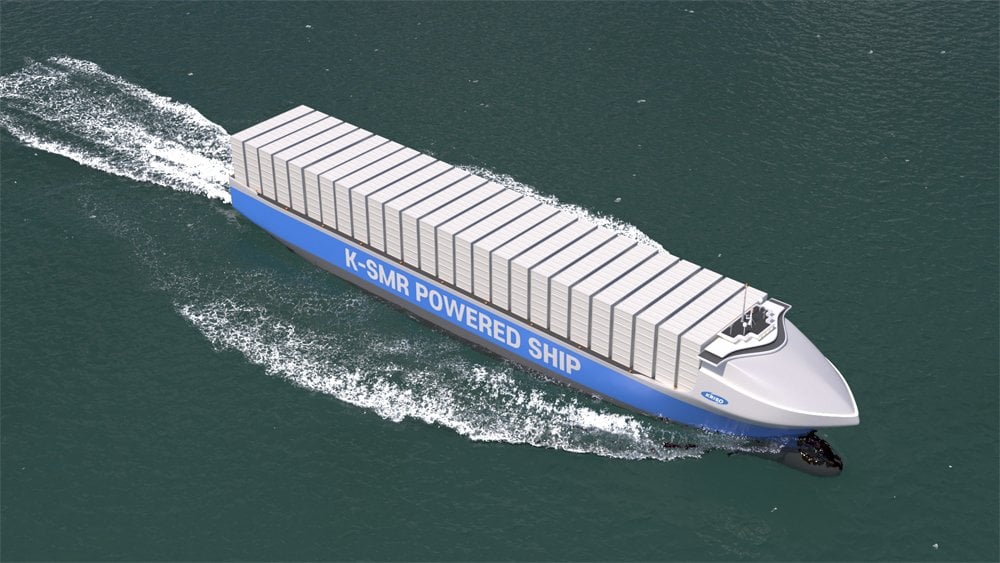
Ships like that can’t really sail on solar, or wind, and the ones using fossil fuels are extremely polluting, so I welcome this
Yes ships like this could sail on wind or solar!
Nuclear heats up water to turn steam turbines to generate power. There’s still that loss from heat source to electricity stage they have to figure out.
The molten salt acts as both a heat storage buffer, and a backup shell if things go wrong. But if there’s a catastrophic failure and seawater gets in, the salt will dissolve in water and spew potentially radioactive particles far and wide. Not sure this is a good idea for use in water. At least, on land the molten salt will stay put.
containership
wordsmearing
Containerschiff
“The companies point to the safety and efficiency achieved through the use of molten salt”
“WCGW?” Said every nuclear proponent. And following yet another technical/economic failure: “This one for sure bro!”
Fuck nuclear power.
I’ll take a nuclear failure completely submerged in water over deisel bilgewater any day of the week.
We’ve had naval reactors for decades. Noting that, what is the holdup with SMRs on land?
Navy ones are small because they’re weapons grade high enriched material, so it’s mostly a proliferation issue that they’re not used everywhere.
They’re a solution in search of a problem. Renewables and storage costs are so low that there’s no business case for new nuclear, let alone the even more expensive SMRs.
The rapidly dropping cost of wind and solar has definitely tanked a lot of nuclear projects. The cost-benefit analysis done during the planning of a new nuclear plant is usually completely underwater 5 years later.
However, there are some areas where there isn’t enough open ground for wind or solar installations, and nuclear would be a good option for replacing existing fossil fuel plants. Small modular reactors would be great for dense urban areas that are still supported by natural gas plants.
That’s where HVDC comes in.
https://en.wikipedia.org/wiki/High-voltage_direct_current
Do you have any examples of places where there isn’t enough open ground for on or offshore wind or solar?
A boat deck (I’m being cheeky)
When a naval reactor fails it gets submerged in water. When an inland reactor fails it either gets submerged in water or the area potentially becomes uninhabited for generations. It’s really all about access to water. Even an island nation like Japan has had trouble keeping nuclear reactors full of water in the past, e.g. Fukushima.
And? So what? There are 9 sunken nuclear submarines on the ocean floor, about 700 Nuclear vessels have sailed since the 1950s and about 200 are current.
They generate a little heat but thats about it. The water shields the outside world from wide spreading bursts of radiation.
Did you read the article? Once seawater enters the reactor, corrosion might affect the control rods to the point where the whole thing might spiral into criticality, maybe to the point of the reactor exploding. It’s just a bit of heat for 50 to 100 years until it suddenly might become an atom bomb.
9 of them
Very constructive.
We’ve also set off hydrogen bombs on the surface of the ocean several times.
Er, wasn’t the problem at Fukushima caused by the plant being full of water?
The isolation condenser (IC) was functioning prior to the tsunami, but the DC-operated control valve outside of the primary containment had been in the closed position at the time to prevent thermal stresses on the reactor components. Some indications in the control room stopped functioning and operators correctly assumed loss of coolant (LOC). At 18:18 on 11 March, a few hours after the tsunami, operators attempted to manually open the IC control valve, but the IC failed to function, suggesting that the isolation valves were closed. Although they were kept open during IC operation, the loss of DC power in unit 1 (which occurred shortly before the loss of AC power) automatically closed the AC-powered isolation valves to prevent uncontrolled cooling or a potential LOC. Although this status was unknown to the plant operators, they correctly interpreted the loss of function in the IC system and manually closed the control valves. The plant operators would continue to periodically attempt to restart the IC in the following hours and days, but it did not function.