370 billion crickets are farmed for food every year. Scientists have discovered they may feel pain
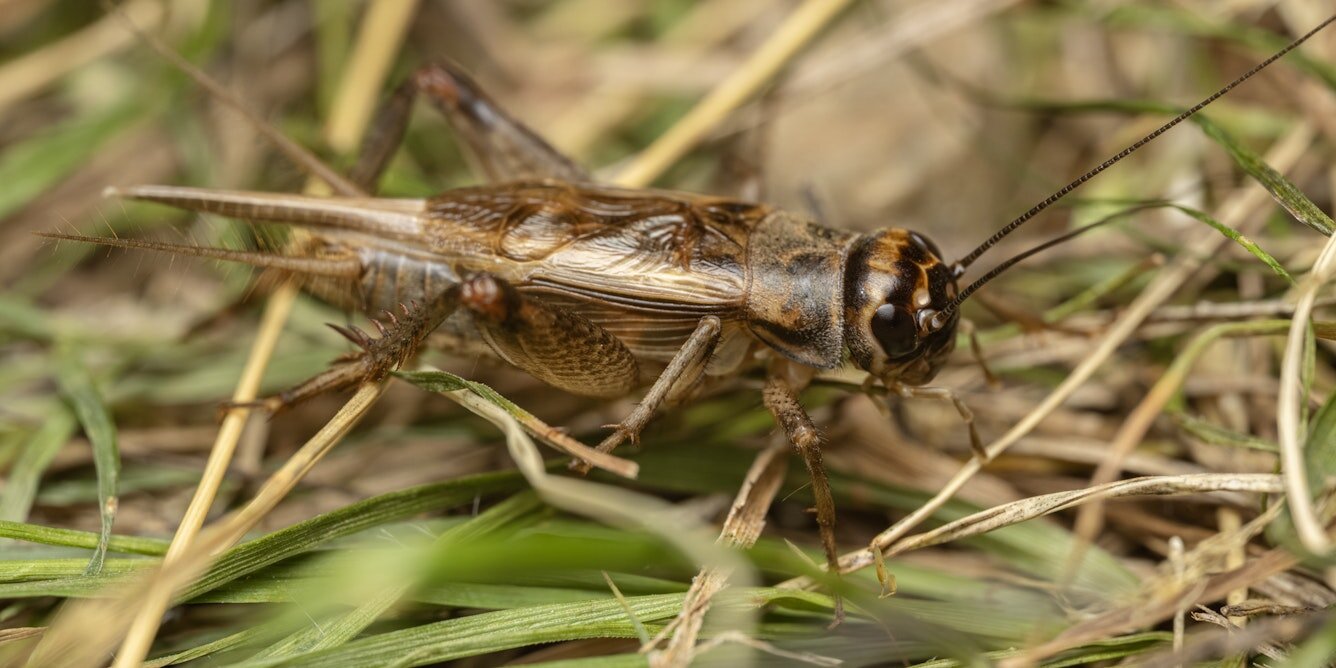
House Cricket (Acheta domesticus). Credit: mani_raab/iNaturalist, CC BY-NC
You’re cooking dinner, distracted, and your hand brushes a hot pan. Nerve signals race to your spinal cord and back to yank your arm away in a fraction of a second, with no thought required.
Then comes the pain. A sharp, spreading sting gives way to a pulsing ache, and you cradle your hand and run it under cold water until it subsides. That felt experience is distinct from the reflex that preceded it. While the reflex moved your body out of danger, pain drives you to protect the wound, recover, and learn to avoid similar mistakes in the future.
We readily accept that other people feel pain by reading cues in their behavior, like the inspection and nursing of an injury. We extend this to some animals too—a dog licking its paw or a cat favoring a limb rightly stir our sympathies. But what happens when we turn that lens on animals far less like us?
In our new study, published in Proceedings of the Royal Society B: Biological Sciences, we searched for behavioral signs of pain in house crickets, one of the most widely farmed insects. After applying heat to an antenna, we found that crickets didn’t just reflexively flinch and recover. They nursed the harm, returning again and again to groom the affected site, much as we rub a burned hand.
The frontiers of feeling
French philosopher René Descartes considered animals unfeeling biological machines, and for centuries the circle of moral concern barely extended beyond our own species.
But the boundaries have steadily crept outward. Recognition that mammals experience pain came first, followed by birds. Fish too, once assumed to lack the necessary brain structures, are now widely accepted as capable of pain-like states.
The leap into invertebrates has been greater and more contentious. Their nervous systems bear little resemblance to our own, so arguments from brain anatomy alone don’t carry us far. Instead, we look to behavior. Does the animal respond to harm in ways that go beyond reflex, ways that are flexible, persistent, and sensitive to context?
Over the past decade, testable indicators for pain in non-humans have been developed and are increasingly accepted. These include learning from unpleasant events, trading off harms against rewards, and actively protecting the site of injury. Evidence meeting these criteria helped crabs and lobsters gain legal recognition as sentient under United Kingdom law in 2022.
Among insects, the evidence has been accumulating fast. Yet most of this evidence comes from bees. Bumblebees weigh the risk of harm against the richness of a food reward, and groom the site of an injury. Honeybees learn to associate particular smells with harmful stimuli and avoid them.
Far less attention has been paid to Orthoptera, the group that includes grasshoppers, locusts and crickets. That gap matters, because the house cricket (Acheta domesticus) is the world’s most widely farmed insect, with more than 370 billion reared annually.
Do crickets feel pain?
We tested 40 male and 40 female crickets, each experiencing three conditions in random order: a hot probe to a single antenna (65°C, to activate damage receptors but not cause lasting injury), the same probe unheated, or no contact at all.
We filmed their behavior for ten minutes. Observers scoring the footage did not know which treatment any animal had received.
The results were clear. After the hot probe, crickets were more than twice as likely to groom the affected antenna compared to controls, and spent roughly four times longer doing so.
Could this simply reflect general disturbance rather than targeted care? Unlikely: grooming was directed specifically at the heated side, not spread evenly across both antennae as it was after gentle touch or no contact.
And the behavior wasn’t a brief, reflexive reaction. It was elevated from the outset and tapered gradually over minutes, much like rubbing a burned hand as the felt sting slowly fades.
Small minds, big feelings
Subjective experience cannot be directly observed in any animal, not even humans.
But we have shown crickets respond to harm in a way that satisfies a key criterion many scientists and philosophers use to infer pain: flexible, directed self-protection. Combined with the knowledge that crickets possess damage receptors, can learn to avoid harms, and respond less to injury under morphine, the weight of evidence for an inner life is growing.
The practical stakes are real. Hundreds of billions of farmed insects are slaughtered each year by freezing, boiling and baking. Pesticides kill trillions more, optimized for lethality with no consideration of potential suffering.
If we take a precautionary approach, credible evidence of suffering should motivate proportionate protections well before we are certain.
Insects have been around for more than 400 million years and are far more behaviorally and cognitively sophisticated than once assumed. The question, then, may not be whether some insects feel, but why we ever assumed they couldn’t.

I don’t understand why the assumption always is that X doesn’t feel pain until proven otherwise. It would be logical that most if not all living things are capable of experiencing pain, as that is the innate way for the body to protect itself from harm.
I think the assumption should always be that every living being can feel pain and then if proven otherwise that would be the exception.
How many times has it been proven wrong that X can infact feel pain - from human infants to mammals to fish, etc…
Exactly, it’s crazy to think that any organism with a nervous system can’t feel pain. The default assumption should be that a nervous system = ability to feel pain unless proven otherwise
Well, because it has not really been proved at all, except if we accept some specific assumptions (about consciousness), and if you wiggle those assumptions just a tiny bit, trees also feel pain, and stones too.
Maybe they do. Maybe they don’t.
But I guess that is why it’s hard to settle down on things, like babies don’t feel pain was so ingrained in people, until it wasn’t. Personally I wonder what should we do if insects feel pain. Accept it? And then do what?
A question more complicated than it seems at first glance IMO.
No, stones don’t feel pain because they aren’t alive. They have no nervous system of any kind. Trees are alive, react to damage and even signal other nearby trees of danger. What we see as pain is obviously subjective, but that does in no way take away that any living being also feels pain. Pain isn’t some thing that exists in itself, it’s the brain or cells sending signals that something is damaging us.
I seriously don’t understand how you could think stones feel pain, they have nothing to make those signals.
That’s because we do not understand consciousness (like at all) and you need consciousness to “experience” the world, and for example, pain.
No consciousness, no pain.
So to your question; one theory is that everything has a little bit of “consciousness” and it’s just in the wildly complex brain it can actually express it so well, which means the whole universe is somewhat conscious.
I personally don’t think so, but I also know that that is just wishful thinking from my side and that I do not know anything more than that I have, a consciousness.
HTH
They are assuming that pain is a reaction to some sort of stimulus. In this case, of course living things with some sort of nervous system will feel pain, as they react when they are hurt, but one could argue that hitting a stone very hard could deform it, cause it to wobble, create cracks, etc. and that could constitute as pain.
Of course, this really stretching the definition of pain by a lot. Personally, I don’t think stones feel pain.
let me know when the trees stop screaming, clarice.
So what? Hasn’t stopped us from farming mammals, so why should it matter for animals that are even less cute?
We at least don’t boil mammals alive, or bake them alive. If we find that crickets suffer from these things, we can find more humane ways of killing them. The article isn’t arguing for not eating them, just killing them humanely.
A bolt gun to a cattle’s head is instant death. We can’t go using tiny bolt guns on crickets, but perhaps asphyxiation or something. Asphyxiation is a painless form of death for mammals, as long as they aren’t breathing excess carbon dioxide. The panic and pain that comes from not breathing is due to carbon dioxide buildup in the blood, not from a lack of oxygen. So maybe that’s an avenue to explore if we want to lower cricket suffering.
I went through a lot of searches on euthanasia for small insects when my pet spider was struggling to get around and stopped eating.
Basically, all the methods are slow, painful and scary… Except for one. Crushing is near instant, faster than they can register pain, just a spider one moment and a smear the next. It’s probably the toughest way for you, but it’s the fastest, least painful, and least stressful way for them.
I hope I don’t ever have to euthanize one of my spiders, as the crush method does seem to be the most humane way to go about it. I can’t imagine having to do that with a 10" tarantula
We absolutely boil or bake mammals and other living things alive, and we do even worse things to them. Whole lives of suffering from issues from being bred for specific things to horrific living conditions and then killed in any manner of inhumane ways.
*humane
Yeah, just a typo. You’ll notice I said “humanely” a sentence later.
I just thought it was funny, humans sure know how to kill things.
We might get there, but yes, just not thinking about it is a common and powerful response.
Will sound weird but I find crickets kinda cute. They are just jumpy annoyingly noisy little fuckers.
Ha it hasn’t stopped us from denying healthcare.
What is this medieval level of thinking?
It’s alive, of course it can feel pain. That is how living things avoid being dead things.
It should be the default assumption for anything mobile with senses.
Plants are alive.
And they react to stimulus, they probably have a perception of pain. They communicate with other plants and will support other plants if they are related, life is complicated. I’m still going to eat my greens.
There’s a leap between react and feel pain. Pain is a useful evolutionary trait that can help survive. For a plant which can’t react quickly “pain” doesn’t offer any value. Sure, they must have systems “know” there’s harm, but without a way to quickly react it’s detrimental.
Pain isn’t some objective thing. You feel pain differently just within your own body, based on where and what kind of damage is being done. A plant reacting to damage is pain, just because it’s not the same as us doesn’t mean it isn’t pain. We know plants react to damage, and that’s what pain is, they even signal other nearby plants of danger.
Recent studies show that plants literally respond to anesthetics in a way that is indicative of them preventing “pain” https://pmc.ncbi.nlm.nih.gov/articles/PMC6215046. Similarly they also recently showed that plants can be desensitized to negative stimuli, here they drop a plant that physically reacts to stimulus and record the expressed atp. By a thousand or so drops the plant is no longer reactive to the minor stimulus, but still reactive to other similarly impactful stimuli. This could suggest that the plant is able to remember the consequences of the dropping and is no longer inciting a stress response, whereas new/known bad stimuli are still demanding of a defensive stress response.
I just don’t think plant life is as clear cut as people make it out to be. There are more studies showing things like related bean stalks grabbing the same poles but unrelated stalks avoiding sharing a pole together, or trees using root systems to provide nutrients to neighboring trees that would otherwise starve out.
I don’t disagree with you, but there’s a body of research about plants’ reactions, and some of them certainly look more like pain than just accommodating to negative stimuli.
Interesting.
That’s also the one critter that I’ve seen evidence for not feeling pain. If a cricket or other grig is eating something, and another bug starts to eat them from behind, they don’t seem to notice, and continue what they’re doing.
Maybe it’s only in their head region?
That is odd as fuk. Really?
Yes, or so I’ve read. A quick search turns up the mentions, but no primary sources.
Bugs are a weird edge case for consciousness. They can learn, plan and remember, and some like bees can do it a lot, but there’s also cases of really automatic, mindless-looking behaviors they’ll engage in. This old blog post goes into how fruit flies respond to all noxious stimuli with a specific anti-parasitoid maneuver.
Yeah, and the problem is if you define “pain” too loosely, you’ll end up concluding plants feel pain. A Venus fly trap can close in response to an insect landing on it. That’s a response to a stimulus. Some plants release chemicals in response to damage or exhibit other responses that could be defined as pain.
You have to be really careful when using “the ability to feel pain” as a litmus test for the ethics of eating a particular organism. If you define it too tightly, you’ll conclude that it would be morally OK to eat a Neanderthal (something clearly conscious but also not human.) Too loosely, and you’ll conclude the only moral choice is starvation.
Those criteria seem vague enough one can probably count most plants as capable of pain…
But generally outcome seems obvious and intuitive enough. Would normal person intentionally torture cricket just for the fun of it?
Plants groom themselves, preferring areas that were damaged? Damn, my local flora is boring as shit.
No, but they will release chemical signals that attract predators of things that eat plants, while telling other nearby plants to start moving nutrients into their root structures to minimize damage.
Pain has an emotional component though. Without a devoted nervous system, any kind of subjective experience a plant has would be on a very long timescale, at the very least. (And you’d have the weird situation where it’s mind “grows” as it’s thinking)
For sure, people treat a dog as if it has pain, and lettuce as if it doesn’t, and I’d be surprised if you wanted to change that.
How do you measure emotions?
Like, how do I know that you have emotions? If I punch you, how do I know you’ll feel pain? I’m not gonna feel what you feel, I can only observe your response. Stimulus, response.
Same thing with plants. Same thing with dogs.
As to your last point, it wasn’t that long ago that Very Smart People argued dogs don’t feel pain. Of course they obviously did, and of course most every normal person recognized they did…but that wasn’t what we “knew”, as a society. Hell, it wasn’t until like, 50 years ago that we recognized human babies felt pain prior to being able to vocalize an “ow that hurts”.
Perhaps it makes people feel better to know that dogs feel pain and lettuce doesn’t. But that’s almost certainly not a true statement.
Edit: also, how much of your body controls your brain? Like, have you ever considered bending your elbow in the wrong direction? No? Why not? Why is it the wrong direction? It just is, right? That’s how the body works?
If this was real life, I’d suggest a trip to a pet store so you can prove there’s no difference. Either you’re a psychopath, or this is bullshit, and in your everyday interactions you make some obvious guess about who feels what.
Insects are a grey area and might spark debate; plants are always a canard.
Edit: also, how much of your body controls your brain? Like, have you ever considered bending your elbow in the wrong direction? No? Why not? Why is it the wrong direction? It just is, right? That’s how the body works?
Yes, I actually have tried bending/pushing my elbows back as far as I can make them go. That’s got to be a pretty normal kid thing to do.
Not sure what medical textbook you’ve been reading out of, but it is a pretty one way street. Like, there’s phenomena that suggest some exceptions, but they’re pretty minor exceptions.
I meant did you try bending your elbows further than that?
They technically could go further. Might, uh, sting a bit. Or is your mind/willingness limited by your body?
Have you ever tried moving your toes? Not as a whole, but individually. Like your fingers. The nerves are there, the brain connections are there, the muscles are there…can your mind grow enough to make them function?
You are correct. I do make a guess as to who feels what. I just don’t feel the need to limit my guesses to some arbitrary definition of life that does feel pain and life that does not feel pain. All life feels pain. Plants included.
So then, logically, if there’s a plant and a dog strapped to two train tracks, and you have to pull a switch…
any kind of subjective experience a plant has would be on a very long timescale
Why would that be an issue? Are sloths less capable of pain because they are slower?
And you’d have the weird situation where it’s mind “grows” as it’s thinking
Why would be an issue with that? Kids brain grows and you have no issue with acknowledging their mind? It is not too hard to imagine?
For sure, people treat a dog as if it has pain, and lettuce as if it doesn’t, and I’d be surprised if you wanted to change that.
What a strange assumption on my intentions…
No, no it’s not.
They do groom themselves. Trees grow a tissue around their wound. A chayote bends its vine on response to my touch. Yes they use chemicals and hormones to perform that action, but so do we?
Their nervous system is of course different and slower than ours, but you have no mechanism that would say you or cricket feels pain and my chayote does not. From my point of view you, chayote and crickets might all just be philosophical zombies and just respond to some stimuly as robots.
Well, yes. Rural kids play with bugs and do all sorts of objectively horrible things to them. Because they are bugs. I am not trying to defend it, but yes, that’s normal.
I agree it is more common than it should be. But to most humans this seems horrible. And it seems horrible because we all assume bugs can feel pain.
It is not that kids treat them like that because they assume bugs do not feel pain. They do it despite that. Kids know this is not the same as cutting grass.
Don’t much care about the sensations that crickets, or even lobster may have.
On the other hand, I’ve spent a lot of time around cows. They know what’s going on. I love beef, but I could not kill a cow. Pigs are fukin smart, and I eat a lot of pork.
My perspective would certainly change if I wasn’t able to buy my food in nice clean packages. I might eat less meat if I had to kill it, but I really doubt I’d quit.Honestly, with the way the economy has been going, my family is eating all-vegatarian two or three days per week because it costs less. And on the meals where we do eat meat, fish and poultry are so much cheaper than pork and beef. The idiot running the US inadvertently forced me into a healthier diet. I guess that leaves more McDonald’s hamburgers for him?
McDonalds uses meat? Here I was convinced it was byproduct paper pulp.
I have to live feed crickets to my pet spiders and gecko… Whether or not they feel pain, it still doesn’t look like a clean or easy way to go.
Learn from my mistake, don’t get pets that need live foods.
Can you kill the crickets quickly before giving it to the spiders? Or will they refuse to eat them unless they’re alive?
No. If it isn’t moving, they don’t really see them as prey to capture. I can sometimes trick the lizard with a dead cricket, but the spider is much more selective.
I should mention I have a jumping spider, not the typical web-spinning spider.
Pics of your jumping spider plz…

Jumpers are fascinating. So much personality in a small package. Other spiders are zero to attack in one second, maybe some chill exploring in between. Jumpers seem genuinely curious and interactive.
😍 Adorable thank you! Is that a female P. regius? What other spoods do you keep?
Yep. I’ve got a male regal jumper as well. The spider pictured passed a few weeks ago unfortunately.
So sorry to hear that. Their short lifespans are their only downside. There are longer lived true spiders that can be fun to keep, and tarantulas can be remarkably long-lived (some of mine will probably outlive me), but jumpers have a special magic to them.
they have nociceptors then yes, they’re wired to feel pain
There’s also a Shrimp Welfare Project.
One could argue that this is even worse than pig farming due to the sheer scale of it and donating to them to enable painless death for the shrimp could be the most good you can do with your money when looking at how far even just one dollar gets you.
Any animal that flees from being eaten probably feels pain. This is not the high bar you vegans think it is. Just accept that we are the top of the food chain already.
So do some plants move as a response.
Indeed! Are we suddenly going to stop eating things because they can feel stuff? Being eaten is as much apart of nature as photosynthesis. It’s not sentience where you should be drawing the line it’s sapience.
Oh fuck right off. Of course they do.
I’m still going to eat.
Oops.
I believe you’ve provided the most coherent take on this subject. Well done.