-1 / 0 can be defined to be a special new number, ⭐.
This system of numbers is actually mathematically consistent and has all the properties that a number system should have. But using simple algebra, you can prove that in this new number system, ⭐ = 0. And then you can also prove that all other numbers equal zero.
This number system is known as the zero ring, and it’s the ring where the only number is 0 and the following operations are defined:
0 + 0 = 0
0 - 0 = 0
0 × 0 = 0
0 ÷ 0 = 0
0^0 = 0
All other symbols, including 1, 2, and ⭐, are just alternative labels for 0 in this number system. In other words, defining division by zero is essentially the equivalent of reality collapsing in mathematics.
So yes, you can validly define division by zero. You just get degenerate mathematics if you do. So be careful what you wish for.
Instead of thinking of division as a “proper” operator, think of it as shorthand for “x0 = -1". Since the multiplication operator already defines "x0 => 0” and “-1 != 0”, there literally is no answer by definition. So “undefined”.
For “0/0”, it’s a little different. Since “x*0 => 0”, literally every number satisfies “0/0”. Since we’re expecting a single number as the answer, we call the answer to this “undefined” too.
That’s probably accurate, but I’m no mathematician. Specifically if you confine yourself to the set of real numbers, it’s undefined.
If you confine yourself to the set of rational numbers, integers, or natural numbers, you could get a bunch more undefined equations. For example, if you’re only working with the set of natural numbers, sqrt(4) is defined, but sqrt(5) through sqrt(8) are undefined because there are no whole numbers between 2 and 3 (2^2 and 3^2). Similarly, sqrt(-1) is undefined in this case because -1 isn’t part of the set of natural numbers, so any expression you used a negative number in would be undefined.
A more intuitive example might be to try using a non-number in an expression. Sqrt(🐱) is undefined. And 🦆-🦢 is also undefined. The operators aren’t defined to include cats or birds.

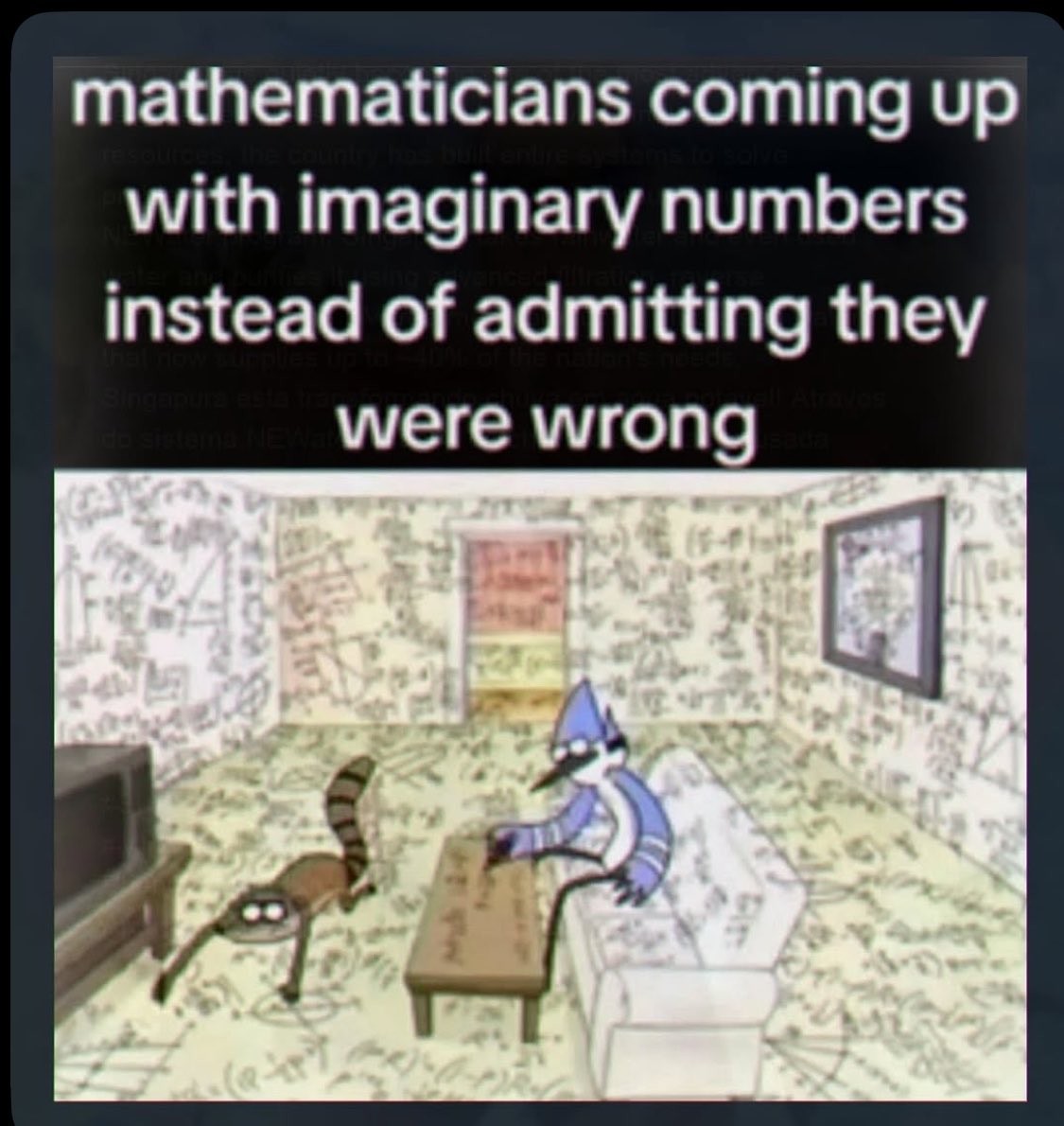
alright wise guy, what IS the square root of -1 then?
alright wise guy, what IS -1divided by 0 then?
-1 / 0 can be defined to be a special new number, ⭐.
This system of numbers is actually mathematically consistent and has all the properties that a number system should have. But using simple algebra, you can prove that in this new number system, ⭐ = 0. And then you can also prove that all other numbers equal zero.
This number system is known as the zero ring, and it’s the ring where the only number is 0 and the following operations are defined:
All other symbols, including 1, 2, and ⭐, are just alternative labels for 0 in this number system. In other words, defining division by zero is essentially the equivalent of reality collapsing in mathematics.
So yes, you can validly define division by zero. You just get degenerate mathematics if you do. So be careful what you wish for.
This would have been so much easier to understand in school. Why aren’t we using this instead!?
-1/0 = Boom
But more literally, the answer is undefined.
Instead of thinking of division as a “proper” operator, think of it as shorthand for “x0 = -1". Since the multiplication operator already defines "x0 => 0” and “-1 != 0”, there literally is no answer by definition. So “undefined”.
For “0/0”, it’s a little different. Since “x*0 => 0”, literally every number satisfies “0/0”. Since we’re expecting a single number as the answer, we call the answer to this “undefined” too.
So without i, sqrt(-1) would be… Undefined?
That’s probably accurate, but I’m no mathematician. Specifically if you confine yourself to the set of real numbers, it’s undefined.
If you confine yourself to the set of rational numbers, integers, or natural numbers, you could get a bunch more undefined equations. For example, if you’re only working with the set of natural numbers, sqrt(4) is defined, but sqrt(5) through sqrt(8) are undefined because there are no whole numbers between 2 and 3 (2^2 and 3^2). Similarly, sqrt(-1) is undefined in this case because -1 isn’t part of the set of natural numbers, so any expression you used a negative number in would be undefined.
A more intuitive example might be to try using a non-number in an expression. Sqrt(🐱) is undefined. And 🦆-🦢 is also undefined. The operators aren’t defined to include cats or birds.
Why should I care?