
It’s more complex than that…
cmon, get real
Think rationally
Let’s get to the root of all this negativity
But it’s plain to see…
*plane
Wasn’t sure which way to go with that one to make the best pun 😔
To pun is a sin, cos to tan is a con.
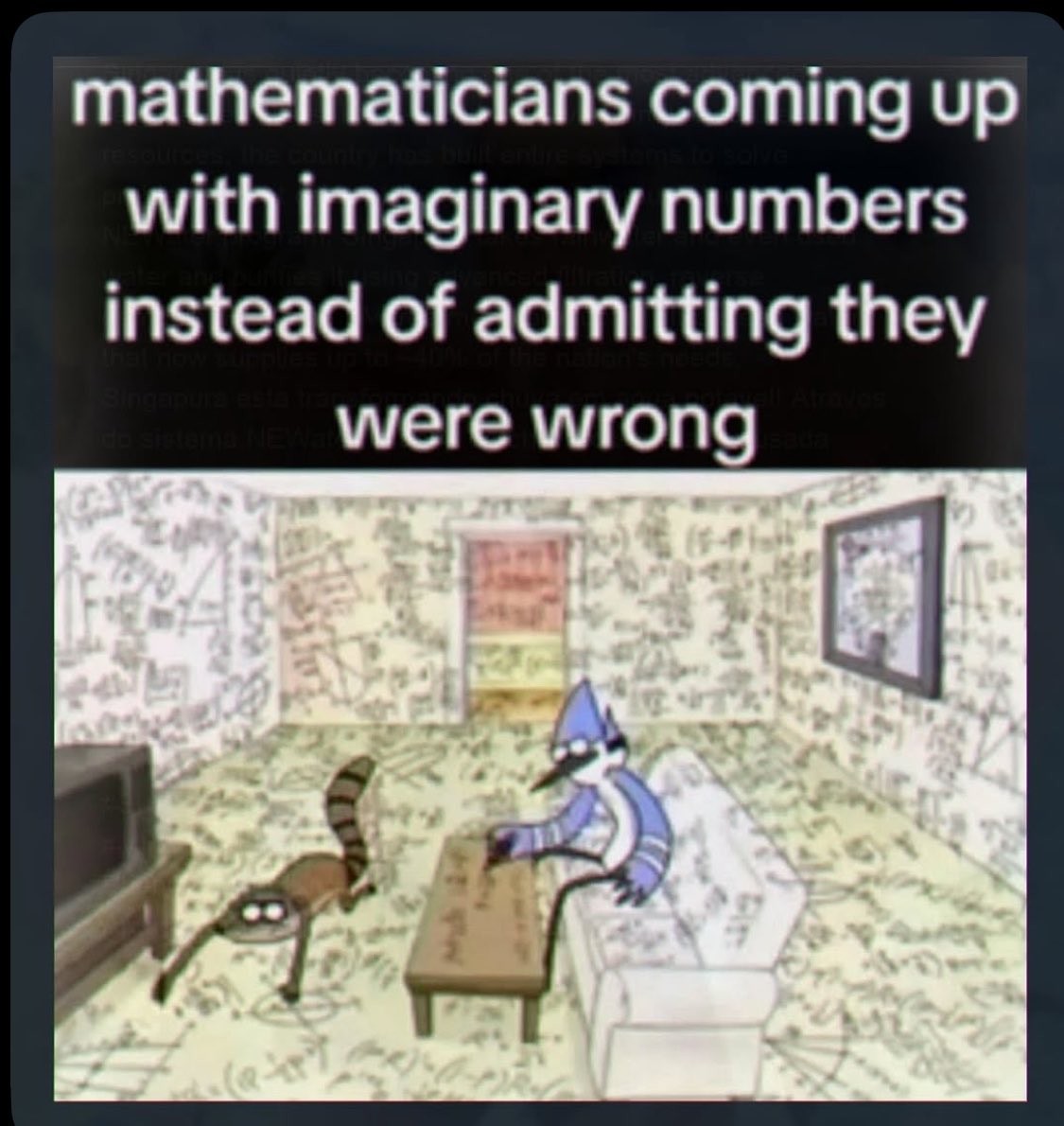
I’ve always thought “imaginary” vs “real” was an unfortunate naming convention.
I don’t know about other fields, but electrical engineering uses imaginary numbers with AC circuits and changing electrical fields. Since electricity moves as waves, imaginary numbers let you represent what’s coming 90 degrees later in a compact way.
Yeah, I think it causes unnecessary difficulties. I actually think they’re introduced at a time when you could instead teach them as two-dimensional vectors with pointwise addition and a special multiplication and division rule, and prove that (0, 1)×(0, 1) = (-1, 0) using that rule, so that sqrt(-1, 0) = (0, 1).
Then you can establish a convention that you write (a, b) as a + bi (and i = (0, 1)).
This is too abstract for younger students, but nowadays I don’t think they learn complex numbers anyway, and I think it would be less spooky for the older students.
Imaginary numbers are typically introduced in a high school “algebra 2” course in my neck of the woods, like junior year unless you are accelerated or held back. I feel like it’s really common for them to not be taught well - the naming is something that occasionally trips up the teachers.
The teaching of them is something that really interests me - they’re the kind of thing that triggers the “when am I ever going to use this?”/rants about not learning how to do taxes. You can talk about the relevance to electronics, but DC electronics is already hard enough for most to comprehend.
I like to connect it to rotation. Show them the pattern of powers of i with physical movement - quarter turns.
Yeah. I think the vectors-first approach allows you to get straight to rotations, too.
The big thing is that vectors seem to be the kind of “shoved into the end of the semester if there’s time after testing” from what I’ve seen. Most of the time, even when I work with calculus students they have no idea what a vector is.
A big thing to is getting them to understand what square roots even really mean. I’ve noticed a lot of students struggle with getting sqrt(x) * sqrt(x) = x, so even just the simple “hey, can you get a negative by taking a number and multiplying by itself?” is often a hurdle cognitively. (A lot of this I suspect has to do with not understanding what multiplication or division really “are” - I usually remediate with the area model)
Wow, (potentially) omitting vectors seems like a big gap. Obviously it has huge direct practical use, but it’s probably also the first introduction to how you can take a structure and augment it with operations. In that way it’s the first step on the road to abstract mathematics.
Also tbf, rational numbers are just the lattice modded out by the equivalence relations (a, b) ~ (c, d) iff ad = bc, and the equivalence classes just happen to form an ordered field. If you show an undergrad math/science student this esoteric definition of rationals, the motivation of “2D numbers” makes a lot more sense. Of course, please don’t show this to an elementary or middle schooler, a high schooler might be able to handle this if they’re passionate about math.
Of course, please don’t show this to an elementary or middle schooler, a high schooler might be able to handle this if they’re passionate about math.
Lol, I was thinking this as I was reading.
The neat thing about complex numbers defined this way is that you don’t need to understand quotient spaces because under addition ℂ is already isomorphic to ℝ²!
Carl Friedrich Gauss would agree with you on the naming. He thought the confusion/mistery around imaginary numbers was due to naming. He said +1, -1, and root(-1) should have been called direct, inverse, and lateral units.
Lateral numbers is my preferred term
don’t forgot signal processing. Complex number theory is used a lot when it comes down to Fourier transforms of discrete or continuous functions.
but yea the naming convention of “imaginary numbers” is pretty bad, we did the same thing for negative numbers (we called it imaginary) when people couldn’t comprehend of a negative quantity.
negative numbers are defined from a conservative system, basically a gain/loss relationship: if I have 2 apples and I give away 1 to a friend, I have 1 apple left, that loss – that apple I gave to a friend – is the negative quantity. For imaginary numbers, we don’t really have a way to comprehend an imaginary quantity; what does it mean that I have sqrt(-1) apples.
It means you have an orange.
And in optics, the “real” portion of a material’s refractive index represents scattered light and the “imaginary” part represents absorbed light.
Well, it applies to all EM-waves, not just radio or optical frequency waves. It also applies to acoustic waves.
Not just electricians.
3d graphics are all about about quaternions (4d version of imaginary numbers).
Quaternions are useful, but no means necessary or intrinsic to 3d graphics.
They are useful for describing rotations in 3d space, but the same can be done with a matrix, or even Euler angles. It’s just a more calculations.
That said, basically all the major game engines use quaternions, so unless you are creating your own 3d renderer, you have to learn at least the basics about them.
Quaternions really shine at spherical interpolation (Slerp - yes thats the real terminology) between two rotations.
I’d say Quaternions are necessary purely because they avoid gimbal locking common with 3 axis Euler rotations.
I know in Blender all other rotation options are really just quaterinions under the hood. But an advantage Euler rotations have over quaternions is continuous rotation. I can set 2 key frames with linear extrapolation and have them just continue along each axis forever. Everything quaternion ideally should be bounded to the 4d unit circle.
Yep, it is bad naming. I took it in highschool but it didn’t really make sense till I saw how it described electric fields with the wave 90 degrees into the flat page.
Electrical engineers also use them as a simple way of solving differential equations with laplace transforms. Much easier as long as you don’t care about what happens at infinity.
Infinity is too far away. We’ll deal with it when it gets closer.
Is that just an EE thing?
Right, it’s just an orthogonal basis. You can extend this to many dimensions, fields and geometries.
Just one more axiom bro and it will all make sense… just one more I swear it’s consistent… BRO I just NEED one more conjecture and it will BE complete… tHe pRincIPles ARe sOLid BrO jUST TruST mE!
It’s not like the regular numbers behave themselves. Have you ever heard a coherent, non-self referential definition of the number 3?
the only numbers that actually exist are 0 and 1. everything else is a reference to those
I can define zero as the absence of 1. But also 1 itself is a reference to the infinitely fractional 0.00…1 and I’d consider that a different number to the whole number 1
that doesn’t actually exist in the standard number system; there is no single real number that’s immediately next to 0, you can always get closer. some number systems have infinitesimals, but real numbers don’t. and any very small real number with a terminating decimal expression is simply the inverse of a very large number, which is simply a long string of 1+1+1+1+1…
It’s 2 plus 1
Oh yeah? Prove it
2+1 … . … 3
What do 2 and 1 mean?
… .
So, take 2 bananas and add 1 banana
Define banana
A banana is an elongated, edible fruit that is botanically a berry produced by several kinds of large treelike herbaceous flowering plants in the genus Musa.
Define “A”
First letter of the latin alphabet
λ f. λ x. f (f (f x))
Succs to succ.
Half life f(x) confirmed?
3 is a sideways nutsack
W is a nutsack getting elaborately crushed
That is an L actually
Well, it’s a W in my book.
=3
{{},{{}}} (I think)
That would be 2. 3 would be {{},{{}},{{},{{}}}}.
is not ø 0, {} 1, {{}} 2 and {{},{{}}} three? or do we not count ø
{} is the same as φ.
right, I took {} as {ø} implicitly
3 = . . .
Yes. In fact, just earlier today, my buddy Darryl was telling me about a coherent, non-self preferential definition of the number 3. It’s not a big deal. People do that stuff all the time.
2+1?
men will invent new fields of mathematics before going to therapy
Well, new fields of mathematics are useful.
You imply that therapy is not.
Yes.
That was literally what Sir Isaac “Deadliest Son of a Bitch in Space” Newton did.
Despite his being a stunningly weird little guy, he did notice some useful stuff!
Therapist: Do you think your dives into math are a type of avoidance for difficult problems in real life?
Me: You know what’s really interesting? I just thought of this, but recipes can be really well represented by a directed, weighted hypergraph. Each hyperedge is an action, the weights are the measurements, and so following the directed hyperedges will result in the meal the recipe is for. It more naturally captures how recipes can be non-linear than regular list based recipes!
Practically everything people say about imaginary numbers you could also say about negative numbers.
Also… wrong about what?
Also infinity and, by extension, irrational numbers.
All numbers are imaginary. So are words.
for real, which is imaginary
Especially for solipists.
They’re just closure-minded.
alright wise guy, what IS the square root of -1 then?
alright wise guy, what IS -1divided by 0 then?
-1 / 0 can be defined to be a special new number, ⭐.
This system of numbers is actually mathematically consistent and has all the properties that a number system should have. But using simple algebra, you can prove that in this new number system, ⭐ = 0. And then you can also prove that all other numbers equal zero.
This number system is known as the zero ring, and it’s the ring where the only number is 0 and the following operations are defined:
- 0 + 0 = 0
- 0 - 0 = 0
- 0 × 0 = 0
- 0 ÷ 0 = 0
- 0^0 = 0
All other symbols, including 1, 2, and ⭐, are just alternative labels for 0 in this number system. In other words, defining division by zero is essentially the equivalent of reality collapsing in mathematics.
So yes, you can validly define division by zero. You just get degenerate mathematics if you do. So be careful what you wish for.
This would have been so much easier to understand in school. Why aren’t we using this instead!?
-1/0 = Boom
But more literally, the answer is undefined.
Instead of thinking of division as a “proper” operator, think of it as shorthand for “x0 = -1". Since the multiplication operator already defines "x0 => 0” and “-1 != 0”, there literally is no answer by definition. So “undefined”.
For “0/0”, it’s a little different. Since “x*0 => 0”, literally every number satisfies “0/0”. Since we’re expecting a single number as the answer, we call the answer to this “undefined” too.
So without i, sqrt(-1) would be… Undefined?
That’s probably accurate, but I’m no mathematician. Specifically if you confine yourself to the set of real numbers, it’s undefined.
If you confine yourself to the set of rational numbers, integers, or natural numbers, you could get a bunch more undefined equations. For example, if you’re only working with the set of natural numbers, sqrt(4) is defined, but sqrt(5) through sqrt(8) are undefined because there are no whole numbers between 2 and 3 (2^2 and 3^2). Similarly, sqrt(-1) is undefined in this case because -1 isn’t part of the set of natural numbers, so any expression you used a negative number in would be undefined.
A more intuitive example might be to try using a non-number in an expression. Sqrt(🐱) is undefined. And 🦆-🦢 is also undefined. The operators aren’t defined to include cats or birds.
Why should I care?
Then they invented quarternions.
If math symbols are fancy for-loops, then this is a fancy array?
They’re useful as hell! I hate gimbal lock, all my homies love quarternions
This is a thing that mathematicians do. Rather than just assume you can’t divide by zero they’ll go ahead and try and see what happens.
Physicists (only because I watch Sabine, and this is what she says they do)

That’s the face I make when someone mentions she is watching Sabine (only because I watch prof Dave)
Sabine is a little nutty ngl, I had to unsubscribe. She huffs her own farts way too much.
deleted by creator
I feel like this is why physicists came up with dark matter/energy
Yes, that’s explicitly what that is. Dark matter/energy is just the name given to the phenomenon that measurements suggest there must be something else we can’t detect yet
Or maybe we can detect that nothing is there and the formulas are just wrong. But it’s a lot easier to make up invisible matter than rework the formulas.
Then, when those numbers appear IRL, what do you do then huh??
another tab of acid since the first obviously wasn’t enough
All numbers are imaginary