I can define zero as the absence of 1.
But also 1 itself is a reference to the infinitely fractional 0.00…1 and I’d consider that a different number to the whole number 1
that doesn’t actually exist in the standard number system; there is no single real number that’s immediately next to 0, you can always get closer. some number systems have infinitesimals, but real numbers don’t. and any very small real number with a terminating decimal expression is simply the inverse of a very large number, which is simply a long string of 1+1+1+1+1…
A banana is an elongated, edible fruit that is botanically a berry produced by several kinds of large treelike herbaceous flowering plants in the genus Musa.
Yes. In fact, just earlier today, my buddy Darryl was telling me about a coherent, non-self preferential definition of the number 3. It’s not a big deal. People do that stuff all the time.


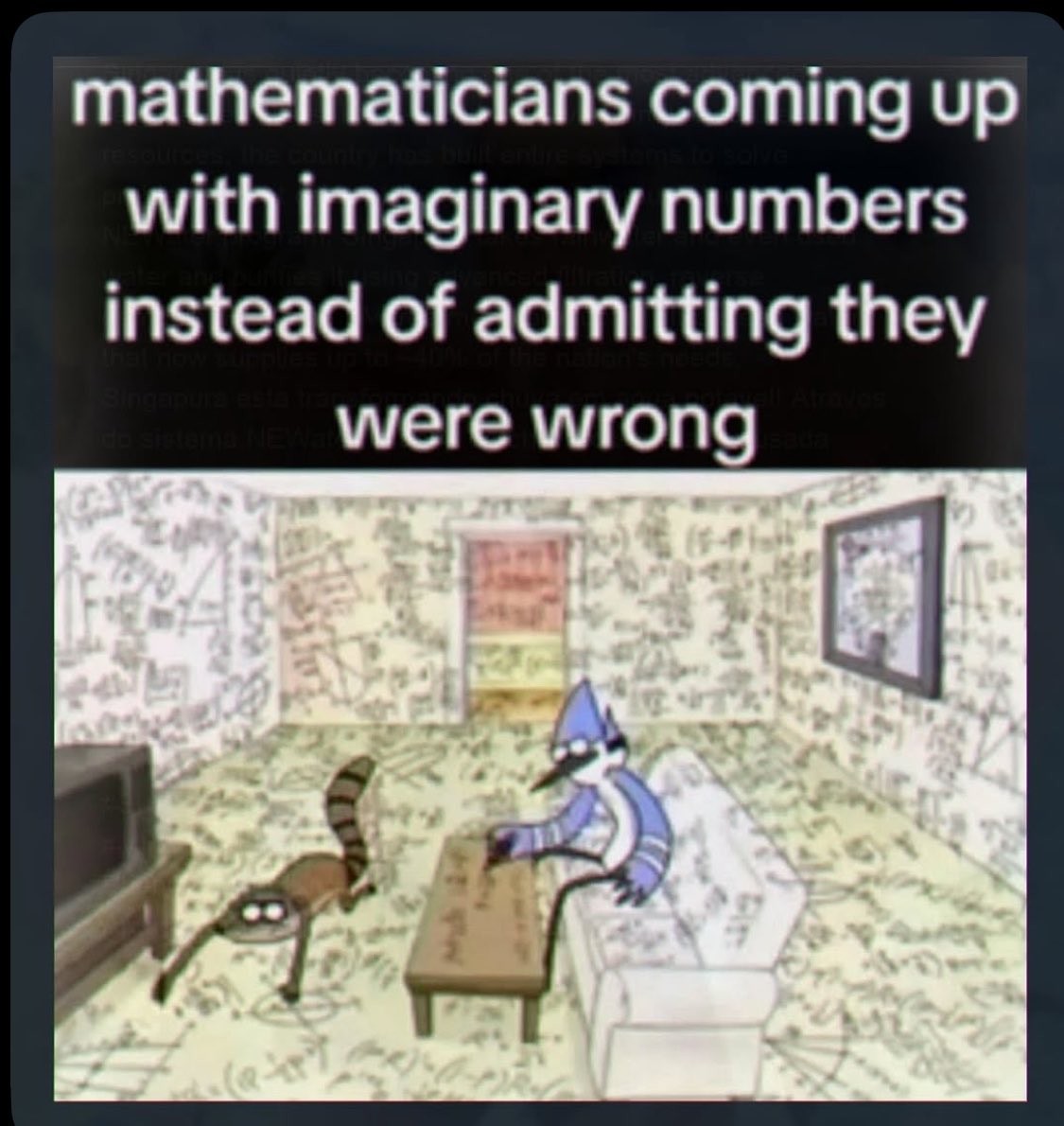
It’s not like the regular numbers behave themselves. Have you ever heard a coherent, non-self referential definition of the number 3?
the only numbers that actually exist are 0 and 1. everything else is a reference to those
I can define zero as the absence of 1. But also 1 itself is a reference to the infinitely fractional 0.00…1 and I’d consider that a different number to the whole number 1
that doesn’t actually exist in the standard number system; there is no single real number that’s immediately next to 0, you can always get closer. some number systems have infinitesimals, but real numbers don’t. and any very small real number with a terminating decimal expression is simply the inverse of a very large number, which is simply a long string of 1+1+1+1+1…
It’s 2 plus 1
Oh yeah? Prove it
2+1 … . … 3
What do 2 and 1 mean?
… .
So, take 2 bananas and add 1 banana
Define banana
A banana is an elongated, edible fruit that is botanically a berry produced by several kinds of large treelike herbaceous flowering plants in the genus Musa.
Define “A”
First letter of the latin alphabet
λ f. λ x. f (f (f x))
Succs to succ.
Half life f(x) confirmed?
3 is a sideways nutsack
W is a nutsack getting elaborately crushed
That is an L actually
Well, it’s a W in my book.
=3
{{},{{}}} (I think)
That would be 2. 3 would be {{},{{}},{{},{{}}}}.
is not ø 0, {} 1, {{}} 2 and {{},{{}}} three? or do we not count ø
{} is the same as φ.
right, I took {} as {ø} implicitly
3 = . . .
Yes. In fact, just earlier today, my buddy Darryl was telling me about a coherent, non-self preferential definition of the number 3. It’s not a big deal. People do that stuff all the time.
2+1?