I’ve been wondering, what is amateur radio hobby about? I’m guessing I’m too young to understand it, since when I was growing up we already had a dial-up and then internet and mobile phones became common as I was starting highschool, but it sounds interesting.
I see a lot of notepads next to the radios in the article, is it about just catching and monitoring the traffic for fun, kinda similar to i.e birdwatching but with radio waves? Or do you talk to other radio operators around you and hang out?
I’m honestly curious what do people generally do, when they become amateur radio operators.
For me it is in part what you said. Radio birdwatching is actually pretty fun just bumping around the spectrum to see what you can find. There is the communication aspect of course. There is a bit of an emergency preparation aspect to it too. You can also do things like listen to satellites and get images from them or use the ISS as a repeater to get contacts from much further away than usual. It is a very broad hobby to get into. I am the youngest operator by probably 30 years in my area which is an interesting experience but it is cool to be able to operate old analog technology since I also grew up in the internet age (mostly). The entry price point into the hobby is relatively low now. I spent maybe 50 USD when I first started, unfortunately as you get more skills and interest the cost for equipment to do things you wanna do definitely goes up.
Thank you, that makes sense. I’ve always been a fan of analog technology (although I never really got the motivation to actually look into it seriously), so I can imagine that being fun.
It does sound pretty interesting, I didn’t know you can get such a long range contacts. I can imagine it is a pretty nice community!
Amateur Radio can also be a digital mode of communication. AX.25 as an example, is probably the most common protocol for packet radio communication.
Where normally you would speak into the radio and talk with someone you can instead use a TNC that would produce digital tones (much like dial-up internet) that can then be used to send digital information.
This is a gross simplification of the process and I am sure I have messed up part of the description. But as an example of what you can do with that is running a forum/bbs only with radios, sending emails over radio, and sending images over radio, etc…
Radio is neat
Can you point us toward an intro activity and equipment?
I am a US operator so my advice will be based on that but this is the path I took: get yourself either a baofeng GT-5R or UV-5R, both are around 20 USD on Amazon. Don’t listen to baofeng haters, they are perfectly fine to start with and in fact I still use a couple of baofengs for various things. These radios are handhelds (also called HTs) and are low power but will cover the 2M and 70 CM amateur bands. With those you can look on a website called repeater book to see if there are repeaters near you. Repeaters essentially re transmit peoples radio traffic on a specific frequency for longer range. If you have one near you, tune to the listen frequency whenever you have the chance and see if people are talking. It may take some time depending on the number of operators in your area.You can also track the ISS on N2yo.com and attempt to listen in to the radio repeater onboard as it passes over you. Those will be amateurs from potentially hundreds of miles away talking on that repeater. You can look up something like ISS radio repeater on YouTube for more information on that. Or you could simply scan through frequencies automatically and see what you find. I guarantee you will hear some sort of signal if you do, though it may not be actual people. If you had some more money to spend you could get something like a baofend BF-F8HP (about 60 USD on Amazon). That is a triband radio that will get the 2 bands I mentioned early, but also will be able to pick up air traffic and ATC towers if you are in to aircraft watching. All of that would give you a little taste without spending too terribly much. To be clear though without a license you can only listen on these frequencies never transmit, unless in case if life or death danger. I know people to transmit without licenses and don’t really care, that is their business but it is technically a crime.
Amateur radio is a hobby made up of many technical hobbies. You can basically do everything that utilizes radio waves. Some people just want to talk to others over long distances. Some like to enter contests: competitions where you try to make as many contacts as you can within a few hours or days, often under special rules like using only Morse code or low power. Some build their own antennas and radios. Those are “classics” but there is so much more. You can make contacts via satellite. Some people use planes, meteors, or even the moon as reflectors for radio waves. Some are only interested in the more extreme ends of the radio wave spectrum like low frequencies or microwaves. You can program digital modes, or send chat messages and pictures over radio waves. You can learn how different antennas, weather, and space weather affect radio wave propagation. Some people like to go hiking with their radios and make contacts from remote places, while others do emergency communication training. I have probably forgotten many things; the possibilities are virtually infinite.
My dad was very big into amateur radio in the 70’s and 80’s, so long before things like the internet, mobile phones, etc. He spent a lot of time on the radio with researchers in Antarctica since radio was their only way to communicate back then. My dad had his radio hooked up to our telephone, and he would make collect calls to family members of the people in Antarctica so that they could talk to each other. He’d spend hours on end doing this.
That is pretty cool!
My dad did this so often that he got to know some of the researchers really well. I think I was in third grade when one of them actually visited my school when he returned from a year in Antarctica. It was all thanks to my dad & his radio.
Everyone does the hobby differently, but for me I like to listen to folks talking to each other. You could have a guy in Nebraska chatting it up with someone in Australia just talking about whatever. I know this doesn’t seem as impressive in the age of the internet, but it was essentially an audio version of the internet before the Internet proper existed for the public.
There are also Radio Nets that happen, pretty much just organized gatherings on a repeater for discussion of a specific topic, kind of like a forum. I like to participate in those because it’s very structured and orderly and they cover a lot of interesting topics.
There are yet others who like to do a myriad other things, like see how many hams in other countries they can contact in a day, or learn and communicate in CW/Morse code, or go out to the wilderness/parks to establish contact with someone doing the same thing. The more mechanically inclined might build their own rigs, antennas and shacks and test/use those. And since radio is considered vital communications during natural disasters when the power and internet might be out, some operators regularly practice emergency preparedness exercises for search and rescue, and the like.
These are just a few activities that I can think of off the top of my head, there’s many, many more. It’s quite a varied hobby!
I had no idea you could get such a long range contacts, that’s cool. It does sound like a nice community.
Also, it sounds pretty impressive to me, even though I’ve never experienced lack of internet/mobile phones. While I had it granted for basically all my life, I have a respect for analog things, and have been a fan of sending letters. I have the luxury that I can romanticize the slower/analog way of living, without actually having to live through it to ruin my experiences, hah!
Thanks, this post has inspired me, while it’s not exactly HAM, I was considering getting Meshcore/Meshtastic relays, which I assume is kind of similar but chat instead of voice, so I might look into it some more. I assume the communities might be similar, and it sounds like a nice hobby.
I wonder wants a good one around $100 to start off with?
Depends on what you want to do. UHF/VHF handheld radio can be had for 20-30, uSDX or QMX type small low power HF radio is closer to 100. You’ll also need battery, antennas (perhaps tuner) and something to put data in and out (headphones and microphone or cw key or audio interface to laptop) (no idea if it’s good but people use it)
What’s the most engaging? UHF is TV, right? Not sure what you can do much with that except watch I Love Lucy ha.
@xSikes @fullsquare my unsolicited advice to any ham-curious:
Budget $25 and an hour of your time. Buy a baofeng mini dual band 2m/440MHz (VHF/UHF) handheld on Amazon.
Go to Repeaterbook.com and learn to program in your local repeaters. Leave it on scan and listen for a few days but don’t ttansmit (w/o a license).
Go from there. If talking to Europe and beyond (HF) through a wire in a tree intrigues you, get licensed, join your local club, and off to the races…
@xSikes @fullsquare if you are technical minded you will probably love weak signal digital data modes. I’ve heard New Zealand FT8 with my HF antenna laying on the ground.
Radio is amazing
It’s up for you to decide. On U/VHF you can talk to other people directly (locally) like on HF. But you can also do things that HF can’t provide, or provides with limitations, like talk through repeater (uncommon on HF), or to ISS, or through satellites (HF bounces from ionosphere) or do longer distance communications from mountaintops, or do image transmission or packet radio (HF has less bandwidth). On receive only you can also download NOAA weather satellite images, or whatever else data are emitted by them. You can make your own repeater from two baofengs. HF gets affected by space weather, U/VHF is not, and we’re entering solar minimum. 6m will take you far further than 2m but it’s usually bundled with HF radios
On higher end there’s also moonbounce, but it’s not in the budget category
e: there’s 50 things you can do with SDR only (many on U/VHF) https://blinry.org/50-things-with-sdr/
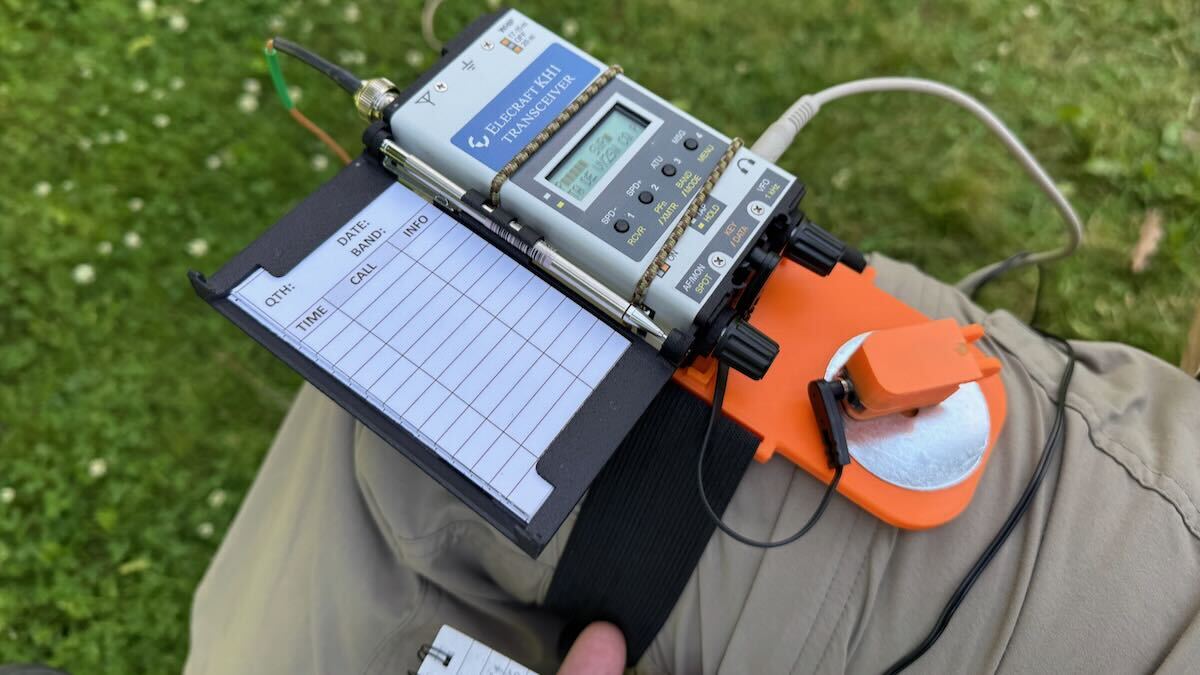
A little off-topic, but what is that gear the person in the picture is holding?
there are photos of 16 different radios and a couple of antennas, but the one in thumbnail is Elecraft KH-1