

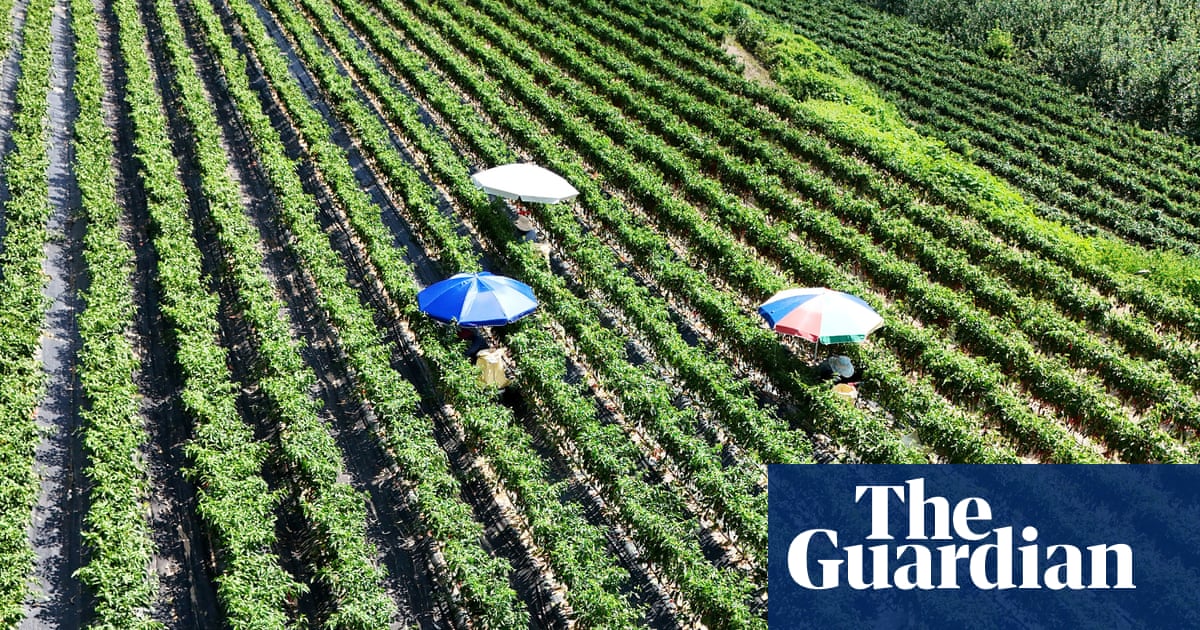
Aweek earlier the crop, located in Gangwon province, had looked fine. Now the potatoes came up soft and collapsing, “like boiled potatoes”, spoiled by heat that had turned the ground into something closer to an oven.
“It’s not just one or two fields like this. How can I even put it into words? It’s so upsetting,” he told local broadcaster SBS.
His ruined harvest is one thread in a punishing summer across east Asia, as record heat swept through South Korea, Japan and Hong Kong in recent weeks.
All I ever read is AC is the answer
This is all global warming baked in from decades ago. We’re not even in the “aww fuck it, crank that hog” past couple of decades of emissions.
Removed by mod
In terms of ecology yes, in terms of climate, no.
Removed by mod
There are isolated places on the planet that still have nature’s abundance, and clean air!
Removed by mod
Cant wait to starve to death from climate related agriculture collapse
we will probably be going to war over freshwater before agri gets hit.
Is desalination plant not an option?
I’ve started my own garden partially because of issues like this, but I don’t think even that will protect someone, you can’t stop A heat wave like that.
I guess maybe we will have to start farming in the Arctic circle or something
While it’s true that we’ve had improved yields in the short term in e.g. Finland (this year has been quite good for farming), suitable temperatures aren’t really enough to make creating a new bread basket in the arctic feasible. Lot of the arctic area doesn’t get enough rainfall in the summer to be proper farmland, especially the vast areas of land in Russia. We’re lacking the predatory insects that would keep the pests in check, and overall the ecosystem is very poorly protected against high temperatures.
This year is also anomalous in being somewhat normal a summer in terms of temperature and rainfall for us. Previous two were very dry, to the point of causing issues for farmers. We’re not necessarily suffering from a drought over here, as opposed to e.g. Mediterranean Europe, but are still seeing abnormally low water levels and less snowfall than usual.
The arctic also doesn’t have a lot of soil that’s suitable for farming, were the weather to warm up. Much of the soil is sand and peatland, covered with a thin layer of moss or lichen. There really aren’t a lot of nutrients available; Finland has a long history of trying to clear fields on swamps as well as planting forests on a drained swamp. Neither have typically worked that well, as drained swamps are a difficult growing medium for most crops and trees. Nowadays we see the swamp as an increasingly more important thing as itself, providing a good carbon sink and improving water quality in the lakes by absorbing excess nutrients and humus.
The only real sustainable solution is, apart for pushing for renewables even harder, trying to decrease the consumption of meat and other unnecessary use of farmland. We can relatively easily absorb a 50-80 % reduction in farming yields globally if we were to get rid of most livestock and bioethanol/biodiesel from edible crops. Another thing is that in developed countries people are far too picky in terms of what they’re willing to eat. As an example, around here we’re actively trying to get people to eat more freshwater fish, as we have an issue with there being too much nutrients in the lakes, and fishing is one of the easiest way to reduce the amount of nutrients in water. Good fish like smelt, roach, ide and bream are often through to be “trash fish” as they can be difficult to prepare (or can smell weird (smelt), can taste of mud at the wrong season (roach)). They’re all very good when prepared correctly and caught at a correct time, though. Nowadays you can get them in a can as a more sustainable alternative to canned tuna, and those have been selling quite well AFAIK.
Gardening can happen underground, I think it’s called a walipini. It uses the cooler dirt underground to keep the garden cooler. Just need to go a little deeper.


