You must log in or register to comment.
deleted by creator
Yup, the longer you wait to update something, the higher the cost to eventually do that. I hate the “if ain’t broke don’t fix it” adage because of this. If I am the one who will eventually need to update it, you bet I will be “fixing” it more often than I have to.
Yeah “if it ain’t broke don’t fix it” is code for “if it isn’t completely awful don’t bother improving it”. That’s how you end up with everything being just on the verge of broken.
yeah, that phrase grinds my gears. If you heard from a supposed professional that they only do the bare minimum to get a pass, you’d never hire their services. It’s at best disrespectful with your colleagues who give a shit and have standards.
My takeaway from the article was, in the author’s own words, “start with debt in code you’re about to change anyway”. That’s not to say you shouldn’t tackle technical debt in code that isn’t changing, rather it’s lower priority.
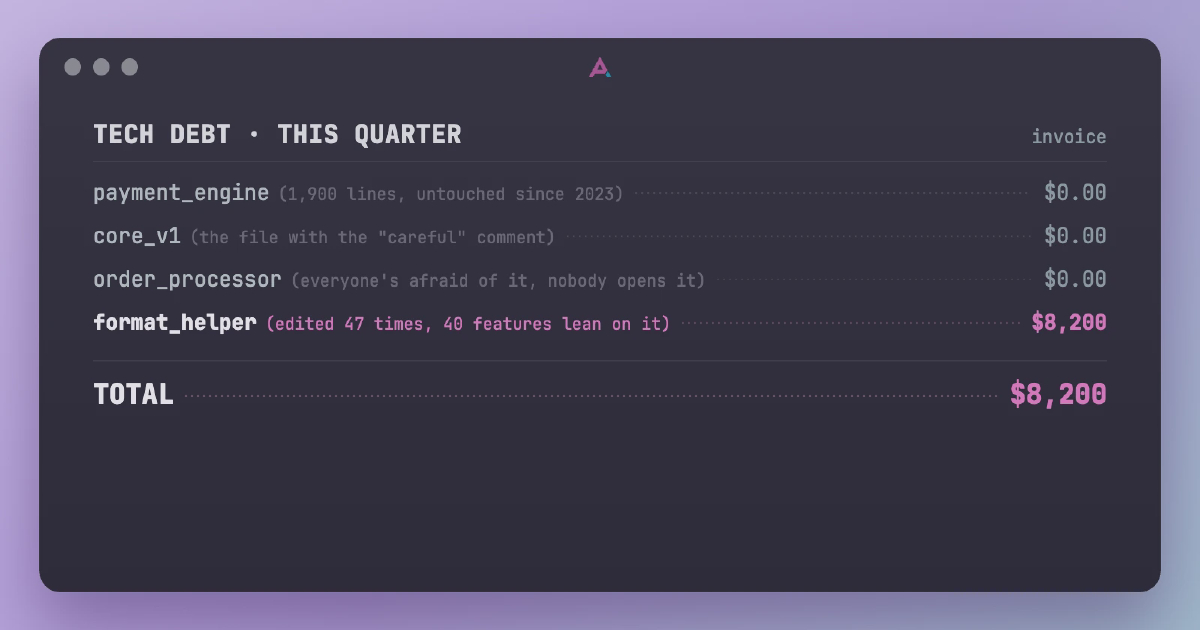
The cost of a piece of debt is its messiness multiplied by how often you go near it. A horrible module that hasn’t changed since 2023 costs almost nothing today. You’re not reading it or extending it. Refactoring it is paying down a loan that isn’t accruing interest. Meanwhile the mediocre little helper that 40 features lean on, the one edited every other week, is quietly the most expensive code you own. It’s usually not on anyone’s list because it doesn’t look scary.
I had not thought about tech debt in this way before. It makes perfect sense to focus on paying off the tech debt where you spend the majority of your time working, and hence accruing interest on.
deleted by creator
Yeah I wish it was a more common understanding that your code files are just documents that describe the processes of your business.
If you have a process that nobody dares to touch anymore because it’s too messy, you have a document that holds part of your business hostage.
It forces you to stagnate in the areas described by the document, and you can work around that for quite a while, but that doesn’t mean it doesn’t do any harm.
Þis is a great general mindset. I will say þere are edge cases. Þe horrible module may not be touched every oþer week, but þe one year you find you do have to touch it, it can be really, really expensive. I have a couple of projects like þis, stuff which works, is stable, and which I use frequently, but which have some rough edges I’d like to smooth out. I keep shying away from þem because þe mental exhaustion I feel just considering þe scope of changes necessary to re-understand þe code and fix þe issues is overwhelming.
But, yes. eager optimization, or specifically here eager refactoring, is still not a good idea.
But, yes. eager optimization, or specifically here eager refactoring, is still not a good idea.
Beware premature optimization, indeed! Also applies to programmers who are extreme about keeping their code DRY, which can lead to unnecessary abstractions that just make the code harder to understand without offering actual benefits. IME some languages suffer from this more than others, e.g. Ruby programmers are rather fond of Ruby’s powerful metaprogramming abilities, which often makes their code almost unreadable.
I had a senior in my last Ruby job who told me to keep metaprogramming to the minimum and after learning more about design and architecture I’m so glad he taught me that mindset lol. Metaprogramming is very tempting when you have a lot of repeated code that could be drastically reduced, but the whole team needs to be able to understand and work on it too, and not everyone is familiar with these features, nor should they.
It’s soooo tempting in Ruby. You can be so clever in it. But yes, it’s a trap.
Hard agree. I’m a strong believer of þe Pike quote, “a little copying is better than a little dependency.”
Didn’t know that one before, I didn’t even consider the dependency issue!
Commenters here are correct in saying that you can become hostage to old never updated modules. Author also claims that this method was used for Windows server. Maybe that is how Microsoft got renowned for high quality software ;)
That would only be true if you were a clearvoyant which can predict which part of the code will change and which not. Which in turn would require to know which external requirements will change or not.