For all of the confusion about where the Ottawa-Washington meltdown will lead, one thing seems certain. The big winners of this diplomatic collapse will be China and other repressive dictatorships eager to become our new “strategic” partners and further undermine the world’s stabilizing democracy bloc.
Opinion piece by Charles Burton, former diplomat at Canada’s embassy in Beijing, senior fellow at Sinopsis.cz, a China-focused think tank based in Prague, Czech Republic. He is and author of ‘The Beaver and the Dragon: How China Out-Manoeuvred Canada’s Diplomacy, Security and Sovereignty’.
…
Beijing in particular wants to inherit Canada’s economic dependence. Establishing such a broader North American beachhead will only further President Xi Jinping’s resolute goal of displacing the U.S. as a global hegemon, and cementing a China-dominated world order whose very foundation is the rejection of democratic freedoms and human rights.
…
If Canada ever reaches a point where attacks on our economy put families’ livelihoods at stake, then standing firm on our moral principles will give way to tolerating – or at least ignoring – human rights abuses in exchange for restoring Canadian prosperity through trade and investment with the likes of Qatar, Saudi Arabia and China. As someone who has been sanctioned by both Beijing and Moscow for standing up for Canadian democratic and civil values in global affairs, this prospect is deeply troubling.
…
When Mr. Xi makes a landmark trip to North America next month, it is expected he will add a Canadian stop, the first time in 16 years a Chinese head of state has visited this country. And this at a time when there have been calls for Ottawa to scrap restrictions on importing Chinese-made EVs, to locate Chinese auto factories here, and to even encourage Canadians to buy “Great Wall wine” instead of Californian.
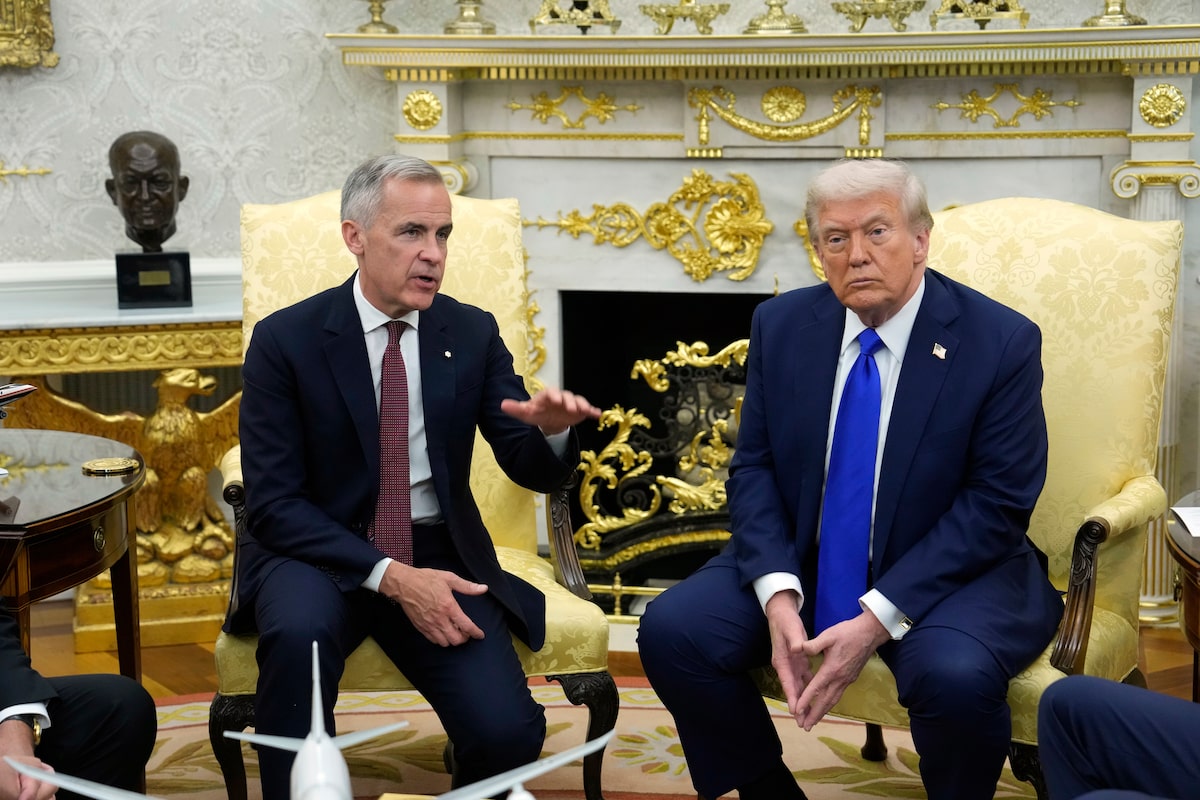
In contrast to the belligerent threats that Canadians have been conditioned to expect from Washington, the Chinese President will project dignity and a tone of respect and goodwill toward Prime Minister Mark Carney and his Canadian business associates, who will be offering a warm welcome to the Chinese delegation.
But like Howitt’s “Spider and the Fly,” in which a cunning spider uses seduction and manipulation to lure a fly into its web, Canada should be wary of those who wield flattery and charm to disguise other intentions. Rushing to embrace China’s expansionist and calculating totalitarian regime will never work out well for Canada’s overall interest.
In the current hostile landscape, Canada could find itself deeply regretting coming out of an American frying pan into a Chinese fire.
…
China aren’t reliable, look at what they did to Australia after our prime minister, rightly or wrongly, called for an investigation into the origins of covid
For the record, I don’t think Scotty did the right thing, but China’s response wasn’t justified either
This guy was a diplomat, but he doesn’t understand triangular diplomacy?
Both the US and China suck balls. They’re both authoritarian, both have dictators that abuse their power and the people of their countries have accept it because of fascist propaganda about how only a strongman can run the economy and foreigners are trying to screw them over.
The main difference is the distance to those countries. It would be nice if we didn’t need to engage with either of these countries, but the US is right next to us so they can’t be ignored. So we need to play both sides. Not on every single thing, we don’t want to engage with China anymore than we have to, because their regime sucks in the same way the US regime sucks. But if they’re willing to fill in any gaps caused by the trade issues with the US, then you gotta do what you gotta do.
Yeah well half of those dictators personally picked on canada in the prez’ first term through now. Because canada is weak without the US and the US now has abandoned canada.
undermine the world’s stabilizing democracy bloc.
stabilizing democracy bloc
“stabilizing”
“democracy”
I’m pretty sure that… inhales

Mexico, Samoa, Hawaii, the Philippeans, Columbia, Hondurus, Cuba, Nicaragua, Haiti, the Dominican Republic, Greece, Costa Rica, Albania, Syria, Egypt, Guatemala, Iran, Indonesia, Iraq, Vietnam, Laos, Cambodia, Congo, Guyana, Brazil, Chile, Bolivia, Angola, East Timor, Argentina, Afghanistan, Granada, Panama, Yugoslavia, Venezuela, Palestine, and Libya
…might have a few words to say about that.

Starting to feel like that’s the point
How do ‘former diplomats’ come up with shit like this. Unless it was meant to be propaganda?
Of all the things you could criticize China for… this guy chooses to criticize it for the US acting like a drunk 14-year-old.
Well, I think I see why he lost his diplomat position.
stabilizing democracy bloc
I was wondering if the pro-US propagandists are gonna be smart enough to stay silent this close to us hearing the layoffs rumbles at our workplaces but no. Dumb as bricks.
Yeah, no. The happiest dictator is the one from the US.
While the rest of the world, Asia, Europe, Africa, Australia, South America, are switching to EVs, Canada and the US are fighting over who will build fossil cars. You can’t make this up.
“Yeah, the person I’m married to threatens me, punishes me, insults me, and doesn’t value my consent, but it’s better than what the other person could be”
Literal battered woman syndrome. Look, I don’t like China or want more trade with them either, but can we please stop pretending doing business with them will be worse than doing business with the U.S.? One keeps their issues much more domestic than the other? I don’t see China raising world oil prices by bombing Iran, raising my cost of living with absurd tariffs, or going back on their word.
We struck a deal with them, and they removed duties for our canola, crab, peas, and lobster for us letting in their EVs, which opens us up for job creation should they bring manufacturing operations here. In turn, we were made exempt from visa requirements to travel to China. I can see the benefits of that deal because they up the income of our farmers and fishers, open up job potential, and make travelling across the world easier for us.
That is how you strike a deal. They are reliable, the U.S. is not, plain and simple. If this guy’s opinion is that China wants less democracy in the world, then I’d like to point to the amount of dictators America backs and has instated. Let’s stop pretending that only one pulls that crap when they both do.
They are reliable.
No, they aren’t. China even imposed tariffs on Canadian pea starch in back in June (so you statement is wrong in this), and this is by far not the worst. The Chinese government’s coercive tactics are well-known across the globe, and so are its human rights violations.
Again, I reiterate.
Who is irrationally increasing the cost of living across the globe, specifically with gas prices?
Who else is committing human rights violations, domestically and abroad, and is actively backing those abuses in other countries?
Also that’s specifically for pea starch, whole peas and other pea products are still good to go, that’s far from going back completely on their word, which a certain other country has done countless times.
Pea sales to China strong despite new starch tariff
If I’m taking anybody’s word, it’s the president of Pulse Canada.
The US has never been a stabilizing democracy. They have been one of the foremost instigators of destabilization for almost a century. And the research is also clear that US citizens’ majority policy concerns only get addressed if they align with corporate policy concerns. So neither stabilizing, nor an actual democracy.
My knee-jerk “um actually” response aside, China’s ability to strategize at long time horizons lends credence to some of his points. For long-term survival, Canada will need to build multiple independent tradepartnerships to remove any single points of failure.
Democracy do not exists we are in a system where the lobbies and oligarchy rule
At least the rest of the world is realizing we’re enemies now.
I think the Prime Minister who called out that middle-powers needed to stick together if they are to survive is probably aware that jumping out of the fry pan into the fire isn’t a good idea. Conversely the Chinese are no worse than the Americans, so Canada all the middle powers need to deal carefully with the 2 superpowers, keep them as much at arms-length as possible, and try to make win-win deals. Something China currently does and the US doesn’t while the orangatun is in power.
As I post somewhere else Charles Burton have … hmmm how to put it … weird credentials.
I’m in his side for this op ed however … but it seems written by AI so much it don’t go in anything serious
I don’t think it’s written by AI, and it makes valid points in my opinion.
Oh Yeah that are valid points. Shifting the Canadian economy out of the American tentacles will be hard and the easiest path forward is, sadly, the Chinese and it will be hard at first on our collective wallets, hopefully it’ll gets better but I doubt it
Now all this point are already known, why an ex-ambassador and specialist on the question (since is writing for a think thank) doesn’t have more insight, something more crunchy to say ? This is here that I feel there’s something afoot
Canada must seek closer ties with like-minded democracies (what it does already). The ‘Chinese path’ is - at best - a short-term convenience, but in the long run a lost game for Canadians and the free world in general. Beijing and other dictatorial regimes aren’t reliable partners, no matter what happens in the U.S.
Which democracy?

Please don’t believe everything you’ve learned from main stream media.
“My country is democratic”
Remind me, when was the last time the ruling party lost an election in China?
Is a two party system any better where both side shame others from not voting to their favourite political cult? Aren’t those who people advocating for a one party system?
Doesn’t matter. I’m talking about China. The US having a shitty democracy does not do anything to legitimize China’s lack of democracy.
They lifted 800 million people out of poverty in 40 years. 90% of Chinese adults own their home.
Why would they lose an election?
This is the same cheap propaganda that is so widespread here. China is a dictatorship where people can’t openly say their opinion about democracy nor anything else, at least not if the opinion differs from the Communist Party’s narrative. And Beijing’s human rights violations have been evident for decades.
Edit:
I remembered a study I read some time ago and could now find it. It’s from 2024, and it essentially says that when Chinese citizens are surveyed anonymously, support for party and government plummets:
Most public opinion research in China uses direct questions to measure support for the Chinese Communist Party (CCP) and government policies. These direct question surveys routinely find that over 90 per cent of Chinese citizens support the government. From this, scholars conclude that the CCP enjoys genuine legitimacy. In this paper, we present results from two survey experiments in contemporary China that make clear that citizens conceal their opposition to the CCP for fear of repression. When respondents are asked directly, we find, like other scholars, approval ratings for the CCP that exceed 90 per cent. When respondents are asked in the form of list experiments, which confer a greater sense of anonymity, CCP support hovers between 50 per cent and 70 per cent. This represents an upper bound, however, since list experiments may not fully mitigate incentives for preference falsification. The list experiments also suggest that fear of government repression discourages some 40 per cent of Chinese citizens from participating in anti-regime protests. Most broadly, this paper suggests that scholars should stop using direct question surveys to measure political opinions in China.
This is just one among many studies that show that ‘perception’ of democracy isn’t that simple to illustrate just by something like a diagram as propagandists make it seem. It should be clear that directly asking citizens who live under a dictatorial regime what they think about their government will provide no useful answers in my opinion.
Cheap propaganda produced by Harvard University? Try harder, lol.
Edit: Got this graph mixed up with a Harvard study that also shows satisfaction with China’s gov’t.
I’m surprised the results aren’t 120%.
Guess who conducted the study?
A marketing firm, looks like.