Metric is great for scientists in a lab with equipment to measure things.
Imperial was created during a time when peasants in the middle of nowhere needed to measure something “close enough” to trade with others, even without tools or measuring equipment, which was only owned by scribes and other members of the nobility.
This is why all imperial length measurements relate to parts of the body and why all volume and weight measurements relate to containers that were commonly used to store the thing you’re measuring (a bushel of grain, for example).
Also, a foot can be divided equally into 2, 3, 4, or 6 equally-sized pieces without resorting to estimation or irrational numbers; a meter cannot.
The US agreed to switch to the metric system centuries ago, but the ship carrying the official units sank on the way over.
Metric is great for scientists in a lab with equipment to measure things.
Metric is just as great for everyday life as imperial units.
Also, a foot can be divided equally into 2, 3, 4, or 6 equally-sized pieces without resorting to estimation or irrational numbers; a meter cannot.
While I agree in principle, I also enjoy the chaos that imperial system causes when you try adding up 1 1/8 inches + 5 27/32 inches + 7 3/16 inches instead of just using decimal numbers.
In practice you would just use decimal inches. Doesn’t really make it better but you can machine something without ever seeing a fraction if you want to since everything will be in thousandths of an inch.
most electronics breadboards and the pins from (non-tiny) microchips / ICs are spaced at 2.54mm apart, which i eventually realised is a tenth of an inch.
Maybe in your particular industry, but I reckon most people using imperial units aren’t using measuring devices with decimal inches or needing the precision of .0001"
Having done my share of automotive and carpentry work, I’ve never in my life had to go down to 64ths. 32nds is the smallest fraction I’ve ever had to use and the amount of times I’ve had to get that small could probably be counted on one hand.
I’m saying that if you knew what you were talking about you wouldn’t be working in 64ths in the first place. You picked 64ths because “hurr sure Americans dumb” and you know it.
You come to a thread where people throw light hearted banter about each others’ measuring systems and you feel attacked by arrogant europeans. Sounds a lot like paranoia. Chill.
If someone were adding those figures they would switch to decimal. I built furniture for 2 years, 64ths are almost never used over thousands of an inch. If you need to be finer than 32nds you use thou. And that pretty much only for wood. Machine shop I worked in used thou exclusively.
Is it really? That’s really interesting, and would cause a lot of confusion in metric-English countries where ‘mil’ is pejoratively used in speech to either mean ‘millimetre’ or ‘millilitre’ depending on context.
But after multiplying, 8 + 54 + 3 over 64 is just clean fun, you end up with 14 1/64 inches and wanna die because you accidentally cut the material at 14 inches and now your whole day is ruined.
I’m using some pvc to build a prototype and the percentage of it that turns to microplastic so I can get precise sizing is terrifying. But I’ma use the chop saw we got instead of buying new, larger pvc scissors
Its crazy how many people upvoted this comment. Didn’t realize there was so much anti-american sentiment on this platform. I get the government is shit, but insulting the general population just kinda makes you out as an ass.
Metric allows you to convert between length volume and mass in your head. Someone smarter than me could probably take a reasonable estimate of how long a kettle will take to boil just by knowing it’s wattage and estimating its volume.
You’re right that “pounds” may have e been a practical measurement back when people didn’t have calibrated and everyone’s hand weighed a pound. However, that advantage ceased once everyone standardised those measurements.
A metre is equally divisible by 50, 25, 20, 10, 5, and 2. There arr numerous advantages to a base 10 system.
“Decimalized currency is great for all those labcoats, but for us regular ol’ normal folk, it’s much easier to use real, easily divisible livres, which can be divided into 20 sous and subsequently into 12 deniers.”
“In fact, imperial is so great because duodecimal invites so much divisibility! What’s that? You’re saying it goes 12 –> 3 –> 1760 for length, 16 –> 2000 for units of mass, that units of volume are a bastardized base-2 system where there isn’t even a consistent multiple between units, and that pounds and short tons aren’t cleanly divisible by 3? And that not a single unit of volume is divisible by 3 unless you bring it down to the level of teaspoons?”
“‘Why not just switch to a fully duodecimal system if divisibility is so important to you’, you ask? Well fuck you, a foot is about as long specifically as my forearm, and there’s no way my poor, emaciated monkey brain would ever have found something similar to latch onto with SI units. Those people living in most of the rest of the world probably just carry meter sticks around up their asses. ‘How many square inches is a 30 x 30-foot room?’, you ask? Well fuck you again.”
I hate imperial. But I do think it would be neat if we had also changed our common numeral system to base 12 when making metric. Dividing by 3 and 4 is WAY more common than dividing by 5.
But no way that would happen unless we had a massive linguistic shift occur as well. Base 10 is too rooted in our culture.
Every country used a system based off body parts or similarly easy-to-measure parts. When the metric system was invented, most of them switched because it was the logic thing to do. Some just decided that the dumb system was better who knows why.
Spain adopted the metric system in 1852 and by the time, they weren’t the most advanced country.
What do you mean you can not divide a meter without estimations or irrational numbers? Do you mean fractions or decimal?
1m/3=3.33… dm ( repeating, which means it is a rational fraction)
complex numbers, often called “imaginary” numbers,
Aside: mostly, but complex numbers are an addition of both a real number and an imaginary number: a + bi. It just happens that a can be 0, making it a strictly irrational number when b ≠ 0.
Thus, the imaginary numbers are a strict subset of the complex numbers.
Even more fun is that US customary units are explicitly defined by their metric equivalents. So the US is using metric whether they like it or not, they just slap pointless conversion factors on top.
In imperial, pounds can be either a mass or a force, or context dependent, or a slug might be the unit for mass derived from the pound force. The foot pound force is a unit for energy.


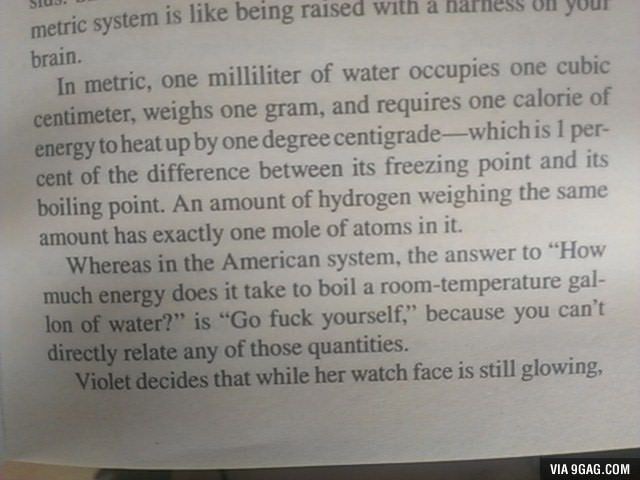
Metric is great for scientists in a lab with equipment to measure things.
Imperial was created during a time when peasants in the middle of nowhere needed to measure something “close enough” to trade with others, even without tools or measuring equipment, which was only owned by scribes and other members of the nobility.
This is why all imperial length measurements relate to parts of the body and why all volume and weight measurements relate to containers that were commonly used to store the thing you’re measuring (a bushel of grain, for example).
Also, a foot can be divided equally into 2, 3, 4, or 6 equally-sized pieces without resorting to estimation or irrational numbers; a meter cannot.
The US agreed to switch to the metric system centuries ago, but the ship carrying the official units sank on the way over.
What? Of course you ca split a METER into smaller pieces.
500, 330, 250 and 115mm
Easy as a pie.
And no one is its right mind is actually using thirds. There is no way you can actually use thirds in anything but as an approximation
That’s why duodecimal is superior to decimal.
Instead of converting to metric, we should convert our entire numerical system to be base 12.
Metric is just as great for everyday life as imperial units.
While I agree in principle, I also enjoy the chaos that imperial system causes when you try adding up 1 1/8 inches + 5 27/32 inches + 7 3/16 inches instead of just using decimal numbers.
Edited for clarity
This is what the metricians say to feel better about themselves, but they never mean it.
“Oh yes, I’ll have a 236.588 milliliters of tea, thank you for offering”
“The kids are out playing in the back 0.914 meters”
“Doctor, I think I broke my left 30.48 centimeters”
Do you see how silly you would sound if you didn’t use imperial?
I was co confused until I got the joke lol
That’s easy, 14 5/32
(Yes, I did it in my head. Yes, I am chaos)
Thank you, Chaos :)
a murmur rises from the deep…
“you’re welcome”
1/8 = 4/32
3/16 = 6/32
4 + 6 + 27 = 37
37/32 = 1 5/32
1 + 5 + 7 + 1 = 14
Total: 14 5/32
I wouldn’t call it chaos, it’s a straightforward algorithm:
This works for every measurement because the denominator is always a power of 2.
With that said I absolutely prefer metric.
In practice you would just use decimal inches. Doesn’t really make it better but you can machine something without ever seeing a fraction if you want to since everything will be in thousandths of an inch.
Decimal inches?

most electronics breadboards and the pins from (non-tiny) microchips / ICs are spaced at 2.54mm apart, which i eventually realised is a tenth of an inch.
hey none of that mathematics witchery here dude. we guesstimate or we do nothing (and i’m too tired to guess)
Maybe in your particular industry, but I reckon most people using imperial units aren’t using measuring devices with decimal inches or needing the precision of .0001"
Chaos? Just normalize to a denominator of 32 and it’s simple
A denominator of 1 makes it even simpler
Or normalize to something sane and use mm
Having done my share of automotive and carpentry work, I’ve never in my life had to go down to 64ths. 32nds is the smallest fraction I’ve ever had to use and the amount of times I’ve had to get that small could probably be counted on one hand.
Are you saying adding 8ths, 16ths and 32nds is trivial and having 64th in my example made it unrealistic?
I’m saying that if you knew what you were talking about you wouldn’t be working in 64ths in the first place. You picked 64ths because “hurr sure Americans dumb” and you know it.
I picked 64 because I don’t use imperial and I have no sense of scalw what makes sense as a fraction unit. A bit paranoid, aren’t you?
Exactly
Nope, just sick of arrogant Europeans acting like they’re experts on shit they don’t have the first clue about.
You come to a thread where people throw light hearted banter about each others’ measuring systems and you feel attacked by arrogant europeans. Sounds a lot like paranoia. Chill.
In US machine shops if they’re getting down to that level of measurement, they’ll switch over to milli-inches.
Yes, milli-inches are an actual unit in use.
Why don’t they use 1024ths? Gotta commit to the bit if you wanna be taken seriously.
Yes, machine shop use thousandths, but 99.9% of the population will never do that.
If someone were adding those figures they would switch to decimal. I built furniture for 2 years, 64ths are almost never used over thousands of an inch. If you need to be finer than 32nds you use thou. And that pretty much only for wood. Machine shop I worked in used thou exclusively.
Which is called a “mil”, a name that has never caused confusion
Is it really? That’s really interesting, and would cause a lot of confusion in metric-English countries where ‘mil’ is pejoratively used in speech to either mean ‘millimetre’ or ‘millilitre’ depending on context.
pejoratively ≠ casually
It causes confusion in the US too, because, despite popular misconceptions, we do in fact use both systems.
While in theory it is like that, I as a non english speaker have come across people trying to add up inch fractions more time than I remember.
Wheeeeeeee fractions!
But after multiplying, 8 + 54 + 3 over 64 is just clean fun, you end up with 14 1/64 inches and wanna die because you accidentally cut the material at 14 inches and now your whole day is ruined.
I’m using some pvc to build a prototype and the percentage of it that turns to microplastic so I can get precise sizing is terrifying. But I’ma use the chop saw we got instead of buying new, larger pvc scissors
The last bit of rationalizing is hilarious. It’s like you don’t even understand numbers or math, well what am I saying, you’re an American
We can figure out what 70% of a meter is.
Good luck with your peasant system
Its crazy how many people upvoted this comment. Didn’t realize there was so much anti-american sentiment on this platform. I get the government is shit, but insulting the general population just kinda makes you out as an ass.
It’s not anti-American sentiment, it’s anti-anti-intellectualism.
Stay in school.
This you?
“Stay in school”, you’re such an ass lol
Metric allows you to convert between length volume and mass in your head. Someone smarter than me could probably take a reasonable estimate of how long a kettle will take to boil just by knowing it’s wattage and estimating its volume.
You’re right that “pounds” may have e been a practical measurement back when people didn’t have calibrated and everyone’s hand weighed a pound. However, that advantage ceased once everyone standardised those measurements.
A metre is equally divisible by 50, 25, 20, 10, 5, and 2. There arr numerous advantages to a base 10 system.
“Decimalized currency is great for all those labcoats, but for us regular ol’ normal folk, it’s much easier to use real, easily divisible livres, which can be divided into 20 sous and subsequently into 12 deniers.”
“In fact, imperial is so great because duodecimal invites so much divisibility! What’s that? You’re saying it goes 12 –> 3 –> 1760 for length, 16 –> 2000 for units of mass, that units of volume are a bastardized base-2 system where there isn’t even a consistent multiple between units, and that pounds and short tons aren’t cleanly divisible by 3? And that not a single unit of volume is divisible by 3 unless you bring it down to the level of teaspoons?”
“‘Why not just switch to a fully duodecimal system if divisibility is so important to you’, you ask? Well fuck you, a foot is about as long specifically as my forearm, and there’s no way my poor, emaciated monkey brain would ever have found something similar to latch onto with SI units. Those people living in most of the rest of the world probably just carry meter sticks around up their asses. ‘How many square inches is a 30 x 30-foot room?’, you ask? Well fuck you again.”
I hate imperial. But I do think it would be neat if we had also changed our common numeral system to base 12 when making metric. Dividing by 3 and 4 is WAY more common than dividing by 5.
But no way that would happen unless we had a massive linguistic shift occur as well. Base 10 is too rooted in our culture.
But then my crusade for metric time would seem silly
FWIW,
wp:Duodecimal#Advocacy and “dozenalism”
Ftfy

Jesse, what the fuck are you talking about?
I thought I was clowning on a tired Gish gallop of flimsy, ad hoc justifications for imperial/US customary.Any concerns over anything I said in particular?Edit: He can’t keep getting away with it!
No… I was just joking
https://knowyourmeme.com/memes/jesse-what-the-fuck-are-you-talking-about
The best part is that Walter White, as a science teacher, would probably agree.
Oooh. I misread that as “Jesus”. LMAO
Every country used a system based off body parts or similarly easy-to-measure parts. When the metric system was invented, most of them switched because it was the logic thing to do. Some just decided that the dumb system was better who knows why.
Spain adopted the metric system in 1852 and by the time, they weren’t the most advanced country.
perhaps when the u.s. finally reaches the level of 1852 spain, americans will switch too.
Chat when was the siesta invented
What do you mean you can not divide a meter without estimations or irrational numbers? Do you mean fractions or decimal? 1m/3=3.33… dm ( repeating, which means it is a rational fraction)
Anyone who thinks you can divide one number by another and get an irrational number… doesn’t know what irrational means.
Irrational numbers are ones with the square root of negative 1 as a factor, right?
Irrational numbers don’t have a predictable pattern to them. Think pi.
irrational numbers are numbers which are not a ratio of integers
complex numbers, often called “imaginary” numbers, are ones with components of unit i =√-1
Aside: mostly, but complex numbers are an addition of both a real number and an imaginary number: a + bi. It just happens that a can be 0, making it a strictly irrational number when b ≠ 0.
Thus, the imaginary numbers are a strict subset of the complex numbers.
Also, US Customary units share many of the same terms as Imperial, but the actual quantities differ.
Even more fun is that US customary units are explicitly defined by their metric equivalents. So the US is using metric whether they like it or not, they just slap pointless conversion factors on top.
And it’s been this way since 1893. The US customary system has been sneaky metric that whole time.
In imperial, pounds can be either a mass or a force, or context dependent, or a slug might be the unit for mass derived from the pound force. The foot pound force is a unit for energy.
Honestly the system shouldn’t exist.