Hot take: the best temperature scale would have 0º be water freeze point and 100º be human body temp. Fahrenheit is already supposed to be that but nobody gives a shit about a saline solution freeze point and they fucked up the human body temp.
I propose the body temperature of an average opossum as the fixed point for 100 because they are cute as heck. We shall call this unit Possigrade. And anything above 100 Possigrade should be called the ‘rabies zone’ and 0 Possigrade should correspond to 8°C, as this feels very cold when dressed inappropriately. In addition, there is now the Bakers Possigrade, where 100 corresponds to 27°C, as this is the temperature at which sourdough bread rises by about ⅓ in 5.5 hours.
But seriously: Celsius is fine. On Earth, we are primarily interested in water at atmospheric pressure. Too many things contain water (pipes, food, paint, etc) and they react differently at 0 °C than at 4 °C. For this reason, we deliberately avoid using water in applications that are regularly exposed to sub-zero temperatures. Water is simply everywhere, so 0 °C and 100 °C are important tipping points for general use.
Celsius is great for engineering because Things Happen™️ when water starts boiling or freezing. But most people aren’t engineering daily. Cooking temps generally dont require much precision and there are too many niche break points to easily factor: safe meat temps, refrigeration temps, oil smoke points, Maillard reaction, etc… Our chefs are basically screwed no matter what.
That leaves measuring weather as the most universal daily application. Celsius is not great because the temp outside your door is going to be between mid -20º and mid 40º. It’s nice to have water freezing at 0º (snow, frost, ice) but thats the only interesting break point. You could just as easily set 100º to be the temperature of the sun and have the same daily experience.
Humans are endothermic, which means being somewhere hotter than us is Not Good™️. That would be very nice to set as a breaking point for weather purposes, but unfortunately the danger varies wildly with humidity/airflow/personal tempature regulation/hydration/etc… If we set the triple digit break to indicate an unsafe body temp then we at least can approximate the danger and get a little bonus medical utility.
Mean body temp varies slightly based on several factors:
So set 100º to be one standard deviation over and its perfect for daily use. Checkmate Celciusts
Celsius is great for engineering because Things Happen™️ when water starts boiling or freezing. But most people aren’t engineering daily.
I’d argue that it’s more covenient to use a common scale for all applications of the same measurement than to have multiple different scales, just because that would eliminate all conversion concerns. Someone I know is in engineering school has switched entirely to using °C simply because that’s what they deal with at school anyway, to the point they don’t even write °C anymore in casual chats.
For other applications, it seems like the scales we’re used to are more or less arbitrary anyway, so that’s really just a matter of getting used to it. Some are used to calling ~70°F room temperature, others say ~20°C,
So if it matters for one case, but not so much for others, and we were to pick a single scale, I should think it would be ideal to go with the case where it does matter.
Or we just keep doing this thing where people use what they’re used to and we just quickly look it up or someone comments with the conversion and move on with our lives.
Just joking around, but setting a scale is just a matter of fixing zero and choosing the size of your degree. So -50º would be halfway to absolute zero and 0º can be any reference point you want.
Perrsonally I set 100° Egg (or 100°E) to equal 180°F because that’s how much i want to heat my egg when i am making ice cream. Gets you a good, custardy base for your ice cream machine.
I would also accept °Icecreams or °Is as the units
zero would be 20°F because that is Ice Cream’s proper storage temperature.
Humans are endothermic, which means being somewhere hotter than us is Not Good™️.
Endothermic refers to the ability of the organism to regulate it’s temperature, not just the ability to generate heat, but also to cool itself down. We humans are so good at it, that we can literally just jog prey down in hot environments and pretty much all animals will overheat before we do.
Hell, in my apartment there’s a room especially for making it very hot and humid. Even above 100c, and I still don’t boil. Weird, huh?
cooking temps generally don’t require much prevision
Hell, in my apartment there’s a room especially for making it very hot and humid. Even above 100c, and I still don’t boil. Weird, huh?
And I bet that room has its own thermostat, fuel, and doesn’t reach that temperature without human input. How often is the average human stepping into a sauna that it needs to be considered on a common use scale? The hottest recorded temperature on earth is 56°C, why would our daily scale need to be pegged 78% higher than that?
Endothermic refers to the ability of the organism to regulate it’s temperature, not just the ability to generate heat
Exactly! So we have 8.3 billion self-adjusting thermostats set to [nearly] the same target no matter their environment. Unlike the freezing temp, water’s boiling point can vary wildly on Earth. If I forget to check the altitude I could mistakenly think my boiling teapot is at 100°C instead of 68°C.
Home cooking usually depends way more on your ingredients and the quirks of your appliances than your target temp. Maybe your kitchen is a little more humid today and this batch of cookies is more chewy than yesterday. That’s why many recipes give hints on target texture or look (crispy, soft, golden brown…). But yes if you want a very specific outcome you’ll care much more about temp accuracy.
And I bet that room has its own thermostat, fuel, and doesn’t reach that temperature without human input.
I don’t manage to see your point. If the point is “you can’t live in places which are hotter the average body temp”, then should I point you towards Australasia? Also, in my last apartment, I didn’t have a sauna, but I did have a kitchen that was constantly above 40 and topped out my 52c meter in my kitchen.
considered on a common use scale?
Only an American things measuring things in average horse blood temperature vs when water boils at sealevel is a “common use scale”.
A “common” use scale for you less metrically abled; “fucking freezing”, “freezing”, “cold”, “cool”, “okay”, “a bit warm” “too hot” “fucking scorching”.
The hottest recorded temperature on earth is 56°C
You mean the hottest ambient temperature measured not from direct sunlight. Yeah, maybe. Still a bit more than our body temp, no?
water’s boiling point can vary wildly on Earth.
Yeah, but 100c doesn’t. It’s always the temperature at which pure water boils at sea level.
If I forget to check the altitude I could mistakenly think my boiling teapot is at 100°C instead of 68°C.
Sure yeah, you sound like a guy who might have a problem like that. Luckily for you, kettles don’t actually have thermostats set to 100c. They shut off when the water is boiling, despite the temperature. So people like you have been accounted for, rest assured. Nor will you be needing to make any thermometers either.
quirks of your appliances
So you microwave shit and then think temp doesn’t matter? I don’t really “appliances”. Is a grater an appliance? A manual one? Knives a few pans, ingredients. Thermometer. Perhaps if you’ve actually been doing a dish for 20 years perfectly you can forget about but it but it’s an absolute must for most kitchen professionals; good measuring instruments. A scale and a thermometer, mainly. Don’t really need anything else. Don’t even need that to cook, obviously. But because of the “quirks of your appliance”, you probe your meat, to meet the right temp. Damn I made myself hungry. Well I got some moose in the freezer.
That’s why many recipes give hints on target texture or look (crispy, soft, golden brown…). But yes if you want a very specific
What’s way more important in cooking is actually the measuring than thinking you can just throw it together and wait until it turns whatever the description wants. If you want it good, you’ll measure it to the gram and use the correct temp. Which is a bit above our body temp again, but guess “cooking” isn’t included in “common use scale”?
☝️😬 Metric-stans when you suggest a theoretical tweak to Centigrade that makes it align closer with human-scale temps while preserving the decimal nature.
My main point is that we spend 90% of our lives wandering around in a fairly narrow range of temperatures. Every day we care about how we should dress or what precipitation to expect or what the high/low might be overnight or checking our apartment thermostat…
The general population only spends a fraction of that time caring about the temperature of anything else (look at a recipe->plug in the baking temp->move on). In a universe where we spent all our time measuring astrological bodies I would probably be arguing for the scale to be normalized around 100ºSol.
I boil water probably 2x per day and I have never once cared about the actual temperature of that reaction. If I dunk my hand in water at 85ºC or 99ºC its gonna hurt like fuck either way. A scale based around horse blood would probably be more tangible because I can actually tell when the mammal blood in my meat-sack body is feeling a few degrees cold/warm.
Stapling a scale solely to pure, scientific, idealized, elemental reactions is silly Enlightenment dogma. Unless we plan on using my theoretical scale for millions of years of human evolution, average body temp is nearly as constant.
So you just never cook anything? Because if you cook, your scale is longer. You have to heat your oven to 350+ degrees, whereas I’m just putting it to 180. So the scale is actually “aligned closer with human-scale temps” whatever your brainfart can be interpreted to mean.
we spend 90% of our lives wandering around in a fairly narrow range of temperatures
You do. You. Just like you think your brainfart is in anyway an improvement instead of just silly rambling without any sense whatsoever.
I have never once cared about the actual temperature of that reaction
Because you don’t live in Peru or the bottom of the sea, so you don’t have to, because you know it’s always pretty much exactly 100 for you.
A person with a stroke could’ve written your comment and it would be none the better.
Not one of your arguments holds any water; Centrigrade is a smaller scale, and a more logical one. Standing naked outside, most people would have a fairly good guess on when it’s near or below 0c. Or as English actually says “freezing.” You couldn’t even tell 0 degrees Fahrenheit. Literally most people in the world have never even experienced such a temperature. I have. I’ve also experienced -40 (where they meet.)
How many days a year do you spend in 0f?
Because in my country being below zero is more common than not. Both C and F, moreso C though, as “it’s closer to a human scale”.
So F is wider, cooking temps are double that of anything in double digits, no-one can even tell where 0f is and 100f is very much not close to the warmest things we handle in our daily lives.
0-100c is quite simple. Over or under, don’t touch with bare skin. (For non cooks stay below 60c though or you’ll burn yourself)
But I don’t need to argue. The works decided long ago.
Lmao no disrespect intended but I hope you take a break for some self care, we’re on a meme post and I’m pitching a hypothetical temperature scale that will see zero implementation or adoption ever. I think it’s fun to play with and debate but there’s no need to get heated about it
Iv always found Celsius makes way better sense for material tempature and Fahrenheit for the weather.
Celsius is no where near granular enough for the weather not by a fucking long shot.
I rather use the arbitrary jacket scale and shorts scale then Celsius for weather.
Is it jacket weather or shorts weather are the only two criteria. And it varies person to person and has zero ability to be translated between people. Yet everyone understands it natively and intuitively anyways.
We do not know because Fahrenheit didn’t document it, and i wouldn’t be surprised if he didn’t keep track of it through his test runs either. He didn’t say which salt and how much of it in how much water, no purity indication, no nothing. He was a craftsman, not a chemist and made the scale to sell his, I concede, at the time superior thermometers. He basically vibe coded a scale in the 1700s.
But that’s all just hogwash, Fahrenheit today is literally defined through Celsius, so the US uses a metric scale but with a factor and an offset they pulled out of their ass to make it more rollercoaster like the rest of the units they like. The same as pretty much every unit they use: inch is defined through meters, pound via kilogram, just butchered for the vibes of yore. Good for them.
Fahrenheit today is literally defined through Celsius
The same as pretty much every unit they use
At this point, that’s basically every unit other than the seven fundamental units. Degrees Celsius is defined from the fundamental unit Kelvin.
Plus the actual definitions of those fundamental units were defined based on historical measurements tied to former definitions. Today the second is defined around the frequency of the cesium-133 atom, but it was traditionally measured as 1/(60 x 60 x 24) of the time of a single rotation of the earth, which stopped serving us when we realized the rotations had too much variation between days. The meter is currently defined around the speed of light and the second, but was previously defined in terms of what they thought the Earth’s circumference was, and then a metal bar they kept in Paris, then based on the wavelength of light emitted from a transition in krypton-86. Same with the kilogram, currently kept at Planck’s constant but previously based on a particular chunk of metal that was mysteriously losing mass over time, and before that defined from the density of 4°C water and the definition of the meter.
Conventions are important. The history of how we got to particular conventions can often be messy.
The same reason why the British still use miles and stone. For some other archaic units still commonly used see horsepower, nautical mile, BTUs, acres, shots (volume), and knots (speed).
Most people use the units they grew up with or use every day as their primary colloquial units. If you grew up using inch, foot, or yard, and enough people around you can also use the unit, it doesn’t change anything in your day to day to continue to use them. It also doesn’t make sense to change what you use and already know if that is also what the people around you use and already know.
That said, Americans do know metric units and many use them every day, they just don’t typically use them when talking to other Americans. If the basis of your argument is US produced media then it just goes to show you don’t really know anything about everyday US culture. Also, why would US media, made for a US audience, with US characters use a unit that most Americans don’t colloquially use?
Complaining about US media containing Imperial Units is like if I watch a Spanish movie and complain about people speaking Spanish instead of English.
I think I see what you’re getting at, but you could just memorize 40, 35, or even 30 as “watch out, pretty close to human body temperature”. Three anchors in the scale beats two.


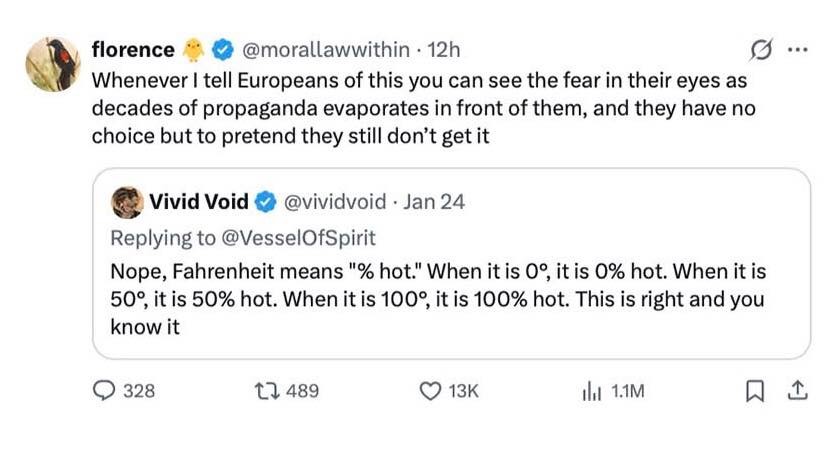
Hot take: the best temperature scale would have 0º be water freeze point and 100º be human body temp. Fahrenheit is already supposed to be that but nobody gives a shit about a saline solution freeze point and they fucked up the human body temp.
I propose the body temperature of an average opossum as the fixed point for 100 because they are cute as heck. We shall call this unit Possigrade. And anything above 100 Possigrade should be called the ‘rabies zone’ and 0 Possigrade should correspond to 8°C, as this feels very cold when dressed inappropriately. In addition, there is now the Bakers Possigrade, where 100 corresponds to 27°C, as this is the temperature at which sourdough bread rises by about ⅓ in 5.5 hours.
But seriously: Celsius is fine. On Earth, we are primarily interested in water at atmospheric pressure. Too many things contain water (pipes, food, paint, etc) and they react differently at 0 °C than at 4 °C. For this reason, we deliberately avoid using water in applications that are regularly exposed to sub-zero temperatures. Water is simply everywhere, so 0 °C and 100 °C are important tipping points for general use.
Celsius is great for engineering because Things Happen™️ when water starts boiling or freezing. But most people aren’t engineering daily. Cooking temps generally dont require much precision and there are too many niche break points to easily factor: safe meat temps, refrigeration temps, oil smoke points, Maillard reaction, etc… Our chefs are basically screwed no matter what.
That leaves measuring weather as the most universal daily application. Celsius is not great because the temp outside your door is going to be between mid -20º and mid 40º. It’s nice to have water freezing at 0º (snow, frost, ice) but thats the only interesting break point. You could just as easily set 100º to be the temperature of the sun and have the same daily experience.
Humans are endothermic, which means being somewhere hotter than us is Not Good™️. That would be very nice to set as a breaking point for weather purposes, but unfortunately the danger varies wildly with humidity/airflow/personal tempature regulation/hydration/etc… If we set the triple digit break to indicate an unsafe body temp then we at least can approximate the danger and get a little bonus medical utility.
Mean body temp varies slightly based on several factors:
So set 100º to be one standard deviation over and its perfect for daily use. Checkmate Celciusts
I’d argue that it’s more covenient to use a common scale for all applications of the same measurement than to have multiple different scales, just because that would eliminate all conversion concerns. Someone I know is in engineering school has switched entirely to using °C simply because that’s what they deal with at school anyway, to the point they don’t even write °C anymore in casual chats.
For other applications, it seems like the scales we’re used to are more or less arbitrary anyway, so that’s really just a matter of getting used to it. Some are used to calling ~70°F room temperature, others say ~20°C,
So if it matters for one case, but not so much for others, and we were to pick a single scale, I should think it would be ideal to go with the case where it does matter.
Or we just keep doing this thing where people use what they’re used to and we just quickly look it up or someone comments with the conversion and move on with our lives.
I’ll agree to a single universal scale but only on the condition that -100º=0ºK
K doesn’t use the ° symbol ;)
And the increments of kelvin are the same as Celsius, they’re just at different points, where at 0K absolutely nothing is a gas or a liquid.
(Trying to decipher it right but you’re suggesting 0K be renamed -100°??
My bad, don’t use Kelvin all that often 😂
Just joking around, but setting a scale is just a matter of fixing zero and choosing the size of your degree. So -50º would be halfway to absolute zero and 0º can be any reference point you want.
Perrsonally I set 100° Egg (or 100°E) to equal 180°F because that’s how much i want to heat my egg when i am making ice cream. Gets you a good, custardy base for your ice cream machine.
I would also accept °Icecreams or °Is as the units
zero would be 20°F because that is Ice Cream’s proper storage temperature.
edit: yeah i think we’re going with °Is
Endothermic refers to the ability of the organism to regulate it’s temperature, not just the ability to generate heat, but also to cool itself down. We humans are so good at it, that we can literally just jog prey down in hot environments and pretty much all animals will overheat before we do.
Hell, in my apartment there’s a room especially for making it very hot and humid. Even above 100c, and I still don’t boil. Weird, huh?
Alright. Sure. Yeah. Why not. /s
And I bet that room has its own thermostat, fuel, and doesn’t reach that temperature without human input. How often is the average human stepping into a sauna that it needs to be considered on a common use scale? The hottest recorded temperature on earth is 56°C, why would our daily scale need to be pegged 78% higher than that?
Exactly! So we have 8.3 billion self-adjusting thermostats set to [nearly] the same target no matter their environment. Unlike the freezing temp, water’s boiling point can vary wildly on Earth. If I forget to check the altitude I could mistakenly think my boiling teapot is at 100°C instead of 68°C.
Home cooking usually depends way more on your ingredients and the quirks of your appliances than your target temp. Maybe your kitchen is a little more humid today and this batch of cookies is more chewy than yesterday. That’s why many recipes give hints on target texture or look (crispy, soft, golden brown…). But yes if you want a very specific outcome you’ll care much more about temp accuracy.
I don’t manage to see your point. If the point is “you can’t live in places which are hotter the average body temp”, then should I point you towards Australasia? Also, in my last apartment, I didn’t have a sauna, but I did have a kitchen that was constantly above 40 and topped out my 52c meter in my kitchen.
Only an American things measuring things in average horse blood temperature vs when water boils at sealevel is a “common use scale”.
A “common” use scale for you less metrically abled; “fucking freezing”, “freezing”, “cold”, “cool”, “okay”, “a bit warm” “too hot” “fucking scorching”.
You mean the hottest ambient temperature measured not from direct sunlight. Yeah, maybe. Still a bit more than our body temp, no?
Yeah, but 100c doesn’t. It’s always the temperature at which pure water boils at sea level.
Sure yeah, you sound like a guy who might have a problem like that. Luckily for you, kettles don’t actually have thermostats set to 100c. They shut off when the water is boiling, despite the temperature. So people like you have been accounted for, rest assured. Nor will you be needing to make any thermometers either.
So you microwave shit and then think temp doesn’t matter? I don’t really “appliances”. Is a grater an appliance? A manual one? Knives a few pans, ingredients. Thermometer. Perhaps if you’ve actually been doing a dish for 20 years perfectly you can forget about but it but it’s an absolute must for most kitchen professionals; good measuring instruments. A scale and a thermometer, mainly. Don’t really need anything else. Don’t even need that to cook, obviously. But because of the “quirks of your appliance”, you probe your meat, to meet the right temp. Damn I made myself hungry. Well I got some moose in the freezer.
What’s way more important in cooking is actually the measuring than thinking you can just throw it together and wait until it turns whatever the description wants. If you want it good, you’ll measure it to the gram and use the correct temp. Which is a bit above our body temp again, but guess “cooking” isn’t included in “common use scale”?
☝️😬 Metric-stans when you suggest a theoretical tweak to Centigrade that makes it align closer with human-scale temps while preserving the decimal nature.
My main point is that we spend 90% of our lives wandering around in a fairly narrow range of temperatures. Every day we care about how we should dress or what precipitation to expect or what the high/low might be overnight or checking our apartment thermostat…
The general population only spends a fraction of that time caring about the temperature of anything else (look at a recipe->plug in the baking temp->move on). In a universe where we spent all our time measuring astrological bodies I would probably be arguing for the scale to be normalized around 100ºSol.
I boil water probably 2x per day and I have never once cared about the actual temperature of that reaction. If I dunk my hand in water at 85ºC or 99ºC its gonna hurt like fuck either way. A scale based around horse blood would probably be more tangible because I can actually tell when the mammal blood in my meat-sack body is feeling a few degrees cold/warm.
Stapling a scale solely to pure, scientific, idealized, elemental reactions is silly Enlightenment dogma. Unless we plan on using my theoretical scale for millions of years of human evolution, average body temp is nearly as constant.
So you just never cook anything? Because if you cook, your scale is longer. You have to heat your oven to 350+ degrees, whereas I’m just putting it to 180. So the scale is actually “aligned closer with human-scale temps” whatever your brainfart can be interpreted to mean.
You do. You. Just like you think your brainfart is in anyway an improvement instead of just silly rambling without any sense whatsoever.
Because you don’t live in Peru or the bottom of the sea, so you don’t have to, because you know it’s always pretty much exactly 100 for you.
A person with a stroke could’ve written your comment and it would be none the better.
Not one of your arguments holds any water; Centrigrade is a smaller scale, and a more logical one. Standing naked outside, most people would have a fairly good guess on when it’s near or below 0c. Or as English actually says “freezing.” You couldn’t even tell 0 degrees Fahrenheit. Literally most people in the world have never even experienced such a temperature. I have. I’ve also experienced -40 (where they meet.)
How many days a year do you spend in 0f?
Because in my country being below zero is more common than not. Both C and F, moreso C though, as “it’s closer to a human scale”.
So F is wider, cooking temps are double that of anything in double digits, no-one can even tell where 0f is and 100f is very much not close to the warmest things we handle in our daily lives.
0-100c is quite simple. Over or under, don’t touch with bare skin. (For non cooks stay below 60c though or you’ll burn yourself)
But I don’t need to argue. The works decided long ago.
Lmao no disrespect intended but I hope you take a break for some self care, we’re on a meme post and I’m pitching a hypothetical temperature scale that will see zero implementation or adoption ever. I think it’s fun to play with and debate but there’s no need to get heated about it
Give one reason why we should use a different system for daily life when we already have a great system for engineering.
You are just making things more complex just to support a system you learned when you were a child when it is completely unnecessary.
Iv always found Celsius makes way better sense for material tempature and Fahrenheit for the weather.
Celsius is no where near granular enough for the weather not by a fucking long shot.
I rather use the arbitrary jacket scale and shorts scale then Celsius for weather.
Is it jacket weather or shorts weather are the only two criteria. And it varies person to person and has zero ability to be translated between people. Yet everyone understands it natively and intuitively anyways.
Celcius is plenty of granular enough for science, why should it not be granular enough for something basic as the weather?
You do know that decimals exist, right?
0 °F is pretty close to the freezing point of salt water. So close I always wonder if that “saline solution” was just salt and water.
We do not know because Fahrenheit didn’t document it, and i wouldn’t be surprised if he didn’t keep track of it through his test runs either. He didn’t say which salt and how much of it in how much water, no purity indication, no nothing. He was a craftsman, not a chemist and made the scale to sell his, I concede, at the time superior thermometers. He basically vibe coded a scale in the 1700s.
But that’s all just hogwash, Fahrenheit today is literally defined through Celsius, so the US uses a metric scale but with a factor and an offset they pulled out of their ass to make it more rollercoaster like the rest of the units they like. The same as pretty much every unit they use: inch is defined through meters, pound via kilogram, just butchered for the vibes of yore. Good for them.
At this point, that’s basically every unit other than the seven fundamental units. Degrees Celsius is defined from the fundamental unit Kelvin.
Plus the actual definitions of those fundamental units were defined based on historical measurements tied to former definitions. Today the second is defined around the frequency of the cesium-133 atom, but it was traditionally measured as 1/(60 x 60 x 24) of the time of a single rotation of the earth, which stopped serving us when we realized the rotations had too much variation between days. The meter is currently defined around the speed of light and the second, but was previously defined in terms of what they thought the Earth’s circumference was, and then a metal bar they kept in Paris, then based on the wavelength of light emitted from a transition in krypton-86. Same with the kilogram, currently kept at Planck’s constant but previously based on a particular chunk of metal that was mysteriously losing mass over time, and before that defined from the density of 4°C water and the definition of the meter.
Conventions are important. The history of how we got to particular conventions can often be messy.
Shh, the non-American’s believe the US doesn’t understand metric at all and if you tell them otherwise they won’t be able to circle jerk.
If Americans actually understood metric, they wouldn’t be using a completely different system from the rest of the world in every media they produce.
Or do you think the rest of the world haven’t discovered your archaic system of temperature yet?
The same reason why the British still use miles and stone. For some other archaic units still commonly used see horsepower, nautical mile, BTUs, acres, shots (volume), and knots (speed).
Most people use the units they grew up with or use every day as their primary colloquial units. If you grew up using inch, foot, or yard, and enough people around you can also use the unit, it doesn’t change anything in your day to day to continue to use them. It also doesn’t make sense to change what you use and already know if that is also what the people around you use and already know.
That said, Americans do know metric units and many use them every day, they just don’t typically use them when talking to other Americans. If the basis of your argument is US produced media then it just goes to show you don’t really know anything about everyday US culture. Also, why would US media, made for a US audience, with US characters use a unit that most Americans don’t colloquially use?
Complaining about US media containing Imperial Units is like if I watch a Spanish movie and complain about people speaking Spanish instead of English.
i mean, we aren’t pure water we’re saline water. so we kinda should care about saline freeze point.
I think I see what you’re getting at, but you could just memorize 40, 35, or even 30 as “watch out, pretty close to human body temperature”. Three anchors in the scale beats two.