

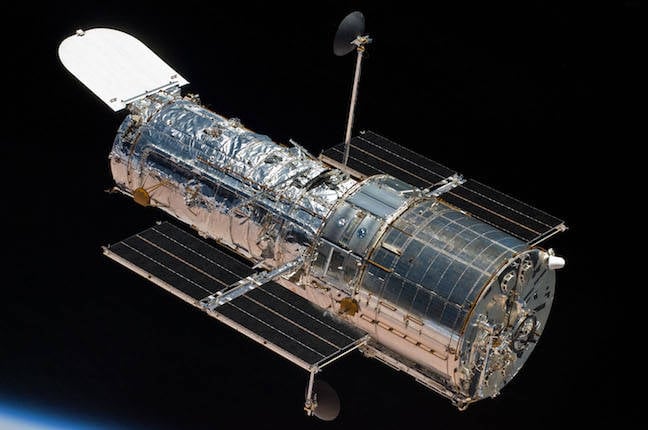
A newly released plot of the Hubble Space Telescope’s altitude shows just how quickly the observatory has descended in recent years.
The post on Bluesky by astronomer Jonathan McDowell is a stark reminder that Hubble is heading back to Earth, possibly sooner than previously thought, as its orbit decays.
Hubble was launched into low Earth orbit in 1990, carried in the payload bay of Space Shuttle Discovery. While it remains capable of pointing its instruments and has returned breathtaking imagery over more than three decades in orbit, it cannot raise its altitude.
Joke’s on you:
Kessler Syndrome’s coming WAAAY quicker than that, & EVERYTHING in low-earth-orbit’s getting smashed to smithereens, then…
( you can’t keep pumping thousands & thousands of minisats into LEO, losing many every week, & NOT keep stacking-odds for Kessler Syndrome, & the periodic weapons-tests done in orbit, like China’s or the US’s blowing-up of a satellite, to throw-around some “muscle”, anti-helps, too )
https://en.wikipedia.org/wiki/Kessler_syndrome
& what happens when 1 country needs suddenly to remove an enemy’s satnav constellation?
Oh, THAT activates Kessler Syndrome, right-then?
Well, then!
This-year, likely, isn’t it?
_ /\ _
Ugh, another Kessler Sydrome loon.
Go read the other user’s reply and then go touch grass. A lot of grass.
I’m not kidding. Roll in the grass, eat the grass, I don’t care. You just need to go outside and touch some grass because you’ve been cooped up inside for far too long
Because there is still a tenuous atmosphere at that altitude, LEO is actually somewhat self-cleaning, which is why so many satellites (including Hubble) will reenter relatively quickly unless regularly boosted, making Kessler Syndrome of low concern.
Kessler syndrome is a much more serious risk in MEO and GEO, where orbits can take decades to millenia to decay naturally.