Neat. It’s going to be interesting how they will solve the issue of different quality settings - I don’t care about FPS at “ultra” settings, usually it’s more important how the FPS are at low settings before you have to take desperate measures like turning down the resolution, completely turning off antialiasing, using upscaling etc. that have an extremely negative effect on graphics fidelity.
Also, two games running at an average of 60FPS might give very different experiences depending on how consistent the FPS are.
They may be able say something like “50% or users run the game at 30fps, 40% at 40fps” or something like that, where you can guess about different settings people are running at.
The biggest thing is just knowing whether it’s possible to run the game on your hardware at the minimum acceptable fps. If average fps for a steam deck game is 25, you know it doesn’t run well. If a significant number of deck users are able to average a higher fps than 30 (40-60), you know the deck can run it decently and you’ll have options besides running everything on the lowest setting.
I hope that it take in account the game versions, eg: they say that my hardware will make 60 fps in the 1.2 version, and then when the 1.3 came out they will make me know that it will run at 50 fps instead of telling me that the game will run at 120 fps because they take in account older version where the game had less laggy stuff
They’re gonna have to take into account for programs like lsfg-vk, Decky-framegen and others that increase frame rates. Easy to do on the deck though just ignore reports from games that have the programs launch option. Cant do that with my laptop though as lsfg-vk just grabs the process by name.
I suspect that will shake out with enough data. And I bet they can cross-estimate based on performance of various hardware configs across games too.
If they end up having a message on some games that says “not enough data yet.” Or similar, you’ll know they need a good sized volume to extrapolate average performance.
I’m sure they have considered all of this and the estimates will be conservative and rages/performance windows, not “we estimate this title will run at 47.5 fps on your rig.”


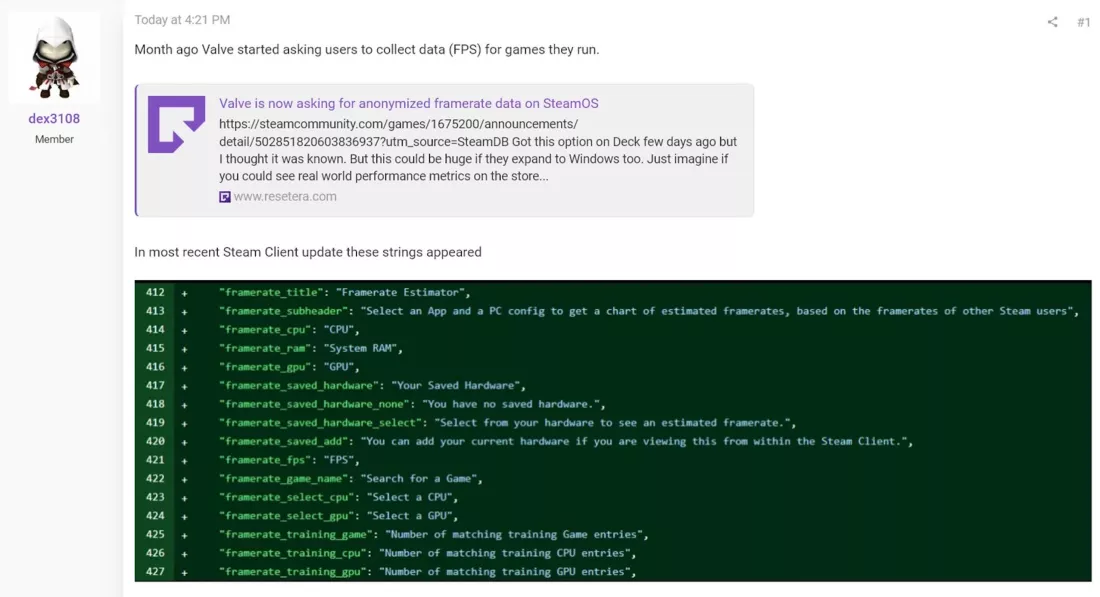

Neat. It’s going to be interesting how they will solve the issue of different quality settings - I don’t care about FPS at “ultra” settings, usually it’s more important how the FPS are at low settings before you have to take desperate measures like turning down the resolution, completely turning off antialiasing, using upscaling etc. that have an extremely negative effect on graphics fidelity.
Also, two games running at an average of 60FPS might give very different experiences depending on how consistent the FPS are.
They may be able say something like “50% or users run the game at 30fps, 40% at 40fps” or something like that, where you can guess about different settings people are running at.
The biggest thing is just knowing whether it’s possible to run the game on your hardware at the minimum acceptable fps. If average fps for a steam deck game is 25, you know it doesn’t run well. If a significant number of deck users are able to average a higher fps than 30 (40-60), you know the deck can run it decently and you’ll have options besides running everything on the lowest setting.
Yeah but the Deck will be really interesting for this, since I play most of my games at 30fps with 7TDP when the Deck could perform better.
I guess, people doing what I do should not be taken into account…
Accounting for patches will also be interesting, especially for newer games that are still working their way towards a decent state.
I hope that it take in account the game versions, eg: they say that my hardware will make 60 fps in the 1.2 version, and then when the 1.3 came out they will make me know that it will run at 50 fps instead of telling me that the game will run at 120 fps because they take in account older version where the game had less laggy stuff
They’re gonna have to take into account for programs like lsfg-vk, Decky-framegen and others that increase frame rates. Easy to do on the deck though just ignore reports from games that have the programs launch option. Cant do that with my laptop though as lsfg-vk just grabs the process by name.
Thinking about it, they’ll probably use a law of large numbers and average out similar specs.
It will probably reveal which crowd is bigger: the high frame rate crowd or the high quality crowd.
I suspect that will shake out with enough data. And I bet they can cross-estimate based on performance of various hardware configs across games too.
If they end up having a message on some games that says “not enough data yet.” Or similar, you’ll know they need a good sized volume to extrapolate average performance.
I’m sure they have considered all of this and the estimates will be conservative and rages/performance windows, not “we estimate this title will run at 47.5 fps on your rig.”
Frame generation is surely on their mind too.