I started elecyrolysis on my face a while ago and my electrologist said that cis men are the biggest babies about the pain. Me laying there getting two hours of electro on my face every week and dudes tapping out after two or three hairs lol.
My theory is that people who have had to deal with neither menstrual cramps (let alone childbirth) nor the various trials of gender affirming treatments are a lot less likely to have had extensive periods of just having to deal with pain for a long time. Like, maybe they’ve had some injuries, or other brief episodes, but unless they have some other condition like chronic migraines, I think a lot of able-bodied cis men haven’t had to regularly sit with pain and just deal with it.
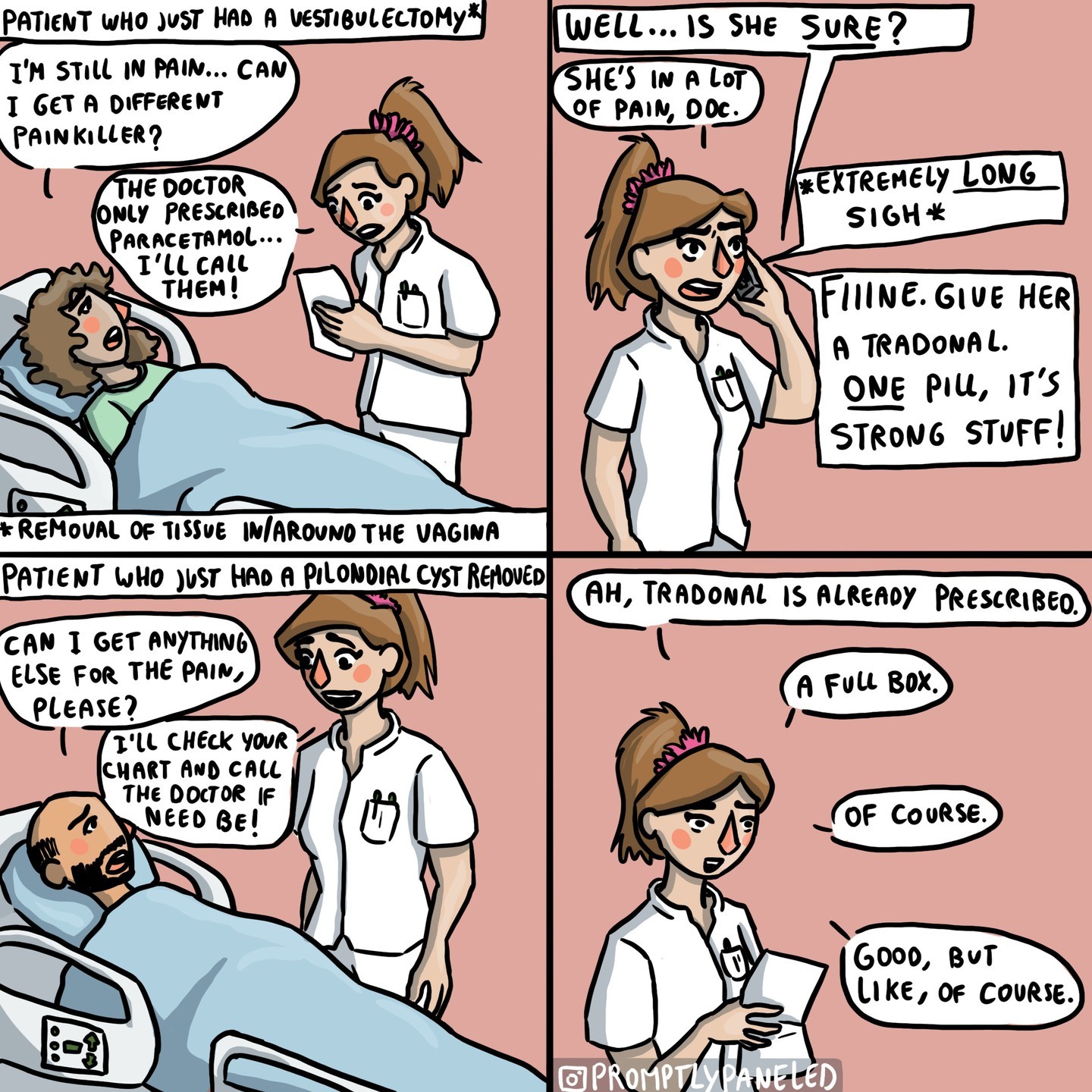
It’s understandable that this would happen, but extremely frustrating when somehow that becomes the default cultural view and condescending cis men in positions of power get to smugly decide that they’re manly men with great pain tolerance and anyone who complains about pain is surely just being a baby/whiny hysterical woman.
(There is also absolutely a racialized component here where Black and brown folks tend to receive fewer painkillers, which this doesn’t really account for, but this is not meant to be a comprehensive explanation of disparities in pain management in health care, just my theorizing why cis men on average seem to have lower rates of pain tolerance.)
I had a TENs machine. I also have endometriosis (after suffering for over 20 years found a surgeon willing to do surgery, gods bless her for giving me a chance to live). When I was still with my ex I used it as a simulator to try to show him what my pain felt like. He was on the floor screaming and couldn’t straighten his legs or stand up because of the pain and I was just standing there chilling and hadn’t even hit the lowest threshold of my normal everyday pain limit, let alone the pain I felt when I had my period. I was like now do you understand why I’m exhausted and depressed all the time and hate my life?
There is a portion of the population for whom fairly intense pain is not a “when that happened to me” but a “when that happens to me” and it just really results in developing a pain tolerance skill that I don’t think those for whom pain is understood as the occasional discrete injury really get. There are conditions that can cause that to happen to cis men, but it’s less common than for, uh, the entire rest of the population, and so fewer of them have had to develop that skill.
(Also, really glad you were finally able to get the surgery to help!)
I see that come up a lot with tattoo artists. Apparently their clients who are men tend to struggle with the pain of it and on the flip side the women tend to be more tolerant.
I know I’ve fallen asleep during certain tattoos, and while I did have one hurt quite a lot (in a well known place for pain) I just remember thinking oh wow this one is a doozy but I didn’t do anything outwardly about it.
My husband on the other hand straight up passes out from the pain. He didn’t believe me when I said I fell asleep for some of my tattoos so on my next tattoo I wore a heart rate monitor and he was in disbelief when I averaged about 50bpm through the whole thing.
There could also be selection effects at work, with regard to who gets tattoos and for what reason.
I knew a woman who had fibromyalgia and she used to get tattoos all the time. She said the tattoos helped with her fibro pain. Pain is weird, that’s all I can say about that!
Woo! Sensory overload! Intense, direct pain in a localized area helps to drown out widespread, decentralized pain.
Basically, one can focus on that one pain and prevent the brain from processing the fact that other parts of the body are also sending signals of pain, allowing one the illusion of momentary relief of that pain.
Also known as “diffuse noxious inhibitory control” or “conditioned pain modulation”.
The human brain is just a meat computer and it can be hacked.


I started elecyrolysis on my face a while ago and my electrologist said that cis men are the biggest babies about the pain. Me laying there getting two hours of electro on my face every week and dudes tapping out after two or three hairs lol.
My theory is that people who have had to deal with neither menstrual cramps (let alone childbirth) nor the various trials of gender affirming treatments are a lot less likely to have had extensive periods of just having to deal with pain for a long time. Like, maybe they’ve had some injuries, or other brief episodes, but unless they have some other condition like chronic migraines, I think a lot of able-bodied cis men haven’t had to regularly sit with pain and just deal with it.
It’s understandable that this would happen, but extremely frustrating when somehow that becomes the default cultural view and condescending cis men in positions of power get to smugly decide that they’re manly men with great pain tolerance and anyone who complains about pain is surely just being a baby/whiny hysterical woman.
(There is also absolutely a racialized component here where Black and brown folks tend to receive fewer painkillers, which this doesn’t really account for, but this is not meant to be a comprehensive explanation of disparities in pain management in health care, just my theorizing why cis men on average seem to have lower rates of pain tolerance.)
I had a TENs machine. I also have endometriosis (after suffering for over 20 years found a surgeon willing to do surgery, gods bless her for giving me a chance to live). When I was still with my ex I used it as a simulator to try to show him what my pain felt like. He was on the floor screaming and couldn’t straighten his legs or stand up because of the pain and I was just standing there chilling and hadn’t even hit the lowest threshold of my normal everyday pain limit, let alone the pain I felt when I had my period. I was like now do you understand why I’m exhausted and depressed all the time and hate my life?
Yeah, that tracks.
There is a portion of the population for whom fairly intense pain is not a “when that happened to me” but a “when that happens to me” and it just really results in developing a pain tolerance skill that I don’t think those for whom pain is understood as the occasional discrete injury really get. There are conditions that can cause that to happen to cis men, but it’s less common than for, uh, the entire rest of the population, and so fewer of them have had to develop that skill.
(Also, really glad you were finally able to get the surgery to help!)
I see that come up a lot with tattoo artists. Apparently their clients who are men tend to struggle with the pain of it and on the flip side the women tend to be more tolerant.
I know I’ve fallen asleep during certain tattoos, and while I did have one hurt quite a lot (in a well known place for pain) I just remember thinking oh wow this one is a doozy but I didn’t do anything outwardly about it.
My husband on the other hand straight up passes out from the pain. He didn’t believe me when I said I fell asleep for some of my tattoos so on my next tattoo I wore a heart rate monitor and he was in disbelief when I averaged about 50bpm through the whole thing.
There could also be selection effects at work, with regard to who gets tattoos and for what reason.
I knew a woman who had fibromyalgia and she used to get tattoos all the time. She said the tattoos helped with her fibro pain. Pain is weird, that’s all I can say about that!
Woo! Sensory overload! Intense, direct pain in a localized area helps to drown out widespread, decentralized pain.
Basically, one can focus on that one pain and prevent the brain from processing the fact that other parts of the body are also sending signals of pain, allowing one the illusion of momentary relief of that pain.
Also known as “diffuse noxious inhibitory control” or “conditioned pain modulation”.
The human brain is just a meat computer and it can be hacked.
When my wife got her first tattoo, the artist remarked that she was very still the whole time. I haven’t gotten one because I know better.
As a cis man, can confirm, we’re whiny little babies about pain.