It feels so out of the blue, so unnecessary. Like the writer had been bored. It’s difficult to imagine that this didn’t jolt readers out of the story, even at the time.
Languages change. Moron, idiot and imbecile used to be medical terms. Gay used to simply mean happy and excited. A fag used to be a term for a cigarette.
I really doubt it would have appeared in a mainstream children’s book if it were seen as at all offensive.
Words like “bugger” and “damn” used to be extremely offensive curses. Now they’re often used as very mild expressions of annoyance to avoid using the serious ones.
I had always heard that it originally meant a stick to be used for kindling and was adapted to smoking once the tobacco trade was a thing. Probably complete horseshit because no internet when I was a kid, but I never bothered to look it up.
A faggot originally meant a bundle of sticks or twigs, and they were used to light fires, but I don’t think this has any relation to “fag” as in cigarette. Etymonline says of the latter:
British slang for “cigarette” (originally, especially, the butt of a smoked cigarette), 1888, probably from fag “loose piece, last remnant of cloth” (late 14c., as in fag-end “extreme end, loose piece,” 1610s)
That meaning of faggot, interestingly, comes from the same root as the Roman symbol “fasces” which is a bundle of sticks from which we get the modern word fascism.
Another fun fact: there’s a traditional British dish called faggots which are a kind of meatball made from offal, somewhat similar to haggis but uncased.
Yeah I think they have a huge filter for words they consider problematic.
It doesn’t bother me enough to switch but it can be annoying, especially when I’m reading a comment in French and late gets removed because it’s written the same as the r word
Exactly. I started reading The Fellowship of the Ring again, and it takes some getting used to that “queer” is used in a completely different way than nowadays.
Queer is a strange one for me, growing up it was a straight up offensive slur for gay people but now the LGBTQ community has embraced it hard enough to give it its own letter.
I’m 40; “queer” was definitely off-limits and felt very wrong when I was young and absolutely, unquestionably straight. I don’t know when it changed for me, maybe the 2010s?… but now it has zero negative vibes in my mind.
Perhaps my acceptance around that time that I am, and have always been, quite queer was responsible for that change in my life.
Addendum: when “Homer’s Phobia” was first aired (I think it’s called?) I was quite young and still felt that being gay is bad and wrong (badong), as I was indoctrinated to believe. I still loved the episode and Homer’s emotional maturation (is that a word?) made me feel good to see, yet it didn’t really affect how I viewed being gay at the time.
It’s funny—when I was “straight”, I would never have used the word “queer”, even to describe things using its non-sexuality-meaning way. It just kinda… tasted vile to say, or hear, if that makes sense?
Nowadays, no matter who says it; be they straight, queer, or… a third thing, it doesn’t taste bad anymore to me. I haven’t heard it used in a derogatory manner since I was much younger (probably due to the reclamation like you said!) but when I imagine someone trying to use it to put someone down, it just seems silly now… like “mhm, sure am, lawl”
I’ve slowly gotten more used to it because it see it used so much in a non-bigoted way, but I think there will always be a bit of cringe on my part with the term.
Maybe i’m too old, but when I was a kid it just meant different, like the family down the street is rather queer, or we played a game where someobody in the classroom would change one thing, like take off their sweater and when you opened your eyes you had to identify which kid was queer
I’ve always heard it as “queer”, and the definition of queer has morphed since then from simply “gay” to “someone whose gender is not easy to define”, or sometimes as an umbrella term for anyone covered by the other letters. The whole thing is rather confusing. I’m content to just treat them like any other people.
But my best gay friend prefers “GSM” for gay and sexual minorities. I don’t like GSM because that is already the Global Standard Man, but I’m a cis-gendered straight white Christian male, so my opinion don’t matter.
Weren’t idiot, moron and imbecile medical terms specifically used by white scientists to describe black people back in the good old eugenics days of the 1920’s America? Language changes sure but it often has very racist roots.
Moron is a term once used in psychology and psychiatry to denote mild intellectual disability.[1] The term was closely tied with the American eugenics movement.[2] Once the term became popularized, it fell out of use by the psychological community, as it was used more commonly as an insult than as a psychological term. It is similar to imbecile and idiot.[3]
Yes, but that’s very different from claiming that the people who came up with terms like “moron”, “idiot” and “imbecile” as a way to describe people with intellectual disabilities were necessarily racist.
Once the term became popularized, it fell out of use by the psychological community, as it was used more commonly as an insult than as a psychological term.
Any term for something that is likely to be a target of scorn or mockery has this problem unless it’s so bloodless, detached and clinical that it is effectively only usable as medical jargon and barely has any meaning outside that context. George Carlin once did a bit on this.
Related is how therapy language seems to increasingly be seeping into literally everything.
All good points. It only stuck with me when I heard it because I personally loved the term moron (it’s fun to say and can be really cutting). But I’m also well aware that loads of the words me and my friends used growing up are now (rightly) frowned upon.
I wonder if straight people were ever convicted of buggery with he opposite sex? I wouldn’t be surprised if “buggery” existed solely to persecute homosexuals back then.
(I was gonna say “non-straight” or “queer” but “homosexuals” read in 30’s English accent sounded funnier to me in my head)
Found one example in the Wikipedia article about the buggery act of 1533, though it seems like he deserved it. I’m not clear if he was actually convicted.
In July 1540, Walter Hungerford, 1st Baron Hungerford of Heytesbury, was charged with treason for harbouring a known member of the Pilgrimage of Grace movement. He was also accused of buggery, as he was suspected of raping his own daughter. Hungerford was beheaded at Tower Hill,[6] on 28 July 1540, the same day as Thomas Cromwell.
Oh, that’s dark D: Rapists for sure deserve whatever extra harsh punishments can possibly be doled out, so that part’s cool at least. But yeah, other than that then, seems like historically it’s pretty much just to condemn gay peeps. D:
Sodomy used to be a common add on charge in sexual assault cases. I don’t know if it was ever used outside that context other than to harass gay people. I assume buggery was used the same way.
I mean… there’s also a famous Agatha Christie’s book that used to have the N-word in its title.
We’re viewing these things with our modern eyes. But they didn’t have this kind of sensibility those days. It probably felt like using any other word: normal.
I wonder if our grandchildren will feel the same way about something we say normally today.
I doubt whether the vast majority of British readers would’ve been jolted by it - at the time of first publication. It was a word that had been in everyday parlance that got attached to dark “things” as a describer.
Here’s the thing though, go forward maybe 15 years again and you have the 1964 Smethwick constituency election. The winner had a, uhh, memorable slogan: “If you want a n***** for a neighbour, vote Labour.”
It’s worth noting that the “n*****s” in question were, most likely, gonna be from the Punjab. Go figure.
So, yeah, in less than a generation the word in question went from everyday speech with no overt pejorative meaning to the explicitly racist word it is today. It morphed.


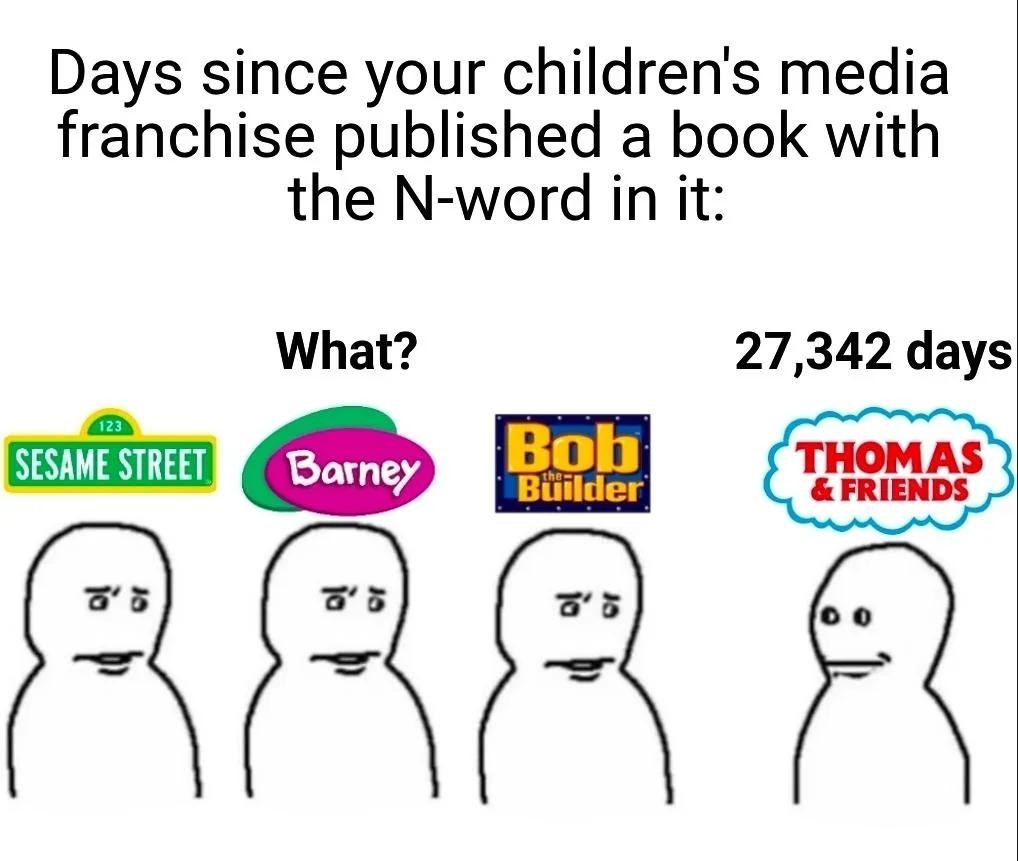
It feels so out of the blue, so unnecessary. Like the writer had been bored. It’s difficult to imagine that this didn’t jolt readers out of the story, even at the time.
Languages change. Moron, idiot and imbecile used to be medical terms. Gay used to simply mean happy and excited. A fag used to be a term for a cigarette.
I really doubt it would have appeared in a mainstream children’s book if it were seen as at all offensive.
Words like “bugger” and “damn” used to be extremely offensive curses. Now they’re often used as very mild expressions of annoyance to avoid using the serious ones.
Fag still is a term for a cigarette…
Yeah, but only in old-timey countries, like England.
I had always heard that it originally meant a stick to be used for kindling and was adapted to smoking once the tobacco trade was a thing. Probably complete horseshit because no internet when I was a kid, but I never bothered to look it up.
A faggot originally meant a bundle of sticks or twigs, and they were used to light fires, but I don’t think this has any relation to “fag” as in cigarette. Etymonline says of the latter:
That meaning of faggot, interestingly, comes from the same root as the Roman symbol “fasces” which is a bundle of sticks from which we get the modern word fascism.
Another fun fact: there’s a traditional British dish called faggots which are a kind of meatball made from offal, somewhat similar to haggis but uncased.
deleted by creator
A granny, if you will
deleted by creator
Reign in thunder, Queen 🤘
Weird I only see removed except for your use of fags in plural. The second is removed in your comment too
deleted by creator
Yeah I think they have a huge filter for words they consider problematic.
It doesn’t bother me enough to switch but it can be annoying, especially when I’m reading a comment in French and late gets removed because it’s written the same as the r word
Exactly. I started reading The Fellowship of the Ring again, and it takes some getting used to that “queer” is used in a completely different way than nowadays.
Queer is a strange one for me, growing up it was a straight up offensive slur for gay people but now the LGBTQ community has embraced it hard enough to give it its own letter.
As a Gen Xer, same. I still don’t like using the word due to the negative connotation it used to have.
I’m 40; “queer” was definitely off-limits and felt very wrong when I was young and absolutely, unquestionably straight. I don’t know when it changed for me, maybe the 2010s?… but now it has zero negative vibes in my mind.
Perhaps my acceptance around that time that I am, and have always been, quite queer was responsible for that change in my life.
I don’t identify with the term, which definitely makes a difference! It was (very successfully) reclaimed from the bigots to empower LGBTQ people.
Side note, it was nice to see Homer get over his homophobia!
Addendum: when “Homer’s Phobia” was first aired (I think it’s called?) I was quite young and still felt that being gay is bad and wrong (badong), as I was indoctrinated to believe. I still loved the episode and Homer’s emotional maturation (is that a word?) made me feel good to see, yet it didn’t really affect how I viewed being gay at the time.
Indoctrination is a powerful thing!
Ahhhh one of my favorite episodes!
It’s funny—when I was “straight”, I would never have used the word “queer”, even to describe things using its non-sexuality-meaning way. It just kinda… tasted vile to say, or hear, if that makes sense?
Nowadays, no matter who says it; be they straight, queer, or… a third thing, it doesn’t taste bad anymore to me. I haven’t heard it used in a derogatory manner since I was much younger (probably due to the reclamation like you said!) but when I imagine someone trying to use it to put someone down, it just seems silly now… like “mhm, sure am, lawl”
“Dad, why did you bring me to a gay steel mill?” was a top 10 Simpsons moment
We work hard, we play hard!
Yeah, same. It still feels as weird and wrong as the f word or the n word.
I’ve slowly gotten more used to it because it see it used so much in a non-bigoted way, but I think there will always be a bit of cringe on my part with the term.
I thought Q was for questioning.
Maybe i’m too old, but when I was a kid it just meant different, like the family down the street is rather queer, or we played a game where someobody in the classroom would change one thing, like take off their sweater and when you opened your eyes you had to identify which kid was queer
I’ve always heard it as “queer”, and the definition of queer has morphed since then from simply “gay” to “someone whose gender is not easy to define”, or sometimes as an umbrella term for anyone covered by the other letters. The whole thing is rather confusing. I’m content to just treat them like any other people.
But my best gay friend prefers “GSM” for gay and sexual minorities. I don’t like GSM because that is already the Global Standard Man, but I’m a cis-gendered straight white Christian male, so my opinion don’t matter.
I must be old, since the original meaning is still what comes to mind first when I hear it in a non-LGBTQ context.
This is from South Africa in the year 2000. It just means unusual in this context.
https://www.songlyrics.com/saron-gas/beer-lyrics/
Weren’t idiot, moron and imbecile medical terms specifically used by white scientists to describe black people back in the good old eugenics days of the 1920’s America? Language changes sure but it often has very racist roots.
I’ve never heard anything about it having a racial component.
https://en.wikipedia.org/wiki/Moron_(psychology)?wprov=sfla1
Moron is a term once used in psychology and psychiatry to denote mild intellectual disability.[1] The term was closely tied with the American eugenics movement.[2] Once the term became popularized, it fell out of use by the psychological community, as it was used more commonly as an insult than as a psychological term. It is similar to imbecile and idiot.[3]
Eugenics was related to racism, but it wasn’t the same thing as racism.
The intellectual ability / disability axis of eugenics was completely different from its skin colour axis.
I’m sure there was quite a bit of crossover between the eugenics people and racists.
Yes, but that’s very different from claiming that the people who came up with terms like “moron”, “idiot” and “imbecile” as a way to describe people with intellectual disabilities were necessarily racist.
Any term for something that is likely to be a target of scorn or mockery has this problem unless it’s so bloodless, detached and clinical that it is effectively only usable as medical jargon and barely has any meaning outside that context. George Carlin once did a bit on this.
Related is how therapy language seems to increasingly be seeping into literally everything.
All good points. It only stuck with me when I heard it because I personally loved the term moron (it’s fun to say and can be really cutting). But I’m also well aware that loads of the words me and my friends used growing up are now (rightly) frowned upon.
Buggery used to be a crime, now it’s a gay way to spend an afternoon
I wonder if straight people were ever convicted of buggery with he opposite sex? I wouldn’t be surprised if “buggery” existed solely to persecute homosexuals back then.
(I was gonna say “non-straight” or “queer” but “homosexuals” read in 30’s English accent sounded funnier to me in my head)
Found one example in the Wikipedia article about the buggery act of 1533, though it seems like he deserved it. I’m not clear if he was actually convicted.
Oh, that’s dark D: Rapists for sure deserve whatever extra harsh punishments can possibly be doled out, so that part’s cool at least. But yeah, other than that then, seems like historically it’s pretty much just to condemn gay peeps. D:
Sodomy used to be a common add on charge in sexual assault cases. I don’t know if it was ever used outside that context other than to harass gay people. I assume buggery was used the same way.
Good on adding more charges to sexual assault.
Boo on using any charges to harass gay peeps D:
Nice one.
Enid Blyton used it a surprising amount. But she was also considered old-fashioned and racist by critics at the time, so…
“Bah humbug,” was that era’s equivalent of Scrooge wandering around saying, “whatever, bullshit.”
I mean… there’s also a famous Agatha Christie’s book that used to have the N-word in its title.
We’re viewing these things with our modern eyes. But they didn’t have this kind of sensibility those days. It probably felt like using any other word: normal.
I wonder if our grandchildren will feel the same way about something we say normally today.
until 1985!
I doubt whether the vast majority of British readers would’ve been jolted by it - at the time of first publication. It was a word that had been in everyday parlance that got attached to dark “things” as a describer.
Here’s the thing though, go forward maybe 15 years again and you have the 1964 Smethwick constituency election. The winner had a, uhh, memorable slogan: “If you want a n***** for a neighbour, vote Labour.”
It’s worth noting that the “n*****s” in question were, most likely, gonna be from the Punjab. Go figure.
So, yeah, in less than a generation the word in question went from everyday speech with no overt pejorative meaning to the explicitly racist word it is today. It morphed.
I mean it is from 1951. I’ve seen a lot worse by people who meant it.
It’s 4 years before Emmett Till was murdered for example.
It was England, which never treated the n-world quite like those ungrateful colonials.
It was called out for being offensive even in that time by fellow English.
I wonder if Carlin ever tried sneaking that past the censors.
George Carlin was voicing Mr Conductor in the American dubs in the 1990s, so a solid 20 years after the retraction
I don’t remember him really weighing in on that word. And if I’m not mistaken he was friends with Richard Pryor.
It was NOT one of his 7 words you can’t say on T.V.