First, the pair of habitats can be rolled by operating the cylinders as momentum wheels. If one habitat’s rotation is slightly off, the two cylinders will rotate about each other. Once the plane formed by the two axes of rotation is perpendicular in the roll axis to the orbit, then the pair of cylinders can be yawed to aim at the Sun by exerting a force between the two sunward bearings. Pushing the cylinders away from each other will cause both cylinders to gyroscopically precess, and the system will yaw in one direction, while pushing them towards each other will cause yaw in the other direction. The counter-rotating habitats have no net gyroscopic effect, and so this slight precession can continue throughout the habitat’s orbit, keeping it aimed at the Sun. This is a novel application of control moment gyroscopes.

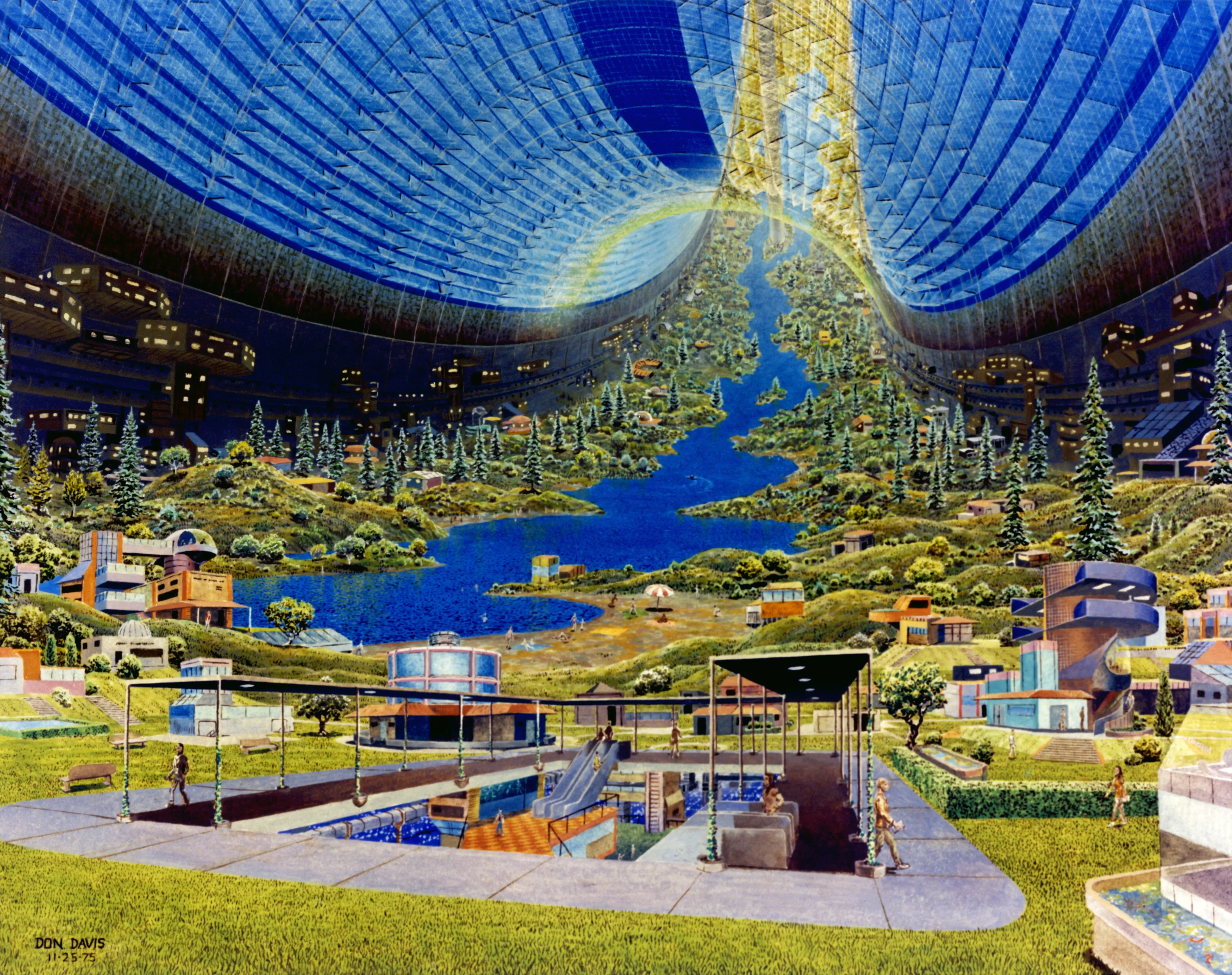
I don’t remember the image having a name, but it’s from Gerard Oneill’s book The High Frontier, Human Colonies in Space. - see OP’s link.
Looked like O’Neill’s work. That’s the same book O’Neill Cylinders are from
aaaand i just learned who i stole that joke from. i’m going to have to thank him.
The neat thing about them:
From Wikipedia: https://en.wikipedia.org/wiki/O'Neill_cylinder