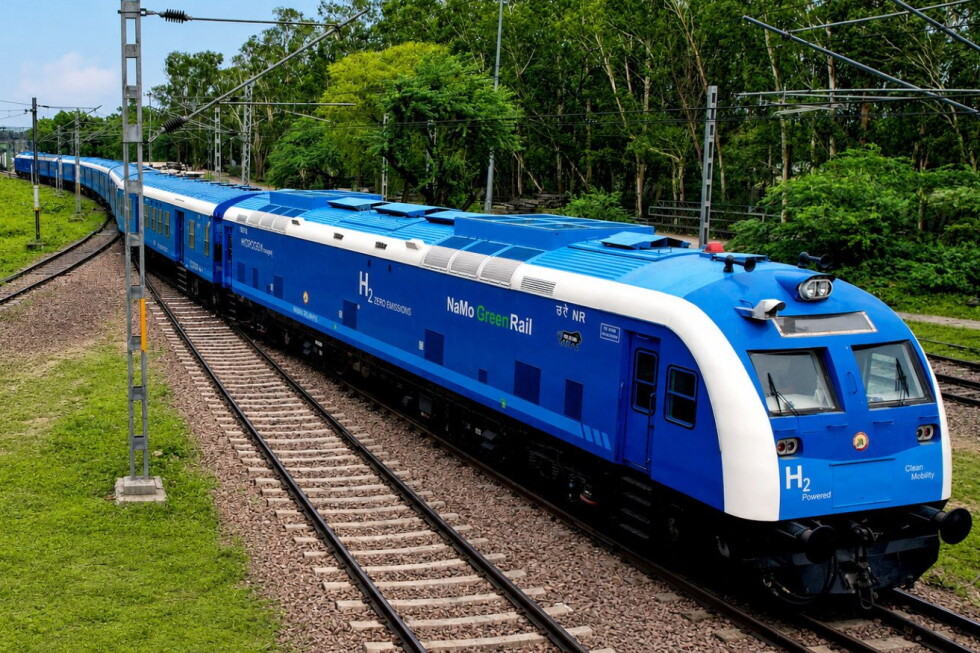
And where do they get the hydrogen???
Fossil fuel… But you really have to dig to find where they admit it.
Last time this came up it was buried in the documentation about how wind and solar don’t provide enough.This is exactly what I was thinking.
In all fairness hydrogen is good battery store for green energy too.
it’s awful. WTF. Takes huge energy to keep it cryogenically stored.
Where are you getting that it needs to be “cryogenically stored”? It’s mostly stored as compressed gas.
The main problem with hydrogen is stores only 40% but with green energy surplus and 40% is better than 0% and hydrogen store systems are quite cheap and mature/simple so still relevant in highly developing areas like those of India.
It’s still a good battery for these specific niches so I wouldn’t discount this as some big oil propaganda
Containment of gaseous hydrogen is problematic because H2’s molecular size is tiny, so it seeps through gaps that would contain other gases. So you need an especially robust container. It’s also highly reactive.
No idea what your 40% comment was about, it’s incomprehensible.
I wouldn’t discount this as some big oil propaganda
They’re the most powerful force pushing hydrogen, so it’d be entirely reasonable to at least consider the possibility.
Only 40% of energy is stored and 60% is wasted in conversation.
Yes everyone’s aware hydrogen is small, no one’s contesting this but you still don’t need freeze store just as you said proper containers. The issue you mostly hear of hydrogen leaking is from dispensaries like hydrogen gas stations not long term static containers.
No. No it isn’t. That’s not how it’s made and not how it’s used. Its overwhelmingly made by the fossil fuel industry and calling it green in any sense is just greenwashing mostly the worst environmental problem generators the world knows.
It’s clean at point of use only. Its overall supply chain is filthy.
I sense a big kaboom in this train’s future.
No specialist or anything, but I imagine most of the kaboom potential is puncture-based. I don’t expect much to make it to the heart of a train as trains generally win in collisions.
Pressure vessel fatigue is possible too, but generally rated and tested well above pressure relief valves.
Depends on how you define “win”. It only takes one small hydrogen leak for a catastrophe. A train will wreck any car or truck for sure, hit or miss with another train, but even a simple derailment of tanker cars often results in a significant mess.
There are nuclear rail transport containers that have been tested in collisions, and they’ve never leaked, but they’re very big and heavy for not a whole lot of volume. And they’re sealed, while a fuel tank needs holes to let fuel in and out.
Luckily hydrogen floats upwards pretty quickly. So paradoxically, storage tanks are safer the less protection they have around them. Or at least, above them.
Just as well trains and other vehicles don’t have roofs then.
Fun fact: Unlike natural gas, which needs enough oxygen and enough gas to explode, hydrogen is explosive at almost any concentration of hydrogen and oxygen!
Boom! Woohoo!
Yes Rico,kaboum
I suggest they name the train the Hindenburg.
So useless, just use overhead lines or batteries.
Hydrogen is just so much less efficient that it doesn’t make sense except for industrial processes where there is no alternative.
The train line close to us already switched to battery trains and most other lines are overhead powered. And then the battery train just charges when it gets to parts of the tracks where there is overhead lines, no extra infrastructure needed.
Yeah… It makes a modicum of sense for cars where overhead lines are impractical and batteries heavy…
But TRAINS? Didn’t we figure out electrification of trains via overhead power lines idk… nearly 150 years ago apparently? Quite literally the easiest mode of transport to electrify…
Eh its still a win, a large scale test cast for a still fairly unproven technology is bound to provide some useful information.
I genuinely wonder what the costs comparison looks like for these options.
I could see the use case for hydrogen as a battery, in rural areas where transporting power over wire would be cost prohibitive. The added benifits being that if you used most of the fuel in between electrified lines you lose the weight of the fuel unlike batteries.
deleted by creator