

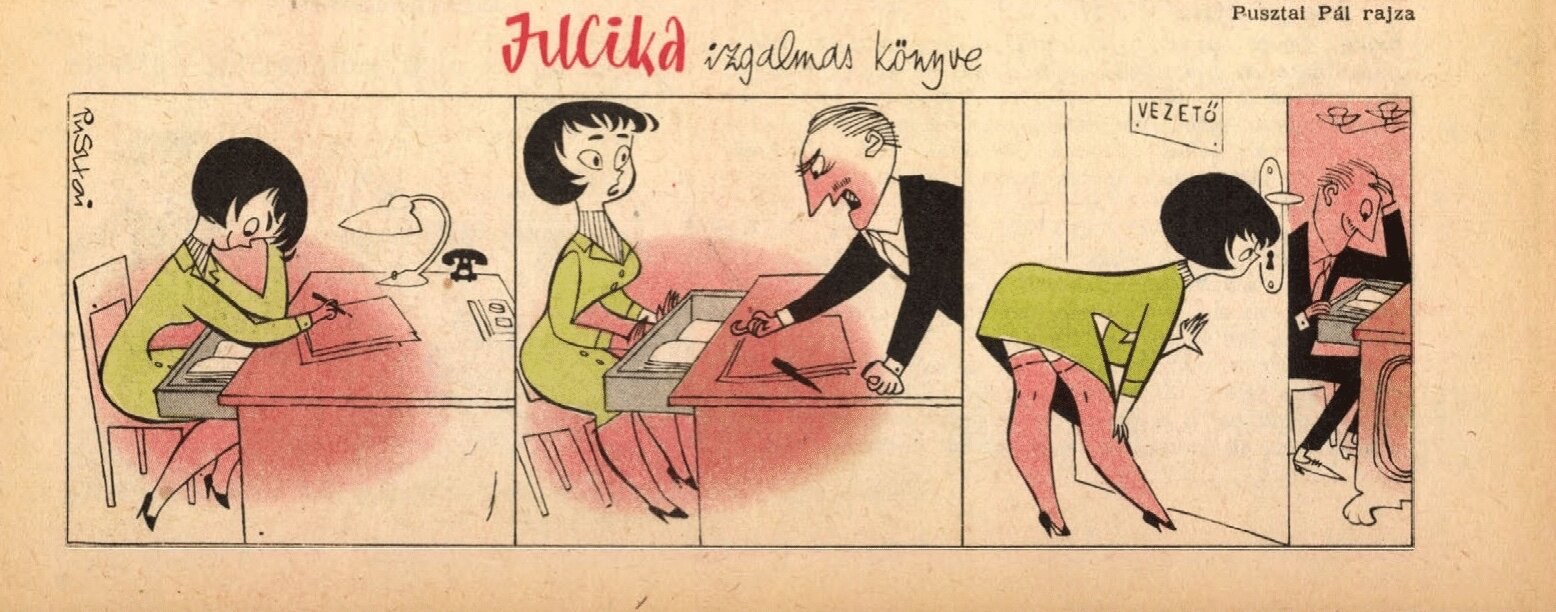
I think Vezetö on the door must translate to “boss”. The translator is calling it “conductor”, but the base word seems to mean “lead”
As always, stay tuned here on !comicstrips@lemmy.world for a slow trickle out of Jucika comics, but if you want to find more, here’s a good post with a large collection that /u/JohnnyEnzyme@piefed.social posted last year: https://piefed.social/post/1258520
**Also, check out some Jucika fan art! https://piefed.social/c/eurographicnovels/p/2128207/the-best-of-jucika-fan-art-12-pieces-with-two-videos
Ha, seriously! I was proud of myself for guessing that Könyve probably meant book, because I remembered translating Könyv from this one a few weeks back:
Lol thats fun, tho for hungarian its very important to look out for the different endings as well. Könyv is the base form while könyve(könyv+e) means it is possesed by someone, in this case Jucika. Jucika is also not a base form, it comes from juci+ka which is the dimunitive of juci which is already the dimunitive of judit(judith in english). So yeah a double dimunitive(dimunitive is like ito in spanish), but that isnt where it stops. A phrase you can construct(and which ive actually seen in use tho as a great exageration) is “kisútcácska” which is a constucted of kis+út+ca+cska where út means road, ca and cska are dimunitives and kis means smaller so its basically a triple dimunitive. Also as for the last word in the title, izgalmas is a doozy. It means exciting and it originated from izz(ik) which means to glow or radiate. That got turned into izgat(iz(z)+gat) which means “to make glow” literally, to excite normally. Then that got turned into izgalom(izga(t)l+alom) which means excitement(literally it would mean like “something involving making something glow”). Then finally izgalmas is formed as izgal(o)m+as which means exciting(if were gonna do the literal thing: “something that has the quality of something that involves making something glow” i guess lol). I like having hungarian as a native language, it doesnt help you understand any other language because its very isolated but its fun to play arround with words like this. There are some insane words and sentences you can form: “A legeslegharcrakészebbeknek ellehetetlenítették a felfegyverkezést” meaning “They have made it impossible for those most ready(readiest) for combat to arm themselves”. Im not writing down how that works lol…
This is so interesting and also so overwhelming, lol. Thank you. I remember you (I think) mentioning to look out for the endings of words before.
I’ve heard of some other languages doing something similar. For example, I’ve been trying to learn a bit of Danish recently, and they’ll sometimes tack on an -et to the end of a word to say “the”. I know German is supposed to be a language where you can frequently combine a bunch of words, but I’m not exactly sure how it works. Languages are fun.
I just happen to speak swedish which does the same. Yeah if you have ett or en(depending on the gender of the word) before the word it means “a/an” and if you have it on the end it means “the”. It does get confusing in some cases tho. Also yeah it was prolly me commenting that lol.
As for german it doesnt really do the same kind of combining as these examples because these examples are affixation, the use of affixes which have no meaning by themselves and only have meaning when attached to a word(et is a very special case, but still a suffix) while german just has very permissive rules when it comes to attaching words. For example blackbird is formed from black+bird, two words wich can stand on their own. In most of the hungarian examples the things attached dont mean anything by themselves. This is still cool tho cause you can form some ridiculous words in german. Sadly english doesnt do this but it does have a lot of clitics which are a third different thing that i also think are cool. Ex.: does+not=doesnt
Just start listening to Thy Catafalque as well, and you’ll be fluent in no time.
https://www.youtube.com/watch?v=twwsCSxmNJw&list=PLkROH3Eqs0T91ihfiAhVJsNOtVCquQCJc&index=2
I’m the absolute worst at hearing lyrics, but I like this band’s sound!
I’m glad.
Catafalque mentioned, thread improved.
The one band whose concerts I never miss.
Glad to see other fans in the wild.
Hey look, it’s that guy from the bad website!
I’m not exactly a fan, I just know they exist and put them on randomly. They’re good.
🫡