

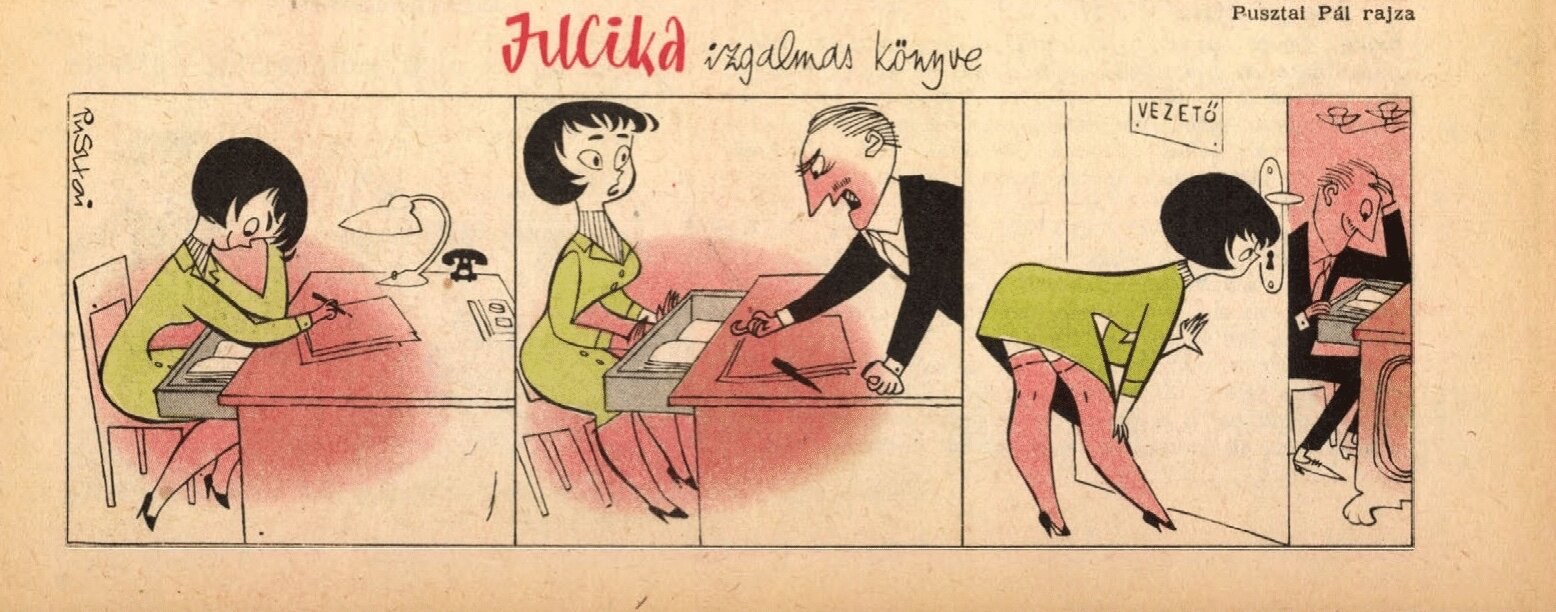
I think Vezetö on the door must translate to “boss”. The translator is calling it “conductor”, but the base word seems to mean “lead”
As always, stay tuned here on !comicstrips@lemmy.world for a slow trickle out of Jucika comics, but if you want to find more, here’s a good post with a large collection that /u/JohnnyEnzyme@piefed.social posted last year: https://piefed.social/post/1258520
**Also, check out some Jucika fan art! https://piefed.social/c/eurographicnovels/p/2128207/the-best-of-jucika-fan-art-12-pieces-with-two-videos
Vezető is a common word that is used to construct compound words where it means manager.
Irodavezető means office manager, osztályvezető means department head, but mozdonyvezető means train engineer where mozdony is the train engine.
Oh! That could’ve been my mistake. I typed ö with the dots instead of ő with the little lines. Thanks
I’m reading now that the ő suffix makes it refer to a person?
It’s a bit like -er. It can be used for objects, as well. Based on the word, it can end with ó or ő.
Vezet (drive, lead, etc) -> vezető (driver, leader).
Hűt (cool [verb]) -> hűtő (cooler, fridge).
Üt (hit) -> ütő ([sports] bat, [sports] paddle).
Olvas (read) -> olvasó (reader).
Úsz(ik) (swim) -> úszó (swimmer, fishing float).
All these might also mean -ing (as in, the continuous participle, NOT the noun), depending on the context.
Ah, that clears it up a lot…