Xbox, in 2013, was trying to be consumer-friendly with it’s game sharing system. I hate to feel like I am defending Microsoft, but the convoluted game sharing system that they had proposed along with the Xbox One reveal would have ultimately allowed consumers to finally resell digital games.
People keep saying this and forget that the reason that wasn’t well received was because they were going to give the ability to third party publishers to decide if you could sell your game or not.
It wasn’t ever all about just letting you sell digital games to other players it was also about limiting discs you could resell period and only at certain participating retailers.
The other big downside of that proposed system was the always-online requirement. Your console had to ping the Xbox servers once every 30 days to check what licenses are attached to your account or something. That was another reason why this system was ahead of its time; by assuming that every user had a stable internet connection. For most people, that wasn’t a problem because they prioritize having a decent Internet connection, but plenty of people don’t use the Internet.
Even to this day, an always-online requirement like that wouldn’t be welcomed by many. Sure, most users in 2026 would be unaffected because they are always connected, but there are enough users without an Internet connection that would find that to be a problem. And saying “People without a good Internet connection are just not ready for this next generation, so we’re still supporting the previous generation for a while” was not the best answer for those people.
Yes. And we know Microsoft was drooling over the day when they shut down that server, and everyone’s library stops working 30 days later, allowing Microsoft to re-sell them all the games they previously bought.
Because with this new proposed system, physical games were effectively just download codes. Which introduced several downsides for the many people who rely on discs, most notably the complex system involved in reselling physical discs.
Sure, this system made physical game ownership worse, but it made digital game ownership much better. Which Microsoft assumed would be a welcome tradeoff because consumers largely prefer digital games. But they had overlooked the large segment of consumers who are physical-first and do not care about digital games at all. Sure, gamers are largely gravitating towards digital games, but we are not yet at a point where literally everyone prefers digital. There are still some consumers who rely on physical for some reason or another.
And how many people are only playing console instead of pc because there are physical games for consoles still? I’m sure it has to be a good percentage.
It made digital game ownership significantly better at the downside of making physical game ownership worse. To people who prefer digital games (which trends show to be more and more users as time goes on), that tradeoff is very welcome. But there are still a lot of users (even in 2026) who do not care about digital games at all, so to them, that system just added extra headaches that were of no benefit to them in any way.


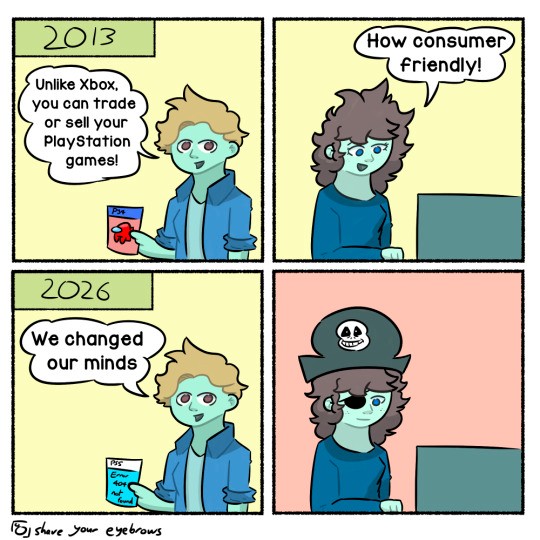
Xbox, in 2013, was trying to be consumer-friendly with it’s game sharing system. I hate to feel like I am defending Microsoft, but the convoluted game sharing system that they had proposed along with the Xbox One reveal would have ultimately allowed consumers to finally resell digital games.
People keep saying this and forget that the reason that wasn’t well received was because they were going to give the ability to third party publishers to decide if you could sell your game or not.
It wasn’t ever all about just letting you sell digital games to other players it was also about limiting discs you could resell period and only at certain participating retailers.
https://www.pcmag.com/news/microsoft-clarifies-xbox-one-used-game-policy
The other big downside of that proposed system was the always-online requirement. Your console had to ping the Xbox servers once every 30 days to check what licenses are attached to your account or something. That was another reason why this system was ahead of its time; by assuming that every user had a stable internet connection. For most people, that wasn’t a problem because they prioritize having a decent Internet connection, but plenty of people don’t use the Internet.
Even to this day, an always-online requirement like that wouldn’t be welcomed by many. Sure, most users in 2026 would be unaffected because they are always connected, but there are enough users without an Internet connection that would find that to be a problem. And saying “People without a good Internet connection are just not ready for this next generation, so we’re still supporting the previous generation for a while” was not the best answer for those people.
Yes. And we know Microsoft was drooling over the day when they shut down that server, and everyone’s library stops working 30 days later, allowing Microsoft to re-sell them all the games they previously bought.
Because with this new proposed system, physical games were effectively just download codes. Which introduced several downsides for the many people who rely on discs, most notably the complex system involved in reselling physical discs.
Sure, this system made physical game ownership worse, but it made digital game ownership much better. Which Microsoft assumed would be a welcome tradeoff because consumers largely prefer digital games. But they had overlooked the large segment of consumers who are physical-first and do not care about digital games at all. Sure, gamers are largely gravitating towards digital games, but we are not yet at a point where literally everyone prefers digital. There are still some consumers who rely on physical for some reason or another.
And how many people are only playing console instead of pc because there are physical games for consoles still? I’m sure it has to be a good percentage.
It was just an easy system to attack, and difficult to justify. I thought it sounded good.
It made digital game ownership significantly better at the downside of making physical game ownership worse. To people who prefer digital games (which trends show to be more and more users as time goes on), that tradeoff is very welcome. But there are still a lot of users (even in 2026) who do not care about digital games at all, so to them, that system just added extra headaches that were of no benefit to them in any way.