

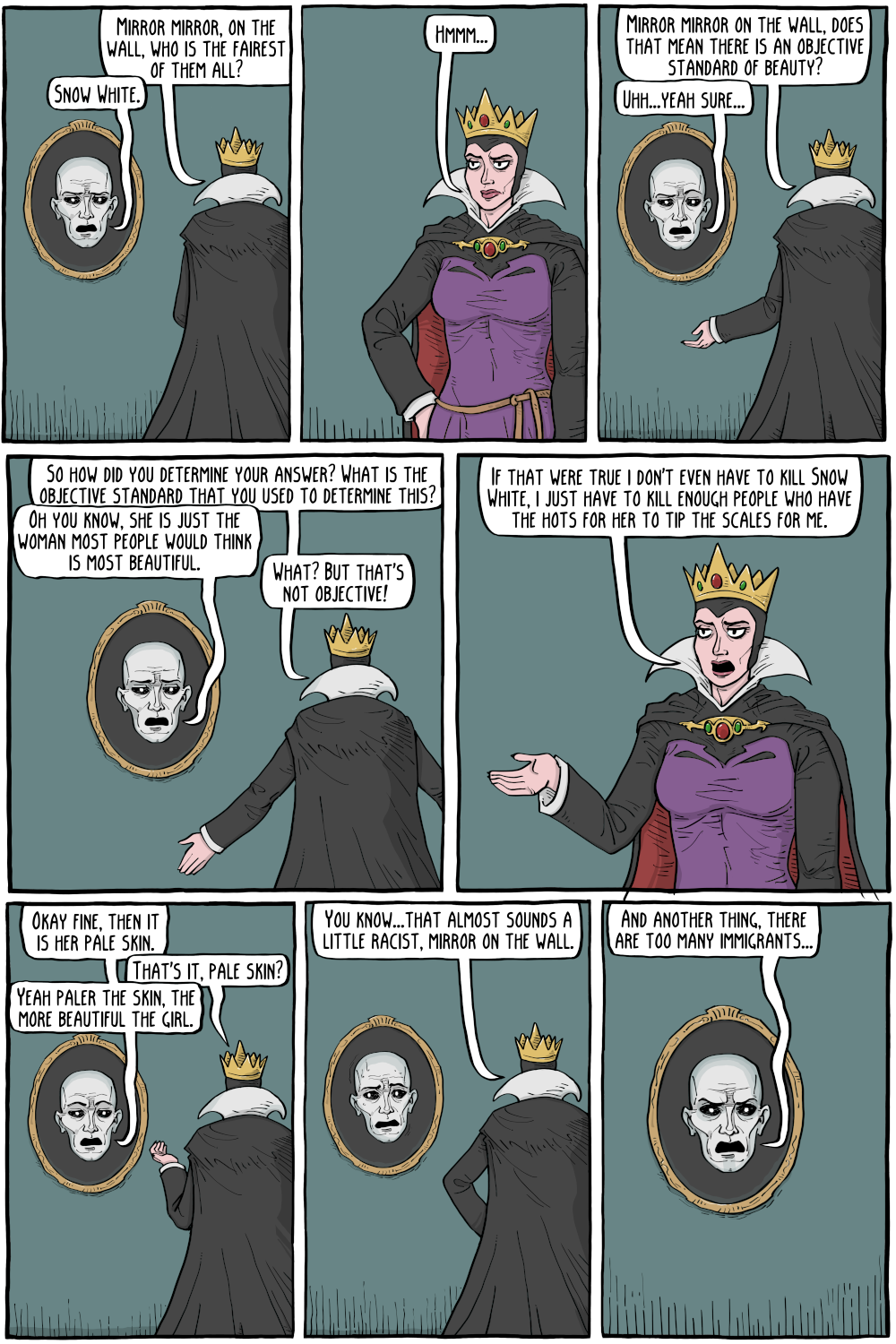
Source: Existential Comics #667
Transcription:
Evil Queen: Mirror mirror, on the wall, who is the fairest of them all?
Mirror: Snow White.
Evil Queen: Hmmm …
Evil Queen: Mirror mirror on the wall, does that mean there is an objective standard of beauty?
Mirror: Uhh … yeah sure …
Evil Queen: So how did you determine your answer? What is the objective standard that you used to determine this?
Mirror: Oh you know, she is just the woman most people would think is most beautiful.
Evil Queen: What? But that’s not objective!
Evil Queen: If that were true I don’t even have to kill Snow White, I just have to kill enough people who have the hots for her to tip the scales for me.
Mirror: Okay fine, then it is her pale skin.
Evil Queen: That’s it, pale skin?
Mirror: Yeah paler the skin, the more beautiful the girl.
Evil Queen: You know … that almost sounds a little racist, mirror on the wall.
Mirror: And another thing, there are too many immigrants …
The earlier meaning of fair is beautiful. Before that there was already a meaning of “suitable”. The “light” meaning grew out of the “beautiful” due to prevailing beauty standards.
Right but,
Source
So by the time the story was written in 1812 wouldn’t fair have just meant light skinned? Is this just bad translation from the German?
Although it’s archaic now, I think this meaning of fair is still understood today. The original German word was “schönste” which unambiguously means “most beautiful” so I don’t think it’s likely any translator would have had trouble with it. My guess is it was even more common back then.
If I were to speculate, the translator will have wanted to give a good poetic meter of this line (which is in verse) and “most beautiful” would bugger everything up. The modern English version scans the historic German one, so if this is true, it’s not down to a desire to get the perfect accurate translation…