How much of this is the contractors being sexists and how much is it them being used to, far too often, having to manage the fragile ego of a male partner who thinks that “as the man of the house I’m suppose to know these things”?
That’s where you actively go “Woah, better spread those handshakes around. If the boss don’t sign off on the plans, my word means nothing!” You give them an out. If they’re sexist, they may engage with an “heh heh, I know how it is, women!” but if they’re cautious they will hopefully just go to being professionally cordial with your partner.
Whilst I’m not sure about contractors specifically, at least in my technical area “Software Development” having the expertise/insight in the social domain (which is not part of the expertise required for the job) to do things like that is more the exception than the rule.
But, yeah, totally agree that the wise, well-rounded and (IMHO) competent professional would at the very least do a bit of subtle “social discovery” to try and figure out who is the best person the interface with.
And how much is it society having conditioned women into “oh I don’t know anything about that” when it comes to anything technical, including home repairs and such so they don’t even try to pay attention? Because I’ve encountered women of all ages who are impressed to hear a woman could do anything considered a man’s job traditionally. It’s a sort of learned helplessness to the point some think they need a man’s help to put together IKEA furniture. Not because they’re incapable of doing it but because they’ve been taught that they’re incapable of doing it.
Gender stereotyping is a vicious cycle (multiple cycles even) and definitelly goes through both genders.
Mind you, in my experience it does have some cultural component to how far it goes, but even in the most gender-egalitarian country I lived in (The Netherlands) there were still plenty such expectations and, for example, before the remote working era the percentage of couples there with a huisman (the male version of housewife) was only 18%.
Given how frequently it happens even with no male partners or it continues despite the male partner saying to talk to the wife about, I’m am gonna guess it’s pretty uncommon to be the primary factor.


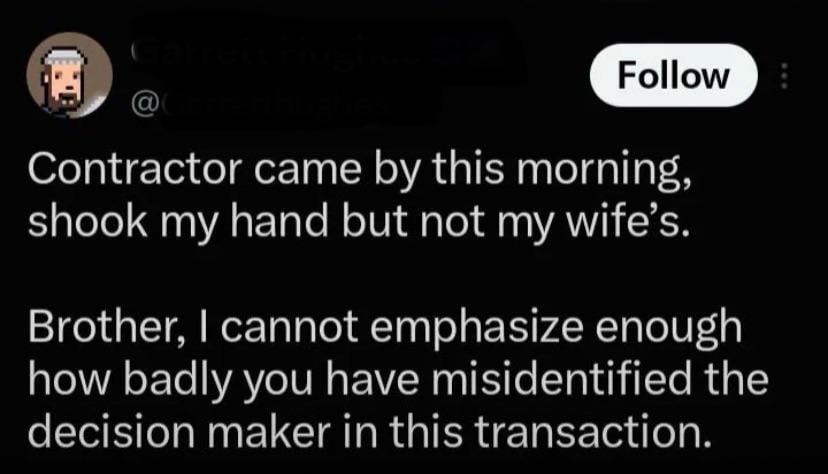
How much of this is the contractors being sexists and how much is it them being used to, far too often, having to manage the fragile ego of a male partner who thinks that “as the man of the house I’m suppose to know these things”?
That’s where you actively go “Woah, better spread those handshakes around. If the boss don’t sign off on the plans, my word means nothing!” You give them an out. If they’re sexist, they may engage with an “heh heh, I know how it is, women!” but if they’re cautious they will hopefully just go to being professionally cordial with your partner.
Whilst I’m not sure about contractors specifically, at least in my technical area “Software Development” having the expertise/insight in the social domain (which is not part of the expertise required for the job) to do things like that is more the exception than the rule.
But, yeah, totally agree that the wise, well-rounded and (IMHO) competent professional would at the very least do a bit of subtle “social discovery” to try and figure out who is the best person the interface with.
And how much is it society having conditioned women into “oh I don’t know anything about that” when it comes to anything technical, including home repairs and such so they don’t even try to pay attention? Because I’ve encountered women of all ages who are impressed to hear a woman could do anything considered a man’s job traditionally. It’s a sort of learned helplessness to the point some think they need a man’s help to put together IKEA furniture. Not because they’re incapable of doing it but because they’ve been taught that they’re incapable of doing it.
Gender stereotyping is a vicious cycle (multiple cycles even) and definitelly goes through both genders.
Mind you, in my experience it does have some cultural component to how far it goes, but even in the most gender-egalitarian country I lived in (The Netherlands) there were still plenty such expectations and, for example, before the remote working era the percentage of couples there with a huisman (the male version of housewife) was only 18%.
To be clear, she doesn’t need to be the technical one to be the one in charge of the decisions.
Given how frequently it happens even with no male partners or it continues despite the male partner saying to talk to the wife about, I’m am gonna guess it’s pretty uncommon to be the primary factor.
I imagine it’s a lot of both