

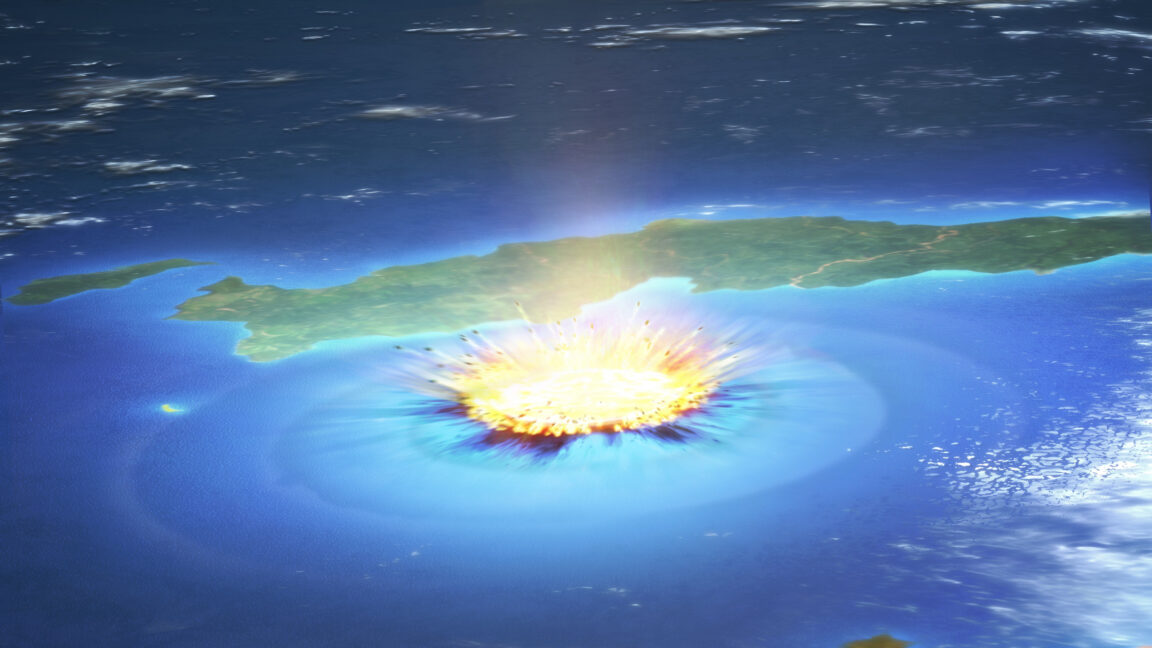
The collision was intense enough to cause deformation far beneath the surface. Subterranean effects reached 35 km (almost 22 miles) down, and included the melting an immense amount of rock. Exposure to seawater made that rock porous. As hot water seeped into the pores, a hydrothermal system formed. The hot water gushing into an isolated region of the freezing depths could have attracted microorganisms and possibly other life forms that were otherwise struggling to survive.
It gives hope to all of us out there that feel like massive craters of former vibrant life! We can be something one day too!
Wait, so you’re saying it was… aliens?
Yes, but they clearly came here to free mammals from the tyranny of dinosaurs.
They became the mammals, FWIW. They are us. We are them.🙆🏼♂️
join us.
join us.
join us…
Whatever bro, not me, I am clearly a vulcan and thus I am descended from pure anger rather than reptiles.
Yep, username checks out. ☝🏼
Unlikely. Maybe teaming with precursor chemistry for life.
I’ve been saying this since the moment the first new horizons images became available. Precursor chemistry for life happens on icy bodies orbiting at a distance where the freeze thaw cycle is sufficient for carbon oxygen and carbon nitrogen bonds to occur.
And there are a fucking shit ton of these bodies orbiting most stars. And there is no rush. The longer they orbit the more time precursor can build up. Then some shit goes down and one bad day, it smacks into an earth like body. The hydrothermal vents are a great addition but the main thing this solves is the concentration issue.
At least on earth there is no obvious way to concentrate enough interesting chemistry into one place for the more complex lipid, protein, DNA, RNA systems to get going. There are potential mechanisms for their production but no obvious way to concentrate them to a sufficient degree where life like or systems could form.
Precursor impact theory solves all of this and comes with its own thermodynamic equilibrium solution to boot.
That’s true, but this is talking about the crater not the meteor
Hol’up. Are you implying that meteorite craters rarely contribute to the impacted substrate with their own composition?
Seems to me that differentiating between the two here is simply a question of time along that same line, and ripe for finessing of the data to feed a narrative. 🤷🏼♂️

