

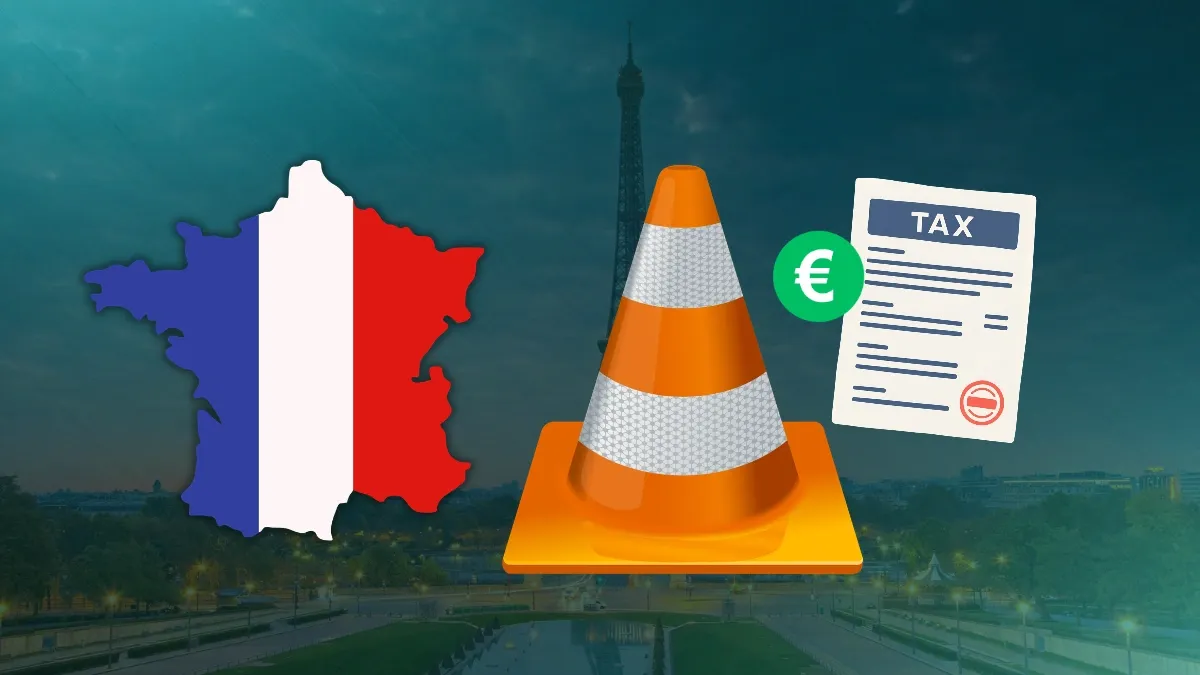
At least that’s what VLC thinks when protesting the new French law.
France’s National Assembly has voted in favour of a new “internet tax” that would charge companies for every gigabyte of data they send to users in France.
The idea is to make Netflix, Google, Meta and the rest of Big Tech pay more.
That sounds like a dream come true for many of us who prefer taking ownership of data in our own hands but unfortunately things are not that simple.
The way this law is written, it doesn’t stop at Big Tech. Even VLC, a free and open source media player maintained by a non-profit, could end up paying this new tax. What the new French internet tax says New French Internet Tax law
The measure is amendment I-1358 to France’s 2027 finance bill, tabled by Laurent Lhardit. It creates a tax on “producers of digital data” at €0.055 (5.5 euro cents) for every gigabyte delivered to subscribers of French internet providers.
Internet providers would measure how much data each sender pushes to their customers, with the collection supervised by telecom regulator Arcep and the tax administration DGFiP. Only the volume is counted, not the content or where it goes.
The amount is capped at 15% of the company’s revenue in France or 2% of its total revenue, as per the amendment. Note that it’s 15% of French revenue, not of total network traffic. And the text joins the two caps with an “or” without saying which one applies when they differ. How much money are we talking about?
The amendment cites an Arcep estimate of 200 billion GB a year flowing to French internet subscribers. It expects the tax to bring in €10 billion a year. It also names Google, Meta (Facebook, Instagram), Amazon, Netflix and Akamai (cloud server provider) as the senders of about half of that traffic.
You’d think the money goes to the telecom operators who build and maintain the networks. That’s the “fair share” argument European telcos have pushed for years.
But that’s not the case. The revenue goes straight into the state budget, and the amendment’s own justification talks about tax fairness between local businesses and digital multinationals, plus the ecological benefit of compressing data.
Why VLC is angry
A gigabyte of open source software counts the same as a gigabyte of Netflix. VideoLAN, the French non-profit behind VLC, posted on X that the tax would cost it over €1 million a year.
Lhardit replied that the cap would protect VideoLAN. He also said he didn’t see how the tax could be passed on to users of Facebook, Instagram or TikTok since those services are free.
VideoLAN didn’t take that well:
You have no idea what you are talking about. What you said about Facebook and Insta and other social networks are not targeted because they are free, means you don't understand the basics of economy. You don't understand the difference between Revenue and Profit.

VideoLAN (@videolan), October 30, 2026
The cap may limit what a low-revenue non-profit owes. But there is no explicit exemption for associations, free software or free content anywhere in the text. VideoLAN’s €1 million is the possible figure before the cap, and right now nobody can tell the exact figure for certain because of all the ambiguity.
VLC isn’t alone. OVHcloud founder Octave Klaba put his company’s gross exposure at around €70 million a year, and Free’s (Teleccom) Xavier Niel called the authors “ignares incompétents”, roughly “incompetent ignoramuses”. Those are French companies, by the way. Not exactly the US giants this internet tax bill was meant to tame. At the end, the consumer pays the bill
See, a “war on Big Tech” sounds great in a headline, and European governments are fond of laws that squeeze extra money out of American tech companies. But I don’t buy the idea that Netflix will pay them out of their pocket.
Netflix will do what it always does and raise subscription prices. And Facebook is “free” only because advertisers pay for it, which is exactly the revenue versus profit point VideoLAN was making.
So the government gets extra money, Big Tech protects its margins, and you end up paying. Meanwhile, non-profit projects like VLC, which never had a price to raise in the first place, are left wondering how big their bill will be.
Let’s just hope that this doesn’t take the form of law. Because this will set a precedence. I wouldn’t be surprised to see other European countries try their own version. No government will say no to extra tax revenue.
Like GDPR, this has all the ingredients of another mess. If a law is going to tax “internet companies”, it needs to say in black and white which ones. Right now, it doesn’t.
What do you think? A fair way to make Big Tech pay, or a blunt instrument that hits everyone else? Let me know in the comments.
Every tax is borne by consumer not the company, dumb govt
Wtf France! That’s a stinking pole of shit. Just tax wealth. Maybe at EU level.
Having such incompetent officials passing such stupid laws explains why French people riot so often.
They tried to introduce an internet tax in Hungary. It was really a ruse. While people protested they pushed much more damaging legislation. My guess is that this might be a ruse as well.
So… tariff on internet traffic?
scary thing is other countries can follow this with different rate. i remember there was not data cap on internet then us companies started data cap some others followed.
This is an attack on the open web and small players.
Big businesses like Netflix, Microsoft, Google, Ubisoft can afford to pay this and will simply pass the costs onto consumers in many cases. They won’t entirely like it but they will like how it will totally destroy free software, small business competition, online file sharing/torrenting (they’ll inevitably amend this if it doesn’t already cover foreign websites to block those that don’t pay the fees for all that data you’re using for videos that don’t result in the big media companies getting paid).
Big corporate entities have used measures in a similar vein in the past to gatekeep a market and keep out competitors. By raising the burden for entering or remaining in a market it creates pressures forcing out all but the biggest entities who can afford to pay it, thus allowing them a monopoly position from which they may better abuse consumers with lower quality, worse service, higher prices, etc.
It will coerce video game distributors like Steam to charge customers in France to re-download a game for example. Some companies would be very interested in this kind of exploitation of every click and move you make.
It’s also not real. It’s legislative clickbait.
-
this is a joke of a law meant to generate headlines and nothing else; congrats on biting.
-
how dare you imply the GDPR is bad. It might just be the best consumer protection law ever put to paper, certainly in the digital space. It has massive positive impact on the privacy of EU citizens, and even beyond. All the shitty things associated with GDPR - namely, annoying cookie banners - are not mandated by GDPR, they are malicious compliance from companies furious they can no longer steal your data without telling you. And even then: incredibly small price to pay.
French companies seem to be biting though so it seems they think there’s danger of it being passed? This is also the country whose courts decided to force Quad9 to block their entire country because the alternative was to start telling their French users which websites they’re allowed to visit based on what private companies say should be banned.
I don’t think the French know how to Internet.
-
Nobody is born this stupid. How does one train to become this stupid? Is it just French wine and cheese or is there more to it?
Every time people ask for government to regulate the internet we get a version of this to the point where it feels more malice than incompetence
Ouch …other applications like CoMaps and OSMand sending me 10GB maptiles a month …
France is cooked
I’m curious on how they plan to handle VPNs
Their hosts or CDNs will be charged. Probably the end goal is a tax on everything and if your traffic hasn’t paid the tax it gets blocked/dropped at the French borders.
This seems absurd. How did the government get to this point? Were there prior frameworks before they decided on this one?
I can’t see any other result than to deter economic activity that uses computers and “the internet”. I feel this is incredibly reactionary. I sympathize if the goal is to capture economic flows that are disproportionate and outwardly foreign. Facebook as an example: it’s a foreign company with a net negative on France. American ‘internet’ companies dominate others because the governments of the past allowed it. Out of sight and out of mind. China’s the only nation that has been doing it correctly. They have domestic equivalents and more. Compare that to the rest: it’s just America rofl stomping everyone and extracting capital.
So if I get this straight, me traveling to france and streaming 1GB of movies I own on my jellyfin server in the US would make me receive a tax bill in the mail?
The french are so good at making laws without scoping out the consequences


