The only possible choice that results in a set of 2, and a set of 1, which are seperated cleanly by a distinct property, is picking C.
The goal is to define a difference between potential sets such that a distinct property exists between the two sets that you create.
To define two sets where unlikeness exists between them when they are compared.
Your job is not to merely compare three elements.
It is to compare three possible pairs of sets that can be made out of three elements.
Which elements have which particular combinations of attributes is thus very important, not irrelevant, as your simplified description of the situation portrays.
No, you’re still not correct just because you chose to reduce the similarities of C with A and B.
Again, I can make the same ignorant reduction of importance you did, but from a different aspect, and get a different answer.
The only reason you’re picking C is psychological, as in, C is the most visually distinct due to the difference in colour (which is something human eyes are keyed towards). The rest of your explanation is a pseudointellectual attempt of forcing logic into your subjective choice, basically, you’re Petersoning it real hard just to be right.
Just to make it clear, let’s apply your same property difference.
If you pick A, the distinction between (A, B) and (A, C) is the same - they are filled, not outline.
If you pick B, the distinction between (B, A) and (B, C) is the same again - they have four sides, not 3.
So, again, the same property difference pair can be applied to literally any of the choices.
Well, I’m glad this moment led to some personal growth!
Remember, making mistakes is okay as long as you 1, can admit being wrong and 2, learn from being wrong.
And to be fair this “puzzle” is specifically designed to be confusing and have people jump to the “obvious conclusion” based on their perspective. To you it was the colour green vs red, to others it was the shape triangle vs quadrangle, and to a third group it would be the outline vs filled state. It’s actually not unlike some IQ test questions where the goal isn’t to see if you can find the “correct” answer (as there isn’t one!), but to see how you think.
I mean, I do my best, normally, to actually admit and thus learn from mistakes.
I’m of the age now where I’ve realized I’m probably not going to be able to change my seemingly fundamentally inexorable bullheadedness when I am, for whatever reason, very convicted about something.
… So, that necessitates the self awareness to realize 1) that I am wrong 2) how I came to be wrong and 3) how I can try to avoid being wrong in the future.
… currently, my conclusion remains the same: Do not attempt a logical argument when exhausted and very hungry.
lol.
… I’m doing much better than a year ago, PTSD is not fun, learning how to disengage from hypervigilance mode … is a skill, hooray for CBT.


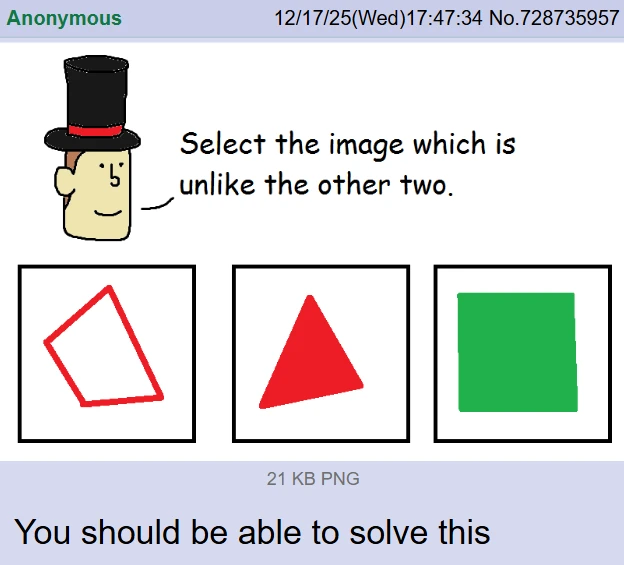
… only one choice is green.
How is this difficult, other than if you are r/g colorblind?
The correct choice is C.
If you pick A, B is also red, and C is also an irregular 4-gon. So A is not unlike either B or C.
If you pick B, A is also red, and C is also filled solid with color. So B is not unlike either B or C.
But if you pick C, while C does have elements in common with A and B…
(it shares ‘irregular 4-gon’ with A, and ‘solid color fill’ with B)
… it is also unlike each of them singly, as well as both of them together, in that it is green.
C is the only choice where ‘is unlike the other two’… is true, in any sense.
It has a distinct property, not found in any member of the remainder set, nor shared by the remainder set as a group.
… only one choice is a triangle.
How is this difficult, other than if you are shape blind?
The correct choice is B.
If you pick A, B is also red, and C is also an irregular 4-gon. So A is not unlike either B or C.
If you pick C, A is also an irregular 4-gon, and B is also filled solid with color. So C is not unlike either A or B.
But if you pick B, while B does have elements in common with A and C…
(it shares ‘red’ with A, and ‘solid color fill’ with C)
… it is also unlike each of them singly, as well as both of them together, in that it is a triangle.
B is the only choice where ‘is unlike the other two’… is true, in any sense.
It has a distinct property, not found in any member of the remainder set, nor shared by the remainder set as a group.
What a fool you are!
… only one choice is an outline.
How is this difficult, other than if you are line blind?
The correct choice is A.
If you pick B, A is also red, and C is also a filled solid. So B is not unlike either A or C.
If you pick C, A is also an irregular 4-gon, and B is also filled solid with color. So C is not unlike either A or B.
But if you pick A, while A does have elements in common with B and C…
(it shares ‘red’ with B, and ‘4-gon’ with C)
… it is also unlike each of them singly, as well as both of them together, in that it is a triangle.
A is the only choice where ‘is unlike the other two’… is true, in any sense.
It has a distinct property, not found in any member of the remainder set, nor shared by the remainder set as a group.
Welp.
I tap out, you’re right lol.
Don’t attempt set theory before breakfast, otherwise you end up making a fool of yourself as I have.
=[
Hangry is not a useful state to approach logic from.
2 shapes are the same colour
2 shapes are filled
2 shapes have four sides
the point of this is that there are multiple distinct properties not found in any member of the remainder set
No.
You are wrong.
“Select the image that is unlike the other two.”
The only possible choice that results in a set of 2, and a set of 1, which are seperated cleanly by a distinct property, is picking C.
The goal is to define a difference between potential sets such that a distinct property exists between the two sets that you create.
To define two sets where unlikeness exists between them when they are compared.
Your job is not to merely compare three elements.
It is to compare three possible pairs of sets that can be made out of three elements.
Which elements have which particular combinations of attributes is thus very important, not irrelevant, as your simplified description of the situation portrays.
And that’s literally what they did.
There’s a set of shapes that are filled, and a distinct set of one that is outline only.
There’s a set of shapes that have 4 sides, and a distinct set of one that is 3 sides only.
There’s a set of shapes that are red, and a distinct set of one shape that is green.
Only when you pick C do you result in a pair of sets that are cleanly dvided by the same property difference.
Is that more clear?
If you pick C, the distinction between C and A is the same distinction between C and B.
Thus, if you pick C, C is unlike A and B in the same way.
This is what I would call a clean or clear distinction, or … kind of unlikeness.
This is not the case, does not occur, if you pick A or B.
You end up with a picked set of one element that differs from the remainder set in ways that are inconsistent among the elements of the remainder set.
IE, a muddled or inconsistent distinction.
No, you’re still not correct just because you chose to reduce the similarities of C with A and B.
Again, I can make the same ignorant reduction of importance you did, but from a different aspect, and get a different answer.
The only reason you’re picking C is psychological, as in, C is the most visually distinct due to the difference in colour (which is something human eyes are keyed towards). The rest of your explanation is a pseudointellectual attempt of forcing logic into your subjective choice, basically, you’re Petersoning it real hard just to be right.
Just to make it clear, let’s apply your same property difference.
If you pick A, the distinction between (A, B) and (A, C) is the same - they are filled, not outline.
If you pick B, the distinction between (B, A) and (B, C) is the same again - they have four sides, not 3.
So, again, the same property difference pair can be applied to literally any of the choices.
Yep, you’re right.
KaChilde ran through a more thorough version of my own logic and I realized I am being a stubborn ass, sorry about that lol!
Well, I’m glad this moment led to some personal growth!
Remember, making mistakes is okay as long as you 1, can admit being wrong and 2, learn from being wrong.
And to be fair this “puzzle” is specifically designed to be confusing and have people jump to the “obvious conclusion” based on their perspective. To you it was the colour green vs red, to others it was the shape triangle vs quadrangle, and to a third group it would be the outline vs filled state. It’s actually not unlike some IQ test questions where the goal isn’t to see if you can find the “correct” answer (as there isn’t one!), but to see how you think.
I mean, I do my best, normally, to actually admit and thus learn from mistakes.
I’m of the age now where I’ve realized I’m probably not going to be able to change my seemingly fundamentally inexorable bullheadedness when I am, for whatever reason, very convicted about something.
… So, that necessitates the self awareness to realize 1) that I am wrong 2) how I came to be wrong and 3) how I can try to avoid being wrong in the future.
… currently, my conclusion remains the same: Do not attempt a logical argument when exhausted and very hungry.
lol.
… I’m doing much better than a year ago, PTSD is not fun, learning how to disengage from hypervigilance mode … is a skill, hooray for CBT.
I think you are overthinking this mate.
I concur, and realized my logic is flawed.
… sorry.
deleted by creator