
- cross-posted to:
- politicalmemes@lemmy.ca
- cross-posted to:
- politicalmemes@lemmy.ca
You must log in or register to comment.

is xi santa now?

isnt that a silver fox flying a plane backwards?
No but they’ve met up irl

If one paycheck is all that stands between half of the people and homelessness, can it really be called the “middle” class?
There was an article with a pretty compelling argument a while ago that basically said the true poverty line in the US is over 100.000$/year family income (when you look at what that number was originally supposed to measure). Below that you’re getting fucked left and right.
Every dollar a family earns between 40k and 100k makes them poorer, because it triggers benefit losses (like health care & child care) that exceed income gains.
So what the US reports as “the middle class” are actually the working poor
I was reading Michael Roberts’ blog the other day, and he pointed out something similar. The official calculations for inflation significantly understate it for various reasons. However, if you look at actual labor hours needed to cover the essentials of life, and you use the median income amount from 1950 (for the US), then that number comes out about $102k per year. Said another way, for a standard of living based on real life, to have the standard of the median American in 1950, you would need to earn over $100k today. But if you take that 1950 median income and just adjust it for official inflation, you only get to like $42k.
So I learned it this way:
Upper Class - can live a luxurious life without working at all, and even have domestic employees etc.
Middle Class - can live comfortably but only if they work
Lower class - cannot live comfortably even if they work, and can very easily end up homeless (no social safety net)
The dude who taught me this was my Sociology of Work teacher over twenty years ago.
This isn’t particularly helpful, though, as it doesn’t explain why these classes exist. Class traditionally refers to how we engage with societal production and distribution, like wage laborers, business owners, sole proprietors, artisans, etc. By focusing on the outcomes of this class distinctions, you obscure the mechanisms by which they persist and are reinforced.
I was just trying to offer a quick explanation/summary of the concepts or the main distinguishing external features of each class, because I see a lot of confusion and wrong self-perception. I see a lot of people saying they’re “mid to upper class” because they can afford a nice home and two cars. Just looking at how much money they have, not how do they have it or whether they can maintain that without working. Obviously to understand class and social stratification you have to read more. I am aware that the upper class are there because of the work of the lower classes and the surplus etc. I’m not obscuring anything, just offering some definitions. Sorry if it didn’t come out that way.
Understood, I just wanted to build on your comment.
Class traditionally
It only refers to how we engage with societal production in a handful of belief systems such as Marxism. These are different from how Anthropologists view class which is different from how sociologists view class and all of the above are different from how many older societies viewed class.
Marxism did not invent that class previously meant things like “serf, lord, slave, merchant, etc,” this was something Marx just used that everyone else was using. Marx developed class struggle further by developing dialectical and historical materialism, but did not invent this conception of class.
Marx overly focused on one criteria to describe class. It’s ok to accept ownership/working classes as a useful tool for understanding the world but other systems also offer useful lessons for understanding the world in different ways and contexts.
Marxism does not limit one’s understanding purely to production and distribution, though, I’m not sure what you’re getting at. Domenico Losurdo’s Class Struggle is a good read.
It’s helpful to divorce class from simple material wealth, and return to how we engage with production and distribution. The true “middle class” is the small business owner, in reality most people are working class.
I certainly don’t disagree, but I think it’s very useful to highlight how this has changed (IMO) in recent decades. I think there was a time when the boomer generation was earning relatively good incomes that allowed them to live comfortably and accumulate wealth (mainly in houses and the stock market). I think this arrangement between capital and the (predominantly white) working class created a situation where even those workers without much wealth could be “bought off” and swear allegiance to capitalism. This wasn’t sustainable of course, as the postwar industrial boom and then the gains from neoliberalism were never sustainable. Couple that with the fall of the Eastern Bloc and with it the “threat of a good example”, and I would say that this arrangement lasted as late as the GFC at most. I think this helps explain how older people today - even if they are solidly working class - might still be hostile to anything they think is “socialism” while younger generations do not share those opinions, it seems.
Yep, you’re referring to the “labor aristocracy.” The working classes in the imperial core are bribed by the spoils of imperialism into complacency. What’s causing the rise in radicalization is a decline in imperialism, due to global south development (largely due to projects like BRI and trade with China). This is why the US Empire is surging to the right, as imperialism is being brought inward and austerity forced on the labor aristocracy. This is causing radicalization:

So it’s important not just to look at the local, but also the international aspects of class. There’s also the fact that the US is a settler-colony, and this is the primary contradiction within Statesian society.
Middle: in between homelessness and millionaires
Its right in the middle, between homelessness and billionaire.
Nor even “the working class”.
The precariat.
There’s only two classes. There’s nothing in the middle.
If you’re in doubt which class you belong to, look at the paycheck. Does it have your name on it? Then you’re one of the ones who get paid.
There are sub categories in addition to worker and capitalist, such as sole proprietors, small business owners, etc, but society is dominated by the capitalists and their necessary pair, the proletariat.
Median class? Mode class?
Precarious class.
Yeah cuz the lower class don’t get paid at all. Homelessness is rampant all over the states
It’s better to think of working, middle, and upper class in terms of how much of their income derives from labour vs capital.
Working class = majority of income from working.
Upper class = majority of income from owning capital, i.e. can afford not to work at all.
Middle = somewhat evenly split.
Traditionally working class was associated with “lower” jobs such as labourers, and those working cushy office jobs usually earnt a high enough income to accumulate enough capital to become middle or upper class.
This is more aligned with the British definition, where their “middle class” is more equivalent to the US “upper middle class.” Make no mistake though, with many jobs not paying enough to accumulate capital, professionals such as teachers, accountants, and nurses would firmly be considered working class, because they you know, need to work.
I mean, the “middle class” doesn’t usually refer to the poorest 50%. The Lower class has always been the majority, Middle a large minority, and Upper a vanishing minority.
Hence why some of the US simply CAN’T protest. If they miss a single pay check-- or get fired for missing work-- they’re fucked. Insurance is also tired to work.
Financial slavery
Mario’s brother said what?
it all started in the city of Wurms in the year 1000
Or get injured and end up with a bunch of medical bills. Or about any number of other things that can go off the rails.
get injured and end up with a bunch of medical bills
especially when having health insurance
The decoupling of employment and insurance needs to be possible
Fuck it. Chips on the table, china taking over america would be a net positive at this point. I’ve never bought into the “country bad because ideology different” bullshit we’re fed here in the us. As I can see from here, just about any other large nation assuming control would bring me everything I ask my government for as a default.

Please, president Xi, the Statesian public yearns for liberation
Maybe the Chinese proletariat can launch a concurrent revolution to overthrow Xi.
Why would they do that? Over 90% of Chinese citizens support their government.
I didn’t seriously consider that they would just like I wouldn’t seriously consider White Americans in the 1950’s launching a revolution. China has high propaganda and they’re at the part of both industrialization and capitalism where average people see benefit from both.
China isn’t capitalist, nor is it an imperialist settler colony that gave 1950s white Statesians a better life. It’s a socialist country, the large firms and key industries are overwhelmingly publicly owned and the working classes are in charge of the state. A revolution would be devastating for the Chinese working classes.
China isn’t capitalist
That’s delusional
the working classes are in charge of the state
The party is in charge of the state. The working class have vanishingly little power.
A revolution would be devastating for the Chinese working classes.
That’s what the Ruling Class in every country says. Can’t let everyday people get too uppity
The CPC is a working class party, not a class in itself. In the PRC, public ownership is the principle aspect of the economy, private ownership is relegated to the small and medium firms, which are about half sole proprietorships anyways.
The idea that the party is a distinct class and the idea that an economy where public ownership is principle is somehow capitalist both are contradictory to Marx and common sense, so I’m not sure where you’re coming from.
A revolution would result in bleak reaction and capitalists in charge of the state, this is the opposite of what the working class wants in China.
It’s genuinely sad to see people who have been so traumatized by living in an epicenter of capitalist profiteering, gaslighting propaganda, and government violence that they can’t imagine a society that doesn’t work that way. You think this is a normal way for a government to be, and you think the smart thing to do is assume everyone is like the US.
Trading late stage capitalism for mid stage capitalism and a pre-existing merger of state and corporate power doesn’t sound like a permanent fix. Also, deposing a strongman in favor a system that has reestablished it’s leadership as a strongman is not an improvement.
China is socialist, the large firms and key industries are publicly owned and the working class is in control of the state. They don’t have a “strongman,” just because Xi gets re-elected. Stability is good if public support is high.
They have a Strongman because Xi went to great efforts to sideline people or policies that served as a check to his power. Something that would have been unthinkable in China at any point after Mao and before Xi.
Do you have an example? The anti-corruption campaigns are immensely popular among the public in China, and they support the government.
Just years of reading. That you bring up the anti-corruption campaign means you’re at least familiar with allegations that Xi unevenly applied the campaign against his political opponents. As a side not, I’ll say the anti-corruption campaigns in China are definitely popular and also one clear situation where improvements in computer technology made a major advance in society and peoples quality of life. Corruption of low level officials was hard to root out when the people would be making complaints to other corrupt low level officials and risking retaliation in the process. Computer technology helped bypass that.
So I still don’t see any evidence of Xi being a “strongman,” but instead an extremely popular and influential leader.
You’re whole persona is pushing the party line and pushing back against any dissent. I didn’t expect you to see any evidence.
I think you underestimate the term “improvement”. Lossing two fingers instead of three is an improvement. 8inches from the ledge is better than 4inches from the ledge even if either measure isn’t even one whole step. If in never going to see best then I’ll take any better I can get.
Yeah but any invasion probably pushes half of the country over the edge before the war would be over.
I wouldn’t wanna risk death and destruction for a mere potential 4" further from the edge.
My dude, you’re on a federated platform. You don’t think you’re going to dodge being lumped in with all the political dissidents and “terrorists” when they run out of trans kids to gas? It’s literally a death risk either way, this way just means you get to watch tv until they get you.
I’m one of the trans
kidsadults, I’d be fucked anyways. Just wanted to illustrate that being invaded, if you welcome it or not, is usually a pretty rough affair.War is brutal, I don’t know if I would be willing to suffer through one, just for stuff to be slightly better afterwards, maybe. Provided I had the choice in the first place ofc.
A permanently better world is possible so why settle for a temporary better situation with little hope for further improvement? Why insist people have to lose fingers when no one losing fingers is achievable and not at all far fetched?
China is still making rapid progress and hasn’t slowed down in that respect, though. It isn’t that they are following a temporary solution, it’s that they are developing towards that better world, and building that better world takes time and effort. There’s no such thing as a static system.
Because they’re moving there? No one said there should be no more progress?
“Unless you’re creating an instant utopia you should not change to the status quo”
What part of creating a mixed capitalist society run by an authoritarian regime leads to an utopia on any time frame? Spell it out for me because history suggests it will end poorly.
China is a socialist market economy, not capitalist. It’s also run by the working classes in democratic fashion. The large firms and key industries in China are overwhelmingly publicly owned and planned, and as the small and medium firms grow they are folded more into the public sphere of influence. The basis of communism is in large scale industry, not in small manufacturing, so it doesn’t necessarily make the most sense to socialize small firms.
As time continues and the productive forces develop, these become economically compelled towards socialization, which is expedited by having a socialist economy where public ownership is principle. These are all basic Marxist observations about production and distribution.
That’s like insinuating that I refuse to lose weight because I can’t lose 60lbs today. I’m literally saying I will take any movement what so ever if it means movement.
It’s more like offering someone a weight loss pill that will work for a couple months and then make you gain more weight than you started with.
Sold. We just have to switch to a different pill before that two months is up. Literally 1% better is still better.
See here for a possible solution to turning a global China into a sustainable hybrid of communism and capitalism: https://philosophyofbalance.com/blog/new-monarchy/
China isn’t turning into a “hybrid of communism and capitalism,” it’s socialist, ie transitioning between capitalism and communism. It isn’t possible to sustain this transitional phase indefinitely, as production grows and develops so too does socialization, which forces higher stages of socialism.
Gross
Been waiting over a year!


Removed by mod
China can do wrong, though. I wish they were stronger when it came to foreign policy, and they are lagging in queer rights. However, both the ideas that China is imperialist and that China is worse than the US Empire are absurd.
The US Empire plunders the global south, expropriating vast amounts of resources and super-exploiting foreign labor, while China engages in mutual cooperation and win-win development. Countries imperialized by the US are underdeveloped, while countries in BRI have rapid development. The US has hundreds of overseas millitary bases, and the PRC has no more than 3. The US Empire is kidnapping leaders and threatening to annex Greenland, while China is engaging in mutual trade.
It doesn’t matter what the country pretends to want to be, as soon as it gets too powerful you always end up with some asshole dictator
This doesn’t logically follow. There’s nothing about size of country that correlates to having dictators, Cuba under Batista was small but dictatorial, while China is a democracy with 1.4 billion people. The vast majority of Chinese citizens believe the government represents their interests:

Russia couldn’t be as bad as the US Empire even if it tried, as it lacks the ability to do so. China is a socialist country. The US is the world hegemon and a dying empire. Entirely different scales of evil here.
pooh Bear
I don’t see why it’s funny to use a yellow bear to describe a Chinese man.
So with that said, why the China worship, why the pretence they China can do no wrong? This is literally “US propaganda baaaad, China propaganda goooood”
Nobody believes China can do no wrong or that Chinese propaganda is good. If your entire argument relies on strawmen, then it’s not really anything useful.
I don’t see why it’s funny to use a yellow bear to describe a Chinese man.
Oh, I see the problem. You need to become more racist! /s
Oh duh! Should’ve thought of that /s
The vast majority of Chinese citizens believe the government represents their interests
I don’t think that the belief of being represented is a good metric for democracy or actual representation.
It might be that the Chinese government is doing pretty good in that regard, but the only thing that metric is actually saying is that people are not disillusioned. Wether that’s because there is no illusion in the first place or the government is just good at selling itself can’t be seen from that data. Although most likely it’s a mixed bag, as per usual in life.
Democracy means rule by the majority. In China, local candidates are directly elected, and then from among these higher rungs are elected, meaning people work their way up in the CPC from the bottom. The CPC itself has tons of polling and data it grabs from asking the public, you can see this in Five Year Plan formation. All of this contributes to a system where the working classes are the ones in control.
Removed by mod
BRI isn’t imperialist, because it results in mutual development. Where the west goes in and plunders and underdevelops the global south, countries in BRI see rising wages and industrialization, escaping the endless trap of imperialism. Does China benefit too? Absolutely. Is it imperialism? No. Here are some good articles:
I don’t know about opinion polls to measure China’s democracy. The CCP have ways of “persuading” citizens to feel like the government respects them. According to the World Press Freedom Index, China actually has the third worst freedom of press in the world, ahead of only North Korea and Eritrea.
The CPC’s “ways of persuasion” are continuously improving living conditions and development. China does restrict private press, yes, because it’s a socialist country and doesn’t want the capitalists it keeps in check abusing the press to undermine the system. Further, data on public support for China is accurate, and isn’t the result of any undue manipulation.
The idea of Russia getting a free pass as better than the US simply because it can’t do as much damage is interesting, sort of like an equality vs equity argument, but at the moment Russia’s the only one throwing around literal nuke threats like christmas cracker jokes.
The US Empire is the one plundering the entire global south at the moment. Russia doesn’t get a “free pass,” but the idea that it’s worse than the US Empire is deeply misinformed.
The meme comparing Xi Jingping to Winnie the Pooh has its origins in China, so it’s nothing racial.
It exploded in the west far more than in China, and is most commonly used among racist right wingers.
Since you mentioned that Chinese propaganda isn’t good either, I know you’re arguing in good faith. I’ll also say that before 2025 I would have said China was easily worse than the US, but now I’m not so sure. Either way, it’s comparing mouldy apples to mouldy oranges.
I don’t agree that it’s comparing mouldy apples to mouldy oranges. It’s comparing late-stage imperialism to early-mid stage socialism, a dying empire vs a rising socialist power. Socialism doesn’t mean free from problems, but it does mean that it’s fundamentally different and regularly improving.
If you want to learn more about China’s system, I recommend Roland Boer’s Socialism with Chinese Characteristics: A Guide for Foreigners. If you want to learn about Marxism-Leninism, which is what China and other socialist countries use as their baseline ideology, I made an introductory reading list.
This is what happens when instead of material analysis you default to mainstream media to be honest about its geopolitical enemies.
No one is saying we’ll like it if China does bad shit in other countries, but they haven’t invaded anywhere in decades even when provoked. Meanwhile the US bombs a few countries a year, and launches a full on invasion every few years, not to mention the unilateral illegal sanctions they impose which kill over half a million people every year. When China does nearly a tiny fraction of that we can talk. In the meantime you’re just repeating western propaganda. China develops our countries, the US coups or invades them.
deleted by creator
In what way is China an empire?
Their first emperor is a fucking dragon.
Your first president is an ungrateful British colonist.
IDK, maybe because they got like 800 million people out of poverty in ~40 years? Meanwhile, the USA just accepted 50 years ago that 10-15% of their population will be poor regardless of being the richest country by GDP in the world since before then.
Maybe.
If you think China is worse than the US, you’re just admitting you don’t think the lives of non-Westerners matter.
China gets mad praise on Lemmy as long as you say US bad in the same sentence
My dudes, you have nothing to lose but your Chains.
So, workers of the world need to unite?
Eat the rich asap obvsly
No thanks I’m on a low fat diet
True. I don’t advocate violence. The class warfare increases constantly. Mario’s brother had an efficient solution for protecting communities from billionaires who profit from the for profit systems of social murder, which is more akin to farming working people for shareholder value gain imo.
France also had gravity based justice systems circa 1790.
What other choice do we have?
Fascism continues to grow, cost of living sky rockets, workers are being displaced by technology. Private interests push on political systems, eroding individual’s rights. Nzs proliferate, the wealthy are literally feasting on the children of the world while they engage in every form of cover up/profiteering possible, destroying our planet, our systems, the hopes and futures of our children.
The wealthy are wealthier than ever, and most working families are being pushed into debt slavery.
The class warfare is too intense. It will only get more intense. Youth revolutions as seen in Nepal, Madagascar etc seem to be the only solution.
Tyranny cannot be tolerated. Class interests and class solidarity must proliferate. Democratic institutions are failing. The people must work with parallel systems.
This is survival. We depend on the strength of our neighbours and the cohesion of our communities. What other choice have they left us?
Eat the rich asap obvsly!
Brits and Germans too.
Canadians and Australians too while we’re at it. … And and and and and…
But sure. First rule of triage, tend to the most in danger first.
It’s almost like we need a goal working class revolution or something. Nepal gives me hope.
Just keep working harder! It’ll trickle down!
I don’t care who does IT. I would worship the brave soul who puts that orange cancer out of our collective misery.
How does that relate to IT?
I totally understand having a world view like this but it’s the rampant censorship of any opposing view point on this instance that made me reconsider my monthly donation to the development of Lemmy and move it to piefed instead.
PieFed is worse when it comes to censorship, though, as a platform. There’s all sorts of tools for “reputation,” replies from blocked users outright aren’t sent for anyone to see, and more. Lemmy as a platform is less susceptible to censorship outright and is more transparent about removed content.
I’m talking about your instance.
It literally has a list of words that dessalines doesn’t like and are replaced with removed.
Yea, it has a slur filter. I’m okay with that, and it’s preferable to PieFed’s thoughtcrime style censorship with literal social credit scores.
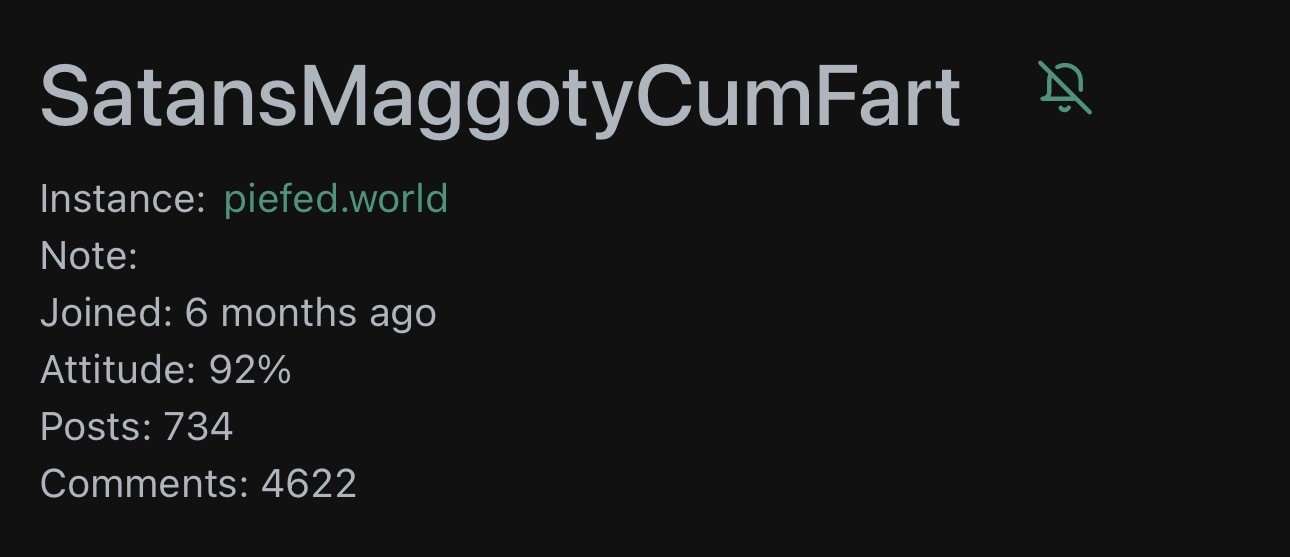
Are you taking about the attitude where I’m currently sitting at 92% even though I don’t ever say the popular thing?
I don’t even know how it works but why is mine there?
There’s a bunch that goes into the reputation score, it’s a combination of upvotes/downvotes as well as other factors. PieFed also has a stronger slur filter, where instead of replacing with removed, it outright doesn’t accept the comment if you type the phrase.
All in all PieFed is built specifically to cultivate echo chambers in ways that go beyond what Lemmy limits itself to, by design.
I’ve never have a comment that hasn’t been posted so can you show me some code to prove what you’re saying?
Dunno man, I‘ve got the double red triangle exclamation mark for „very low reputation“. Certainly it „warns“ unsuspecting people and I had already at least one commenter, that mistrusted my commentary just for that. Cool. Cool, cool.
Don‘t have an account — do I also have an attitude, it doesn‘t show any publically?
Either way, branding users like that, intransparently, by machine logic, I certainly am not convinced.

Whatever 100% attitude is you got it. Reading that shit would make me feel like a bad bitch tbh.
Attitude is just how much you upvote vs. how much you downvote.
But why?
So how’s that a social credit score?
It’s the one that auto hides or warns others on piefed just like reddit is doing.
Well at very high downvote rates, you simply can’t downvote anymore. It’s a mitigation against downvote trolling. There is also a hidden reputation score for instance admins which logs how much you also get downvoted.
You’re misunderstanding the blocked user issue. If every instance was Piefed, you simply wouldn’t be able to reply to anyone who has blocked you. “Reply” is essentially faded out. The difference is that Lemmy doesn’t implement the block function in the same way, so Piefed just throws out replies by blocked users to the person who has blocked them coming from Lemmy.
Is that the best way to handle blocked users, who have indicated they no longer wish to contact you? I don’t know. I can imagine it changing - but in my experience there’s no good way of handling it that won’t upset someone.
I’m not misunderstanding it, it’s a fact of how federation between Lemmy and PieFed works, and it results in comments appearing on Lemmy that do not exist on PieFed. Given Rimu’s clear ideological stances and vocal support for building in censorship into PieFed itself, I think it’s pretty obvious why this is the case: PieFed developers don’t like that Lemmy has a lot of communists, and wish to make a space easier to shut out communists.
I’m not misunderstanding it, it’s a fact of how federation between Lemmy and PieFed works, and it results in comments appearing on Lemmy that do not exist on PieFed.
Correct, but you’re assigning some malicious intent to it - when it’s simply differences regarding how blocking should work.
Given Rimu’s clear ideological stances and vocal support for building in censorship into PieFed itself
What “ideological stances” would these be that relevant here? Anyone can be blocked. You could block me now and I couldn’t reply via Piefed. This specific decision has no relevance to anything here.
I think it’s pretty obvious why this is the case: PieFed developers don’t like that Lemmy has a lot of communists, and wish to make a space easier to shut out communists.
Except that anyone can be blocked. A communist could utilise the block function in the same way and stop the person from being able to reply.
Rimu baked-in default blocking of Lemmygrad and Hexbear, to me this is already proof of malicious intent. Rimu’s ideological stances are reflected in the code itself, including things like a social credit score system that makes it more difficult to see comments from “unsavory users.” I’m aware that anyone can use the block function, but when viewed with the context of how Rimu’s views impact the project and how it relates to the fediverse in general, it’s designed with creating an echo chamber in mind.
Oh yeah, I remember hearing about this. Even apart from instances some community names by default aren’t federated. It’s a really weird stance.
It all makes sense if you look at it from the point of view of Rimu developing a platform that suits their views and interests first and foremost. I don’t agree with it, but it’s logical and predictable with that frame of analysis.
That’s an automated check-system for new piefed instances that specifically ignores communities with specific names. That list has been trimmed down now purely to just insults and slurs. It really isn’t a major component of the system as said communities with those names can still be manually federated to it.
Rimu baked-in default blocking of Lemmygrad and Hexbear, to me this is already proof of malicious intent.
Easily turned-off - and is by multiple other instances, but yes, Rimu doesn’t like them.
Rimu’s ideological stances are reflected in the code itself, including things like a social credit score system that makes it more difficult to see comments from “unsavory users.”
Not sure what this has to do with any particular or specific allegation of anti-communism. This is mostly to catch trolls and spammers, and it works.
I’m aware that anyone can use the block function, but when viewed with the context of how Rimu’s views impact the project and how it relates to the fediverse in general, it’s designed with creating an echo chamber in mind.
I simply don’t follow that at all. It means more accurately that Rimu simply believes that a blocked user shouldn’t be able to be replied to by the person they blocked as that can be used to harass by some.
I don’t think it’s particularly outlandish to say that the facts that Rimu thinks it’s acceptable to build ideological bias into the code itself, and that PieFed specifically has tools designed to more cultivate an echo chamber, are likely connected with Rimu’s own political bias. PieFed makes censorship easier and more opaque, Lemmy makes it harder and more transparent. I’m not saying that there are no good reasons to use PieFed, but that at least acknowledging that it’s being developed primarily to specifically counter issues Rimu personally has with Lemmy, including politically, is pretty reasonable.
As long as you can reply to replies of people who blocked you, I think it’s fine. Reddit’s approach is absolutely insane.
*Which is not what piefed does
Reddit goes further and does the [unavailable] thing.
That’s not further, it shows you that someone tried to reply. PieFed doesn’t even show that.
No, if you are blocked by someone on Reddit - you can’t see their profile or responses. All responses by them become [unavailable] and you can’t reply.
Ah, gotcha, misunderstood. It’s been a while since I used Reddit. Still, you’re effectively shadowbanned either way on PieFed, but not on Lemmy.
Removed by mod
Communists created Lemmy, and have been here since the start. Not sure why you’re surprised that communists are on Lemmy.
Removed by mod
“Tankie” is just a pejorative for anyone that upholds existing socialist projects as legitimate, so yea, “tankies” are usually communists.
We are.
Removed by mod
Is that all you got? Lmao
Oh hell yeah, can’t wait to read an incredibly babybrained and incoherent treatise on the “difference”.
If libs aren’t calling you a tankie, you aren’t a communist
Lol. How dare those commies take over their own community…
Y’all have no idea what you’re asking for
I’ve got a pretty good idea: Death to America
Y’all have no idea what you’re asking for


You’re on lemmy.ml
This has always been a Tankie instance for people that hate the west but don’t have the balls to move to the countries they simp for.
Yep, communists were here from the start.
“We are never more than nine meals away from anarchy.”
What’s the context?
isn’t homeownership rate around 66%?
Home ownership rate is the percentage of homes occupied, not the percentage of people who own their homes (or even have positive equity in them).
From what I could find, 1/3rd of the adult population rents, another 3rd have mortgages with negative equity, and 1/3rd have positive or paid off mortgages. I couldn’t find the number who fully own their homes.
Either way all of the above categories could still be house-poor, meaning you’re spending most of your income on housing and upkeep, and could still be a paycheck away from homelessness, unable to pay rent/mortgage. I had a relative who fully owned her home, but was unable to pay the property tax and her house was seized.