

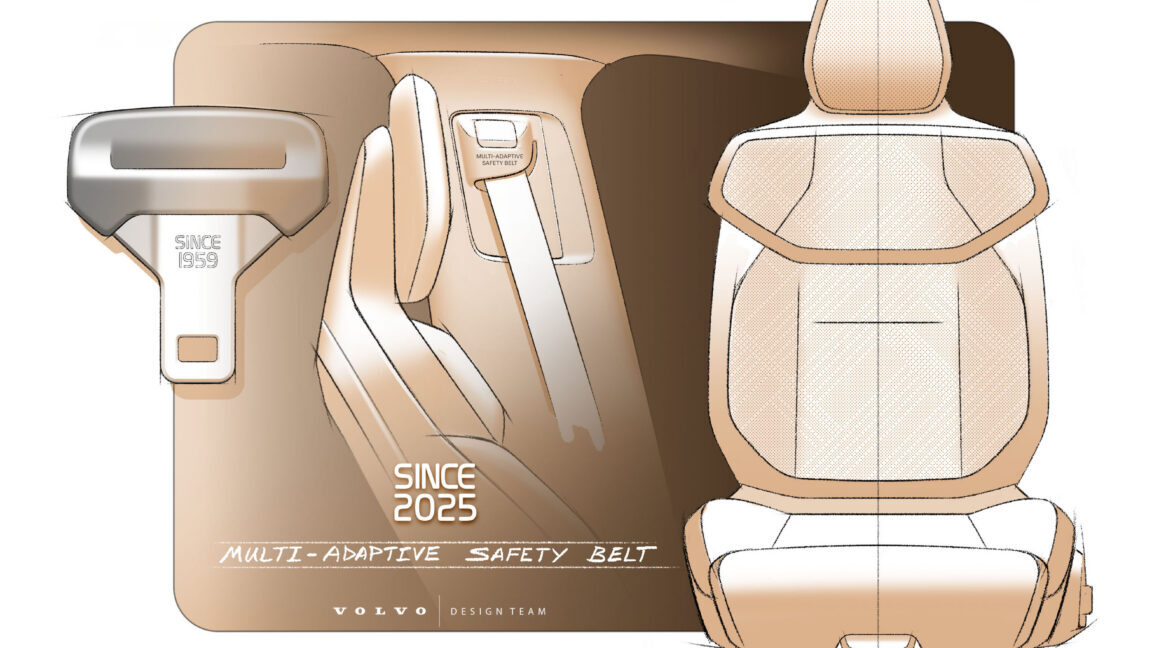
With the launch of its all-new, all-electric EX60, Volvo has put lessons learned from the EX30 and EX90 to use. The EX60 is built on Volvo’s new SPA3 platform, made only for battery-electric vehicles. It boasts up to 400 miles (643 km) of range, with fast-charging capabilities Volvo says add 173 miles (278 km) in 10 minutes. Mega casting reduces the number of parts of the rear floor from 100-plus to one piece crafted of aluminum alloy, reducing complexities and weld points.
Inside the cabin, however, the real achievement is Volvo’s new multi-adaptive safety belt. Volvo has a history with the modern three-point safety belt, which was perfected by in-house engineer Nils Bohlin in 1959 before the patent was shared with the world. Today at the Volvo Cars Safety Center lab, at least one brand-new Volvo is crashed every day in the name of science. The goal: to test not just how well its vehicles are protecting passengers but what the next frontier is in safety technology.
Senior Safety Technical Leader Mikael Ljung Aust is a driving behavior specialist with 20 years under his belt at Volvo. He says it’s easy to optimize testing toward one person or one test point and come up with a good result. However, both from the behavioral perspective and from physics, people are different. What’s not different, he points out, is how people drive.
“We’re shaped into a very similar automated behavior when we drive, so that makes the collision prevention side of things a bit easier,” Ljung Aust says. “But on the injury-prevention side of things is where the seat belt comes in, we’re working on the principle of equal safety for all. The idea is that independent of who you are in terms of size, shape, weight, all of these things, you should have exactly the same protection.”
Fuck right off with over the air updates to my life saving devices. I have enough over the air updates to my regular devices that break things thank you very much. I don’t want my ribs or life to be next.