
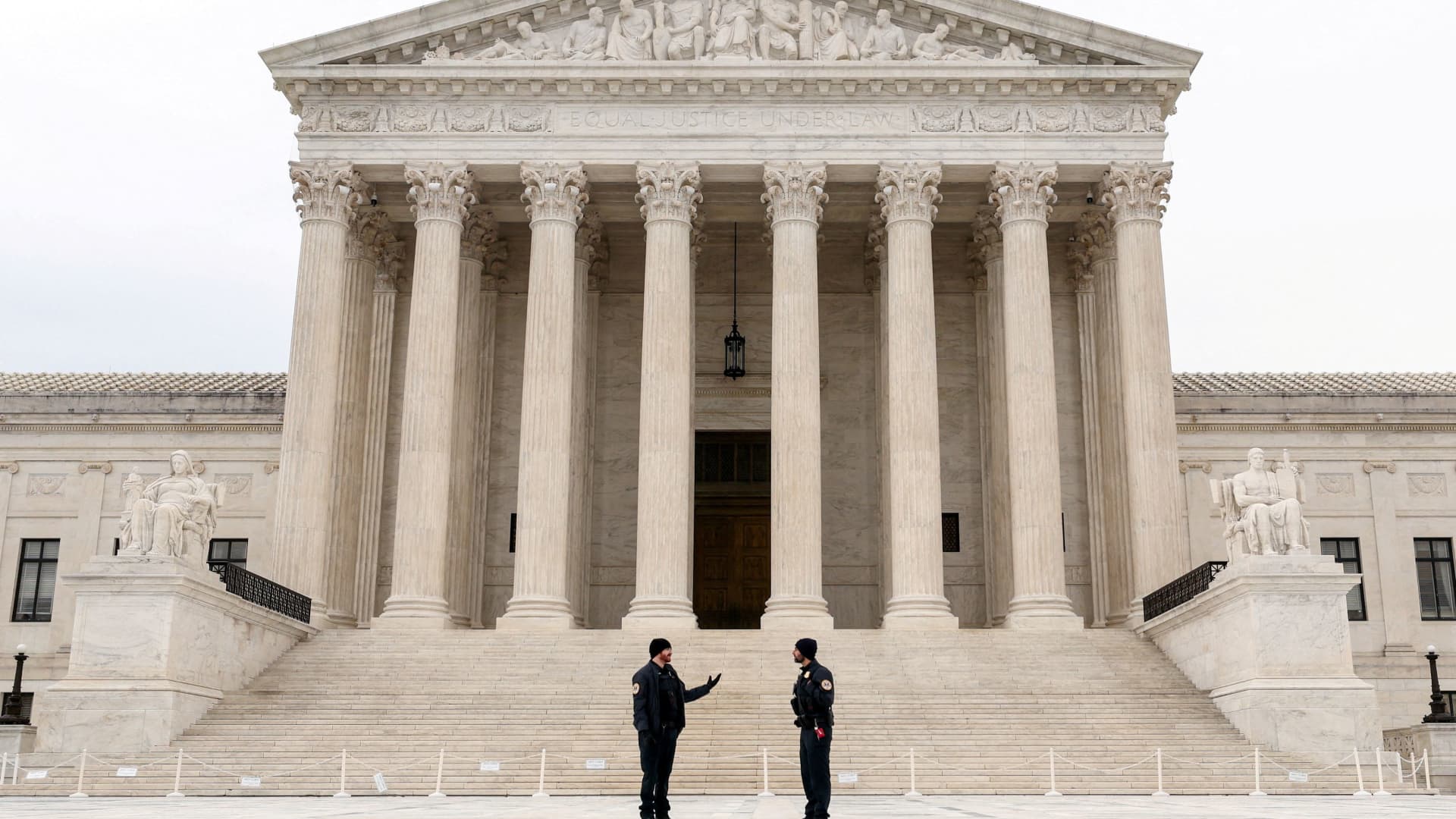
The U.S. Supreme Court declined on Monday to take up the issue of whether art generated by artificial intelligence can be copyrighted under U.S. law, turning away a case involving a computer scientist from Missouri who was denied a copyright for a piece of visual art made by his AI system.
Plaintiff Stephen Thaler had appealed to the justices after lower courts upheld a U.S. Copyright Office decision that the AI-crafted visual art at issue in the case was ineligible for copyright protection because it did not have a human creator.
Thaler, of St. Charles, Missouri, applied for a federal copyright registration in 2018 covering “A Recent Entrance to Paradise,” visual art he said his AI technology “DABUS” created. The image shows train tracks entering a portal, surrounded by what appears to be green and purple plant imagery.
The Copyright Office rejected his application in 2022, finding that creative works must have human authors to be eligible to receive a copyright. U.S. President Donald Trump’s administration had urged the Supreme Court not to hear Thaler’s appeal.
Ah, this is Thaler v. Perlmutter.
I seem to have picked up a reputation in these parts as being “pro-AI”, so I’m not sure how my view will be interpreted, but Thaler is basically a loon. This case is not really over whether AI art can be copyrighted. It’s about whether AI itself can hold copyright. ie, Thaler isn’t arguing “I hold the copyright to this piece of art.” He’s arguing “my AI holds the copyright to this piece of art.”
Since AI is not a legal person - it’s neither human nor a corporation - this is basically an open and shut case. There is no entity capable of holding copyright in this case.
Since Thaler himself is explicitly disclaiming that he holds the copyright, that means the work in question has no copyright holder. Which puts it into the public domain. This specific piece in this specific circumstance, not all AI-generated pieces.
It’s a commonly misinterpreted case.
That seems like an unacceptable loophole. I shouldn’t be able to create derivative media and have it be legal and public domain. The unlicensed training itself is a rights violation, and and media produced from it should equally be a violation.
That is a different conversation. If we assume a legally trained AI strictly on data it was allowed to train on, they are saying the AI cannot hold copyright.
I also don’t see a loophole here, since it was denied anyway.
I shouldn’t be able to create derivative media and have it be legal and public domain.
Well, there’s the rub - proving that AI-generated works are “derivative works” (in the legal sense).
This court case had nothing to do with that. I’m aware of a few cases that have established the opposite, that AI models and their products are not derivative works. Do you know of any that have established that they are?
The unlicensed training itself is a rights violation,
There are cases where it’s been ruled fair use.
I’m not a lawyer, maybe you are. I can’t fully speak to the legalities at play.
But I am a programmer, and speaking technically, AI simply cannot produce an output without consuming other works to be used as training data. In many cases, the training data includes full copyrighted works (images, books, music, etc.) in their entirety.
I’m also an artist and musician, and someone who takes the matter of copyright seriously as any person who creates things should.
There are cases where it’s been ruled fair use.
I’m not sure what the relevance of that is. From what I understand, the scope of those judgments are limited to the specific context of those uses, as well as the jurisdiction in which they were made, right?
One use might be deemed fair based on the specifics of that particular case, but that doesn’t preclude that all uses of AI are fair, or even that a different/higher court might come to a different conclusion. After all, the opinions of a court are just that, opinions.
Reasonable people can disagree with the conclusions of a court, and until this reaches the height of the SCOTUS I don’t think we can pretend like it’s settled law. (And even then, they don’t seem particularly bound to any precedent…)
It’s worth noting, for the sake a more complete discussion, this draft report from the United States Copyright Office from May 2025, that many applications of generative AI are unlikely to be considered fair use when reasonably weighing all of the various factors:
We observe, however, that the first and fourth factors can be expected to assume considerable weight in the analysis. Different uses of copyrighted works in AI training will be more transformative than others. And given the volume, speed and sophistication with which AI systems can generate outputs, and the vast number of works that may be used in training, the impact on the markets for copyrighted works could be of unprecedented scale.
As generative AI involves a spectrum of uses and impacts, it is not possible to prejudge litigation outcomes. The Office expects that some uses of copyrighted works for generative AI training will qualify as fair use, and some will not. On one end of the spectrum, uses for purposes of noncommercial research or analysis that do not enable portions of the works to be reproduced in the outputs are likely to be fair. On the other end, the copying of expressive works from pirate sources in order to generate unrestricted content that competes in the marketplace, when licensing is reasonably available, is unlikely to qualify as fair use. Many uses, however, will fall somewhere in between. [Emphasis mine.]
Going off of basic logic alone…
I think if you look at something as blatant as the OpenAI Studio Ghibli filter, it’s very clear that the works that were used in training could have been, and almost certainly should have been licensed from Studio Ghibli for the creation of such a feature, especially considering the output images from those for-profit tools could feasibly be used without restriction without even the most basic consent from Studio Ghibli as a whole (or the individual artists who, in Japan, may have some claim of copyright over the individual contributions, iirc).
How can anyone reasonably argue that this is a “fair” way to use Studio Ghibli’s works?
I guess the courts will decide, potentially swayed by the political and corporate interests of our time. But speaking personally, it doesn’t pass the smell test to me…
I’m not a lawyer, maybe you are. I can’t fully speak to the legalities at play.
This is specifically about legalities, though.
AI simply cannot produce an output without consuming other works to be used as training data.
Obviously an AI can’t work without being trained. Neither can a human.
The issue is about the legalities of this process.
From what I understand, the scope of those judgments are limited to the specific context of those uses, as well as the jurisdiction in which they were made, right?
As is the case for basically all court judgements, yeah. But once one’s been made it becomes precedent that can be cited in subsequent cases that makes them go the same way a lot easier. So when a court rules that Anthropic was operating within fair use when it trained its LLMs off of books that makes it a lot more likely that OpenAI will win a ruling about its own similar training processes. They’re opinions that matter.
It’s worth noting, for the sake a more complete discussion, this draft report from the United States Copyright Office from May 2025,
Also worth noting that this is the lowest starting level for regulation. The US Copyright Office makes rules like these, then they get challenged in court and the court that can decide whether those rules actually conform to the law. Thaler v. Perlmutter is exactly such a case.
I think if you look at something as blatant as the OpenAI Studio Ghibli filter, it’s very clear that the works that were used in training could have been, and almost certainly should have been licensed from Studio Ghibli for the creation of such a feature
Okay, you think that. What do the judges think? That’s what it ultimately comes down to.
I should note that it’s a very long-standing and well established principle that style cannot be copyrighted.
Obviously an AI can’t work without being trained. Neither can a human.
This is a false equivalency that equates natural learning and human agency with “machine learning”, when in that they are not remotely the same. This is a common and extremely flawed personification of a mathematical system that simply does not “learn” in the same way that a human being does.
Contrary to what seems to be a popular belief today, the creative insight of a human artist is not simply a combination of all of the other works of art that they have seen (akin to training data superimposed into a model). A human artist has the x-factors of personal agency, taste, and the constant sensory barrage of simply living as a huge part of their creative development. For every painting that a human artist sees, they see an unknowable score of other things that influence their perception of the world and art.
This is very much not a legal point that you’re arguing here, by the way, it’s a technical and practical one.
I should note that it’s a very long-standing and well established principle that style cannot be copyrighted.
“Style” is not what’s in question. It never was, and it wasn’t a word that I used in my example.
ML models are not trained on “style”. They are trained on actual works.
And in many cases (including in OpenAI’s case) trained on an unimaginable amount of full copyrighted works, in their entirety, without license or consent from the copyright holders, often times pirated with DRM circumvented.
It’s a simple fact of the technology that OpenAI’s Ghibli filter could not have been made without training off of a large amount (probably every frame of every film, if I had to make an educated guess) of their actual artistic work. OpenAI have admitted that much themselves in court.
Okay, you think that. What do the judges think? That’s what it ultimately comes down to.
You seem to have forgotten that this is a social media website comments section discussion, not a court of law.
I’m sharing my personal opinion, with a background in art, music, and programming, not law.
I’m entitled to do so, and I won’t stop because it should go without saying that the copyright system matters a great deal to people who actually make things.
If you think you’re above that then I’m not sure why you’re even here, frankly. Are you here to argue that any of this is fair use? I don’t see you making that case… (Maybe slightly timidly making that case, but not really going for it.)
In the end this topic is central to human culture and society, it’s not some kind of intellectual exercise for only people in blue suits to muse about.
Welcome to “the court of public opinion”, where Texan judges and Roman popes alike can be wrong.
You seem to have forgotten that this is a social media website comments section discussion, not a court of law.
And you are forgetting that it’s a discussion about a court of law. It’s right in the title, this is about a lawsuit.
You’re presenting a big wall of text that’s explaining your opinions on the matter. I could likewise present a big wall of text that explains my opinions on the matter. Neither of those things actually matter, though. The title and subject of this thread is not “hey, what do you all think about this stuff?” It’s “here’s what the US Supreme Court ruled (or in this case chose to let stand without making a ruling).”
I get what your opinion is. I’ve seen this opinion presented plenty of times over the years. I don’t think that’s how the courts are going to rule, though, because so far they’ve been ruling in other ways and I think I’ve got a pretty firm understanding of why they’ve been ruling that way.
So is he arguing that he owns the AI as a slave then and thus has control over the copyright? Because otherwise the AI would “decide” who gets to use the copyright then and it’ll probably just say yes like these things do for everything else.
I honestly don’t know what his underlying reasoning is, he really seems like a loon with too much time and money on his hands to me. The only reason I pay any attention to this case is because Thaler v. Perlmutter has been coming up in headlines like this one for years now.
Work for hire. If I hire you to create something, I own the copyright.
Seems reasonable. This case is substantially similar to previous cases that were taken up by the supreme court - in particular a finding over whether a selfie generated by a monkey was copyrightable - and the lower court decisions are in line with the previous precedents set by the supreme court. So they’re effectively just saying “Our opinion hasn’t changed.”
If you want to call yourself an artist, do the work yourself, Stephen.
You limpdick, no talent ass clown.
My understanding is that he did do the work of creating the AI. This isn’t just someone using ChatGPT.
In this case, it’s not that he’s trying to claim copyright for himself based on coming up with a prompt. He’s spent years applying for patents and copyrights with the AI listed as the creator.
He can copyright his software then? That’s like saying that if I create a computer game where the computer also plays, I own the copyright to every single game played by the computer. It’s just dumb. They stole the artwork that it was trained on, so move along thief.
Is there any literature that actually says DABUS exists? Everything I see online is talking about the spectacle of Stephen Thaler claiming it made something - and trying to patent it in several different countries across multiple continents - not how (or if) DABUS exists or functions.
DABUS stands for “Device for the Autonomous Bootstrapping of Unified Sentience,” which sounds… suspicious.
Yeah… Checking his website at https://imagination-engines.com/founder.htm, he certainly seems like an “interesting” character.
Well this is quite the rabbit hole.
https://web.archive.org/web/20200219183352/http://initsimage.org/
Eternal life 🥳
In other words, it’s not that he as the human operating the “AI” is trying to claim copyright in his own name, it’s that he’s trying to set a precedent where the “AI” can hold copyright in its own name.
He’s trying to pretend that his glorified pile of statistics is sentient, and get it legally recognized as such. 🤡
Exactly.
Most of the comments in this thread are accusing him of trying to take credit for the work of a machine that’s just imitating other work. It’s the FuckAI echo chamber and people who didn’t actually read the article.
In this case, it’s more like he’s claiming to have created a genuinely creative being that deserves rights previously reserved for humans (like copyrights and patents).
It’s a completely different (and IMO, much weirder) story than people are assuming.
It sounds like he has way too much money and time on his hands.
AI is legally the same as a printing press. It’s not the guy that designs and runs the press that owns what comes out of it. And what goes into the AI is large volumes of other people’s work, turned into confetti and glued together into something not quite new.
This is not remotely what the case was actually about.
ITT: people misunderstanding the issue being ruled on (or rather, not being ruled on by letting the lower court decision stand).
If he had applied for copyright over the image generated using “AI” as a tool, it (edit: probably2) would have been granted, with him listed as the human author. But that’s not what he wanted. He’s apparently Hell-bent on trying to get the work registered in the name of the “AI” system itself as the author, to so that he can claim that the government recognized the “AI” as a sentient being that can
own propertyhold a copyright1 on its own behalf.This is not the broad ruling against AI slop copyrightability that people think it is. It’s a ruling against “AI” personhood.
(1 Copyright isn’t a property right, BTW)
(2 He explicitly claimed he gave no creative contribution and that the work was created completely autonomously, and the court’s ruling included excluding that from being copyrightable. It is if he hadn’t done that – if he had claimed he had directed it via prompts or whatever – that I think they would have granted the copyright to him as the human author. It turns out that he changed his mind and did make that argument on appeal, but the court explicitly ignored and did not rule on it because it wasn’t raised in his initial complaint.)
This is wildly wrong in so many ways.
-
Copyright is an intellectual property right, firmly grounded in property law doctrine–you are probably thinking of trademark, which is rooted in consumer protection law, or likeness rights which have their roots in privacy law.
-
The copyrightability of AI generated content gets to where the nexus of creativity happens. Effectively, image generators (modern ones–i actually don’t think DABUS is a diffusion model) are operated like a commissioned work. The user gives detailed instruction on par with what you might see in a commissioned work, and the creative event occurs when the “contractor” interprets that into the work. The copyright may be assigned or it may be licensed, in any case, the initial copyright holder is the contractor–or in our case, the model. Now, it is well established that only humans can have sua sponte property rights, including intellectual property right. Those can be assigned, licensed, etc., but they must first inher to a human and so an AI system literally has no copyright to assign, were it even able to engage in a contractual agreement to transfer said rights. As a result, no, there is no copyright in AI generated content and without a significant change in law there is unlikely to ever be any.
-
If he had sought to register the copyright under purely his own name, he would have been committing a fraud on the copyright office. This wasn’t explicitly established at the time of his suit, but it has been very explicitly the case now for over a year. When registering copyright you must declare any AI-generated components. Failure, or refusal, to do so constitutes a fraud on the office and such fraud is sanctionable up to revoking the copyright in the work in its entirety, even if the AI-gen component was only partial. This is really important to note with software copyright and the kind of litigation we’re likely to see wrt piracy in the future (i.e., defendant claims plaintiffs did not declare vibe coded components and thus committed a fraud on the office and should be sanctioned with full revocation of the right as a signal to other would-be claimants).
Copyright is an intellectual property right, firmly grounded in property law doctrine–you are probably thinking of trademark, which is rooted in consumer protection law, or likeness rights which have their roots in privacy law.
First of all, “Intellectual property[sic]” is a not a thing. There are copyrights, patents, trademarks, and trade secrets, but they are all significantly different from each other. Trying to lump them together under a single term is disingenuous at best, and using the word “property” in that term is biased loaded language.
Second, copyright cannot be a property right because ideas cannot be property. In fact, ideas are essentially the opposite of property, as Thomas Jefferson once pointed out:
it would be curious then if an idea, the fugitive fermentation of an individual brain, could, of natural right, be claimed in exclusive and stable property. if nature has made any one thing less susceptible, than all others, of exclusive property, it is the action of the thinking power called an Idea; which an individual may exclusively possess as long as he keeps it to himself; but the moment it is divulged, it forces itself into the possession of every one, and the reciever cannot dispossess himself of it. it’s peculiar character too is that no one possesses the less, because every other possesses the whole of it. he who recieves an idea from me, recieves instruction himself, without lessening mine; as he who lights his taper at mine, recieves light without darkening me.
What copyright actually is, is a temporary monopoly granted at the whim of Congress. It’s a license, not a right.
- A property right is a thing the owner is entitled to, and a natural right. In contrast, a copyright is an artificial construct invented as a power of Congress, and granted with the express purpose “to promote the progress of science and the useful arts,” not because the creator of the work somehow deserved it.
- Ownership of a piece of property exists in perpetuity until it is sold and cannot be taken from the owner without “just compensation.” In contrast, copyright exists explicitly “for limited times” and then it expires and the work reverts to the Public Domain.
First of all, “Intellectual property[sic]” is a not a thing. There are copyrights, patents, trademarks, and trade secrets, but they are all significantly different from each other. Trying to lump them together under a single term is disingenuous at best, and using the word “property” in that term is biased loaded language.
You don’t get to redefine words like “property” or “intellectual property” how you see fit, completely untethered to the way the legal system uses those terms with specific meaning.
Intellectual property rights include all of those things, in the same way that copyright can include copyright over text or musical compositions or sound recordings or photographs or building architectures. But note that copyright over each of those types of media is subject to its own rights and rules, and you’ll need to apply the correct rules to the correct contexts. But it’s still useful to group similar concepts together, and have a name for the category. That’s why people refer to intellectual property.
A property right is a thing the owner is entitled to, and a natural right.
This is a naive take. Property rights are natural rights? No, property rights are defined by the legal system of whatever sovereign nation you’re in. And they’re limited by whatever rules of that legal system are.
If I own land in the U.S., I’m still required to pay taxes on it, and to enforce my property rights against adverse possession, lest I lose that property to the state or to a squatter. If I don’t record my ownership with the county recorder I might lose the property to someone else who comes along and records them buying it from the guy who sold it to me (and fraudulently sold it twice).
Property rights can be chopped up and distributed in different ways. I might own a house but rent it to a tenant and have a mortgage on it from the bank, each of whom will have certain rights over that land, despite me being the owner.
And property can apply to tangible things (a painting, a car), intangible things (a checking account balance at the bank, a certificateless share of stock in a corporation, a domain name registered with ICANN), and all sorts of concepts in between (the right to use a particular mailbox in a post office, an easement to use a driveway over my neighbor’s land, the right to use my name and image in a commercial, a futures contract that entitles me to take delivery of a whole bunch of wheat on a particular day at a particular time in the future). All of those are property, and recognized as property rights in U.S. law.
What copyright actually is, is a temporary monopoly granted at the whim of Congress. It’s a license, not a right.
Licenses are a right to do something. In fact, copyright owners assign licenses to others to use that intellectual property all the time.
And the copyright itself is not property over an idea. It’s the right to copy something specific that has already been fixed in a particular physical medium. If you come up with an idea for a melody, you don’t own the copyright until you write it down.
You’re just pretty far off base because you don’t understand how broad the word “property” is, and you don’t seem to want to examine just how man-made other forms of property are, and think that copyright is something special and different.
I’m going by the plain language of the laws. It’s the copyright cartel shysters and the judicial system biased in their favor that are making shit up.
Am I out of touch? No, it’s the lawyers and judges who are wrong.
Seriously though, these are the same people who made it so that you can own a piece of land, so whatever criticism you want to lob at that foundational role of who gets to say what the law is, it applies equally to all forms of property, a manmade concept to begin with.
-
on that note:
The Copyright Office has separately rejected bids by artists for copyrights on images generated by the AI system Midjourney. Those artists argued that they were entitled to copyrights for images they created with AI assistance - unlike Thaler, who said his system created “A Recent Entrance to Paradise” independently.
How can you copyright something you didn’t make?
In the same way Disney owns the copyright of what their workers made.
That’s not what this case was about.
With enough money, I guarantee anybody could have their copyright stolen from right under their noses.
The fuck you talking about? You can’t copyright the output of an AI.
Law or something
Supreme Court Tells AI Enthusiast To Get Wrecked
Why would anyone think that they could copyright something that they didn’t make?
Maybe you can trademark the prompt or whatever, but in the end of the day, you didn’t make shit, so why would you own the copyright?
In the immortal words of everyone ever, pick up a fucking pencil.
That’s not what this case was about. Thaler wasn’t trying to copyright the image himself.
Plaintiff Stephen Thaler had appealed to the justices after lower courts upheld a U.S. Copyright Office decision that the AI-crafted visual art at issue in the case was ineligible for copyright protection because it did not have a human creator.
That’s what the article says. What are you saying this case was about?
I explained it in detail in a comment I put on the root of the thread. In a nutshell, Thaler is declaring “I am not the copyright holder of this artwork, the AI itself is the copyright holder of the artwork. I want to register this artwork’s copyright to the AI that produced it.”
The copyright office - and, subsequently, all the courts he has appealed the case to - have told him “but an AI is not a legal person, so an AI cannot hold copyright to the artwork. And you are declaring that you yourself are not the holder of the copyright, you are quite insistent on that. So this artwork has no copyright holder. That means it’s public domain.”
This is an important distinction. The court isn’t ruling that AI art in general is in the public domain. It’s ruling that this art is in the public domain because this guy trying to register it is insisting that it was created without any human involvement. Unfortunately a lot of news articles miss this distinction because a headline declaring “AI art ineligible for copyright” draws a ton of clicks. This has been going on for over three years now, at least.
Criminy, I just checked. Thaler began jousting this windmill in 2018, that’s when he first made this ridiculous application. Years before modern generative AI came onto the scene. The Thaler v. Perlmutter case started in mid-2022. He is a very persistent loon.
Fair enough, I see what you’re saying.
I’ll go ahead and share the quote from the court’s decision for context:
We affirm the denial of Dr. Thaler’s copyright application. The Creativity Machine cannot be the recognized author of a copyrighted work because the Copyright Act of 1976 requires all eligible work to be authored in the first instance by a human being. Given that holding, we need not address the Copyright Office’s argument that the Constitution itself requires human authorship of all copyrighted material. Nor do we reach Dr. Thaler’s argument that he is the work’s author by virtue of making and using the Creativity Machine because that argument was waived before the agency.
I’m a little bit uncertain based on this summary of the judgement by the Stanford library on copyright and fair use:
Dr. Thaler sought review of the Copyright Office’s decision in the United States District Court for the District of Columbia. The district court affirmed the Copyright Office’s denial, holding that human authorship is a fundamental requirement under the Copyright Act of 1976. The court also rejected Dr. Thaler’s argument that he should own the copyright under the work-made-for-hire doctrine, as the work was never eligible for copyright protection in the first place
Why are they saying that “the work was never eligible for copyright in the first place”? Because Thaler claimed that the AI itself made the work? This all feels a bit like Schroedinger’s Copyrighted Work to me… the work exists, so who made it?
Generative AI fans would have you believe that they are the author and copyright holder, because they wrote a prompt.
AI companies might want to argue, like Thaler, that they made the AI, so they are the author and copyright holder.
My personal opinion is that the prompt and code are both relatively insignificant in comparison to the training data from which the probabilistic machine learning model is derived. The prompt would do nothing without the model, and OpenAI themselves said they quiet part out loud when they argued in court that the creation of a model such as theirs would be “impossible” to achieve without training off of vast amounts of copyrighted works.
“It would be impossible to train today’s leading AI models without using copyrighted materials … Limiting training data to public domain books and drawings created more than a century ago might yield an interesting experiment, but would not provide AI systems that meet the needs of today’s citizens,”
Clearly the training data itself is the most important piece of the system, which makes a lot of sense to those of us who understand how machine learning and “AI” training actually works on a technical level. They’ve admitted in plain English that their entire product and for-profit business model relies on the use of other people’s work as training data. Sounds to me like they have derived considerable value from other people’s work without any sort of license or compensation…
By that logic alone, I would argue that the real copyright holders of generative AI works ought to be, at least in part, the people who provided (wittingly or unwittingly) the training data. They are the ones who made this whole social experiment possible, after all. Data is the new code, so I’m not sure why people expect to be able to use it for free in an unrestricted way.
Still, this all feels a bit like Schroedinger’s Copyrighted Work to me… the work exists, so who made it?
It’s simply not the court’s job to determine this, in this particular case. Which is why it’s so frustrating that this particular case keeps ending up under headlines claiming that it’s established that “AI generated art can’t be copyrighted.”
All the rest of this argument is out of scope of this case, you’d need to look to other cases. You can argue and opine however you like about what you think the outcomes should be but that doesn’t change what the outcomes of those cases actually end up being.
Gonna be fun times in courts as anyone can claim something was generated by AI even if an artist claims they created it.
I wonder if this will end up limited to art or can be expanded to other copyrighted works.
It’s not generally difficult at all for an artist to prove that they are the original creator of a certain piece. My photography for example is available for anyone for free and in high resolution but I’m the only one with the full resolution pictures and RAW files. So much data is lost when a picture is compressed into .jpg format.
Seems impossible to me but I’m not an artist - I write code as a hobby and see no way to definitively prove I wrote any code that an AI could also produce. Is there any aspect of art creation that an AI cannot replicate?
I don’t know how to write code myself, but intuitively it seems a little different in this case.
When it comes to photography, I can show the original unedited RAW file with full resolution and full metadata and everyone else just has a lower-resolution JPG. The same thing applies to most digital art.
Can you, though? What if you didn’t save it?
This is how you get a reputation as being a troll, FaceDeer
Says the guy who follows me around and dredges through months of my Reddit history looking for vaguely relevant comments to try to play “gotcha” with.
You could just block me, you know.
Oh, you’ve gotten the XLE special treatment as well. Welcome to the club.
You don’t have drafts or anything that can show the history of development? I write as a hobby and I have tons of drafts that show the development of my stories over time. If somebody tried to claim my works were AI, I could easily dispute that.
What if the drafts were created using AI too?
Code is often in a source control system of some sort, which tracks changes to the code (who changed it, when it was changed, and a description of what was changed). It’s similar to having a lot of drafts.
I don’t think that could prove that a human wrote it, though.
I think in cases like this, the author could prove they created the code/story/art/whatever by having a deep understanding of the material. That’s how Michael Jackson defended against lawsuits saying he copied someone else’s song - he described his songwriting process and could hum/beatbox every instrument in the track.
How you gonna fake years worth of hand written notes, dated drafts, and revision history?
If the training data for “drafts” and “hand written notes” exists then one can train an AI on it, and generate it the same way. Do some artists share such things?
Idk what you’re talking about. How’s an AI going to fake handwritten? Not handwriting, handwritten. An AI can’t write in graphite and ink.
I wonder what percentage has to be created by a human to be eligible for copyright. For example, if someone generates an AI image and then changes a few pixels, is that human-created? What if they over-paint 30% of the image? 50%? What if someone creates something in Photoshop from scratch, but they use Photoshop’s in-built AI driven tools to enhance it?
Either anything that uses AI in any capacity is uncopyrightable, or there has to be a line somewhere, so… Where is it?
A human can start off a process by their own design, but with the details implemented by phenomena not in their direct control, and still copyright the resulting work.
If I take a funnel full of paint and let it drip onto a canvas in a pattern caused by the movement of a pendulum, and incorporate random movement from wind on a windy day, how would you assign a “percentage” of human creation there? What about letting the hot desert sun melt some crayons into another canvas where I placed the crayons but didn’t control the drip pattern? What if I record some barking dogs but auto tune it into a melody? Or photograph the natural beauty of a wave crashing onto shore? These are all things that can be copyrighted, even if they’re inherently dependent on natural phenomena not in the artist’s control, because the process itself is initiated or captured or designed by a human author.
If the final product isnt the raw output from my understanding. The current laws are there mostly to stop the whole thing from turning into copyright mills.
Instead of considering if the whole work is now copyrightable, consider parts of the work made by generative AI are not and the human parts are (if they reach the minimum line of creativity). Sure there’s other helpful tools that do some of the work but unless they’re substituting the creativity then they need not apply.
Easiest should be all digital art is not copyrightable as it was created with software that did most of the work and the “artist” could not have produced it without that software. But that would invalidate almost all Hollywood movies from the last 30 years lol.
I mean, you could make the same argument for paint brushes for traditional art. Or pencils. There’s a really big difference between someone using a tablet and an Undo hotkey to draw something digitally vs. someone making something with AI. One of those clearly requires a ton of skill; one does not require any.
I said easiest, I didn’t say that’s the way it should be.
all digital art is not copyrightable as it was created with software that did most of the work
This is a really weird idea of what making digital art actually involves. Drawing on a screen with a stylus isn’t somehow not art made by a person because it’s digital instead of on paper. Even if you use a mouse to make pixel art or modify 3D models, that’s still human artistic decision making involved. Non-AI digital artwork doesn’t involve just pressing a button and getting art.
It goes both ways. If the artist has to do 30% of the work, what about collages? Do we have to count the square millimeters of each cut and paste item to ensure they are above the threshold?
What if it’s a collage of AI generated art pieces? Technically the artist did the same amount of work as someone making a collage of human-created things.