EASY WAY TO REMEMBER HOW TO USE YOUR SCREWDRIVER
[a screwdriver is unscrewing a screw by turning counter-clockwise]
The LEFT liberates the screw from its oppression
[a screwdriver is screwing a screw by turning clockwise]
The RIGHT tightens the screw’s place in the social order imposed to it
But the right side will also remove the screw with the left-hand thread pictured.
Whoops, not anymore 😅
There we go!
Thanks for pointing it out :)
Mirrored by dumb ai or dumb human?
Dumb human in this case, OP is OC. It’s a throwback to his original (bad) art style /s.
I think it would be better if the left picture had left hand thread, and right picture right hand thread. It would be more realistic where both were beating you down, just one was a bit more obvious about doing it.
Found the libertarian. We can draw you as a nut.
Left and right to describe rotation is like the least helpful mnemonic ever.
Reposting this as a direct response to you in case it’s helpful:
Try using your right hand directly to figure out which way to turn a screw. Make a loose thumbs up. Point your thumb in the direction you want the screw to go. The way your fingers are curling is the way you turn your screwdriver. If it helps, try to imagine there are arrows pointing out of your fingertips. Works just like the right hand rule in physics.
EDIT: here’s a picture of what I mean:
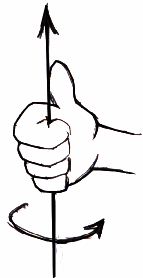
I absolutely love this method. Whenever you’re screwing anything (unless it’s reverse threaded ofc), just point your thumb in the direction you want it to go and twist it in the direction or your fingers. Really helps when you’re all turned around like lying on your back under the kitchen sink and need to tighten a nut.
It’s such a godsend. I wish people would teach both methods. It’s great that the “righty-tighty” thing works for so many people because it’s probably much faster than using your hand, but I spent so many years thinking I was shit at mechanical stuff because I couldn’t figure which way to turn a screw. I probably wouldn’t have a fucking obnoxious complex about it nowadays if I had learned this when I was five.
deleted by creator
deleted by creator
CW and CCW (or anti-clockwise) don’t alliterate with loose or rhyme with tight though.
Plus there was a whole generation that never bothered to learn to read clocks…
I always say clock in, counter out.
For a screwdriver. Not really. If your body is in a different frame of reference then I really doubt the direction is the worst of your problems.
It’s basically the same as the right hand rule in physics. The reference frame is not difficult to derive. The ease of the rhyme or “hand” to use is the point.
Or just use your right hand directly, just like some forms of the right hand rule. Make a loose thumbs up. Point your thumb in the direction you want the screw to go. The way your fingers are curling is the way you turn your screwdriver. If it helps, try to imagine there are arrows pointing out of your fingertips.
A few years ago, I learned that there are people who can distinguish left and right as easily as they can distinguish up and down. Righty-tighty lefty-loosey as a mnemonic device works for those people. I have never had, nor will I likely ever have, an intuitive understanding of which way to turn a screw. If one part of the screw is moving left, another part is moving right. My brain simply cannot keep it consistently straight. I have to use my right hand in the manner I described every so often. It’s not a hindrance to me (I build stuff all the time and have a little hobby machine shop), and I sure as shit wish I had been taught this method as a child.
This is an interesting comment. I don’t have an issue with left and right. They as easy are up and down to me. But I have this problem in my brain inverting something. It’s hard to describe exactly. But say I need to fold something or do some set of steps in a 3D space in reverse from what I usually do. I “think” I can do it. I understand all of the operations. But when I actually perform the movements it feels like something doesn’t connect.
Again, it’s hard to describe what exactly breaks in my brain connected with my actions. But it’s a consistently inaccurate operation no matter how many times I try.
You’re describing your issue better. But I definitely understand it in a way.
Edit: I’m gonna leave my dyslexia typo in here. Since its probably related to dyslexia in some way. Actually, my typo probably explains it better as an example than I ever could.
And the picture above is a clear example why. The one saying left has an arrow pointing to the right and vice versa.
When you are asked to turn left or right, you instinctively know where to turn your body. Now, imagine you are looking at it from above, seeing yourself from the top. When you turn left or right, your head and the rest of your body turn in a specific direction, which should be easy to visualize. That’s the same movement in which you’d turn a valve / turn a steering wheel / rotate a screwdriver when asked to turn it left or right.
Not everyone has this instinct. There are many people who are unable to differentiate left from right. For those people, this doesn’t really work. I’m in my thirties and I still give shitass directions because I suck at telling left from right. I can do cardinal directions pretty well as long as I have a reference like some mountains, but like, I still have to think about left versus right.
I posted this elsewhere in this thread, but the only thing that’s ever worked for me was the right hand rule, where you use your right hand to physically demonstrate to yourself which way a screw needs to go.
Also, TIL that there’s a specific term for this: https://en.wikipedia.org/wiki/Left-right_confusion
How about S-rotation and Z-rotation (imagine ends of letters being arrows)? Been thinking about this recently.
“La derecha oprime, la izquierda libera,”
I think this is the first time I’ve seen this joke, which now that I’ve seen it seems crazy and like it should be everywhere. Was this your original joke idea, Bad? Or were you just illustrating an old classic that I’ve never heard? Cos if you came up with this, damn, its a legendary one
It’s not an original idea, but rather a direct translation of how some spanish speakers remember how to use screwdrivers.
Thanks though :)
Based Spanish
Learned it from a colombian, so based Colombia, !que chimba este pais!
“Righty tighty, Lefty loosey” has been working for me all these years, I don’t see a reason to change now.
Lefty locky, righty removey. Alliterates better.
Same, and English is not even my native language. It’s just such and easy and effective phrase to remember
Your pants seem a bit too right.
meta
But as a screw I have a single purpose to be screwed. If not I am just living out my days in a sack of screws, never screwing. Being screwed is cozy.
Sounds kinky
Well then, screw you.
Can we get one more rotation on the arrows. Left one points right.
deleted by creator
Idk i never understood left or right for turning a screwdriver, like depends which way you are facing it goes left or right so it never helps me.
When you are asked to turn left or right, you instinctively know where to turn your body. Now, imagine you are looking at it from above, seeing yourself from the top. When you turn left or right, your head and the rest of your body turn in a specific direction, which should be easy to visualize. That’s the same movement in which you’d turn a valve / turn a steering wheel / rotate a screwdriver when asked to turn it left or right.
And what if im looking at from below now it’s the opposite, i dont have a problem knowing how to turn a screwdriver, i have a problem with understanding people saying left or right, because the top half turns one way and the other half of the rotation the opposite. Like when you turn right in a car the bottom of the steering wheel goes left, so idk you guys keep talking about it and ill just keep turning it the way i need to turn it without ever using the words left or right lol
Then it doesn’t work for you, which is fine.
Everyone has their own way of visualizing things.
Left/right is deeply ingrained in a lot of people for steering and screwing. Makes “natural” sense to me so I use it.
I’m rarely tasked with screwing a screw into my eye, so it typically points away from me. And then it’s just associating clockwise rotation with ‘right’.
Pretty common for me to screw the back of something facing me and I have to reach around and use the screwdriver on the back of the desk or something. Idk left or right just doesn’t enter my mind at all when I use a screwdriver but people call me autistic so i guess im the weird one.
I just use the USB-A technique:
- Try direction A: fail
- Try direction B: fail
- Try direction A: success
deleted by creator
Too many people feel bored and are getting screwed so it’s easy for them to mistake who they are in this diagram.
I like it. Reductionist, as the left has potential to be just as authoritarian, but it works.
screws*
😋
I like to say screw with or against the sun.
… and fucks babies. Rapes and kills babies. One policy does that too, which also can make it easy to remember