

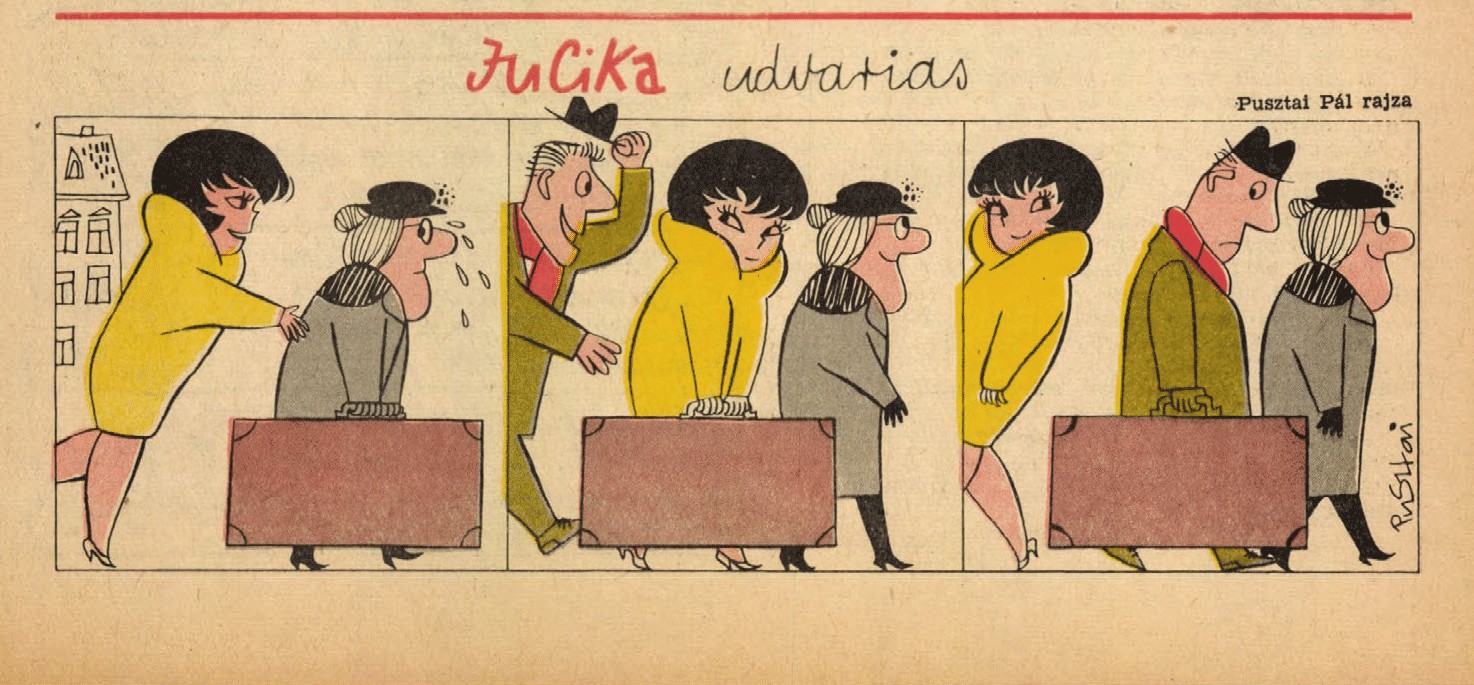
As always, stay tuned here on !comicstrips@lemmy.world for a slow trickle out of Jucika comics, but if you want to find more, here’s a good post with a large collection that /u/JohnnyEnzyme@piefed.social posted last year: https://piefed.social/post/1258520
**Also, check out some Jucika fan art! https://piefed.social/c/eurographicnovels/p/2128207/the-best-of-jucika-fan-art-12-pieces-with-two-videos
Weird stuff about Hungarian: we don’t use a form of ‘be’ when saying name+(is)+adjective. If you want to say ‘Jucika is modern’, in Hungarian you just say ‘Jucika modern’.
In this case (since they are written with different fonts) you can consider the two words as main title - subtitle, as the post title says.
They, however, also work as a full title, meaning ‘Jucika is courteous’.
Good to know! I went back and forth about that, wondering if that was the rule. I picked this way in case the intent was to jokingly apply “courteous” to the man too.
It’s fine either way 👌.
Do you use a form of the verb to be when ascribing adjectives to normal nouns?
Nope: ‘the tea is bisexual’ -> ‘a tea biszexuális’.
Do adjectives change their form in the same way verbs do? So could you gloss “a tea biszexuális” as “the tea bisexuals”, with a different form for plural tea, for if you or I are being described as bisexual"?
Sounds like someone speaks the language here : ). No and no. Plural of tea: teák. The ‘is’ is still not needed, but the plural gets added to the adjective, too: a teák biszexuálisak.
For I, you (singular), we and you (plural) we actually use the appropriate form of is/be (but note that pronouns are not needed, unless you want to emphasise them). ‘Be’ gets inclined accordingly to the person/pronoun, therefore:
I am bisexual -> biszexuális vagyok
You (s) are bisexual -> biszexuális vagy
We are bisexual -> biszexuálisak vagyunk
You (p) are bisexual -> biszexuálisak vagytok
I can’t wait for the future recommended words by my keyboard app now.
Oh interesting, so you can omit it only in the third person (or maybe some other situations - but not all) I’ve not heard of that exact set up before :)
I wonder how it works in Finnish and Estonian - the two distant relatives to Hungarian. I can’t think of anything else within the language family.
I believe in Finnish you use “is” with adjectives, although I can’t remember any Finnish adjectives right now.
…
Had to look it up, yeah found an example: “lukeminen on hauskaa” = “reading is fun”
Ah, thanks! Hauskaa.