

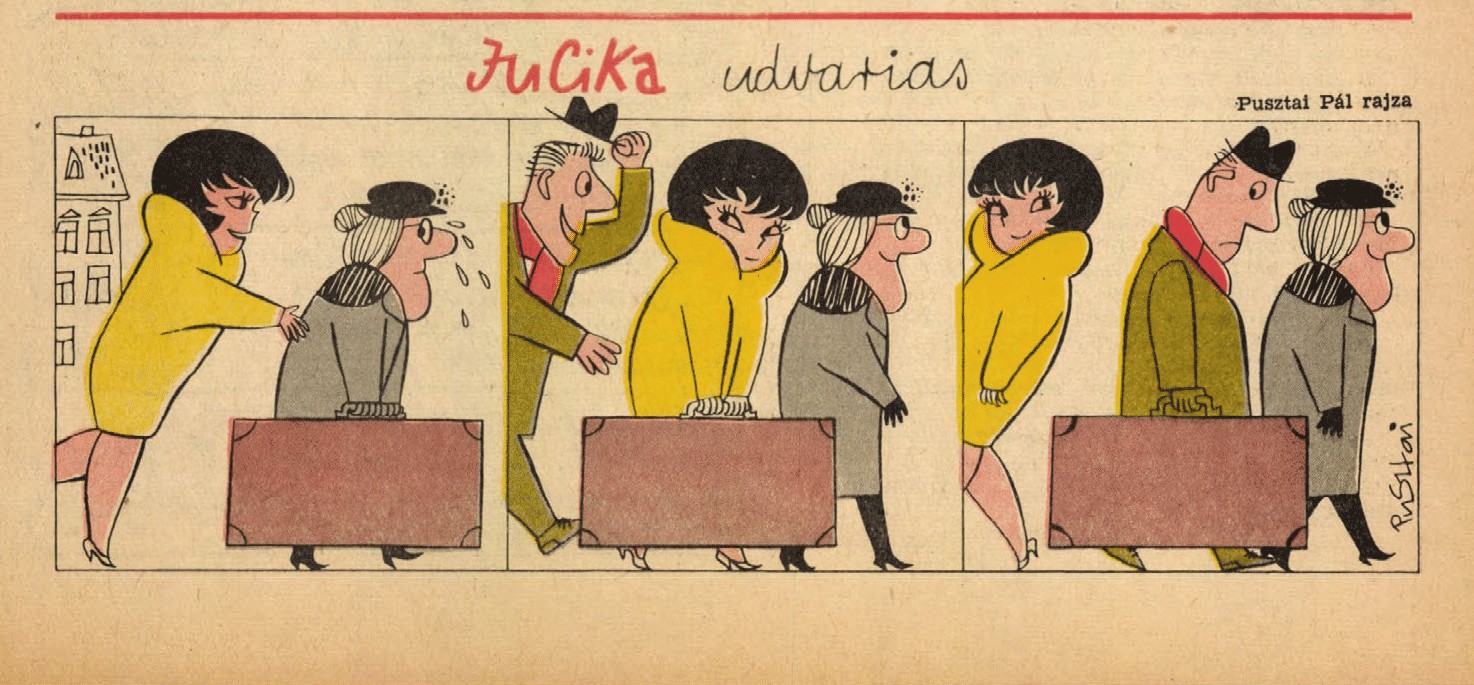
As always, stay tuned here on !comicstrips@lemmy.world for a slow trickle out of Jucika comics, but if you want to find more, here’s a good post with a large collection that /u/JohnnyEnzyme@piefed.social posted last year: https://piefed.social/post/1258520
**Also, check out some Jucika fan art! https://piefed.social/c/eurographicnovels/p/2128207/the-best-of-jucika-fan-art-12-pieces-with-two-videos
Nope: ‘the tea is bisexual’ -> ‘a tea biszexuális’.
Do adjectives change their form in the same way verbs do? So could you gloss “a tea biszexuális” as “the tea bisexuals”, with a different form for plural tea, for if you or I are being described as bisexual"?
Sounds like someone speaks the language here : ). No and no. Plural of tea: teák. The ‘is’ is still not needed, but the plural gets added to the adjective, too: a teák biszexuálisak.
For I, you (singular), we and you (plural) we actually use the appropriate form of is/be (but note that pronouns are not needed, unless you want to emphasise them). ‘Be’ gets inclined accordingly to the person/pronoun, therefore:
I am bisexual -> biszexuális vagyok
You (s) are bisexual -> biszexuális vagy
We are bisexual -> biszexuálisak vagyunk
You (p) are bisexual -> biszexuálisak vagytok
I can’t wait for the future recommended words by my keyboard app now.
Oh interesting, so you can omit it only in the third person (or maybe some other situations - but not all) I’ve not heard of that exact set up before :)
I wonder how it works in Finnish and Estonian - the two distant relatives to Hungarian. I can’t think of anything else within the language family.
I believe in Finnish you use “is” with adjectives, although I can’t remember any Finnish adjectives right now.
…
Had to look it up, yeah found an example: “lukeminen on hauskaa” = “reading is fun”
Ah, thanks! Hauskaa.
No worries! Yeah linguistics is fascinating! The possibilities are mind-boggling.
I agree that linguistics are fascinating. Even if I don’t understand the rest of the language this was such a fun comment chain to read! This is why I love the fediverse, I got enlightened in the comments of a meme