You must log in or register to comment.

Qr codes are kinda like punch cards in a way
Aren’t tapes still used for long term storage?
From what I know yes, but it’s also way out of consumer use. Heck, many people don’t even back up the only copy of their data.
I had a shirt with this on it. It ripped today. Crazy timing.

You know, CD is just round glorified punch card.
We have forgotten:


No because what the fuck are those
History.
specifically the please no touchey one looks so cool
That’s a warp core, duh.
The idea of using a cave to store memories for a bit by yelling into it so the idea echoes back later, is a beautiful dwarven fantasy solution that I don’t think could have even been imagined today. Nerds just no longer spend their formative years exploring the real world
We are lost in the deeps, crafting a new world, completely enchanted by the demon we awakened in the delving.
I watched a whole video on someone storing data as in-flight ping packets to the highest latency servers they could find. I don’t think we’re lacking in creativity at least.
You can also use birds as a storage medium.
https://flowingdata.com/2025/07/30/storing-png-image-data-in-a-birds-song/
That’s really cool. That was the 90s wasn’t it? I think I remember reading something about that in 2600. Cool though it may be, it’s just the same delay-line memory, but using the Internet as a medium rather than a drum of mercury. Which echoes what I was saying. I agree with you that creativity is not lacking now. I was just musing on how it’s mostly mapped off the map now rather than the territory.
This was much more recent, in 2022: https://youtu.be/JcJSW7Rprio
Edit: Wow, I completely forgot where this video went. The ping storage is only the first 10 minutes. I won’t spoil it, but it goes hard(er)
Would be cool to bring back 3.5" floppy as some sort of cartdrige for PCs but instead of the disk they have an SSD or similiar
Syquest: “Mortimer, we’re back!”
A 2230 m.2 drive is only 30mm long. That would easily fit in a 3.5" floppy with room to spare for a USB interface.
Yep, exactly what i was thinking, maybe the only troublesome thing may be the heat generated by the drivers and not being able to put an heatsink
How about a Lil fan in the drive
That’s even worse
bit bucket /n./ 1. The universal data sink (originally, the mythical receptacle used to catch bits when they fall off the end of a register during a shift instruction). Discarded, lost, or destroyed data is said to have “gone to the bit bucket”. On Unix, often used for /dev/null. Sometimes amplified as “the Great Bit Bucket in the Sky”. 2. The place where all lost mail and news messages eventually go. The selection is performed according to Finagle’s Law; important mail is much more likely to end up in the bit bucket than junk mail, which has an almost 100% probability of getting delivered. Routing to the bit bucket is automatically performed by mail-transfer agents, news systems, and the lower layers of the network. 3. The ideal location for all unwanted mail responses: “Flames about this article to the bit bucket.” Such a request is guaranteed to overflow one’s mailbox with flames. 4. Excuse for all mail that has not been sent. “I mailed you those figures last week; they must have landed in the bit bucket.”
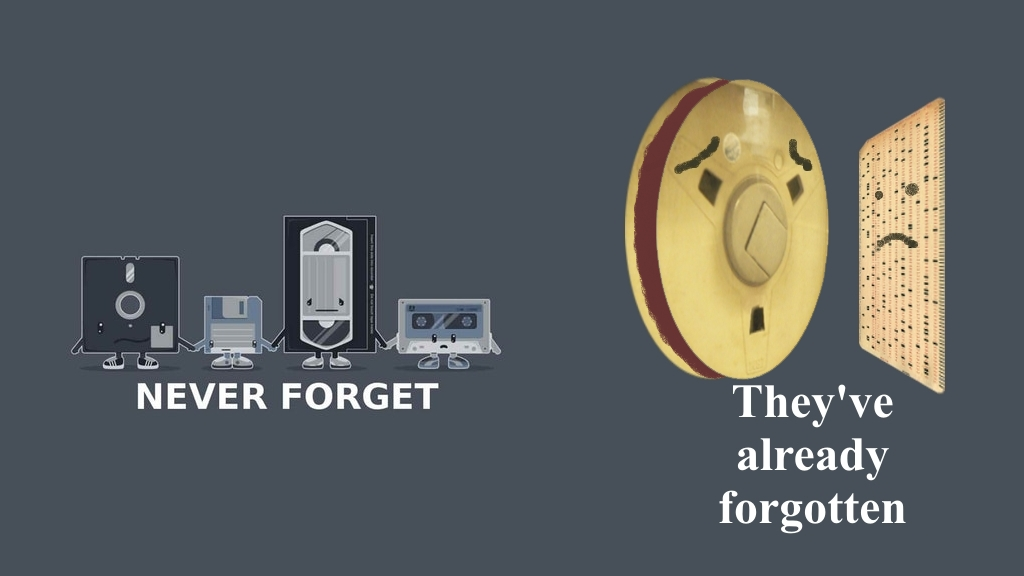
I recognize all but the large, black rectangle (Too big to be floppy?) on the left and the round thing on the right. What are those 2 things?
Left to right:
- 5 1/4” floppy
- 3.5” floppy
- Sony Digital Tape Format, though may be D1D or Data8
- audio cassette ( often used as cheap data storage in home computers)
- one of any reel to reel formats
- punch card
I didn’t know floppys (floppies?) got that big! I only recognize the 3.5 inch one from old Windows 98 physical installs.
They get bigger. I saw I think it was an 8 inch floppy once
My first had a 5 1/4, and I’ve seen the 8 inchers, but never had the pleasure of using one.
That sounded way dirtier than I meant.
From left to right:
5.25 in (130mm) and 3.5 in (90mm}

https://en.wikipedia.org/wiki/Floppy_disk
VHS tape

https://en.wikipedia.org/wiki/VHS
Compact Cassette

https://en.wikipedia.org/wiki/Cassette_tape
Open-reel magnetic tape (as opposed to a cartridge or cassette)

https://en.wikipedia.org/wiki/9-track_tape
https://en.wikipedia.org/wiki/Magnetic-tape_data_storage
Punched card

https://en.wikipedia.org/wiki/Punched_card
See also:
108 Rare and Bizarre Media Types - The8BitGuy (much has been forgotten)
Your floppies go 8 inch to 5 inch to 3 inch. You got three of them, not two
Yeah, that’s the picture that Wikipedia has.
Thats an 8" or 5.25" floppy on the left, there were 3 sizes:

Not exactly sure what kind, but I think they‘re both forms of magnetic tape storage (cassette on the left, tape reel on the right)(Edit: Got the one on the left wrong)
Side note: Tape storage is actually still pretty popular for long-term data storage!
The left one is a big floppy
Oh yeah, thanks!
That’s a 5.25" floppy. Back when they were actually a bit floppy. Before that there was an 8" floppy.
Next to it is the 3.5" floppy that came much later.
5.25" were square, so maybe you’re referring to the VHS that comes after the 3.5" floppy?
Edit: I should continue reading before replying.
No, they were that big and indeed quite floppy, too (only half as thick as those 3.5" disks and from rather soft plastic).
3.5" floppy (left). Those badboys actually were floppy. Not sure about the other.
The 5.25s were floppy. The 3.5 were only floppy when the plastic melted
Oh yeah I got my inches wrong 🤦♂️
pff look at the silly european doesn’t know how to measure using their arm. wait shit foot. my cover’s blown!
Related question for old data media enjoyers: I have extremely vague memories of a computer I used as a kid that had a punchcard like system where the holes had colored cellophane or something in them, presumably to add a few more bits of data per hole. I think the cards were probably some sort of plastic or maybe laminated paper? Has anyone heard of something like this?
I’ve seen punch cards where the optical media meant to be illuminated and projected for people to see, was accompanied by punched information for a computer to read. They were both on the same punch card. I want to say the USGS, the patent office, the army, and maybe Bell systems used these at some points?
I think this may be what you remember? I’ve never seen one where the holes carried a few extra bits of color information though. I do not think that existed on an industrial scale. Was it in a niche children’s toy?
Edit: found an image of the ones I was referring to

I finally figured out what it was, though embarrassingly I found out it wasn’t a punchcard, but a colored card with a barcode on the back.
https://hackaday.com/2020/04/27/teardown-vtech-whiz-kid-luggable-computer/
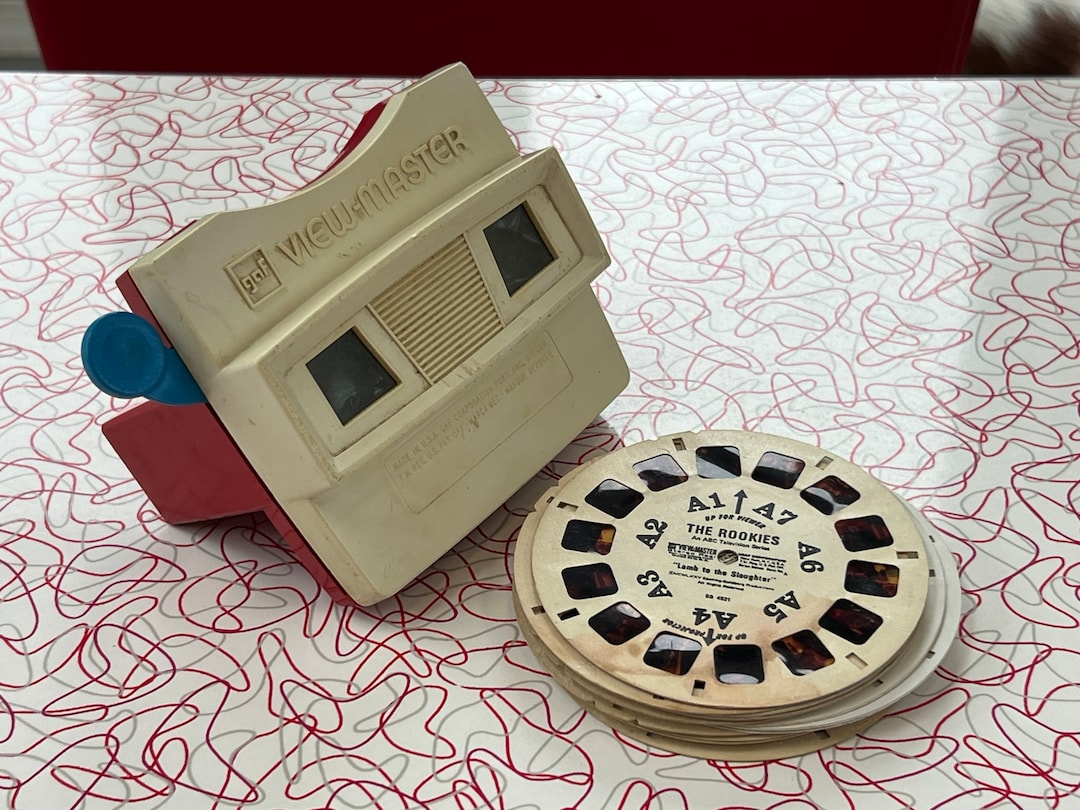
Nice, but it wasn’t a viewmaster. Similar idea, but it was an actual computer of some sort.
What you’re describing sounds very weird because punchcards are mechanical media and colored cellophane would be optical. We didn’t have any popular optical media until CDs. I think using optical media to store the extremely limited amount of data something like punchcard can store makes no sense.
It only really made sense as a way to give slides meant for human viewing, computerized data for sorting, filling, or otherwise using simultaneously with the slide. Like, a picture of an engineering diagram, patent, survey site, military target, etc.
Before we could store a picture as raw binary data, this was an interesting way to fill the need to digitally notate images. Punch cards like this were definitely in use for a while. I have a post above with an image.