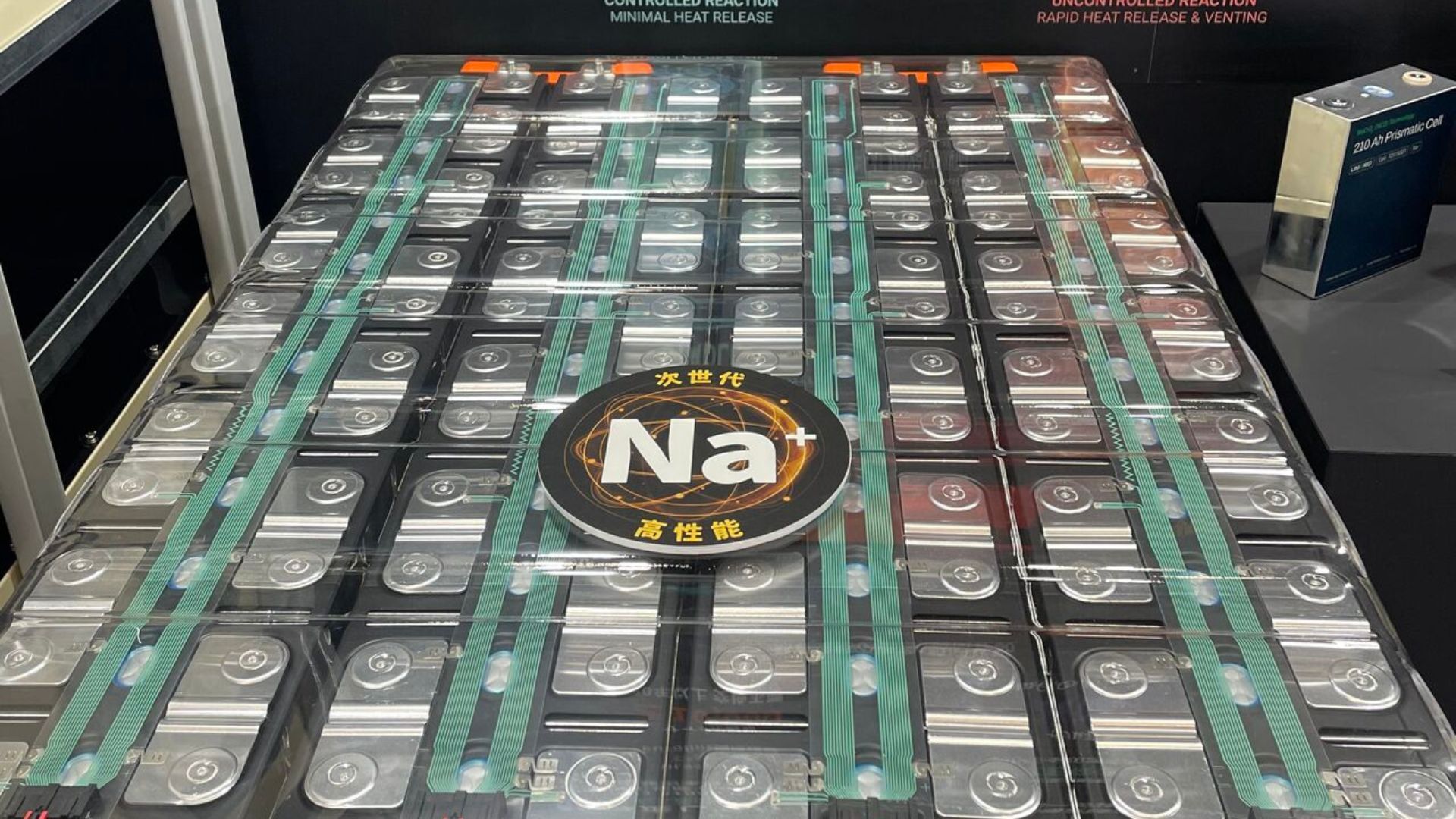
I’ve been hearing about these for a few years now. Huge if they work out at a large scale.
Commercialize it? Oh this one could be real
Is this the next big thing? Na. /j
Maybe they will make a potassium battery, K?
I was hoping science would’ve gotten us to a tri lanthanside by now https://youtu.be/D8fHatctfRo
Sodium-Ion is already in production at CATL. Been for about half a year if I recall. It’s slightly less dense than LFP but it’s cheaper and promises to get cheaper yet.
You’re right, they were making a pun about sodium’s chemical symbol.
Not who you replied to, but thanks for explaining! I saw the /j but still didn’t get it. I wasn’t a good chemistry student…
Any info about energy density?
I think they are testing Unigrid battery model 72173207 (terrible name). That is their 210Ah NCO prismatic cells.
I found this spec sheet. No definitive metrics, but someone else could do the napkin math.
CATL’s that went into mass prod sometime ago are 175Wh/kg.
According to Wikipedia:
Looks like power to weight it much higher, while energy per volume and energy per mass is comparable to existing lithium ion batteries.
idk about that, the regularly cited reason Na-ion batteries are mainly being looked at for grid storage rather than vehicle applications is their bad Wh/l and W/kg numbers compared to Li-ion. the table in the Na-ion article seems to use “1000W/kg” without a source, and it shows lithium as being about a third of that even though the Li-ion article quotes figures up to 10kW/kg.
seems the editors of the two articles aren’t cross-checking eachother.
Googling says 175 whr/kg for catls sodium car battery that’s already in production cars vs 270 whr/kg for Tesla’s lithium.
The “1000W/kg” figure appears to be from Wikipedia, which claims https://www.idtechex.com/en/research-article/sodium-ion-batteries-will-diversify-the-energy-storage-industry/30405 as a source. Wikipedia has the information in a table flagged as “Needs update”.
Anyway, most of the lithium-ion chemistry variations drop off relatively fast in capacity over repeated charge cycles (the exception being LiFePo4). If the sodium-ion chemistry is better that way, and drops off less in the cold, it’s still worth exploring for vehicle use even if the energy density is a little lower.
according to their product page, the charge rate for a single cell seems to max out at 3C, which could be a pretty big obstacle to grid-scale deployment. unless that’s a problem that can be fixed with a different arrangement; i’m not too up on how to build batteries.
deleted by creator
I assume 3C is a 20 minute charge?
Kind of, yes. But more importantly, it also means it can only push enough power to run at 3c. And that’s probably not for the full charge of the battery.
So a 100 amp hour battery rated at 3c can push out 300 amps. Which also means that if the grid needs a short spike in power, it might be limited.
It shouldn’t be too hard to get a 15c LiPo battery, which could push 5x as much energy at peak demand.
You’d probably kill the battery if you charged it from 0-100 at 15c, but for short bursts of charging and discharging, it should handle it just fine.
The comment I am replying to is discussing charge rate of 3C, not discharge rate
1 C is defined relative to 1 hour for full discharge and 3 C means a 3x faster discharge rate (full capacity can safely be discharged in 1/3 hour, or you can discharge 3 cells sequentially in an hour). Good lithium cells tend to be above 5C, can reach 10C for peak load or if cooled.
For a large enough battery it doesn’t really matter, but for dense portable ones a lower C rating means you have to discharge from more cells simultaneously to maintain a given output. That makes it more complicated, and you have less headroom to the battery’s maximum Watt output if you need to accelerate a car hard suddenly.
The comment I am responding to is about charge rate, not discharge rate
For most batteries that’s the exact same rate
Sodium ion batteries are asymmetrical, pushing charge current hard can drive the anode negative enough to deposit metallic sodium causing formation of dendrites which destroys the battery