You don’t have to, no. But you should. Not understanding how a system works that you fundamentally completely set up yourself is setting you up for massive failure. That’s like using unreal engine and only relying on blueprints without understanding C++.
If you want Arch without knowing shit about arch, there’s plenty of distros you can use. Stop trying to be cool. Pick something that fits your use case.
I haven’t paid attention to Omarchy to be honest. So I went to their website to see and was trying to watch the video on their distro. When he opened a terminal and intermediately opened a tiled browser window with X loaded, I just noped right out of there.
You are correct about the unable to read, and it’s a good thing they can’t.
Damn didn’t know about omarchy hate! Not that I care much. Don’t really understand why the developer gets flamed because of his vibe code obsession, if that’s the case (his problem not mine). But he is kinda insufferable to listen to - that’s why I chose not to.
Thanks. Interesting read. Not that I disagree with the points made in the post, but I find it quite problematic that the author at no point defines what he means by fascist. Does he subscribe to Marx, Umberto Eco, Walter Benjamin or other of the numerous philosophical descriptions. A little off topic but I think it’s important to at least reflect on this before labeling people without having properly defined the concept. I usually return to Eco and by his definition, DHH does indeed seem to align with (at least) Eco’s third aspect; Cult of Action for Action’s Sake. DHH rant on how “stupid” internal discussion and conflict in FOSS project is just bad leads me to believe that he is valuing action over reflection, leading to anti-intellectualism (which is also touched upon in the blog post).
Installing arch won’t give you anymore understanding of how system works, at least no more than installer would, linux systems are somewhat hard to understand especially if you aren’t deeply involved with them. Also that understanding requires so much peripheral knowledge of linux to start with, it’s not even funny. Like you can start on disk partitioning and it would take a week to explain everything you can do, look at this pie: encryption, vdo, lvm, different filesystems, billion things available in device mapper, then systemd mounts etc., etc…
I installed arch “from scratch” for the first time after installing it with archinstall like 4+ times previously, and yes it definitely somewhat did this, but honestly not quite to the extent that I expected. I feel like most of my system’s configuration was determined for me by the KDE plasma dependencies and defaults lol
My bootloader configuration is definitely one of the parts that I was more exposed to with a manual install, but honestly I don’t really see how what I learned would help me fix issues like that in the future, more about how I could customize the boot screen and extend my configuration with more boot options
idk it was a good experience to have but I think it brought more personal satisfaction than real practical benefit
Idk, my first time a while back (after Mint and git clone, ./configure copypasting), as soon as I stopped trying to debug the python script and started following the damn wiki, it took me like 2 hours or so to choose F2FS out of all options then chain that with LUKS with all of the relevant options to allow discards. Not counting the time it took to reboot from a “you are a dumbass lol - systemd” screen back to the installer. I completely ignored LVM and all of those other funny initialisms because it said it was optional and I didn’t see the point. I still don’t. Then I looked up how to get 3000000FPS in minenhandwerk and found alhp.go, that was mostly just copy pasting.
That’s like using unreal engine and only relying on blueprints without understanding C++.
I like your comparison in this situation. It’s so layman-unfriendly that one can doubt its usefulness. And I’m happy to see that I’m not the only one struggling to find suitable comparisons.
First of all, I disagree, kind of. You don’t need to know about unreal engine specifics to use arch. On the other hand, I can guess what blueprints are without knowing unreal (therefore I only disagree kind of). On the 2nd other hand, if they’re able and motivated to read up what you mean, they’re likely able to use arch.
Second of all, it’s not really good news, because if they don’t understand the comparison, they will not understand what you told them and therefore just ignore it. A warning in a language that you don’t understand will not stop you.
I appreciate your PSA, my point is maintaining arch properly sounds more challenging than the actual process of installing arch using archinstall.
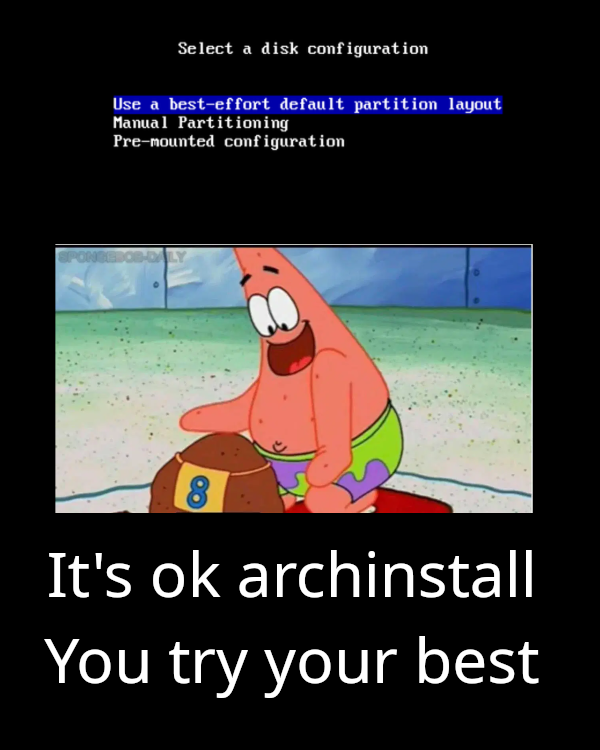
And like I said in the explaination, I use arch just for random VM shit , precisely because you can set up arch in like 2 mins using arch install in a braindead manner, just like patrick. It’s how I slop it into VMs.
Oh I get it, dw. But I often see memes like that used as “excuses” for technically illiterate people who want to be cool and use arch without understanding it. Like, it’s not about gatekeeping, it’s about people using software they are unable to handle and use, not because they’re dumb, but usually because there’s just no interest in learning these things. That’s the whole reason we had this AUR problem a few weeks ago, and that just kinda pissed me off so I’m reacting a bit allergic to these kind of memes.
That’s the whole reason we had this AUR problem a few weeks ago, and that just kinda pissed me off so I’m reacting a bit allergic to these kind of memes.
I had some fun trying to get started with buildbot and looked at packages that were pre-requisites and some of them were on AUR and I noped the fuck away from that shit precisely for that reason.
I need to have set up a lil’ debian to have done this shit in an env that I am familiar with, but archinstall is that easy and carefree that I can’t be bothered for debian installer to take ages in each step.
I’m not great at Linux, did programming for most of my life in Windows, but so far I’ve gotten by for about a year in CachyOS (uses Arch). Having it work so well in gaming has been a strong motivator.
Using a distro that’s a derivation of arch is perfectly fine. Cachy does all the configuration for you. SteamOS runs on arch aswell and is absolutely targeted towards non-technical people.
Plain arch does nothing of that. You have to install every package yourself. Want a network connection? You need something like NetworkManager for that. Wdym, a desktop? You have to install that. Oh, you don’t want your desktop to start via something like startx in the CLI? Well, you better go take a look at something like lightdm or sddm.
Most non-technical people that have no interest in learning that will not be able to use arch properly.


You don’t have to, no. But you should. Not understanding how a system works that you fundamentally completely set up yourself is setting you up for massive failure. That’s like using unreal engine and only relying on blueprints without understanding C++.
If you want Arch without knowing shit about arch, there’s plenty of distros you can use. Stop trying to be cool. Pick something that fits your use case.
Omarchy users in shambles right now. oh who am I kidding, they can’t read.
There are 10 users on omarchy right now, 3 of them are very pissed at you. The other 7 are AI agents so they don’t care.
That’s a really insightful observation, and you’re right to push back…
The angry user case is gated by the human emotion capability so it never ran for omarchy users.
I haven’t paid attention to Omarchy to be honest. So I went to their website to see and was trying to watch the video on their distro. When he opened a terminal and intermediately opened a tiled browser window with X loaded, I just noped right out of there.
You are correct about the unable to read, and it’s a good thing they can’t.
Damn didn’t know about omarchy hate! Not that I care much. Don’t really understand why the developer gets flamed because of his vibe code obsession, if that’s the case (his problem not mine). But he is kinda insufferable to listen to - that’s why I chose not to.
It’s so much more than that.
He’s a white supremacist and calls for genocide (whether you choose to listen to him or not).
https://crimier.github.io/posts/Framework-Omarchy/
Thanks. Interesting read. Not that I disagree with the points made in the post, but I find it quite problematic that the author at no point defines what he means by fascist. Does he subscribe to Marx, Umberto Eco, Walter Benjamin or other of the numerous philosophical descriptions. A little off topic but I think it’s important to at least reflect on this before labeling people without having properly defined the concept. I usually return to Eco and by his definition, DHH does indeed seem to align with (at least) Eco’s third aspect; Cult of Action for Action’s Sake. DHH rant on how “stupid” internal discussion and conflict in FOSS project is just bad leads me to believe that he is valuing action over reflection, leading to anti-intellectualism (which is also touched upon in the blog post).
Installing arch won’t give you anymore understanding of how system works, at least no more than installer would, linux systems are somewhat hard to understand especially if you aren’t deeply involved with them. Also that understanding requires so much peripheral knowledge of linux to start with, it’s not even funny. Like you can start on disk partitioning and it would take a week to explain everything you can do, look at this pie: encryption, vdo, lvm, different filesystems, billion things available in device mapper, then systemd mounts etc., etc…
Installing it manually will at least give you all the tools to fix your boot loader or troubleshoot an issue that prevents you from booting.
I installed arch “from scratch” for the first time after installing it with archinstall like 4+ times previously, and yes it definitely somewhat did this, but honestly not quite to the extent that I expected. I feel like most of my system’s configuration was determined for me by the KDE plasma dependencies and defaults lol
My bootloader configuration is definitely one of the parts that I was more exposed to with a manual install, but honestly I don’t really see how what I learned would help me fix issues like that in the future, more about how I could customize the boot screen and extend my configuration with more boot options
idk it was a good experience to have but I think it brought more personal satisfaction than real practical benefit
Idk, my first time a while back (after Mint and
git clone,./configurecopypasting), as soon as I stopped trying to debug the python script and started following the damn wiki, it took me like 2 hours or so to choose F2FS out of all options then chain that with LUKS with all of the relevant options to allow discards. Not counting the time it took to reboot from a “you are a dumbass lol - systemd” screen back to the installer. I completely ignored LVM and all of those other funny initialisms because it said it was optional and I didn’t see the point. I still don’t. Then I looked up how to get 3000000FPS in minenhandwerk and found alhp.go, that was mostly just copy pasting.I like your comparison in this situation. It’s so layman-unfriendly that one can doubt its usefulness. And I’m happy to see that I’m not the only one struggling to find suitable comparisons.
Good news, if you don’t understand that comparison, you shouldn’t use arch linux.
First of all, I disagree, kind of. You don’t need to know about unreal engine specifics to use arch. On the other hand, I can guess what blueprints are without knowing unreal (therefore I only disagree kind of). On the 2nd other hand, if they’re able and motivated to read up what you mean, they’re likely able to use arch.
Second of all, it’s not really good news, because if they don’t understand the comparison, they will not understand what you told them and therefore just ignore it. A warning in a language that you don’t understand will not stop you.
Amazing prose, fellow human. First of all, you wrote with one hand, another hand, and then another hand. Just to finish with, secondly.
Indeed. And I used my muscles powered by bread to move my internal skeleton to write this.
… there’s a reason why I said arch(install).
I appreciate your PSA, my point is maintaining arch properly sounds more challenging than the actual process of installing arch using archinstall.
And like I said in the explaination, I use arch just for random VM shit , precisely because you can set up arch in like 2 mins using arch install in a braindead manner, just like patrick. It’s how I slop it into VMs.
Oh I get it, dw. But I often see memes like that used as “excuses” for technically illiterate people who want to be cool and use arch without understanding it. Like, it’s not about gatekeeping, it’s about people using software they are unable to handle and use, not because they’re dumb, but usually because there’s just no interest in learning these things. That’s the whole reason we had this AUR problem a few weeks ago, and that just kinda pissed me off so I’m reacting a bit allergic to these kind of memes.
I had some fun trying to get started with buildbot and looked at packages that were pre-requisites and some of them were on AUR and I noped the fuck away from that shit precisely for that reason.
I need to have set up a lil’ debian to have done this shit in an env that I am familiar with, but archinstall is that easy and carefree that I can’t be bothered for debian installer to take ages in each step.
I’m not great at Linux, did programming for most of my life in Windows, but so far I’ve gotten by for about a year in CachyOS (uses Arch). Having it work so well in gaming has been a strong motivator.
Using a distro that’s a derivation of arch is perfectly fine. Cachy does all the configuration for you. SteamOS runs on arch aswell and is absolutely targeted towards non-technical people.
Plain arch does nothing of that. You have to install every package yourself. Want a network connection? You need something like NetworkManager for that. Wdym, a desktop? You have to install that. Oh, you don’t want your desktop to start via something like
startxin the CLI? Well, you better go take a look at something like lightdm or sddm.Most non-technical people that have no interest in learning that will not be able to use arch properly.