
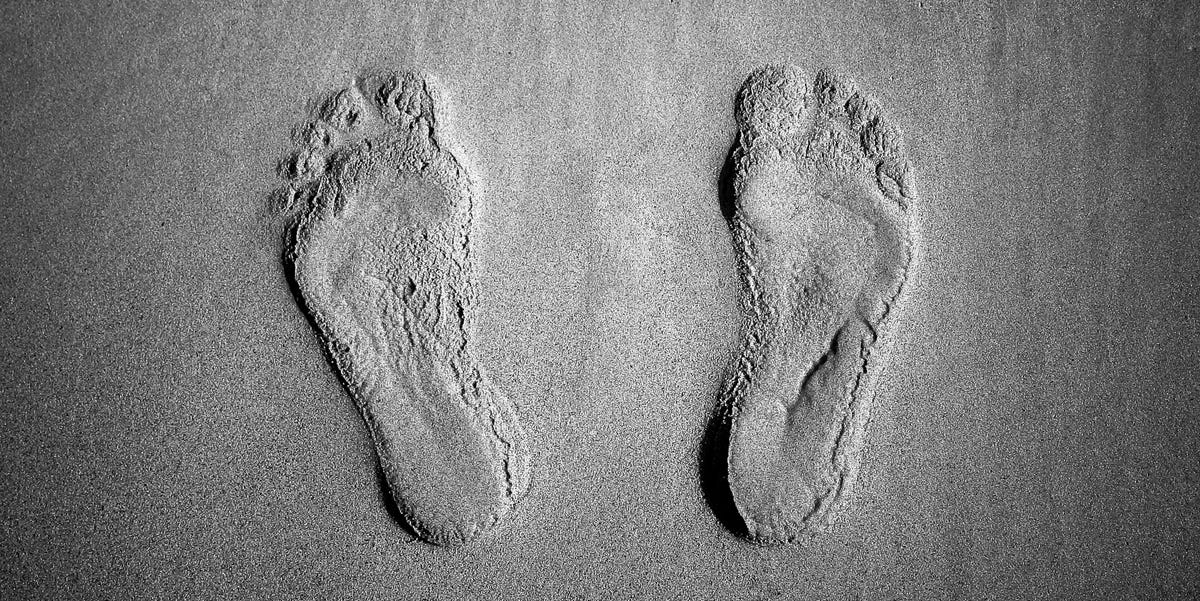
I hate the clickbaity title and will not click it. So I’m just gonna assume they’re talking about the moon
Taken from the what you’ll learn in this article section at the top:
- Fossilized footprints in Saudi Arabia show human traffic on the cusp of a subsequent ice age.
- Like carbon dating, scientists use isotopes and context clues to calculate the approximate age of fossils.
- These human prints were surrounded by animals but not hunted animals, indicating humans were just thirsty.
3. These human prints were surrounded by animals but not hunted animals, indicating humans were just thirsty.
Uh… Thirsty for what? 😬
Look… What in nature haven’t we fucked.
Real estate?
gestures broadly at everything
Humans have been around, as a species, for 0.3 million years (approximately). The most recent 10,000 years are not a statistically representative sample of humans.
- Thirsty - feeling thirst
- Thirst - a sensation of dryness in the mouth and throat associated with a desire for liquids, also : the bodily condition (as of dehydration) that induces this sensation
Jokes aside, why does everybody feel the need to gravitate towards the least popular definition here?
For fake Internet points?
projection…
given the fossil and archeological evidence for the spread of H. sapiens into the Levant and Arabia during [the era 130,000 to 80,000 years ago] and absence of Homo neanderthalensis from the Levant at that time, we argue that H. sapiens was responsible for the tracks at Alathar.
Scientists: Since we already know H. Sapiens was here then, we think they did it.
Headline: Human footprints shouldn’t be here then!
The linked Popular Mechanics article cites this Smithsonian article.
The Smithsonian article cites this National Geographic article and this Science Advances article (among others).
The National Geographic article is paywalled.
The Science Advances research article seems to be the original source—here’s the abstract:
The nature of human dispersals out of Africa has remained elusive because of the poor resolution of paleoecological data in direct association with remains of the earliest non-African people. Here, we report hominin and non-hominin mammalian tracks from an ancient lake deposit in the Arabian Peninsula, dated within the last interglacial. The findings, it is argued, likely represent the oldest securely dated evidence for Homo sapiens in Arabia. The paleoecological evidence indicates a well-watered semi-arid grassland setting during human movements into the Nefud Desert of Saudi Arabia. We conclude that visitation to the lake was transient, likely serving as a place to drink and to forage, and that late Pleistocene human and mammalian migrations and landscape use patterns in Arabia were inexorably linked.
You da real MVP.
[science-news-cycle.png]
Ceiling?
On the moon ?
Yepp, sounds like humans all right.
Right outside your bedroom window.
Ugh, probably tracking sand across my freshly washed floors!
On my lawn‽

How does one get two upvotes and a heart on Lemmy? (Maybe it’s a Mander.xyz thing I never noticed before.)

It’s client dependent, but for that one the heart is the final karma score after downvotes and upvotes are calculated together
Oh, interesting. I’m seeing it on my comment. Haven’t noticed this on other instances before. Thanks!
Someone downvoted my question. Classic.