
- cross-posted to:
- technology@lemmy.world
- hardware@lemmy.world
- cross-posted to:
- technology@lemmy.world
- hardware@lemmy.world
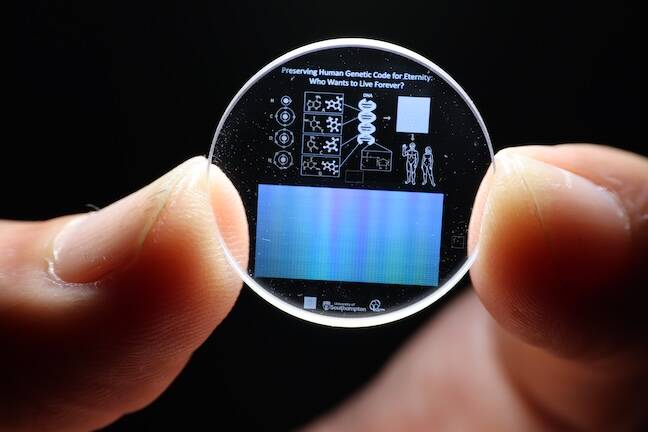
After decades of research and development, humanity finally has a data storage medium that will outlast us.
The 5D Memory Crystal stores data by using tiny voxels – 3D pixels – in fused silica glass, etched by femtosecond laser pulses. These voxels possess “birefringence,” meaning that their light refraction characteristics vary depending upon the polarization and direction of incoming light.
That difference in light orientation and strength can be read in conjunction with the voxel’s location (x, y, z coordinates), allowing data to be encoded in five dimensional space.
And because the medium is silica crystal, similar to optical cable, it’s highly durable. It’s also capacious: The technology can store up to 360 TB of data on a 5-inch glass platter.
You must log in or register to comment.
Data hoarders everywhere rejoice!
But on a more serious note, a commercially viable product would be awesome.
Data hoarders
This is the Internet, you can say it: pr0n collectors
Oddly, as I’ve gotten older, I’ve ceased enjoying internet porn. Maybe it’s shooting it myself years ago, but, like: Why would you want random people you’ll never meet? I don’t get the industry as a whole … like, yeah, people liked my wife, but where does that get you?
where does that get you?
Off.
My ex-wife would shoot you back so hard that you think fingering is interesting porn.
That’s well and good, but imagine keeping your software backwards compatible with an ancient 14 billion year old file standard.
Hell, I have no way of getting data off a 3.5" floppy!
I got you buddy. https://thespotreview.com/usb-powered-floppy-drives/
That’s fine as long as it’s a standard 1.44MB or 720K formatted disk. For anything else, you will probably need an old PC or a Greaseweazle.
Thanks! Definitely a little niche for my purposees, but I can definitely see that being really useful for retro tech!
That’s pretty much the universe being compatible with the big bang
A technology I’ve been eagerly anticipating for many, many years now. It still sounds like it’s in the “Real Soon Now, honest!” Phase though:
In the next 18 months, the company hopes to have a field-deployable read device that customers can use to read archived data. But SPhotonix isn’t presently targeting the consumer market. Kazansky estimates that the initial cost of the read device will be about $6,000 and the initial cost of the write device will be about $30,000.
[…]
“We need another three or four years of R&D to get it to the production and marketing standpoint,” Kazansky said.
[,]
“We are not aiming to become a manufacturing company,” said Kazansky. “We are a technology licensing company. We love the model of Arm Holdings. And to a certain extent, we love the model of Nvidia. So we are developing the enablement technology, and then we’re going to be forming some form of a consortium, some form of a group of companies that will help us to bring this technology to market.”
Which is where it’s been for all of those many years I’ve been anticipating it. But who knows, perhaps this will be the company to finally start selling them. I’m fine with them being expensive at first, the cost will come down if they take off.
Initial cost of the read device will be about $6,000
That’s not bad at all. It’s something that basically every library could have. Imagine that level of distributed redundancy for hundreds of terrabytes worth of information, in a medium that essentially lasts forever.
Assuming it really is coming out at that price of course.
Hope this becomes affordable enough to utilize. The main problem with optical disks is the length of time. Still would be nice to have something as convenient as a usb drive even if it can’t be rewritten. Disks were sorta of annoying to put some stuff on and then a bit more and a bit more.
The real annoying part of CDs was the failure rate. It could be the medium, the burner, or the software, but it always seemed you’d spend time waiting for the data to be saved to a more “permanent” source, and it would finally pop up with an error and the whole disk is now trash. Kind of glad that tech is now obsolete. I think you could redo a read/write a few times, but they had similar issues and it was a pain.
I literally burned some DVDs last week…
deleted by creator
I doubt it was the microwave situation. One does that once. In college. On the floor kitchen because even though you have your own, this experiment is worth doing in public.
ehhhh get back to me in 14B years, i only believe REAL-WORLD metrics

Move over FeRAM
This is perfect for mass surveillance and social credit data. So they can keep all your important data from day 1 until your death and even for the next hunedred generations…