I know what you mean, just beware: in lots of cases it’s not as universal (as in distro-independent) as some still think it is.
For people who want to get things done with their PC that isn’t inherently IT-related (like, doing office work or music production or anything else) and just need to do the occasional light sysadmin thing like setting up new drives to be auto-mounted somewhere, pointing to GUI tools is just so much better. And in many cases it is also safer (making your system fail on boot with a small typo in the fstab is painfully easy).
I get where you’re coming from. But as something of an enthusiast myself I don’t always know GUI tools for all the tasks I can do in a terminal. Edit: typos
As someone that started in Linux, for real, with Debian, and in a time that I had to mannually install my graphics card, I learned the way I did things on Debian was significantly different from things got done on other distro families. That, alone, kept faithful to the Debian tree.
Yeah, I’m with you. I fucked up my Deb install because I strayed from “doing things the debian way” and overtinkering with things I wasn’t meant to do.
But compared to other distros, debian feels like a bomb bunker; once you set it up, it’s going to stay set up.
It’s like a landmark. It just exists and reality itself seems to bend around it.
I ran a Debian machine, a laptop, until the hardware literally gave up. Eight years of solid service. Regular updates and one reinstall to move to the next version.
It kept working. It kept playing music, playing videos, managing my office needs, surfing the web and receiving my email. Flawlessly.
It outperformed newer machines in its last years and people could not wrap their heads around the notion.


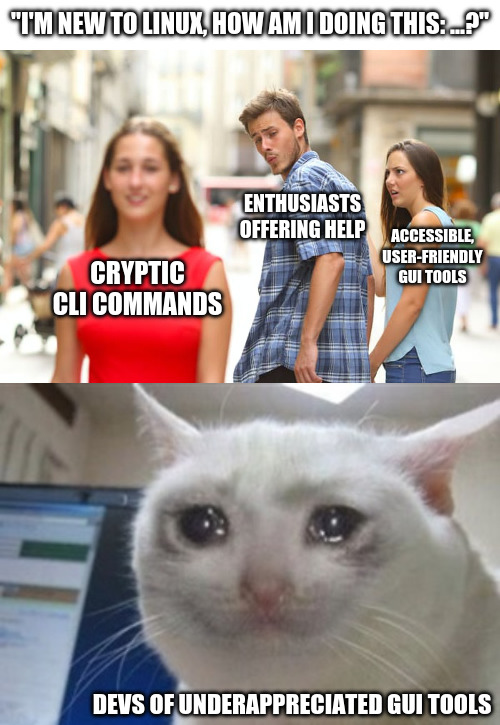
I’ve been in a situation like this recently and all I can say is that the CLI is universal.
Yes, it is complex. Yes, it is challenging. But it gets things done.
Don’t be afraid.
I know what you mean, just beware: in lots of cases it’s not as universal (as in distro-independent) as some still think it is.
For people who want to get things done with their PC that isn’t inherently IT-related (like, doing office work or music production or anything else) and just need to do the occasional light sysadmin thing like setting up new drives to be auto-mounted somewhere, pointing to GUI tools is just so much better. And in many cases it is also safer (making your system fail on boot with a small typo in the fstab is painfully easy).
I get where you’re coming from. But as something of an enthusiast myself I don’t always know GUI tools for all the tasks I can do in a terminal. Edit: typos
This is especially true when we start talking about BSDs and other non-GNU platforms.
True.
As someone that started in Linux, for real, with Debian, and in a time that I had to mannually install my graphics card, I learned the way I did things on Debian was significantly different from things got done on other distro families. That, alone, kept faithful to the Debian tree.
Yeah, I’m with you. I fucked up my Deb install because I strayed from “doing things the debian way” and overtinkering with things I wasn’t meant to do.
But compared to other distros, debian feels like a bomb bunker; once you set it up, it’s going to stay set up.
Monolith is a word that fits Debian very well.
It’s like a landmark. It just exists and reality itself seems to bend around it.
I ran a Debian machine, a laptop, until the hardware literally gave up. Eight years of solid service. Regular updates and one reinstall to move to the next version.
It kept working. It kept playing music, playing videos, managing my office needs, surfing the web and receiving my email. Flawlessly.
It outperformed newer machines in its last years and people could not wrap their heads around the notion.
Debian, as a Linux+FOSS combo is a winner combo
Also, GUI changes faster than CLI, CLI has ALWAYS more options, and you can save those commands to a file.
Also can get explanations for every command.
It’s not even that complex, it just looks that way if you’re not used to using it
It isn’t, I admit. But the first impression is intimidating.