There was a whole team of “engineers” that once told me, “using infrastructure as Code obfuscates things, using the GUI allows us to see exactly what is happening!”
They did not appreciate it when I told them to “git gud, or GTFO”.
Subsequently the company hired 5 more automation engineers like me and the two dozen of ClickOps “engineers” were let go. Our productivity is even higher with the 6 of us compared to more than two dozen of them.
GUI is nice for hobbyists and mainstream consumers.
I mean, there are definitely use cases where gui makes more sense. For example, utilities like GParted or KDE Partition Manager make messing with partitions much easier since they’re easier to deal with visually (imo)


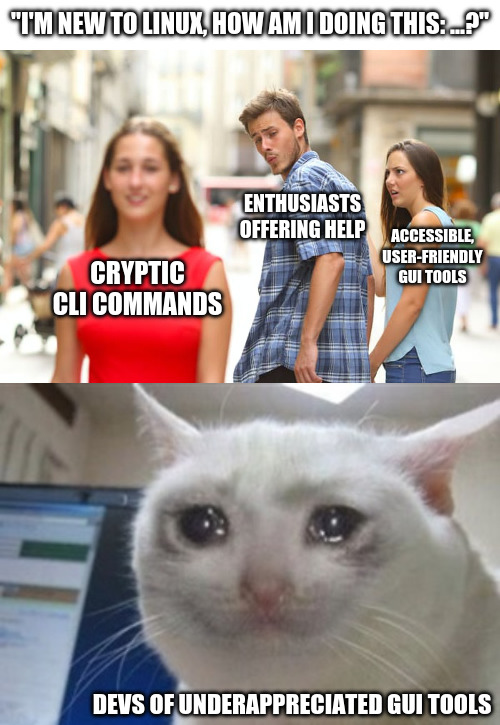
There was a whole team of “engineers” that once told me, “using infrastructure as Code obfuscates things, using the GUI allows us to see exactly what is happening!”
They did not appreciate it when I told them to “git gud, or GTFO”.
Subsequently the company hired 5 more automation engineers like me and the two dozen of ClickOps “engineers” were let go. Our productivity is even higher with the 6 of us compared to more than two dozen of them.
GUI is nice for hobbyists and mainstream consumers.
I mean, there are definitely use cases where gui makes more sense. For example, utilities like GParted or KDE Partition Manager make messing with partitions much easier since they’re easier to deal with visually (imo)
GUI enables high level view and inspection of large data sets. I ain’t reading Mona Lisa byte by byte.
Don’t know what using infrastructure as code is supposed to mean.
It’s not “supposed” to mean anything. It’s a well defined and commonly used term you can easily find on a search engine.
Config file setups. Makes sense. Didn’t know that term for that very simple thing. Could have been less rude.
We both know the “supposed to mean” comment was the rude thing to say here. And no, your summary isn’t nearly as accurate as “infrastructure as code”.