

With the launch of its all-new, all-electric EX60, Volvo has put lessons learned from the EX30 and EX90 to use. The EX60 is built on Volvo’s new SPA3 platform, made only for battery-electric vehicles. It boasts up to 400 miles (643 km) of range, with fast-charging capabilities Volvo says add 173 miles (278 km) in 10 minutes. Mega casting reduces the number of parts of the rear floor from 100-plus to one piece crafted of aluminum alloy, reducing complexities and weld points.
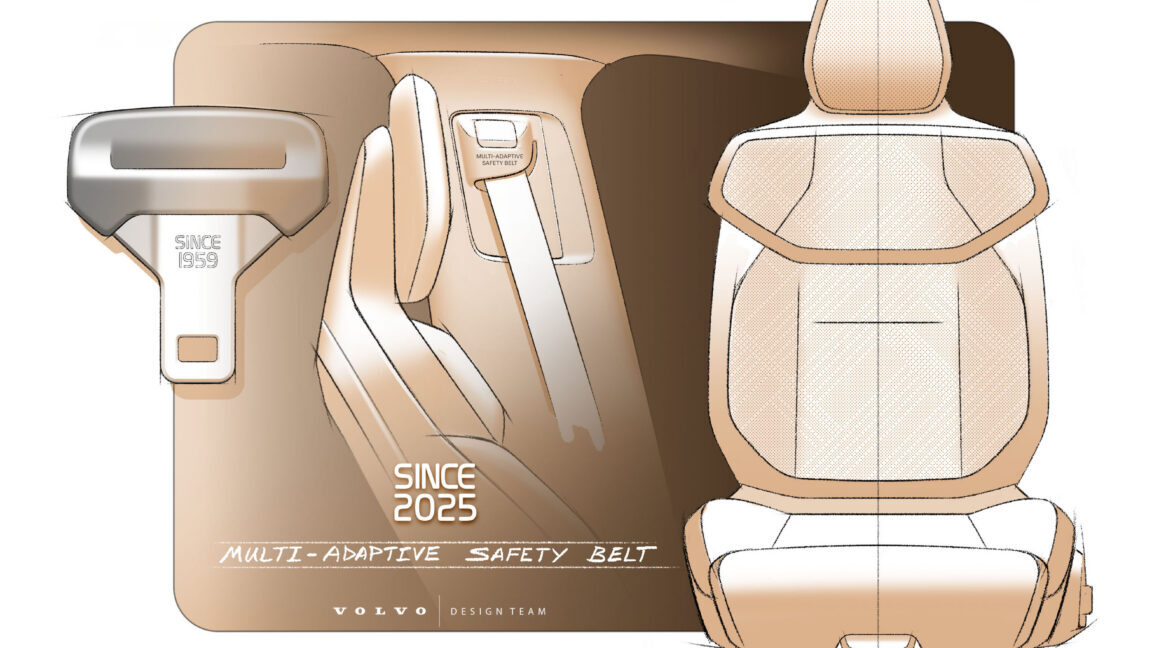
Inside the cabin, however, the real achievement is Volvo’s new multi-adaptive safety belt. Volvo has a history with the modern three-point safety belt, which was perfected by in-house engineer Nils Bohlin in 1959 before the patent was shared with the world. Today at the Volvo Cars Safety Center lab, at least one brand-new Volvo is crashed every day in the name of science. The goal: to test not just how well its vehicles are protecting passengers but what the next frontier is in safety technology.
Senior Safety Technical Leader Mikael Ljung Aust is a driving behavior specialist with 20 years under his belt at Volvo. He says it’s easy to optimize testing toward one person or one test point and come up with a good result. However, both from the behavioral perspective and from physics, people are different. What’s not different, he points out, is how people drive.
“We’re shaped into a very similar automated behavior when we drive, so that makes the collision prevention side of things a bit easier,” Ljung Aust says. “But on the injury-prevention side of things is where the seat belt comes in, we’re working on the principle of equal safety for all. The idea is that independent of who you are in terms of size, shape, weight, all of these things, you should have exactly the same protection.”
That’s nonsense.
That’s why patents are relatively short. A patent grants exclusivity for the inventors, which incentives people and companies to invent in the first place. But it’s limited in time so that the whole world benefits eventually. Everything that was invented over 20 years ago is now public domain. This includes a ton of safety mechanisms, some in cars, that never would have been invented if there wasn’t a financial incentive for it.
I don’t like this all that much from a moral standpoint, but this is a good compromise for the world we live in. To say it would have been better if it didn’t exist it all is just plain wrong.
“Volvo has a history with the modern three-point safety belt, which was perfected by in-house engineer Nils Bohlin in 1959 before the patent was shared with the world.”
This story is a famous example of seemingly putting human safety before personal profit.
In a direct comparison this innovation on it is worse because it lacks the defining feature that makes it truly applaudable.
The original 3 point seatbelt patent would also expire after 20 years but they (presumably) saw the amount of people they could save and chose not to wait.
Though you might have reasonable argument on corporate motivation that is commonly accepted i personally am in very strong disagreement with the notion that profit incentives are anything but harmful.
In my own reasoning and experience i found that a desire for profit or personal success sabotage the effective value of any potential invention.
The objective value of a product that i attempt to perceive is directly correlated to how many living beings can successfully use it without losing value in return.
For example the most advanced designer cars that exist that can only the super rich can buy… those are complete worthless junk and leaching valuable assets and energy from our planet trown in the proverbial bin.
A text file that explains in detail how to fix and maintain a generic bike written by some passionate nerd and freely available online has in comparison uncountable value.
Chances are a for profit product is also build needlessly complex just to stifle future competition (Apple likes that one also) or intentionally flawed so a new later patent can save the day and sustain the practical monopoly on it. If you look around you see this everywhere.
I see the same trends in digital development. Closed source only exist to exploit people who have not learned how to property own and maintain a computer and to block off ways open source devs could use to innovate for the benefit of everyone.
This is why i prefer the proprietary systems not exist at all. So someone else can invent it instead. In theory all knowledge is out there and so are all inventions, to be discovered and shared for enrichment of the species as a whole.
If you ask me, if the benefit of everyone including yourself is not enough motivation to build something better then what already is. I don’t want you on my team.
If your motivation requires a self serving result, i would prefer if society paid you to STAY AWAY from any important work decisions because the losses are too great to give that power to what subjectivity understand as a mental illness.
If everyone benefits, i benefit. If no one suffers, i don’t suffer. You can keep the ego happy and still arrive to the same conclusion, i am award this is considered an extreme stance but i will die on this hill unless someone can point me to a higher one,
That’s great. That’s not the world we live in.
That is the world we live in, sure capitalism is dominant but you can’t simply dismiss open technology movement as non existent just because you aren’t aware of them.
Have a few:
Free beer, https://freebeer.org/blog/
Open bikes, https://openbike.cc/download/
Open source ecology, https://www.opensourceecology.org/
Wikihouse, https://www.wikihouse.cc/
And as long as you continue to ratchet progress, it always will be.
Enjoy being part of the problem.