
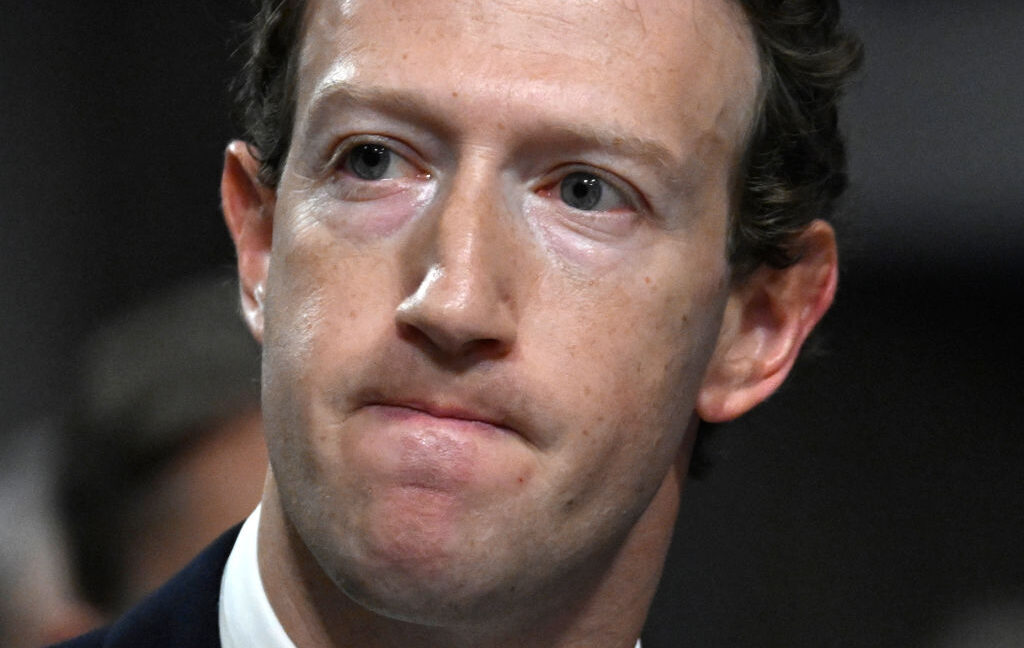
Doom them to a modest fine where they will not admit wrongdoing, got it.
“Notice of class-action settlement: your cash payout has arrived, 83¢ has been deposited on a Meta giftcard in your name.”
Just send a written letter with your name, bday, ss no., mothers maiden name, address, and return a signed copy of the nda agreement barring you from speaking of the case, our company, lawyers, and holding us harmless. The gift card for .88 dollars will arrive within 6 to 8 weeks, visit www.fuckyouthatswhy.com to activate!
Our politicians are taking bribes. All over the world.
Fuck Facebook and also this is clearly morphing into a moral panic about social media in a way that is extremely unproductive, dangerous and ultimately a distraction from the actual issues at hand.
Not sure if you’re trying to argue that modern social media is a good thing… Because it really isn’t. All of these platforms are actively detrimental to our mental health and destabilizing society. All of them have their billionaire owners manipulating the algorithms to maximize what they want you to see and minimize opposing views, if not outright removing them (like Meta is doing with the ICE List currently).
Massive corporate social media companies and rightwing billionaires are the problem, not social media.
Not sure if you’re trying to argue that modern social media is a good thing… Because it really isn’t.
What are you doing here then?
Lemmy might fit within the technical definition of social media, but don’t be so obtuse as to equate an anonymous community message board with the likes of Facebook and IG that are tied to your identity, and are designed algorithmically to keep you engaged as long as possible while pressuring you to share more and more of your personal life.
The “If social media bad, why on Lemmy?” Thing is the epitome of halfwit false equivalency.
Lemmy might fit within the technical definition of social media, but don’t be so obtuse as to equate an anonymous community message board with the likes of Facebook and IG that are tied to your identity, and are designed algorithmically to keep you engaged as long as possible while pressuring you to share more and more of your personal life.
then use your brain and analyze this deeper than social media = bad
Nobody is interested in seriously engaging with your sophomoric “you criticize society yet you participate in it” nonsense. We get it, you’re 14 and think you’re deep.
Y’all are literally calling for this website to be banned for the sake of pseudo-science.
Lots of people are interested in this. Y’all are actively helping the worst.
Naw. I didn’t say anything about banning anything nor about any pseudo-science. No clue what you’re talking about
Great and I am not interested in being subjected to a moral panic that feels like the logic was laid out by grifters trying to distract from their grift by manipulating gullible idiots to empower them even more.
100%. Haven’t these people been watching what happened to TikTok?
Or are they in denial because they were just as rabid about attacking TikTok?
Good, take your L and leave lol
Lemmy might fit within the technical definition of social media, but don’t be so obtuse as to equate an anonymous community message board with the likes of Facebook and IG that are tied to your identity,
Do you really think the state and its fascists care about this differentiation?
They will literally come after Lemmy the first chance that they get. Far more so than insiders like zuck, musk, etc.
And it will be at least partially a result of y’all libs calling for it based on this wacky pseudo-science.
Getting my fix, now move over.
Who is downvoting this? jfc…
People here are rabid about this “social media” but give a pass to literal fascism.
news networks have been doing this same pretty much since they’ve existed
No, news networks are not algorithmically curating content specifically for each individual person, based on personal traits that they record based on usage.
Yes they are. That’s what Fox news does. It curates content specifically for their wacky users.
Whether they use an “algorithm” or not is a meaningless difference based on luddism.
Fox is curating content for their viewer base as a whole.
Corporate social media is targeting each individual user based on their identity and preferences.
While similar, they are not the same.
Humans have been killing each other as long as we’ve existed isn’t an argument to avoid trying to make it happen less
just saying billionaires manipulating shit has been the norm for ages, which is why we used to have media-ownership limits…repealed under Clinton iirc
Agreed, but now they have tools that enable them to do it with unprecedented impact.
In my opinion, the difference is so huge, we might as well think they didn’t manipulate things at all before.
Agreed, but now they have tools that enable them to do it with unprecedented impact.
Yes tools like TikTok that libs lobbied to hand to fascists. Now they want more of the same.
Yeah, by memory Rupert Murdoch had his hand at that and in Aus and the UK. I’d love to see that reined in again too
Murder =/= social media.
It’s pretty sad that I have to say this. People are really losing their minds of this “social media” hype.
🤦♂️ Don’t put words in my mouth to try to make an argument
All of these platforms are actively detrimental to our mental health and destabilizing society.
According to you? How do you feel about the TikTok takeover? Anxiously awaiting the same for Lemmy?
We have study after study showing various prominent social media platforms are bad for mental health, so that part feels pretty clear
Destabilizing society is a harder one to show, but I’d argue Cambridge Analytica, and similar programs are what got Trump elected in 2016. Social media played a very interesting part in elections in the Philippines as well, due to the inability for most to fact check any information shared on social media (Meta/Facebook provided cell service for free only to their platforms)
It’s undeniable that large numbers of bots are used to shape public perception of topics. Several talks at Black Hat and Defcon have investigated specific attack chains used, and how sock puppets are used to spread specific misinformation
Given those factors, I think it’s fair to say social media is destabilizing society. It’s far too easy for relatively small groups to affect public perception. That isn’t to say propaganda didn’t exist before, just that it’s a far more powerful tool than has ever existed in history
How do you feel about the TikTok takeover?
Obviously negatively, and I think it’s irrational for Americans to feel positively about it. For an average citizen, a foreign country controlling a platform like that should be a good thing. China can’t do anything to me. I don’t have to fear reprisal from China for speaking out against the government. I do have to worry about reprisal from the US
Further, China has far fewer incentives to shape the opinions and discourse of Americans. Obviously they want to push a pro-China message, but that’s a relatively small sub-sect of American politics compared to the issues the US government would like to shape public opinion on
deleted by creator
deleted by creator
Except the propaganda mostly isn’t what the “social media addiction” folks are worrying about.
deleted by creator
The “social media is a drug” people are interested in using this pseudo-science to promote more of their propaganda and eliminate counter-narratives.
TikTok? Anybody remember what happened there? Exactly this.
nah… mark is clearly an international drug dealer and needs to have all his property seized, and then destroyed while he rots in prison.
both things can be true!
moral panic about social media in a way that is extremely unproductive, dangerous and ultimately a distraction from the actual issues at hand.
100%. Yeah that’s the point. If there’s any alternative narrative, hegemony stirs up a panic then takes over control.
Just look at what happened with TikTok. A bunch of obvious fascists started up a campaign. A bunch of liberals and other obvious fascists took it over… Now we have fash tiktok.
The people foaming at the mouth in this comm want to do it all over again with every form of “social media”. It’s gonna be rich when they come for Lemmy.
Zuck has kissed the ring. He will be fine. You can all stop worrying about him now. Barbecue sauce.
That’s just a news bite. He or yuckbook has never ever really been in trouble. It’s vital tool for global surveillance.
Remember Cambridge analytica?rohingya genocide? and other countless controversies?
You do not realize how far the us will descend into madness if they fix elections securely. Zuck is safe, for now.
His money will make him a target though. But mark my words, the oligarchy will rue the day they supported a one-party State taking over.

Zuck helped forge the ring
It really is! I was off for about three months, and I decided to go back to it just to be up-to-date with some friends and creators, right? Well, I was doom-scrolling for hours in about just a week of usage. Whenever that happens, I uninstall the app causing it, so I just deleted it again. The craziest part? After a couple of hours, I could feel the craving to open the app. Crazy shit.
I use instaDM. I am not able to see what other people post unless I go to their profile, but default won’t show it anyway most of the time as it will mainly give short content videos so I just removed the feed altogether
EDIT: also try revanved manager with the disable scrolling patch
Can I get a link? My search hit several disparate projects.
There’s a Discord and a Telegram
Bleeper is also a good option. That said, do you have any solution for shorts on YouTube?
I use Revanced, but my wife has an iphone and she struggles.
Well I have android too so I block all shorts with revanced. Maybe she can try YTLite ? https://github.com/dayanch96/YTLite I see on the screenshots there are some yt short settings
Sadly, I do not trust third party apps with my main account. There is so much to loose.
You can use Revanced Manager to patch it locally
It really is!
No it’s not. That’s absolute pseudo-science. Not even close to reality.
Try actual drugs sometime. Very very different.
“Look guys, I said the opposite of the content in the replies.” 🤓☝️
Disable YT history. Make YT Subscriptions page your home page. Now all you see are the most recent videos from your subscribed channels. You can keep up with them without being distracted by garbage suggestions. It’s a much better experience.
YouTube Unhook is great for this. Blocks suggested video sidebar, too - and can be customized.
I just block the side-bar using Ublock Origin. Makes more room on the page and im not sold shit. If I want random videos ill hit the home page the post-screen after a video.
Keeps my time down on the site by a lot.
I don’t know man… I found so many nice channels randomly… Kurzgesagt, science asylum so many great educational channels that just pop up
Just remember they are education and entertainment, don’t binge watch them like I did
It’s okay though because Zuck greased the Trump admin’s palms with his Presidential Library bribe, so they’ll get a slap on the wrist at best.
“Let’s see, here is a fine of 7 million dollars, please pay to this account that tax payers will never see a dime from.”
Fucking GOOD. We need these useless companies to fail out and be held responsible for their actions.
Facebook helped to cause Arab Spring. These platforms are responsible for the destruction of civilization under the guise of “connecting everyone”.
These platforms are responsible for the destruction of civilization under the guise of “connecting everyone”.
CA discovered how to “hack” people’s minds, then maybe the Russians and Chinese figured it out, and the oligarchy and the lunatic fringe want all in to brainwash the world.
Makes me angry knowing that at anytime a bigger war could break out.
at anytime a bigger war could break out.
Welcome back to the late 1970s / early 1980s I grew up in.
We just learned to live with it- maybe move to a big city for a better chance at instant vaporization.
Meanwhile in 1984: When Doves Cry you might as well Jump, and when the 99 Red Balloons Float by you’ll be sitting pretty in this dust that was a city.
The 80s were anxiety inducing because the specter of war was then high until the Soviet Union collapsed on itself, so throughout the 90s and the naughts a nuke war wasn’t going to happen even with North Korea trying to rattle sabers.
Instead and beginning last year we now have madmen on hair triggers, and if it’s not a third world war, then a prospect of another American civil war where there’s a high potential of causing a global economic catastrophe.
The 90s and the naughts were actually a pretty good time… we did too little to ensure that continued, in so so many ways.
As far as I can tell, advertisement/profit-driven social media that is directly tied to your real identity might actually be the worst thing humanity has ever invented.
Oops!
Turns out we’re mostly vain and stupid, in our default state.
Now amplify.
Oh and as a bonus:
It serves as a kind of self perpetuating auto-panopticon.
It never ceases to amaze me how many people just record thems committing, planning to commit, bragging about committing, or admitting to commiting crimes that can put you away for 5 years plus… on fucking TikTok.
I wouldn’t use Arab springs as an example of why Facebook is not a good product. Facebook has many problems and misuses, but I would not list allowing people to organise as one of them.
That lawsuit documents the case of a 19-year-old, K.G.M, who hopes the jury will agree that Meta and YouTube caused psychological harm by designing features like infinite scroll and autoplay to push her down a path that she alleged triggered depression, anxiety, self-harm, and suicidality.
What the hell is everyone watching? YT recommends me Red Letter Media, Veratasium, old movies, Blender tutorials and a bunch of other stuff that’s never going to drive me to self-harm. I don’t understand. May be this woman doesn’t have ad blocker installed and is forced to sit through a bunch of soul crushing PSAs? Why is my experience so drastically different from this?
Algorithms try to push body negativity if it thinks you’re a teen girl because they tend to scroll more and buy more when depressed.
If it thinks you’re a single man then it tries to push manosphere stuff.
On YouTube I find I my relevant suggestions last about a month before I have to mark a bunch of videos as not interested or block a bunch of channels.
Yeah there was a period where it noticed I watched a few trans youtubers and so it started promoting anti trans content, it was around the election (I forget if before or after), but either way it disgusted me that they’d do that
Algorithms aren’t that smart. Maybe there needs to be general education about how they work so people will understand that viewing a video is like searching for a topic in google so people will understand how much control over what they see and use the technology appropriately.
If you watch a video about anorexia that’s like typing “Anorexia” in Google or pressing 9 on a remote control, you’re getting channel 9. That’s why to me this sounds crazy. It’s like someone complaining their TV keeps pushing the cooking channel at them.
You used to be able to see what Google thought about you.
https://myadcenter.google.com/controls
Can’t check myself if they still do but on the advertiser end they definitely let you target demographics.
Sure, google knows I’m a 50+ year old man but YT isn’t pushing me a bunch of videos about retirement and how to keep the damn kids off my lawn. If I made a new account and it knew nothing about me, it might. But right now it knows I’m interested in obscure early 20th Century comic books and early 70s horror anthology shows.
Edit:
I misunderstood what you said. I use ad blocker so I don’t see ads. Sometimes they get through and it’s always Wix. That is kind of a mystery to me.
On a podcast I was listening to a researcher had made an account and subscribed to just like technology and sports and within a few months they had him on like manisphere stuff with tate and those types of assholes
I get some manosphere stuff for the same reason, but mostly ignore it. At the risk of getting beat up here, I like Joe Rogan. His celebrity interviews are entertaining and I like wacky subjects like UFOs and such which he covers. Plus I’m a gamer so I watch videos about guns frequently because I find that fascinating though I don’t want to own one. So that’s why I’ll get recommended manisphere stuff. And I’ll get curious and take a look at those videos, and get more recommendations. But when I stop watching them, they go away. My recommendations are based on whatever I’m interested in at the time.
Everybody talks about Andrew Tate but I have never ever seen any of his videos. Him or Mr. Beast. They never get recommended. I only know about Tate because everybody everywhere else is complaining about him. So I don’t what that researcher did to get that.
I’ve never seen any of his videos either or any of the manosphere stuff, but I don’t get on YouTube like that. But this researcher I think he signed up for Tech and sports and then just played the auto suggestion from there and it ended up on like Nazi shit and entertain pimping out people’s daughters. And treating them like shit. I tried to give Rogan a chance, I found out he was a Bernie Sanders supporter and he even had Sanders on his show last year and I tuned in and listened to maybe eight episodes around then and I can’t get past his pretending to believe Republican bullshit, like the president’s lawsuits against media, pretending those are in good faith and with merit, most of all his castigating of environmental protesters, as paid actors, as an environmental protester I take issue with that Above All Else.
I appreciate that he is leading his flock to better outcomes on some subjects but I just can’t get past his cynical self-interested Embrace of lies that are extremely harmful. It’s not like this asshole needs more money from those lies either. That is actually why I am on lemme much now I said basically the same thing and reddit violated me for a 3-day ban for advocating violence. Literally just said the exact same thing about Rogan here, I appeal but I will never know how it turns out because at a 3-day ban I abandoned the accounts. Over half a dozen just in a few years now.
He would be half likable if he was not such a cynical pos pushing the most harmful lies, quite knowingly. Still though I appreciate he say acknowledged inflation is understated, since the 70s, it was 5 to 8 pc by the unchanged mdtric, 2 to 3 under the newer just by 2008.
Absolutely no one will touch that one. It is the most harmful.of all actions perhaps as no one affords what they could while experts tell us we have never had higher buying power.
Seriously, I think there is some systematic pollution that is inhibiting the fear Center or other parts of the brain and making people more docile. Because previous generations never would have stood for this shit. Also rampant texoplasmosis which inhibits the fear Center in the brain. I’m serious about that done not even half joking anymore. Something is wrong with people.
My youtube is used exclusively by my toddler, with me seeing about 10 videos a month. It pushes me AI generated sprunky and brainrot bullshit.
Truth is these people watch garbage and the algo delivers… garbage.
I’m not trying to victim blame but, i mean… not my YouTube either (but I’ve seen the front pages of some…stupid people too say it nicely).
Meanwhile my girlfriend and I just got done watching a 2 hour video on Japans creepiest educational video, subject of which is the Heian era of Japan. Her algorithm pulls are goated.
all eyes on breen
Sounds like you consume useful information. I wager she uses socials as many: to compare herself to others, perusing a mix of ego-affirming and ego-damning content. These are powerful emotional hooks and oscillating between those states can be confounding. Add a dash of fatalism, which is not hard to come by in this culture, when at a low, and I think it easy to see how one might capitulate.
There are a lot of people out there that think their personality traits are inherent and that their physical attributes are static. In fact, my brother was one of these people. He passed away at 40 years old due to morbid obesity. I attribute his downfall to capitulation by way of comparison. He came to think the hole was too big and that his genetics were too poor to make changes, despite me providing an example to the contrary. Sadly, my parents fanned the flames of his dissonance with their own identity-bound delusions.
So, my guess is that you have developed a healthy personal philosophy and have not surrounded yourself with the type of people or digital content that renders that philosophy dissonant.
edit: Check out Daniel Dennett’s book “Freedom Evolves” for an appropriate take on the folly of genetic determinism.
But it should also be noted, teenagers are particularly targeted by and vulnerable to such messaging. In my 30s I can look around and see the evidence against such comparisons, but at 16 I was just some kid who worried she’d never be attractive or well liked. Had I been in spaces that encouraged such attitudes such as Instagram or 4chan I would have been really vulnerable to it.
Young people are often overly worried about such things because adolescence is a difficult and transitory stage where these worries are developmentally appropriate. They’re supposed to have adults who can help them deal with this, and peers that they can learn by interacting with, but it’s normal to not believe your parents on such issues and interactions with peers has been moved online with social media and there’s little interaction with adults. This has led room for teenagers to be preyed on by algorithms that encourage their worst instincts and online communities that teach anything from antisocial behavior to masochistic epistemology.
deleted by creator
Watching those hack frauds causes psychological harm. Rich Evans is known to trigger depression
That’s just because he looks like depression.
pondered letting “tweens” access a private mode inspired by the popularity of fake Instagram accounts teens know as “finstas.” That document included an “internal discussion on how to counter the narrative that Facebook is bad for youth and admission that internal data shows that Facebook use is correlated with lower well-being (although it says the effect reverses longitudinally).” Other allegedly damning documents showed Meta seemingly bragging that “teens can’t switch off from Instagram even if they want to” and an employee declaring, “oh my gosh yall IG is a drug,” likening all social media platforms to “pushers.” Similarly, a 2020 Google document detailed the company’s plan to keep kids engaged “for life,” despite internal research showing young YouTube users were more likely to “disproportionately” suffer from “habitual heavy use, late night use, and unintentional use” deteriorating their “digital well-being.” Shorts, YouTube’s feature that rivals TikTok, also is a concern for parents suing, and three years later, documents showed Google choosing to target teens with Shorts, despite research flagging that the “two biggest challenges for teen wellbeing on YouTube” were prominently linked to watching shorts. Those challenges included Shorts bombarding teens with “low quality content recommendations that can convey & normalize unhealthy beliefs or behaviors” and teens reporting that “prolonged unintentional use” was “displacing valuable activities like time with friends or sleep.”
Get off that shit.
I’ve been saying for a long time that IG is cigarettes
i can get a little high from lemmy, but ig? feel nothing
I can get high off of Amazon.
Most of my feed winds up being world news so I just end up feeling sad
If only some country would bomb supposed drug smugglers.
Social media is a drug tho. Gotta bomb them too.
Hey wow its like I’ve been saying that for a decade, but because I’m poor and I say that, clearly I am some kind of antisocial insane person, not somebody who can read a bunch of existing studies and data and form a conclusion.
Corporation would never gaslight you!
… unless you deserved it.
You’ve been making pseudo-scientific statements with no evidence for a decade? Brave.