

- cross-posted to:
- fuckcars@lemmy.world
- cross-posted to:
- fuckcars@lemmy.world
Plug-in hybrid electric cars (PHEVs) use much more fuel on the road than officially stated by their manufacturers, a large-scale analysis of about a million vehicles of this type has shown.
The Fraunhofer Institute carried out what is thought to be the most comprehensive study of its kind to date, using the data transmitted wirelessly by PHEVs from a variety of manufacturers while they were on the road.
The cars involved were all produced between 2021 and 2023. The data transmitted enabled analysts to determine their precise and real-world fuel consumption, as opposed to that stated in the vehicles’ official EU approved certification.
PHEVs, cars which combine a petrol or diesel engine with a battery-powered electric motor that is charged from an external energy point, give drivers the flexibility to be able to switch between the ecologically safer power source, and the more conventional, but environmentally more damaging one, as and when conditions allow. Manufacturers typically market the vehicles as energy efficient. On paper at least, the vehicles are said to use much less fuel, between one and two litres per 100km, than conventional cars. However environmental groups have long since voiced scepticism over the claims.
According to the study, the vehicles require on average six litres per 100km, or about 300%, more fuel to run than previously cited.
You must log in or register to comment.
I mean 6 litres per 100km still ain’t bad tho.
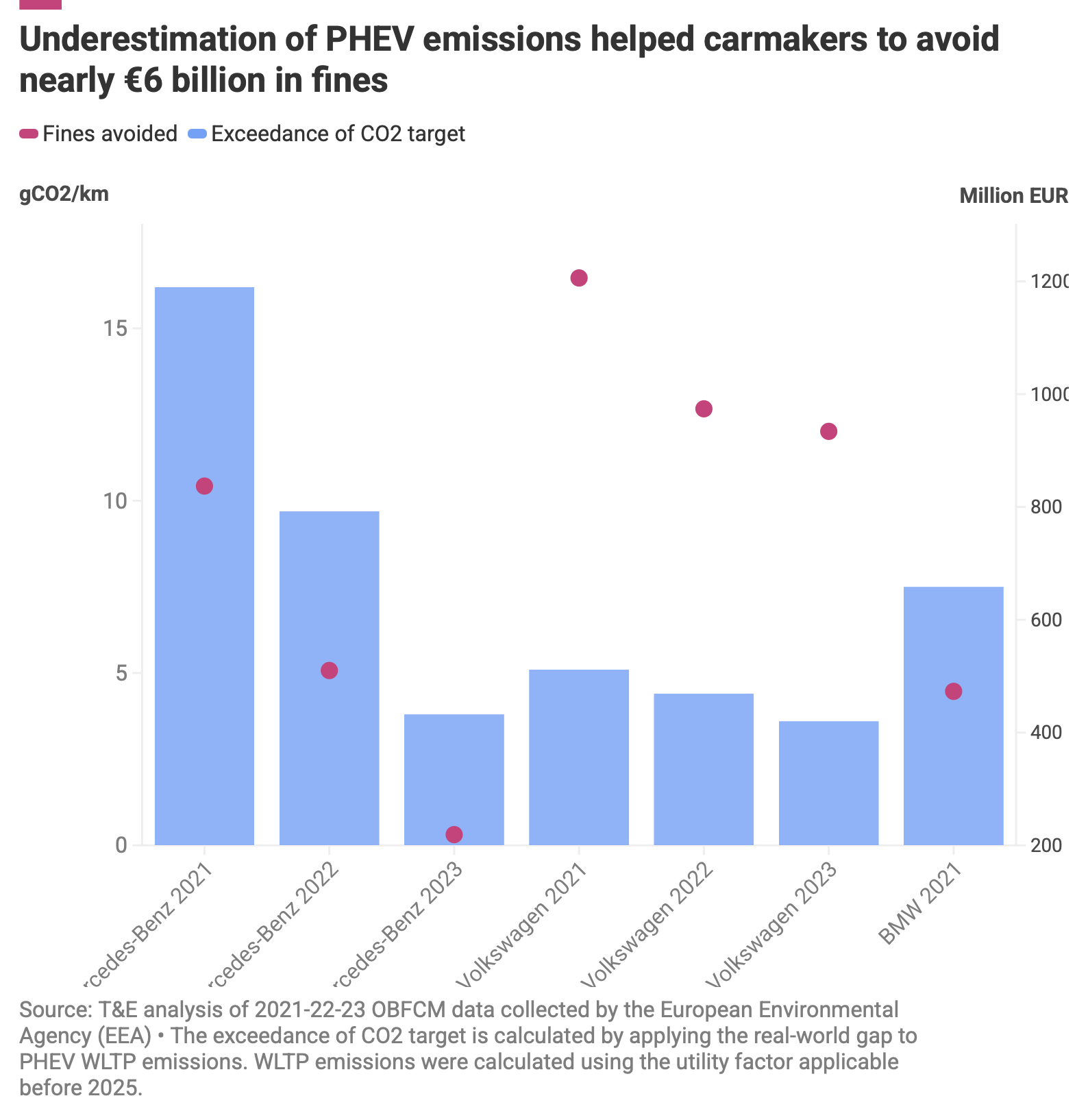
Maybe, but consumers might have to pay extra for gas compared to what they expected? And (in the EU) this allows companies to avoid paying fines for extra emissions (T&E).
It’s worse than I got in my 1998 Civic, so I’m not sure I’d agree.
Arithmetic says 16.67km/L (I’m converting here for those of us across the pond), working out to 39.2 mpg. I was consistently exceeding 50 mpg.
My 95 civic did high 30s into low 40s. (Mpg) (17km/l)
My first Civic was a 1996, which was a new body style from 1995, but I can confirm about the same mileage.
Thing was, it was an automatic. My 1998 was a stick. I spent as much time in neutral as possible.
It really depends on the owner and how they are driven. We have a plugin hybrid that probably uses even less fuel, since it mostly gets used around town and is consistently plugged in when at home. The gas engine doesn’t kick in at all until the battery is drained, or until it decides the gas in the tank is getting too old.
I had one and only put gas in it when taking a trip out of town. On a road trip I would get about 38mpg. Not great for what is was but better than anything else I owned before. I had that car for 5 years and 120,000 miles.
The fact that I used 0 gas for my daily use brought the cars lifetime mpg to 163mpg!
Also, I learned the hard way that gas can go bad fairly quickly.
or until it decides the gas in the tank is getting too old.
Thanks for answering a question I had about what happens if the gas starts getting too old.
It really depends on the owner and how they are driven
I’m not sure about this study (can’t read any German oops), but expected vs real-life usage of PHEVs (Plug-in Hybrid) is exactly the problem brought up by T&E and others at the end of last year, see for example this report from October 2025:
The [fuel consumption and CO2 emissions] gap is mostly caused by flawed assumptions on the share of electric driving mode (the ‘utility factor’, UF) which leads to a drastic underestimate of official PHEV emissions. The UF overestimated the electric driving share, assuming 84% over 2021-2023, whereas real-world data shows this to be just 27%.
I’m not doubting at all that you outperform the expected consumption, but sadly on average it seems like there’s more of a systematic (and significant) under-performance. However, this is comparing WLTP testing to real-life driving EU data, for cars sold in the EU. I’m sure that this might be region-dependent as models and driving habits might be radically different.
I don’t want to call this BS. But maybe something got screwed somewhere? My Prius totally rocks in fuel savings. I find it hard to believe that a hybrid jeep could do the same, but according to a friend that owns one it does get just a little worse milage. Not 3 times worse. But I could be wrong.
How old are they? I bet the efficiency decays over time and impacts the overall
Mine is like 15 years old. His is 2025.
I think that’s part of it. Wait like 5 years for his to severely drop off from what I’ve seen anecdotally
Yeah probably. I can see that angle. But even then the system would be more efficient than a Normal internal combustion only system.
Definitely is, I suspect that consumers will see faster degradation with these new, heavier, vehicles.
I haven’t seen the paper itself, but the article does mention that there’s quite a spread between manufacturers, e.g. Porsche being the worst offender.
I think the issue is driver be shoot more than the car.
eg.
-many companies bought plugin hybrids for corporate cars and handed them to employees since they would get some incentive, but employees did not have chargers at home so they just used them as a regular car.
-people buying them to get easier parking in the EV reserved spots
twice I rented out a plugin hybrid and both times it had the battery empty (around 2021)
This is explicitly about the hybrid cars using far more gas than advertized in electric mode! Meaning the combustion engine turns on in battery mode regardless (which I did not know prior to this study).
I see. there was another similar study that touched on what I mention. I assumed it was the same https://www.transportenvironment.org/uploads/files/2025_09_TE_briefing_PHEV_gap_growing.pdf
Around here public chargers are ridiculously overpriced so even if you use slow chargers you end up paying more per km for a plug-in hybrid than if you only put fuel in it. And if you want to use a fash charger then it’s of course even more expensive. You only get cheaper costs per km if you can charge at home.
I think the concept behind plug-in hybrids is great: The battery of an EV is by far the most expensive part, and also by far the most polling part to produce. So making a car that acts like an EV with a battery only just big enough for your daily commute, with a back-up power system for when you need to go further and to avoid range anxiety makes a lot of sense. But unfortunately they are held back from reaching their potential by lacking charging infrastructure and too high electricity costs.