
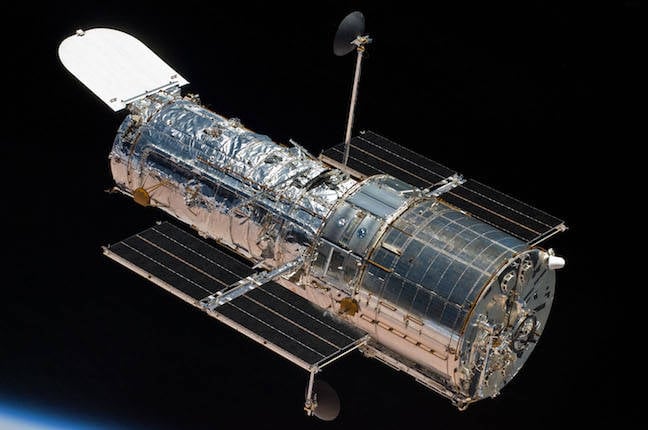
A newly released plot of the Hubble Space Telescope’s altitude shows just how quickly the observatory has descended in recent years.
The post on Bluesky by astronomer Jonathan McDowell is a stark reminder that Hubble is heading back to Earth, possibly sooner than previously thought, as its orbit decays.
Hubble was launched into low Earth orbit in 1990, carried in the payload bay of Space Shuttle Discovery. While it remains capable of pointing its instruments and has returned breathtaking imagery over more than three decades in orbit, it cannot raise its altitude.
It’s hope it’s chosen a suitably epic intro song to play as it enters.
Better not land anywhere near us, or ICE’ll send it to El Salvador
Dear billionaires with space rocket companies,
Would you mind take a quick break from corroding Western democracy to fix the Hubble?
No
That would be awesome, but we don’t have a space vehicle that is capable of what the shuttle was. And it would be an incredibly tall order to design and launch one before 2028.
It would probably be an easier task to build a modernized telescope and put it into orbit. The Hubble deserves better than to just burn up though. The volume of work the Hubble has done during its lifetime is incredible.
I think it is reasonable to lift the orbit of hubble. For the Neil Gehrels Swift Observatory, NASA announced in 2025 that a private company will lift its orbit which should be done by mid 2026. (space.com Article) And it “only” costs 30 million $, which is really cheap compared to designing, building and launching science satellites.
Couldn’t we just use a shuttle?
The shuttles have been retired since 2011. They were heavily used, and already old at that point. Plus they didn’t have a great safety record.
I just wish we had taken what was learned from the shuttle program to develop a proper replacement.
I mean if it just needs to grab it and boost it, it should be a simpler job, right? No real payload.
Grab, boost, maintain, upgrade. There is a lot that would be needed to keep Hubble functional. It hasn’t been maintained since like 2009. And I know we have crewed space craft, and I’m assuming there is something out there capable of grabbing and boosting it. If it was simple, it probably would have been done post shuttle era.
Though I’ll admit I’m no expert, I just like space shit.
I’m no expert, I just like space shit.
My next T-shirt.
NASA and SpaceX looked at using Dragon to service Hubble back in 2022. In 2024 NASA decided that was a bad idea because of potential damage to the observatory. Not sure how that was the better option instead of at least trying to save it, but that’s the conclusion they had at the time.
Yeah, I know. That sounds to me like they were trying to accomplish the boost without equipment designed for the task. I agree that a damage risk is better than of burning up, but they also thought they would have more time. They had forecast deorbit in the mid 2030s I think.
The only equipment designed for the task was the Shuttle. Hubble was designed and built for the Shuttle’s service bay. So we haven’t had equipment “designed” for this task since the Shuttle was decommissioned in 2011.
The whole point of the research in 2022 was to see about designing new equipment that would work with Dragon.
if it’s any consolation, in the al gore wins 2000 timeline they’re on Super Shuttle, the next generation of SSTs, and multiple Hubbles now orbit.
Along with a moon base and a stable climate.
Yeah, that’s basically what I said above. Designing a shuttle replacement is a huge task. I can’t imagine a dragon capsule will be easy to build out to perform the same functions. It’s unfortunate that all the attempts to build a shuttle replacement have failed.
Hopefully Jared Isaacman can make that rejected project a reality now that he’s NASA administrator?
It was at one point a potential plan for the 2nd of the planned 3 Polaris mission.
And those last 2 missions were cancelled as promised due to the conflict of interest when he became the NASA Administrator.
So… The exact opposite? Because that’s what people demanded.
NASA has already been researching using systems like Dragon to boost Hubble.
https://www.nasa.gov/missions/hubble/nasa-spacex-to-study-hubble-telescope-reboost-possibility/
In fact IIRC that was part of the purpose for some of the research being done by Inspiration4 and Polaris Dawn. The second Polaris mission at one point was potentially going to be a Hubble servicing mission before further Polaris missions were cancelled by Jared Isaacman due to conflict of interest after becoming the NASA Administrator.
At one point Isaacman even offered to fund the mission himself hack in like 2022, but NASA and SpaceX couldn’t agree on the mission’s risk and in 2024 NASA rejected a private servicing mission because of “potential damage to the observatory”. Who knows if that would still be the case now with several more years of Dragon mission data and the alternative being deorbiting Hubble anyway.
Joke’s on you:
Kessler Syndrome’s coming WAAAY quicker than that, & EVERYTHING in low-earth-orbit’s getting smashed to smithereens, then…
( you can’t keep pumping thousands & thousands of minisats into LEO, losing many every week, & NOT keep stacking-odds for Kessler Syndrome, & the periodic weapons-tests done in orbit, like China’s or the US’s blowing-up of a satellite, to throw-around some “muscle”, anti-helps, too )
https://en.wikipedia.org/wiki/Kessler_syndrome
& what happens when 1 country needs suddenly to remove an enemy’s satnav constellation?
Oh, THAT activates Kessler Syndrome, right-then?
Well, then!
This-year, likely, isn’t it?
_ /\ _
Ugh, another Kessler Sydrome loon.
Go read the other user’s reply and then go touch grass. A lot of grass.
I’m not kidding. Roll in the grass, eat the grass, I don’t care. You just need to go outside and touch some grass because you’ve been cooped up inside for far too long
thousands of minisats into LEO, losing many every week
Because there is still a tenuous atmosphere at that altitude, LEO is actually somewhat self-cleaning, which is why so many satellites (including Hubble) will reenter relatively quickly unless regularly boosted, making Kessler Syndrome of low concern.
Kessler syndrome is a much more serious risk in MEO and GEO, where orbits can take decades to millenia to decay naturally.
Help us, Jared Isaacman. You're our only hope :)