Thumbnail is Marx’s manuscript for The German Ideology. Summary below is a compilation of my notes I wrote when reading Materialism and the Dialectical Method by Maurice Cornforth, along with general knowledge from reading various Marxist authors.
Often times, Marxists use the term “material conditions,” and “dialectics.” What does this mean? Why do Marxists care so much about material conditions? The answer is that Marxists seek materialist explanations for observed processes as opposed to idealist, and do so dialectically, as opposed to metaphysically. In other words, Marxists apply dialectical analysis to find materialist explanations for phenomena. Dialectical materialism is the world outlook of the proletariat as a class, and serves as the most vital ideological tool for overthrowing capitalism.
In order to understand dialectical materialism, we need to understand its component parts, materialism and dialectics, and their historical predecessors, idealism and metaphysics.
Idealism

Idealism is, in short, to put ideas prior to matter. Idealism has been used by feudal lords to justify their position above the serfs, forming the ideological basis for feudalism. The 3 major assertions of idealism are as follows:
-
Idealism asserts that the material world is dependent on the spiritual
-
Idealism asserts that spirit, or mind, or idea, can and does exist in separation from matter. (The most extreme form of this assertion is subjective idealism, which asserts that matter does not exist at all but is pure illusion.)
-
Idealism asserts that there exists a realm of the mysterious and unknowable, “above,” or “beyond,” or “behind” what can be ascertained and known by perception, experience, and science.
Early Materialism

Common idealist arguments are appealing to a supernatural “human nature,” or “good vs. evil” explanations for processes. Materialism arose over time, as people grew to understand the world more deeply, and especially as a tool to overthrow the feudal aristocracy that justified its existence via the church. In other words, materialism rose to help the bourgeoisie. The 3 basic teachings of materialism as counterposed to idealism are:
-
Materialism teaches that the world is by its very nature material, that everything which exists comes into being on the basis of material causes, arises and develops in accordance with the laws of motion of matter.
-
Materialism teaches that matter is objective reality existing outside and independent of the mind; and that far from the mental existing in separation from the material, everything mental or spiritual is a product of material processes.
-
Materialism teaches that the world and its laws are fully knowable, and that while much may not be known there is nothing which is by nature unknowable.
Shortcomings of Metaphysical Materialism

The type of materialism that overthrew the feudal lords was still underdeveloped, and metaphysical. The bourgeoisie needed an explanation for why the feudal lords were illegitimate, but still needed to support their own static, permanent rule. This was called mechanistic materialism, for the bourgeois scientists saw the world as a grand machine repeating simple motions forever. Mechanistic materialism, therefore, makes certain dogmatic assumptions:
-
That the world consists of permanent and stable things or particles, with definite, fixed properties;
-
That the particles of matter are by nature inert and no change ever happens except by the action of some external cause;
-
That all motion, all change can be reduced to the mechanical interaction of the separate particles of matter;
-
That each particle has its own fixed nature independent of everything else, and that the relationships between separate things are merely external relationships.
Moving from Metaphysics to Dialectics

This, of course, has proven false. History did not end with the dissolution of the USSR, despite what modern mechanistic materialists claim. Mechanistic materialism relies on metaphysics, seeing everything as a static abstraction, devoid of its context. It has no explanation for how new qualities emerge, and ultimately fell to idealism to explain the “first mover,” ie “God.” Dialectical materialism holds instead:
-
The world is not a complex of things but of processes;
-
That matter is inseperable from motion;
-
That the motion of matter comprehends an infinite diversity of forms which arise one from another and pass into one another;
-
That things exist not as separate individual units but in essential relation and interconnection.
Dialectical Materialism

This became remarkable for the proletariat, as it sees nothing as static, and therefore marks the eventual downfall of the bourgeoisie. Putting it all together, we get the following:
- Dialectical materialism understands the world, not as a complex of ready-made things, but as a complex of processes, in which all things go through an uninterrupted change of coming into being and passing away.
In other words, when analyzing events and contextualizing them, we must always viee them as a struggle between the rising and the falling, the old and the new, for example the concentration of capital in markets and the rise in socialize labor.

- Dialectical materialism considers that matter is always in motion, that motion is the mode of existence of matter, so that there can no more be matter without motion than motion without matter. Motion does not have to be impressed upon matter by some outside force, but above all it is necessary to look for the inner impulses of development, the self-motion, inherent in all processes.
In other words, all movement is a result of contradiction. Your foot presses on the Earth, and the Earth presses back on you.

- Dialectical materialism understands the motion of matter as comprehending all changes and processes in the universe, from mere changes of place right to thinking. It recognizes, therefore, the infinite diversity of the forms of motion of matter from the simple to the complex, from the lower to the higher.
In other words, dialectical materialism recognizes that development exists as a change of quantity into quality. Addition or subtraction gives way to qualitative change. A balloon is filled with air, until at a given point it pops due to pressure buildup. Water goes from liquid to gas at its boiling point, and back into liquid when cooling down to said point.

- Dialectical materialism considers that, in the manifold processes taking place in the universe, things come into being, change and pass out of being, not as separate individual units, but in essential relation and interconnection, so that they cannot be understood each separately and by itself but only in their relation and interconnection.
In other words, everything is connected, and must be analyzed in context to truly understand it. A worker isn’t just an individual, but instead part of a social class of many workers. Wages are not something invented brand new every time, but instead are set by societal standards, controlled by the ruling capitalist class.

Conclusion
Karl Marx created dialectical materialism by turning Hegel’s idealist dialectic into a materialist one. Then, he applied it to the progression of society, creating historical materialism. By analyzing social structures and progress as a dialectical process based in materialism, we can learn from history and analyze where it’s going. This is scientific socialism in progress. Human thought is shaped by our social experience, forming class consciousness and ideology. How we produce and distribute determines our ways of thinking.
Socialism and communism also have their own contradictions as well, and just because we progress on to socialism does not mean we cannot fall back to capitalism. The dialectical materialist world outlook understands that nothing is static, and there is always new contradiction and new movement from that.
If you keep these in mind, you can do your own dialectical materialist analysis. Always seek explanations based on the material, not the ideal, and always do so by contextualizing the processes, analyzing their contradictions, the unity and struggle of opposing tendencies. Quantitative changes lead to qualitative development, and progresses as a result of the conflict or struggle of opposite tendencies. There’s much more to dialectical materialism, but this should help serve as a simple overview!
An example of metaphysical idealism can be found in @PugJesus@piefed.social’s post Here, on Piefed.social’s History Memes community. Here is the post in question:

And here is the context provided by PugJesus below, in full:
Explanation: A common argument of Soviet apologists is that everything the Soviet Union did was, in some way, dictated by ‘material conditions’, and thus necessary for the development of Socialism™. Obviously, this line of argument is dubious to begin with, but beggars belief when applied towards the Soviet Union’s instances of ethnic cleansing and genocide, which are either denied or so justified.
Anarcho-Communists tend to be more critical of… well, everything. The CNT-FAI was an anarchist trade union which was one of the major players in the Spanish Civil War. After offering amnesty to all criminals to begin with a clean slate, they implemented work/detention camps for criminals convicted by local tribunals and fascist PoWs. Since prison abolitionism is a common cause amongst modern anarchists, they’re less willing to go to bat for ‘Good Team’ when it contradicts their basic moral code, even though the CNT-FAI is one of the most beloved examples of anarchist praxis in the 20th century.
Let’s break this down.
Explanation: A common argument of Soviet apologists is that everything the Soviet Union did was, in some way, dictated by ‘material conditions’, and thus necessary for the development of Socialism™.
Nobody makes this point. Marxists seek to understand and explain why socialists made the decisions they’ve made. The reason for this is so that we can learn the true causes, understand the decisions made, and thus learn from their mistakes so as to not repeat them, while learning from their successes so as to apply when possible.
The reason this is metaphysical and idealist is because the topic of the post, population transfer of Koreans, happened during the period of World War II, both its build-up and during the war itself. Paranoia was at an all-time high in the soviet union, and Koreans were suspected due to the highly reactionary dictatorship Japan had installed there as a part of their colonial project. As such, the soviets decided to forcibly relocate 170,000 Koreans from the far-east of Russia to Kazakhstan and Uzbekistan.
For PugJesus, the reason for this is unstated, and context does not exist. The only explanation left for PugJesus is just “soviets did it because they were evil.” Not only this, but PugJesus therefore makes the strawman that Marxist-Leninists believe that every misstep of the soviet union was actually necessary and unavoidable. Population transfer is one of the most universally accepted mistakes of the USSR by most Marxist-Leninists, with some exceptions, but because we are dialectical materialists, we seek root cause analysis.
The handling of the Koryo-Saram was a deep tragedy and mistake. It was not necessary for “building socialism,” despite what PugJesus believes Marxists think, nor was it done as a deliberate act to wipe out ethnic Koreans. It was a deeply flawed handling of a percieved problem based on real threats from Japan.
Obviously, this line of argument is dubious to begin with, but beggars belief when applied towards the Soviet Union’s instances of ethnic cleansing and genocide, which are either denied or so justified.
This line of argument is dubious because it does not exist. Nobody defends literally everything the soviets did, we seek to understand their achievements and mistakes in context, and the underlying causes. Further, the “genocide” and “ethnic cleansing” is left open, here.
Anarcho-Communists tend to be more critical of… well, everything.
Debatable, especially considering the strawman PugJesus made of Marxism-Leninism in general and dialectical materialism in particular.
The CNT-FAI was an anarchist trade union which was one of the major players in the Spanish Civil War. After offering amnesty to all criminals to begin with a clean slate, they implemented work/detention camps for criminals convicted by local tribunals and fascist PoWs. Since prison abolitionism is a common cause amongst modern anarchists, they’re less willing to go to bat for ‘Good Team’ when it contradicts their basic moral code, even though the CNT-FAI is one of the most beloved examples of anarchist praxis in the 20th century.
The interesting bit here is that PugJesus says the CNT-FAI made a “mistake” by imprisoning criminals and fascists, because of an idealist “moral code.” The reason the CNT-FAI developed prisons over the course of the war was because they learned that they needed them in the context of war, even if they sought to abolish them afterwards. This is an example of anarchists adjusting their theory after it ran into problems in reality, adjusting to it, and becoming more effective as a consequence.
By understanding the context of the prisons, ie a brutal war, and their material causes, having a ton of fascists and criminals during the brutal war, we can see that this was a necessary step. By contrast, when analyzing the population transfer of the soviets, we have to question what may have happened had they focused directly on cracking down on infiltration of Japanese spies in the far-east of Russia, rather than relocating the entire ethnic group.
It’s more reasonable when contextualizing the population transfer to recognize it as a mistake, but not one made out of a supernatural “evil,” and not one made for no reason, but due to deep suspicions on the eve of war. It was not necessary to handle the threat of espionage in this manner, and a number of other courses could have been taken. This is a mistake to learn from, while the prisons employed by the CNT-FAI were a strategic advancement on previous anarchist theory when waging open war.
Dialectical materialism allows us to identify root causes. It is not the answer to any particular question, but tells us where to look and how to do so. This is the weakness of bourgeois historiography, the erasure of context and analyzing events and history as a “series of static snapshots” rather than an unfolding process leads to dramatic errors.
Note: replying here rather than on PugJesus’ post itself, because both PugJesus and Deceptichum ban Marxism and Marxists.
An addendum, for @PugJesus@piefed.social post on the Nazi bar “Meanwhile On Grad:”
My favorite bit is “PugJesus doesn’t think they had any reason for what they did, he thinks they did it just for the evulz 😭😭😭 can’t they see they were just making a rational, if disagreeable, decision to perform ethnic cleansing???”
Understanding the root cause of something isn’t defending it. I quite literally stated that “the handling of the Koryo-Saram was a deep tragedy and mistake.” Understanding history counts as “defending” actions you claim are horrible tragedies that were avoidable. What a brilliant bit of double-speak!
Imagine if someone made that argument about the fucking Nakba. Or said that anyone objecting to apologia for the Nakba just didn’t understand Israel’s motivations.
The Nakba was also horrible, and we can explain it as a settler-colonial land-grab. The founding Zionists were quite explicit in their settler-colonial aims and subsequent genocide. Theodore Herzl, one of the founding Zionists, once wrote "It would be an excellent idea to call in respectable, accredited anti-Semites as liquidators of [Jewish] property. To the people they would vouch for the fact that we do not want to bring about the impoverishment of the countries we leave. The anti-Semites will become our most dependable friends, the anti-Semitic countries our allies.”
Also amusing is the accusation that I ban Marxists, when I only ban revisionist shitheads who think taking power away from the proletariat is praxis because their favorite genocidal dictators told them it was. And I’m pretty sure Deceptichum is even less ban-happy than me.
This is perhaps the most amusing part, by PugJesus’ estimation all major communist parties are “revisionist shitheads,” that socialism in real life is anti-democratic, and that this is based on having “favorite genocidal dictators.”
To the contrary, the USSR brought dramatic democratization to society. First-hand accounts from Statesian journalist Anna Louise Strong in her book This Soviet World describe soviet elections and factory councils in action. Statesian Pat Sloan even wrote Soviet Democracy to describe in detail the system the soviets had built for curious Statesians to read about, and today we have Professor Roland Boer’s Socialism in Power: On the History and Theory of Socialist Governance to reference.
When it comes to social progressivism, the soviet union was among the best out of their peers, so instead we must look at who was actually repressed outside of the norm. In the USSR, it was the capitalist class, the kulaks, the fascists who were repressed. This is out of necessity for any socialist state. When it comes to working class freedoms, however, the soviet union represented a dramatic expansion. Soviet progressivism was documented quite well in Albert Syzmanski’s Human Rights in the Soviet Union.
In reality, PugJesus doesn’t actually understand socialist history or theory, and would rather cape for social fascists.
As for deceptichum, they banned me from memes of production for “voting while tankie,” which is pretty funny.
Either way, there’s still no evidence provided by PugJesus for Marxists defending the deportation of the Koryo-Saram, only contextualization and understanding it, as any decent historian would do.
Albert Syzmanski’s Human Rights in the Soviet Union.
I see a Russian surname and a title referencing the USSR. Comrade, I couldn’t find this author on the Russian version of Google—only on the English one.
Comrade, I strongly urge you not to rely on Western authors, even if they describe positive developments within the USSR.
If you are interested, you would be better off reading contemporary Russian authors instead.
I recommend this particular author to you; he is a highly renowned contemporary Russian historian with leftist views—someone who plays an active role in debunking myths about the USSR.
https://litmir.club/br/?b=904208
And I don’t understand who it is you keep mentioning and referring to here. Could you please explain it to me?
I’d read more Russian authors if more were translated into English. Sadly, it’s hard to come by, and for the purposes of debunking anticommunist claims, Statesian authors tend to make westerners less skeptical.
As for the person I am replying to, it’s really unimportant. Just a western anticommunist.
I’d read more Russian authors if more were translated into English. Sadly, it’s hard to come by
Finally, Comrade, you understand what I’ve been trying to explain to you for so long.
You tell me I’m subjective, basing my statements solely on my own experience, and I tell you it’s because you haven’t read the books I’ve read, nothing more.
And as we’ve already noted, the books I’ve read are somewhat different from the ones you’ve read, judging by your reaction to them. That’s why I kept saying that everything here is somehow different, seemingly in its place, but somehow different…
I highly recommend you read the works of this modern historian.
https://en.wikipedia.org/wiki/Yuri_Zhukov_(historian)
Here’s his book, which explains the fatal mistake the Bolsheviks made by not listening to Stalin.
The book is called: Stalin’s First Defeat. 1917-1922
In Brief:
This book recounts the early political career of the future leader of the Soviet Union. It tells how, during the years of revolution and civil war, he tried to preserve Russia’s unity, preventing its disintegration or fragmentation into national republics. It also explores who opposed him in this effort, and why Stalin was ultimately unable to achieve victory in such a brutal and uncompromising struggle. Based on unique archival documents, most of which have only recently been declassified, the book offers a completely new perspective on the events of those turbulent years. It provides a fresh perspective on questions that remain extremely sensitive today, convincingly proving the seemingly unbelievable: the views of Stalin—the third-largest figure in the Bolshevik Party in 1917—and Milyukov—the leader of the Cadet Party and ideologist of the “White movement”—were completely aligned on the question of what the country should be. The disintegration of Russia, as early as the spring of 1917, was initiated by the separatist aspirations of the Ukrainian Central Rada. In the spring of 1919, Stalin was removed from Moscow, barring him from participating in the leadership of the party and state until the end of the civil war; in 1920, there were no serious grounds for recognizing the independence of the Baltic republics; the USSR, in the constitutional form approved in December 1922 and which remained in effect until December 1991, was created over Stalin’s objections, in favor of the left-wing radical utopias championed by Lenin, Kamenev, Zinoviev, and Trotsky.
He wrote many books, I recommend him to you. His first book was published in 1995; he was the first to publish it.
As for the person I am replying to, it’s really unimportant. Just a western anticommunist.
Regarding the “Holodomor”: I have a question for this anti-communist. What possible motive would Stalin have had for exterminating Ukrainian peasants, given that they were the ones producing the most grain in the USSR? I would only believe such a claim if it were on par with Putin blowing up the Nord Stream pipeline.
Such an act would be the behavior of a mentally unstable madman. It would imply that Stalin killed Ukrainians purely for pleasure—even at the cost of incurring economic losses. There is absolutely no common sense or logic in such actions. Why would he do it?
Incidentally, the Holodomor was not confined solely to Ukraine; that summer was marked by a severe drought.
That year, famine struck the Volga region as well, and affected several Eastern European nations—Poland, Hungary, and Romania, if I recall correctly.
As for the repressions and Stalin’s personal involvement in them: the peak of the purges occurred between the summer of 1937 and the autumn of 1938. During this period, the NKVD was headed by Yezhov. Following Yezhov’s arrest, he was succeeded by Beria, who—in an incredibly short span of time—ordered the release of a million people from prison.
Subsequently, a major public trial was organized to prosecute the very NKVD officials who had issued unlawful orders. The entire foreign diplomatic corps, as well as representatives of the international press, were invited to attend this trial. The court transcripts were published in the press.
This raises a pertinent question: what possible benefit could Stalin have derived from this entire spectacle?
Zhukov posits that the repressions were triggered by the “Stalin Constitution,” which envisaged free elections for local Party leadership positions. Fearing the loss of their posts, local Party officials began eliminating their rivals or engaging in excessive zeal to curry favor with their superiors.
Another significant contributing factor was the looming threat of a major war; the domestic political climate had become strained to the breaking point, and people began to view everyone around them as a potential Trotskyist or German spy. Furthermore, it can now be stated with certainty that a conspiracy was brewing among the military elite to oust Stalin from power.
Yet, at the very same time:
GDP growth during the 1930s stood at 14% per year.
By 1930, the USSR had already emerged as a global power.
The 1939 Census: According to the census results, the population of the USSR totaled 167 million people. Over the entire decade, the total population growth amounted to approximately 15 million people.
I appreciate the recommendation, comrade, though unfortunately I can’t find it in English (yet). You can see my frustration, given that most books written by communists are not available in English, be they Chinese, Russian, etc.
As for the 1930s famine, indeed. The liberal narrative is that “Stalin targeted Ukrainian nationalists in a terror-famine,” but of course this runs counter to the fact that the USSR needed grain both to industrialize and feed its people.
Interesting commentary on the purges, I had not seen that theory before.
I appreciate the recommendation, comrade, though unfortunately I can’t find it in English (yet).
Specifically for our conversation, I would like to briefly introduce you—in outline form—to the contents of Yuri Nikolayevich Zhukov’s book, The Flip Side of NEP (Обратная Сторона НЭПа):
Crisis Phenomena: According to the researcher, the partial return to market mechanisms did not lead to the long-awaited economic boom; instead, it triggered a protracted economic crisis.
Political Struggle: The transition to the NEP (New Economic Policy) exacerbated latent conflicts within the USSR’s party elite (during the 1923–1925 period), resulting in a fierce struggle for power.
Social Stratification: Economic liberalization led to the rapid enrichment of a narrow social stratum—the “NEPmen”—a situation that stood in stark contrast to the dire plight of the majority of workers and peasants.
As you can see, there exists a radically different perspective on the events of that era. Zhukov is an archivist; his work relies primarily on archival documents. In his books, every claim is substantiated by the figures and statistical indicators of those years, which form the core of the economic analysis within his work. The political struggle is evidenced in the minutes of party meetings, while social stratification is clearly visible in criminal police reports. One such report, for instance, describes the formation of a student gang in Moscow that specialized in robbing NEPmen. A great number of such motley gangs sprang up, triggering a rampant surge in crime.
Indeed, we know that between 1919 and 1921, “War Communism” was implemented at the behest of Trotsky. Both Trotsky and Lenin indulged in fantasies of a global revolution; they fully expected that a wave of socialist revolutions would erupt across Europe at any moment, and that the Red Army would immediately rush to their aid. Consequently, the army was effectively transformed into a “labor army.”
It was a truly terrible time for the workers and peasants. Soldiers were not demobilized from the army; instead, they remained under barracks conditions, working in factories and receiving no wages—only food and clothing. Yet, even these basic necessities the state was unable to provide in sufficient quantities. As the situation deteriorated, unrest and strikes began to erupt in the factories; workers refused to work. Measures had to be taken. To breathe some fresh life into the economy, War Communism was abolished and the NEP was introduced; however, as it turned out, this dawn was short-lived. As for the notion that the NEP was actually effective in the USSR—that was a myth later inflated by Gorbachev in order to push through his own hare-brained ideas.
The NEP did achieve its desired effect of socializing the means of production and centralizing them. This is why it was employed. Of course, it also came with new stratification and new problems, but so too did collectivization. Further, we can see in China that the NEP-style socialist market economy is remarkably effective at developing the productive forces.
Is the NEP the only way? No. Is planned economy from the outset the only way? Also no.
I don’t think there is any reason to doubt his data. If he were distorting the facts, it would have come to light long ago—he has been publishing on this subject since 1995.
He is currently the most authoritative and widely recognized expert in Russia regarding the Stalin era—and beyond—at least within certain progressive circles. In these circles, everything has long since been double-checked.
Oh, neat! Thanks for checking! Sedan has a lot of intriguing information that I’m upset isn’t available in English (even if the Moon landing claims make me skeptical of other claims).
Addendum 2, for @PugJesus@piefed.social second post on the Nazi bar “Meanwhile On Grad,” where PJ deceptively erased the part of my comment (sound familiar? That’s all these social fascists do anyways, erase context) where I directly responded to their double-speak and my own further condemnation of the deportation of the Koryo-Saram:
lmao, more Soviet apologia about how it was the most progressive and democratic country in the world, while also blowing the usual Holodomor denial whistle about how it was just the ‘kulaks’ and other ‘class enemies’ who were suppressed.
Contemporary historians recognize that the famine in the 1930s wasn’t intentional. Such a myth originates with the literal Nazi party of Germany. It was largely due to adverse weather conditions, coupled with the bourgeois farmers called “kulaks” killing their livestock and burning their crops to resist the Red Army collectivizing agriculture. However, to paint those who died as “victims of communism” when the communists were the ones that finally ended famine in a region where famine was historically common and regular is hardly genuine.
The term “Holodomor,” the right-wing theory describing a man-made and intentional famine, was created by Ukrainian nationalists in the 80s. It was named as such to draw direct connection to the Holocaust, and as such is a form of Holocaust trivialization. Archival evidence proves that there was no such intentional famine, but it is used politically to demonize socialism in the real world, wielded like a club.
The PEOPLE’S single-candidate elections picked by party apparatchiks! The PEOPLE’S gulags for gay folk! The PEOPLE’S purges of officials by a dictator! The PEOPLE’S deportation of Ukrainian peasants living at a subsistence level to Siberian GULAG!
This is a firehose of bullshit, to be honest.
-
The soviet model of democracy, which PugJesus is allergic to studying, was based on approval voting. Candidates were chosen from among the local people, and put forward. Rather than competing, it resulted in approval-based voting on legitimacy of the chosen candidate that had already been presented through consensus building.
-
Soviet repression of homosexuality was a clear-cut mistake. Socially, the soviet union was more progressive than their peers, and they became better on sexuality over time.
-
The purges were supported by the public, based on historical evidence, because corruption was a real problem, as was infiltration.
-
Regarding deportation of Ukrainians to Siberia, this is extremely deceptive. During World War II, the OUN-B and other fascist elements that were collaborating with the Nazis. There wasn’t a blanket order to deport Ukrainians and force them to work in prisons.
He doesn’t actually address the comparison to Nakba apologia either, just goes off about how the Nakba is bad (it is, but that’s not what’s being pointed out, lmao). Guess it might have be too sensitive a point for him to attempt an actual rebuttal to, even in his fascist circlejerk.
I do address it, and you didn’t even show it so others could see your lie caught out. The Nakba involved mass settler-colonialism and massacre, and was done for that purpose. The deportation of the Koryo-Saram was done out of paranoia on the context of World War II. Neither are good, but are fundamentally different. Providing historical context is a “fascist circlejerk” for the very serious history major PugJesus.
Also, “I didn’t DEFEND ethnic cleansing, I just said it was totally understandable given the material conditions!”
I did not say it was justified, I said we can learn and understand why it happened. That’s the purpose of studying history, learning from it, not just memeing about it. PugJesus has to lie and misframe communists, because otherwise their arguments fall apart like a house of cards. PugJesus relies on deception to lie to their audience.
PJ could respond to me directly, but would rather continue to deceptively screengrab and whine. Apparently, having the studiousness to understand historical progression and place events in their context, searching for the reasons they happen so as to learn from them, is “tedious.” What history major rejects studying history and historiography?
In practice, PugJesus does the same thing bourgeois historians do: omit vital context, abstract away events, draw false comparisons, and commit “doublespeak,” claiming I am defending the deportation of the Koryo-Saram despite unquestionably calling it wrong.
Addendum 3, for @PugJesus@piefed.social’ third post on the Nazi bar MeanwhileOnGrad, where PugJesus deliberately misgenders and sexually harasses me. Fun.
Boggles the mind that some people take ghouls like this seriously. Even moreso than genocide denial like this is allowed in any decent instance on the Fediverse. Admins need to start taking this seriously.
Communists are allowed in Lemmy because Lemmy was made by communists, pretty clear cut. As for the 1930s famine being “genocide,” this idea is simply fringe among contemporary historians, same with claims of white genocide in South Africa. For example, serious bourgeois academic sources tend to say it was a failure of planning, rather than genocide. For instance, Mark Tauger wrote:
[data] indicate that the famine was real, the result of a failure of economic policy, of the ‘revolution from above,’ rather than of a ‘successful’ nationality policy against Ukrainians or other ethnic groups.
Tauger believes it was a failure of economic policy, not an intentional attack on ethnic Ukrainians. The 1930s famine was a combination of drought, flooding, and mismanagement. Further, the Kulaks, wealthy bourgeois farmers, magnified matters by killing their own crops in the midst of a famine rather than letting the Red Army collectivize them. The Politburo was also kept in the dark about how bad the famine was getting:
From: Archive of the President of the Russian Federation. Fond 3, Record Series 40, File 80, Page 58.
Excerpt from the protocol number of the meeting of the Political Bureau of the Central Committee of the All-Union Communist party (Bolsheviks) “Regarding Measures to Prevent Failure to Sow in Ukraine, March 16th, 1932.
The Political Bureau believes that shortage of seed grain in Ukraine is many times worse than what was described in comrade Kosior’s telegram; therefore, the Political Bureau recommends the Central Committee of the Communist party of Ukraine to take all measures within its reach to prevent the threat of failing to sow [field crops] in Ukraine.
Signed: Secretary of the Central Committee – J. STALIN
Letter to Joseph Stalin from Stanislaw Kosior, 1st secretary of the Central Committee of the Communist Party of Ukraine regarding the course and the perspectives of the sowing campaign in Ukraine, April 26th, 1932.
There are also isolated cases of starvation, and even whole villages [starving]; however, this is only the result of bungling on the local level, deviations [from the party line], especially in regard of kolkhozes. All rumours about “famine” in Ukraine must be unconditionally rejected. The crucial help that was provided for Ukraine will give us the opportunity to eradicate all such outbreaks [of starvation].
Letter from Joseph Stalin to Stanislaw Kosior, 1st secretary of the Central Committee of the Communist Party of Ukraine, April 26th, 1932.
Comrade Kosior!
You must read attached summaries. Judging by this information, it looks like the Soviet authority has ceased to exist in some areas of the Ukrainian Soviet Socialist Republic. Can this be true? Is the situation invillages in Ukraine this bad? Where are the operatives of the OGPU [Joint Main Political Directorate], what are they doing?
Could you verify this information and inform the Central Committee of the All-Union Communist party about taken measures.
Sincerely, J. Stalin
Muggeridge and Jones reported on the famine. Völkischer Beobachter reported on it as intentional, and then spread the story around further. We are not qustioning the legitimacy of the famine, but whether or not it was intentional, which all evidence post-opening of the soviet archives points to it not being intentional.
Why do people take me seriously? Because I take historiography fairly seriously, and don’t just treat history like a collection of tidbits to make memes out of.
btw bbg, screencapped the whole post, even the parts where you ramble on about things irrelevant to the point in order to give your your bootlicking the old Ben Shapiro shine. Keep watching, sweetheart, I know you can’t live without me 💋
Extremely strange misgendering (don’t call me babygirl) and sexual harassment, but at this point it’s entirely unsurprising from you. Either way, you’ve made a dozen or so posts about me, shouldn’t it be you that can’t live without me?
More:
I consider myself pretty stubborn, verbose, and terminally online, and even I can’t hold a candle to his constant, tedious, and repetitive drivel. Quantity is truly a quality all its own!
I have yet to see you explain how anything I post is “drivel.” I certainly am thorough, you won’t find me denying that, but I can’t seem to see you actually managing to discredit what I have to say. I do agree with you on one bit, you are likely terminally online.
Read the correspondence between Stalin and Sholokhov.
Sholokhov makes some very bold statements in it.
This is what you wrote about.
https://neodemocracy.blogspot.com/2020/10/from-correspondence-between-masholokhov.html
Very interesting, thank you for sharing!
For everyone, this serves as a clear indication that Stalin was not the monster he is portrayed to be in the West—and not only in the West, for many in Russia hold that very same view. Had Stalin truly been a monster, he would have responded to letters like these by first having Sholokhov shot, then roasting him on a barbecue somewhere at a dacha near Moscow, and finally devouring him alongside Comrade Beria… )))
Stalin maintained a correspondence with Sholokhov almost until the very end of his life.
Mikhail Sholokhov was awarded the First-Class Stalin Prize in March 1941 for his renowned epic novel, And Quiet Flows the Don. The prize carried a monetary value of 100,000 rubles—a sum the writer promptly donated in its entirety to the USSR Defense Fund, doing so even before the outbreak of the Great Patriotic War.
That is how true Communists conduct themselves… both of them!
Thanks for sharing!
Sholokhov, in essence, blackmailed Stalin. He told Stalin that if he did not take action, he would describe everything that was taking place in the collective farms at the local level in his future book.
Makes sense!
The term “Holodomor,” the right-wing theory describing a man-made and intentional famine, was created by Ukrainian nationalists in the 80s. It was named as such to draw direct connection to the Holocaust, and as such is a form of Holocaust trivialization.
You should have shared a source. Not that PJ would have read it, but there are lurkers who would have appreciated one.
Agreed, and thanks!
This went to my inbox 20+ min after you posted it and claimed to mention me. Wild. I’ve never interacted with any of this stuff afaik. I was so confused at the wall of text awaiting me, but I assume it’s sort of like the comment bug where stuff ends up on the wrong post or smth.
That’s a really strange bug! I only meant to mention PugJesus. Might be an odd communication error between PieFed and Lemmy? Either way, I’d certainly be confused too if I were you!
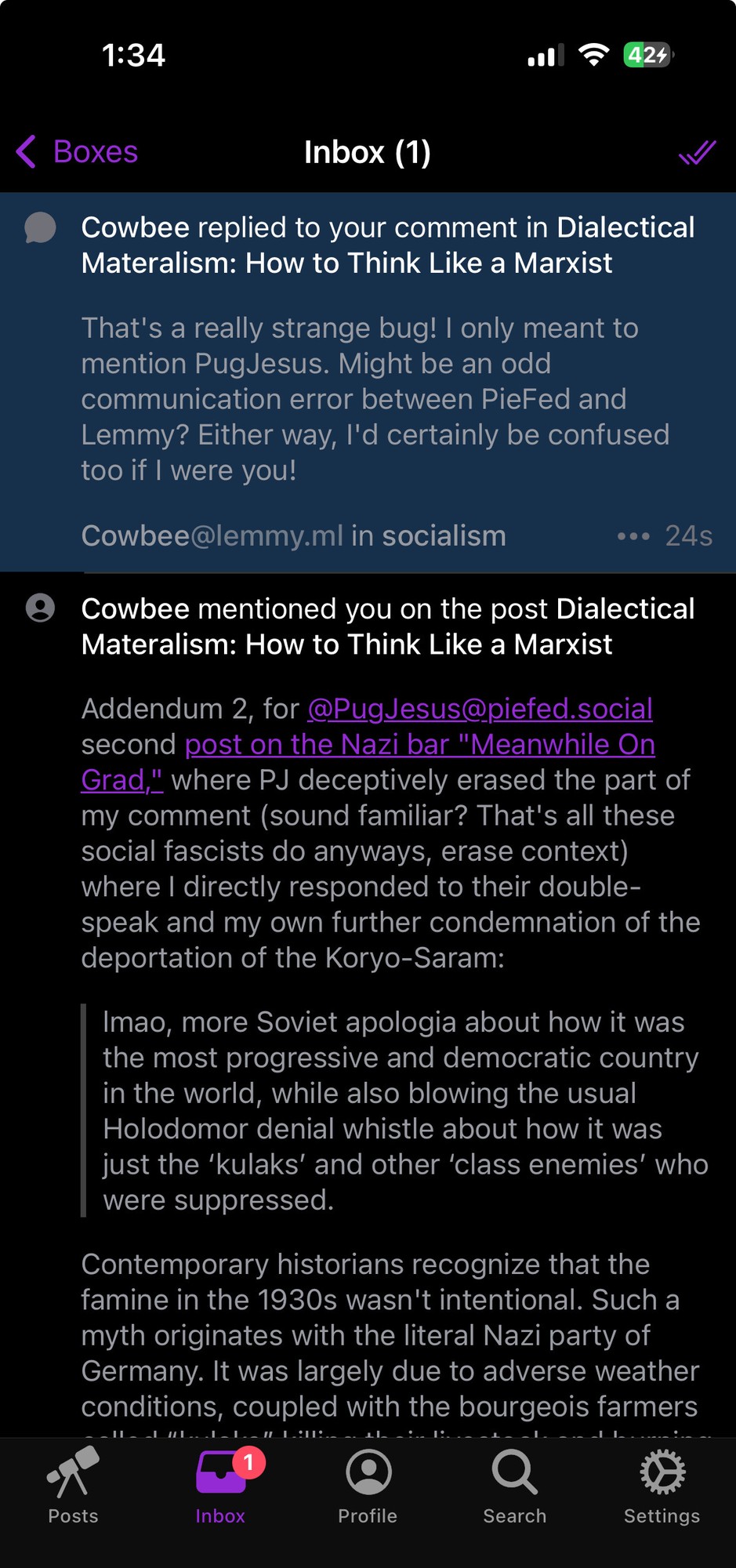
I have to assume communication issue or smth, especially with the delay. It showed up after a comment on something else so I know it wasn’t just sitting there.
Either way, yeah, hi and stuff!
lol I just wanted to share in case I missed something in the post body but since it seems I didn’t, have a great day!
Yea, have a great day yourself! Sorry that you ended up getting a fairly aggressive comment out of nowhere, even if it wasn’t directed at you in any way. Maybe bring it up with Lemmy/PieFed devs?
@dessalines@lemmy.ml @nutomic@lemmy.ml seems @ mentioning one PieFed user ended up notifying a different PieFed user. No idea if this is common, but figured I’d bring it up!
I’m not sure what’s causing it, someone should probably open an issue. It could be a problem on either side.
cc @rimu@piefed.social
Same
Really? Interesting! That’s a really odd bug.
-
Either way, there’s still no evidence provided by PugJesus for Marxists defending the deportation of the Koryo-Saram, only contextualization and understanding it, as any decent historian would do.
it’s not like PugHitler is a historian, he’s a ‘history major’ with a concentration in jerking off about the roman empire
Yep, agreed. It’s just more effective to explain precisely why PJ’s historiography is deeply flawed. Whenever they screengrab for MeanwhileOnGrad, it de-legitimizes them in the eyes of those that can see the logic in what I have to say, and the ones that agree with PJ to a fault aren’t likely to be swayed by logic to begin with.
You really upset him and made him make a post that looks like a corkboard and a strings tying conspiracies together.
Oh shit, didn’t see that, lmao. Kinda disappointed that throughout that whole “exchange” PJ never even tried to counter any of the sources I brought. You’d think a history major would love a chance to debunk a “tedious tankie” if I’m so clearly wrong, but no, they just repeated that I’m tedious and ran to the Nazi bar every time.
As for the misgendering bit from PJ, “bbg” means “babygirl,” which was combined with the kiss emoji. I am not a girl, and I felt both to be extremely creepy and unwanted. Call me a “tankie” or whatever, but please don’t resort to creepy sexual remarks (not directed at you).
You mean to tell me the Rome-obsessed commie hater is also weird with pronouns? Next you’ll tell me PJ is banned from Blahaj for not respecting pronouns…
You’d think a history major would love a chance to debunk a “tedious tankie” if I’m so clearly wrong, but no, they just repeated that I’m tedious and ran to the Nazi bar every time.
It’s his safe space, no one can question narratives there. Even if it’s all propaganda by capitalists.
You’re the only major ML on Lemmy I feel actually respects people on here.
Thanks, I appreciate it. Honestly I don’t blame anyone for being tired, being an activist in the west is enough to drain anyone and thus lashing out online becomes an outlet for people, but I try to keep aggression as low as possible and back up any claims that go against the grain.
I am tempted to write something informative and then ping him so that he’ll mindlessly screencap it for his audience. That way his collages will actually be useful to somebody (other than himself) and my research will reach more readers.
Based on my experience, PJ will likely just cut your entire comment out if it debunks them too hard, but it might be worth a shot!
It’s always the Roman history guys…
deleted by creator
♥️
Peak
anarchistsocial fascist praxis: I drew you as the soyjack ✊Less anarchist, more social fascist. PugJesus is neither an anarchist nor a Marxist.
I stand corrected
Why was having prisons a necessary step?
It’s more reasonable when contextualizing the population transfer to recognize it as a mistake, but not one made out of a supernatural “evil,”
What is colloquially referred to as ‘‘evil’’ can be explained in plain material terms: people in power often do not care about the ethical or human consequences of their actions, and so they do not have reason to prioritize the health and wellbeing of their victims.
Why was having prisons a necessary step?
I suppose they could have executed everyone, but that would have been more extreme. Letting everyone go would have resulted in huge amounts of chaos and people returning to the fascist army.
What is colloquially referred to as ‘‘evil’’ can be explained in plain material terms: people in power often do not care about the ethical or human consequences of their actions, and so they do not have reason to prioritize the health and wellbeing of their victims.
Evil itself is not a reason, though. Just like one can explain lightning by saying Zeus did so or by talking about friction within clouds, there are both materialist and idealist explanations for questions. Further, an explanation being materialist does not mean it is correct, just that it seeks answers based on materialist understanding.
Evil here just means apathy; the reason could be literally any thing? I.e. they would need a reason to care.
That’s not what I am referring to by “evil,” I mean the religious notion of a supernatural evil.
deleted by creator
Responding to @Ourst@lemmy.sdf.org here for this comment, since @Pandantic@midwest.social tagged me on a comm I can’t actually post or comment in for “voting while tankie.” This was for the following meme:

And subsequent comment:
CowBee is a lemmy user who posts large swathes of text and quotes random bits of theory to back up support Russia/China/North Korea. Dengism is the state-capitalism side of “communism”. A loser who hides behind ‘the theory’ to push authoritarian state propaganda.
There are a few key lies here.
-
I don’t quote “random bits of theory” much at all. I did do that years ago, but learned that that’s extremely ineffective. Instead, I explain my points in my own words, and use facts, statistics, and primary sources for talking about contemporary politics. Discussion of theory is largely useless with those that have no interest in learning, which was a major mistake I used to make while talking about socialism and communism online.
-
“Dengism” does not exist as an ideology. Deng Xiaoping Theory exists, and largely refers to Reform and Opening Up. When Ourst alleges that it is “state capitalism,” we have to investigate what changed between the Mao era and the Deng era, and the PRC today.
Contrary to common belief, the economy wasn’t 100% publicly owned and planned under Mao or the Gang of Four. Private and cooperative ownership existed, and did so not because of a belief that private ownership is better than public in the abstract, but because of the level of development in the productive forces of China. What Deng Xiaoping did was largely carry over plans from Zhou Enlai and Mao Zedong in opening up secondary, non-critical industries to foreign investment, with dominant state ownership.
What is “state capitalism?” It best describes an economy that is both capitalist and heavily state run and controlled. What is capitalism, then? Capitalism is a mode of production where private ownership is the principle aspect of the economy, ie governing the large firms and key industries at a minimum. The Republic of Korea, dominated by megacorporations like Samsung while employing strong state controls, is an excellent example of such a system.
Why is it important to judge what is principle in determining the mode of production? Because no economy on the planet is “pure.” Whoever controls the large firms and key industries indirectly controls the small/medium firms and secondary industries. As an example, the rubber factory has control over the rubber ball factory.
In the PRC, the large firms and key industries are all dominated by state ownership. This is qualitatively different from capitalism, and as such this gets fundamentally different results. If we use the lessons on dialectical materialism learned in the topic post, we can see that public, socialized ownership is the rising factor in the PRC, as the privatized sector grows it socializes itself and prepares for easier integration into the public sector. This is a “birdcage” economy, capital is let free within specified confines.
Why allow private ownership at all? To fill in the gaps left by the public sector, to help with technology transfer from the west, to stave off war by integrating heavily into the global economy, and to accelerate the growth and development of small and medium firms. Is it necessary to do so? No, but for the strategy chosen by the PRC it is undeniably working out for them, as the PRC continues to grow and rise.
In other words, “billionaires vs. no billionaires” isn’t a binary choice. It’s a tradeoff, with either path offering their own strengths and weaknesses. The soviet union took the “no billionaires” path and was isolated by the west, weakening it’s global integration. The DPRK and Cuba took the “no billionaires” path, and while they have been doing very well despite their circumstances, they havw been some of the most isolated countries on the planet as a consequence. The PRC’s decision to integrate with the global economy came with new contradictions, but also new opportunities, and by retaining public ownership as the principle aspect of the economy has done so without undermining socialism, but building on top of it.
- The allegations that I “hide behind theory to push authoritarian state propaganda.” This is essentially making the point that I phrasemonger and cherry-pick quotes from Marx, Engels, etc. to defend what shouldn’t be. The problem with these allegations is that I don’t. I reference facts and statistics, and I use the methodology of Marxism-Leninism to form my arguments. I don’t simply say whatever Marx and Engels said is infallible and ignore material reality, I begin with material reality and apply dialectical materialist analysis to it (see the post above).
It must be extremely convenient to claim everything I say is simply propaganda. However, there’s absolutely no investigation in the quality of the sources I use, just a blanket statement. If Ourst has an example of this, I’d be more than happy to discuss it.
Overall, I’m confused by the point Ourst is making here, because they aren’t engaging with real points I make. I suggest they speak to me directly, rather than hiding in a comm I’m banned from.
Addendum, for fun. After responding to the allegations from @Ourst@lemmy.sdf.org, let’s see what kinds of things they post.


Both are against the DPRK, which is obvious. The former is just the assertion that the DPRK isn’t democratic, believing it humorous that it calls itself as such. The latter hits on similar beats, with the addition of depicting Kim Jong-Un, a Korean man, as a yellow creature. Ourst also depicts Xi Jinping as a yellow cartoon bear, and has several memes hinting that they’ve been accused of racism by Marxist-Leninists. Shocking!
Returning to the topic of the DPRK and whether or not it’s democratic, I’ll pull from professor Roland Boer’s book Socialism in Power: On the History and Theory of Socialist Governance:
The DPRK’s electoral democracy relates primarily to the people’s assemblies, along with local state organs, assemblies, and committees. Every eligible citizen may stand for election, so much so that independent candidates are regularly elected to the people’s assemblies and may even be elected to be the speaker or chair. The history of the DPRK has many such examples. I think here of Ryu Mi Yong (1921–2016), who moved from south to north in 1986 so as to take up her role as chair of the Chondoist Chongu Party (The Party of the Young Friends of the Heavenly Way, formed in 1946). She was elected to the Supreme People’s Assembly and became a member of the Standing Committee (then called the Presidium). Other examples include Gang Ryang Uk, a Presbyterian minister who was a leader of the Korean Christian Federation (a Protestant organisation) and served as vice president of the DPRK from 1972 until his death in 1982, as well as Kim Chang Jun, who was an ordained Methodist minister and became vice-chair of the Supreme People’s Assembly (Ryu 2006, 673). Both Gang and Kim were buried at the Patriots’ Cemetery.
How do elections to all of the various bodies of governance work? Elections are universal and use secret ballots, and are—notably—direct. To my knowledge, the DPRK is the only socialist country that has implemented direct elections at all levels. Neither the Soviet Union (in its time) nor China have embraced a complete system of direct elections, preferring—and here I speak of China—to have direct elections at the lower levels of the people’s congresses, and indirect elections to the higher levels. As for candidates, it may initially seem as though the DPRK follows the Soviet Union’s approach in having a single candidate for each elected position. This is indeed the case for the final process of voting, but there is also a distinct difference: candidates are selected through a robust process in the Democratic Front for the Reunification of the Fatherland. As mentioned earlier, the struggle against Japanese imperialism and liberation of the whole peninsula drew together many organisations, and it is these that came to form the later Democratic Front. The Front was formed on 25 July, 1949 (Kim Il Sung 1949), and today includes the three political parties, and a range of mass organisations from the unions, youth, women, children, agricultural workers, journalism, literature and arts, and Koreans in Japan (Chongryon). Notably, it also includes representation from the Korean Christian Federation (Protestant), Korean Catholic Federation, and the Korean Buddhist Federation. All of these mass organisations make up the Democratic Front, and it is this organisation that proposes candidates. In many respects, this is where the multi-candidate dimension of elections comes to the fore. Here candidates are nominated for consideration from all of the mass organisations represented. Their suitability and merit for the potential nomination is debated and discussed at many mass meetings, and only then is the final candidate nominated for elections to the SPA. Now we can see why candidates from the Chondoist movement, as well as from the Christian churches, have been and can be elected to the SPA and indeed the local assemblies.
To sum up the electoral process, we may see it in terms of a dialectical both-and: multi-candidate elections take place in the Democratic Front, which engages in extensive consideration of suitable candidates; single candidate elections take place for the people’s assemblies. It goes without saying that in a non-antagonistic system of class and group interaction, the criterion for election is merit and political suitability
As for the bodies of governance, there is a similar continuity and discontinuity compared with other socialist countries. Unlike the Soviet Union, there is a unicameral Supreme People’s Assembly, which is the highest authority in terms of laws, regulations, the constitution, and all leadership roles. The SPA is also responsible for the national economic plan, the country’s budget, and foreign policy directions (Han 2016, 47–48). At the same time, the Democratic Front for the Reunification of the Fatherland has an analogous function to a second organ of governance. This is a uniquely Korean approach to the question of a second organ of governance. While not an organ of governance as such, it plays a direct role in electoral democracy (see above), as well as the all-important manifestation of consultative democracy (see below). A further reason for this unique role of the Democratic Front may be adduced: while the Soviet Union and China see the second body or organ as representative of all minority nationalities and relevant groups, the absence of minority nationalities in a much smaller Korea means that such a form of representation is not needed.
I highly recommend the book, it helps shed light on some often misunderstood mechanisms in socialist democracy, including the directly addressed fact that the DPRK’s voting process includes single candidate approval voting. Without the context of the candidate selection process, this is spun as entirely anti-democratic.
The DPRK doesn’t have a liberal democracy. They do have a comprehensive candidate election system, direct voting at all levels of government, 3 political parties, and a system of approval voting. They do not align with what the west thinks democracy looks like, but instead this form of democracy evolved out of Korea’s struggles against Japanese colonialism and the structures set up during that time period.
Ourst has nothing actually backing their claims of the DPRK being undemocratic, and additionally seems to think it’s okay to depict both Xi Jinping and Kim Jong-Un as yellow caricatures. Even if one could claim a single time is a coincidence, the fact that it’s consistent across Ourst’s depictions of asians, and their defensive stance surrounding allegations of Ourst’s racism, this appears to be a pattern.
-
Great intro, only thing I’d add would be to note that it should also be made explicit that socialism and communism stages here have their own contradictions as well, and they too will continue to evolve going forward.
I’d suggest that we should think of this less of a directed progression, but rather a graph of states and edges connecting them. When you’re at any particular state, you can transition to a different adjacent state from it. For example, capitalism can transition to socialism, regress back to feudalism, or turn into fascism. These are all possible outcomes based on how the material conditions develop. But we cannot jump from capitalism directly to communism because these states are not directly adjacent to each other. There is too much change necessary, and therefore you need an intermediate state like socialism to make the transition. But that too can revert back to capitalism as we saw in USSR. Thinking of this in terms of a two dimensional space adds a bit more nuance rather than framing it as an inevitable linear progression towards communism.
Those are great additions! I’ll see if I can add that somewhere, thanks!
O7
🫡

Well done! Saving this, and hoping you’ll do more like it :)
Thank you!
This is a great write-up, thank you for sharing! For those who want to know more, do you mind if I plug Luna Oi’s translation of a Vietnamese textbook on Dialectical Materialism? In terms of books I’ve found it to be a great long-form explanation of Dialectical Materialism.
One thing I appreciated in the book is that it separates Dialectical Materialism and Materialist Dialectics - the former being the philosophy and the later being the tools. It might seem like a distinction without a difference but separating the two helped me understand both better.
These are way better, I just wanted a brief summary to reference. Go for it!
Wow, this is pretty good! Usually people understand Marxism very superficially. I’m glad there are people who take the theory seriously.
This is not about summarizing the “classical” marxist view and more about extending it, but on the side note, I think the very split of being into matter and consciousness should be overcome. The two opposing sides should be united in something that interconnects and comprehends both of them. And that is human action (and activity in general). Idealism states what we perceive is created by our mind. Materialism states what we sense is the world itself. But actually both are true. Cognition is human action towards the world. We do create what we see, but we do so by changing the world around us. So it’s more similar to how a painter depicts something than to how water reflects surrounding objects.
Thanks for your contribution! That’s an interesting perspective regarding the idealism/matetialism split, and it sounds similar to how the juche idea tries to iterate on dialectical materialism, seeing it as true, but then moving forward. That’s an area I intend to study more.
I’ve just read a little bit about Juche idea and it seems to me it’s the opposite to my views. Wikipedia (which I know isn’t always a credible source) states:
Juche incorporates the historical materialist ideas of Marxism–Leninism but also strongly emphasizes human agency, role of consciousness, and primacy of ideology and propaganda. In politics, Juche emphasizes the nation state, national sovereignty, and strongly defends the role of an individual leader.
If this is true, I think Juche idea is closer to idealism. Human agency is taken here more as the ability of an individual to influence other people, as leadership, which produces the idea of “primacy of ideology and propaganda”. And I, by human agency, mean transforming the world around us, evolving the artificial environment we live in, i.e. the development of means of production. So the conclusion I draw is that overcoming alienation can only be done through changing the mode of production and can not be done politically.
Btw, check out Ilyenkov. He’s an example of a philosopher who took Diamat forward.
Juche accepts dialectical materialism as true, it just attempts to build upon it. Essentially, once humans are aware of historical materialism and their place in it, they can actively participate in the historical process deliberately.
Ahh another maximum effort post by Cowbee! I actually liked what Pugjesus had to say in his meme post but as always you offer a well thought out and extended explanation and counter. Not sure how you both feel about each other but as a filthy fucking lurker myself I greatly appreciate the discourse from you both.
Thanks so much!
Pretty sure PJ hates me, and I don’t care for PJ myself. PJ harbors social fascist views and is permanently wrong about Marxist and Marxist-Leninist theory and history, yet is perfectly happy to continue making terrible memes. Just my 2 cents.
What do you consider their social fascist views? And yeah they do seem to treat Marxist theory with a bullish attitude as if it’s a monolith. Tbf so did I for a long time.
PJ labels themselves as “vaguely left-wing,” but rejects both Marxism and anarchism. In doing so, they cape for factions like the German SPD, who murdered communists and assisted Hitler’s rise to power. Further, their views on the history of socialist countries and the global south in general is absolutely drenched in liberal historiography. No matter what evidence is shown, they dogmatically cling to right-wing views of socialism, even to the point of condemning the Black Panther Party (though this was over a year ago).
One only needs to see how much time PJ spends in anti-communist safe havens for Zionists, such as TankieJerk and MeanwhileOnGrad, to see that PJ is sort of trapped in what they feel is left-wing views, but no actual theory or practice to speak of forces them to adopt pro-imperialist viewpoints. You can see that all of their posts and comments regarding Marxism and socialist countries either rely on strawmen that do not exist in reality, or purely repeat Red Scare dogma.
In short, PJ thinks they are left, but doesn’t accept non-western viewpoints on history as genuine. Further, PJ doesn’t understand Marxism nor anarchism, yet is more than happy to keep repeating misinformation on them, a factor of their obsession with the political compass. This leads them to be held back into supporting imperialism and demonizing socialism.
Just follow PJ’s “responses” to me and see how dishonest they are.
Dang so a typical fucking liberal then? Disappointing. I had thought they were, at worse, just an anarkiddy. Do ya reckon they have at least read Kropotkin? honestly, being anti black panther is a fascist flag for sure and enough to know about someone to discredit them.
If what they’ve said is true, they’ve read a few isolated Marxist and anarchist texts, but given how distorted their understanding is of Marxism and anarchism it’s really difficult to suggest that they comprehend it. What I believe happens is that their liberal historiography causes them to take from the little theory they have read that which conforms to their pre-existing beliefs, the way someone can try to quote-farm What is to be Done? to suggest Lenin would have supported voting for the DNC (when he absolutely wouldn’t).
I’m no PJ expert, this is all based on conversations from over a year ago, as we haven’t directly spoken since PJ permabanned me from every comm they moderate after losing an argument on an unrelated comm.
To be truthful, I made this post in the first place because I wanted to have something to reference regarding the problems with PJ’s historiography. Not PJ exclusively, it’s common for metaphysics and idealism to cloud one’s judgement, but certainly prompted by them.
Hey I remember being like that back in the day when I first started reading history seriously. I would like to think I have grown past that behaviour and thinking though. I’ve got to thank the hardcore anarchists and commies that have made that possible and it’s largely been through high effort content like yours that politely point in the direction of more learning. Regarding PJ, perhaps they’re still early in their leftist journey, with any luck they only become a better ally… Or maybe they’re just an idiot that won’t do the homework haha
I was the same way, years ago! I think we all were, or at least most of us. Anti-communism is a religion in the west, and we are all molded by that. Regarding PJ’s potential for growth, I hope so too! Ideally they join an actual organization and start treating political theory as a guide to action, and not a source for making memes.
Not bad, and no disrespect, but you missed the simplest and most important part, centering human thought, experience, time, and effort. Without it, we are just peddling impractical abstraction

(Sorry I wrote out this whole thing but just decided to post this instead)
I’ve read Theses on Feuerbach, I’m not sure exactly how I missed its core essence. I explained that dialectical materialism is a tool for understanding the world and its processes, unless you mean matter shaping thought. If the latter, I added a short bit on that.
I’m sure you have, I’m being glib. Most people miss it.
All social life is essentially practical. All mysteries which lead theory to mysticism find their rational solution in human practice and in the comprehension of this practice.
Dialectical Materialism needs to explicitly center human contemplation, experience, time, and effort. For example, this is what Lenin understood that Plekhanov did not. Fortunately, we have the benefit of Marx’s own notes describing exactly how to negate all forms of idealism. Without it, we can’t connect abstraction to concrete specifics in a principled, coherent and scientific way, and “morbid symptoms appear.”
Anyway I’m insufferable when it comes to this point. Again, no disrespect, you cover all the high points quite well without referring to Engels, except for this one
Fair enough!
Not well-read on communism, why is Lenin often cited in marxist discussion; wasn’t he a terrible person who created fascist rule?
Lenin was a Marxist, and he advanced Marxism into the era of imperialism, using this advancement to establish socialism.
wasn’t he a terrible person who created fascist rule?
Only if you’re a horseshoe theorist. Previously:
- ‘Horseshoe theory’ is nonsense – the far right and far left have little in common
- https://en.wikipedia.org/wiki/Horseshoe_theory#Academic_studies_and_criticism
- Funny thing about Hannah Arendt’s construction of “totalitarianism”: She came from a bourgeois family and so was unsurprisingly anti-communist, and she was funded & promoted by the CIA.
Imperialist Propaganda and the Ideology of the Western Left Intelligentsia: From Anticommunism and Identity Politics to Democratic Illusions and Fascism
One of the centerpieces of the cultural cold war was the Congress for Cultural Freedom (CCF), which was revealed in 1966 to be a CIA front. Hugh Wilford, who has researched the topic extensively, described the CCF as nothing short of one of the largest patrons of art and culture in the history of the world. Established in 1950, it promoted on the international scene the work of collaborationist academics such as Raymond Aron and Hannah Arendt over and against their Marxian rivals, including the likes of Jean-Paul Sartre and Simone de Beauvoir.
I’m familiar with the horseshoe theory. I am not against being far-left.
But from my [limited] understanding of the figure, he did a u-turn on his policies the minute he came to power, and became the thing he was supposed to destroy [fascism, dictatorship] instead of actually applying communism/socialism the way it was intended (i.e. to liberate the working class from the social elites and restore the means of production back to them).
CMIIW.
Your understanding of Lenin comes from the last eighty years of anticommunist propaganda.
became the thing he was supposed to destroy
Please don’t get your politics from Star wars
Naw, let’s cook:
- Cassian Andor/Han Solo -> Joseph Stalin
- Princess Leia -> Petyr Kropotkin
- Obi-Wan Kenobi/Master Yoda -> Vladimir Lenin
- C3PO -> Leon Troysky
- Luke Skywalker -> Voldymyr Zelenskyy
- Darth Vader -> Donald Trump
- Emperor Palpatine -> Vladimir Putin
The soviet union was both socialist and democratic. Why do you believe otherwise? What do you think socialism looks like?
Lenin is not associated with fascism in good faith. I have heard some people describe the Bolshevik revolutionary government as fascist, but I dont believe they have a very good definition of fascist. In those cases, fascism means something kind of like authoritarian. Was Lenin an authoritarian? Ive looked in to this quite a bit, and even though I think such criticisms dont actually stick to Lenin very well, there were a few things that happened in 1921 that were imo harmful to international socialism. Those were, the banning of factions, attack on Kronstadt (carried out by Trotsky), and the New Economic Policy. After that point, I believe Russian socialist experiment was essentially over, it had turned into something else. This was not purely the fault of Lenin, who was doing his best to navigate an impossible situation made worse by bloody civil war against the government. Other communists will disagree with me on this point, but this is what ive learned.
However, Lenin was a revolutionary leader. He helped organize the revolution for decades leading up to the Oct 1917 revolution, led the Bolsheviks through numerous difficulties, including the years of severe repression, exile of himself and many of the leaders, opportunism from the Menshevik faction, opportunism from ultraleft factions, and the crucial months before the revolution.
When considering if Lenin was actually a fascist, consider this: fascists will always make war. Lenin and the Bolsheviks on the other hand, in carrying out the revolution, actually ended WW1. The revolution itself was practically bloodless. What wasnt bloodless, was the civil war, initiated by the Russian monarchists, and helped by numerous invaders, like France and the USA. Still. The Bolsheviks fought a political battle, and won. But the cost was incredibly high. Russia had been the most backward country in Europe, and now, the scant industry Russia had built up over the last 100 years got completely destroyed. Without places to work, there was no working class to defend the revolution. Lenin was dead by 1925, and suffered from severe health problems for years. The fact is Lenin didn’t have time to be a tyrant.
I have criticisms of him but he was the proof of concept for revolutionary Marxism. He was a fierce defender of Marx’s dialectical materialist method, and used it to understand the past, interpret the present, and make plans of action to organize the workers to seize control of industry. The workers had their own revolution in February 1917, but were already about to hand control of the government to the capitalists. The workers defeated the monarchy but was about to empower a new ruling class, whose plan would have been to allow a guy named Kornilov to declare vicious repression and martial law, and restore the king to a constitutional monarchy. And King Nick was a stupid, vicious tyrant. On the other hand, only the Bolsheviks could have possibly carried out and defended the workers revolution.
We study Lenin because we are revolutionaries for worker revolution, and he was the first person to use Marxist struggle to educate the workers, not only to overthrow the tsar, but also seize state power for the workers. He was a brilliant political scientist and theorist. The people who call him tyrannical and fascist tend to be very closely aligned with capitalism in one way or another. He faced impossible conditions at every step, but with a clear understanding of facts afforded to him by Marxism, helped forge a way forward, and set an example for how to overthrow capitalist power and keep the capitalists from seizing state power
Yeah, authoritarian… no thanks.
Besides war, fascism is known for it’s crackdown on opposing thought. Banning of factions like you said, is one red flag. He created a single-party state.
Then there’s the suppression of opposition along with massacres in the Red Terror. Then you have the ‘‘war communism’’ he instated from 1918-1921:
The system has often been described as simple authoritarian control by the ruling and military castes to maintain power and control in the Soviet regions, rather than any coherent political ideology.
And this guy is lauded as an anti-imperialist figure?
What’s the opposite/absence of “authoritarianism”?
I don’t think factionalism is a good thing, and in the context of the USSR it likely would have been a bad thing. That doesn’t make it less democratic or more fascist. War communism was for the purpose of the Russian Civil War, and getting your information on it from liberals isn’t going to help you understand it.
deleted by creator
Incredible write-up! I’m about to study diamat with the translated books by comrade Luna Oi so this is very welcome
Thanks, and good luck! Those are great from what I’ve seen! Way more in-depth, too!
That second image with the open hand is… slightly gross. Maybe change it?
I might, need to find a different example of early materialism in art format, ideally from the era where the bourgeoisie were rising. I’m grossed out by it too.
Edit: Changed!
I’m not typically inclined to the metaphysical, but consciousness is the rare case where I am. How do you explain consciousness in a materialist worldview? Just random processes and atoms that evolved for us to be able to be self-aware and alive? Not very compelling, I suppose it doesn’t register experientially, for me, at least. This would also apply to mental illness and how people can literally die of a broken heart [I’m referring to heart conditions, not suicide, here]. Though I’d like to hear if there’s more.
Other issues:
The 3rd premise of Early Materialism here is very much an unproven assertion, not much unlike those of Idealism. The 3rd premise of Dialectical Materialism (under moving from metaphysics to dialectics) implies an infinite regress, which fails to explain how anything exists, because if an infinity has to pass before the current process/matter can exist, it should never exist.
Thoughts are extraordinarily complex electrochemical signals, nerves, etc. They are not outside the material world.
Materialism teaches that the world and its laws are fully knowable, and that while much may not be known there is nothing which is by nature unknowable.
This doesn’t mean everything will be known, just that it can be.
That the motion of matter comprehends an infinite diversity of forms which arise one from another and pass into one another
I don’t see what you mean by an “infinite regress” here.
How do you know thoughts aren’t outside the material world if they cannot be observed?
This doesn’t mean everything will be known, just that it can be.
This is still an unproven assertion; it is not necessarily true.
I don’t see what you mean by an “infinite regress” here.
If anything has to form through a process where it has to pass through an infinite number of processes or forms of matter, it should never arise, because infinity can never be ‘‘completed’’.
Thoughts can be observed, brainwaves and activity have been recorded.
This is still an unproven assertion; it is not necessarily true.
How so? What stands beyond the possibility of knowing, if not the supernatural alone?
If anything has to form through a process where it has to pass through an infinite number of processes or forms of matter, it should never arise, because infinity can never be ‘‘completed’’.
This doesn’t follow, though. The point isn’t for it to be completed. Infinity as a concept exists, even if we never reach it in reality, the capacity for always increasing does.
Brainwaves and activity are not thoughts. We cannot actually directly ‘‘observe’’ the thoughts themselves. We can’t look at someone in a lab and be like, ‘‘ah yes, he really wants to go play football right now’’, that’s not something we can observe.
How so? What stands beyond the possibility of knowing, if not the supernatural alone?
Human limitation, for one. We are not omniscient or omnipotent, nor will we ever be. We’ll never have the full picture of the totality of reality, even if progress can be made. Our limitations are inherent to us, limitations in our mental ability, perception, senses, etc.
This doesn’t follow, though. The point isn’t for it to be completed. Infinity as a concept exists, even if we never reach it in reality, the capacity for always increasing does.
It follows necessarily. If it’s not completed, no process or matter can arise. Because we know these processes/matters exist, they can’t be coming from an infinite loop.
Square circles and married bachelors also exist as concepts.
Brainwaves and activity are not thoughts. We cannot actually directly ‘‘observe’’ the thoughts themselves. We can’t look at someone in a lab and be like, ‘‘ah yes, he really wants to go play football right now’’, that’s not something we can observe.
Just because we cannot currently categorize the output does not mean the thoughts exist in the supernatural plane.
Human limitation, for one. We are not omniscient or omnipotent, nor will we ever be. We’ll never have the full picture of the totality of reality, even if progress can be made. Our limitations are inherent to us, limitations in our mental ability, perception, senses, etc.
This just means we likely won’t know everything, not that there is something we cannot know, period.
It follows necessarily. If it’s not completed, no process or matter can arise. Because we know these processes/matters exist, they can’t be coming from an infinite loop.
It does not. Matter continues to change. Water can boil and return to liquid over and over again.
Just because we cannot currently categorize the output does not mean the thoughts exist in the supernatural plane.
You cannot assert they are material, either. It’s about observation, though, not merely categorization.
This just means we likely won’t know everything, not that there is something we cannot know, period.
If you can’t know everything, there’s at least something(s) you can’t know.
It does not. Matter continues to change. Water can boil and return to liquid over and over again.
And because these processes are occurring, they could not have arisen from an infinite loop, because that would suggest infinity had passed for them to occur, which is impossible.
You cannot assert they are material, either. It’s about observation, though, not merely categorization.
I can, because supernatural processes do not exist.
If you can’t know everything, there’s at least something(s) you can’t know.
There’s a difference between saying it’s unlikely that everything will be known and saying there’s something in particular that cannot be known.
And because these processes are occurring, they could not have arisen from an infinite loop, because that would suggest infinity had passed for them to occur, which is impossible.
This does not follow.
How do you know thoughts aren’t outside the material world if they cannot be observed?
Because you made that up. There’s no piece of evidence that even hints at “thoughts in another world”.
Also, they can be observed. EEG.
A lot of these things might simply be unknowable for all we know, but if they aren’t we’ll eventually advance our analysis to account for more and more stuff.
I have my personal religious beliefs, but that’s very much unprovable, it seems that the only thing we can research, analyze and agree on is material, so this isn’t and it doesn’t have to be a theory of everything, it just has to be useful.