I don’t make the rules…. but I have observed far too often for it to be coincidence that the more brilliant a type theorist is, the more likely it will be that they identify as 🏳️⚧️ or 🏳️🌈.
Counterpoint: I used to be a computer scientist in obscure languages, I’m as cis as they come, and I’ve always been absolutely average. Wait that’s not a counterpoint at all
Tbf I had a friend who worked in CS but was actually a mechanic. He just fixed the systems so much they would pay him a diff to go work at other shops computers.
You’ve convinced me we need to start marketing HRT as performance enhancing drugs for programmers. Maybe that would make corporate America support trans healthcare
Indeed. [And caveat this whole comment with “as far as I understand” because this is maths and you can’t be too careful…] The difference being that set theory is way more fundamental and abstract than most mathematicians ever need, so on the one hand it can be completely stated with only 8 or 9 axioms (and a system of first-order logic) but on the other hand it can take some ingenuity to encode a mathematical object as a set in a way that makes it easy to do stuff correctly and hard to mess up.
Most type theories take a more intuitive approach, so they do resemble something, namely, functional programming. Just a very rigorous approach to it. If you manage to construct a term of the correct type, you can be sure that it’s what you think it is, whereas with set theory you have to constantly check yourself (if you require the rigor). The trade-off being that type theory requires you to work with complete rigor and reasoning at a low level can be more difficult than set-theoretic reasoning at a low level.
The TL;DR is that in type theory your constructions often look like what you actually want to do (and as a consequence you sometimes have to work directly with the underlying system, like a programming language), but in set theory there’s a disconnect between the conceptual level and the underlying nitty-gritty logic.
Dunno about type theory per se but I visited a Haskell-based company a while back, and they said 50% of the women they interviewed were trans. Not sure of the cause and effect relationship. I know of several male-at-the-time programmers who got interested in Haskell and then transitioned later.


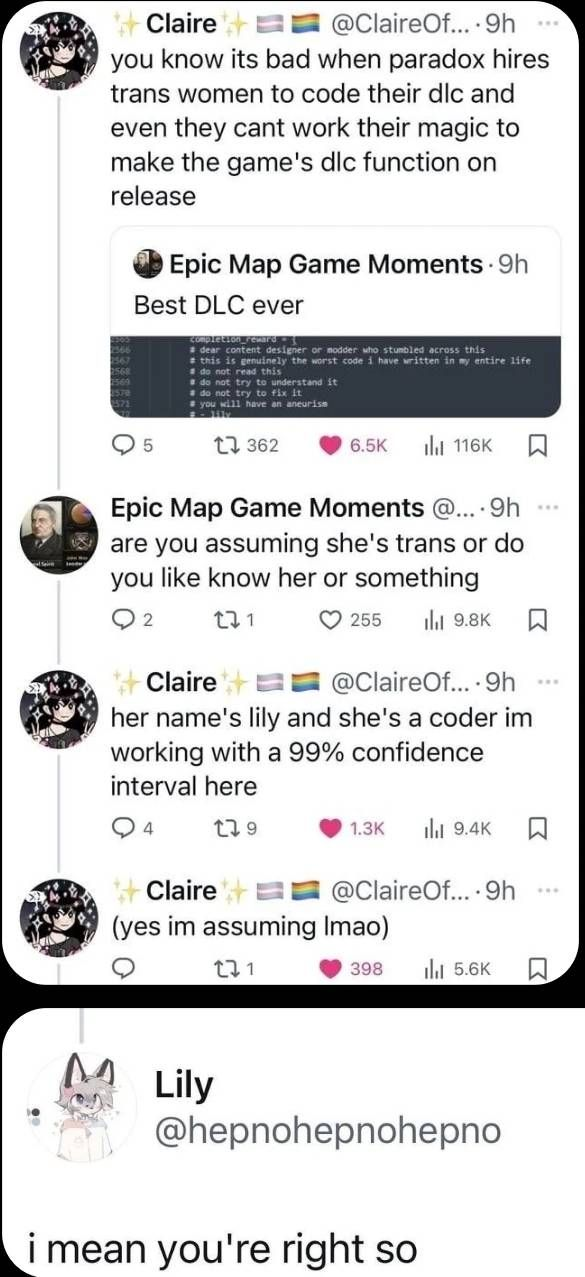
I don’t make the rules…. but I have observed far too often for it to be coincidence that the more brilliant a type theorist is, the more likely it will be that they identify as 🏳️⚧️ or 🏳️🌈.
Counterpoint: I used to be a computer scientist in obscure languages, I’m as cis as they come, and I’ve always been absolutely average. Wait that’s not a counterpoint at all
Counterpoint: I am a trans woman in CS and I am incompetent
Maybe you just have imposter syndrome: you think you work in CS but you actually work in retail.
Tbf I had a friend who worked in CS but was actually a mechanic. He just fixed the systems so much they would pay him a diff to go work at other shops computers.
That’s…not…
Maybe taking estrogen will elevate your rank.
You’ve convinced me we need to start marketing HRT as performance enhancing drugs for programmers. Maybe that would make corporate America support trans healthcare
Would this be considered doping?
I mean, you’re gonna be dope as hell!
In that case she’d be able to double jump
This is a common misconception. Trans people actually have a directional air dash.
As a trans woman, I can say it’s actually both
What do the Linux socks unlock? Sneak while running?
Removes fall damage
Ooh, nice! Do they work on bikes too? Even if you’re tragically cis?
Asking for a friend who’s me 😁
You still need a helmet, but they do add flair :3
Sneak while browsing, Microsoft and Apple can’t track you
Same! :)
I think that would be a contrapositive, as the truth table is the same; unlike a converse or an inverse where the truth tables would be opposite
But we’re also working with inductive logic here, so maybe truth tables aren’t the right tool to use anyway
You could say that type theorists are isomorphic to LGBT.
type theorist?
It’s kinda like set or category theory. The kind of math that hardly resembles anything at all yet somehow applies everywhere, to infinity and beyond
Indeed. [And caveat this whole comment with “as far as I understand” because this is maths and you can’t be too careful…] The difference being that set theory is way more fundamental and abstract than most mathematicians ever need, so on the one hand it can be completely stated with only 8 or 9 axioms (and a system of first-order logic) but on the other hand it can take some ingenuity to encode a mathematical object as a set in a way that makes it easy to do stuff correctly and hard to mess up.
Most type theories take a more intuitive approach, so they do resemble something, namely, functional programming. Just a very rigorous approach to it. If you manage to construct a term of the correct type, you can be sure that it’s what you think it is, whereas with set theory you have to constantly check yourself (if you require the rigor). The trade-off being that type theory requires you to work with complete rigor and reasoning at a low level can be more difficult than set-theoretic reasoning at a low level.
The TL;DR is that in type theory your constructions often look like what you actually want to do (and as a consequence you sometimes have to work directly with the underlying system, like a programming language), but in set theory there’s a disconnect between the conceptual level and the underlying nitty-gritty logic.
People who use templates and types to achieve absurd outcomes that just work, maybe?
I have seen a few haskell magic.
Dunno about type theory per se but I visited a Haskell-based company a while back, and they said 50% of the women they interviewed were trans. Not sure of the cause and effect relationship. I know of several male-at-the-time programmers who got interested in Haskell and then transitioned later.
They’re putting something in the Haskell that’s turning the coders trans! (jk)
Straight men are into OCaml, did you not hear yet?
Tell me what programming languages straight women like, because that’s what I need to study!
You should see what Visual Basic used to do to people.
VB was probably triggering domestic disputes.
I know VB from my early days as something like Mikrosofts take on Python. But not 99% sure anymore.
Eh, it was just BASIC combined with the best (by far) visual forms editor available at the time.
What about Gödel, Frege, Cantor, and the other great philosophers-mathematicians of the 20th century?
Godel has a vibe. Don’t be so sure.
Cantor is the infinity guy, so clearly he/it’s a mind-breaking eldritch abomination with tentacles. (Also, mostly 19th century)
I don’t know Frege.
what about alan turing?
They grew up in an oppressed environment and couldn’t develop their own personal preferences (what did I just write?)
What about them? Listing a few brilliant straight people doesn’t negate the other commenter’s claim.