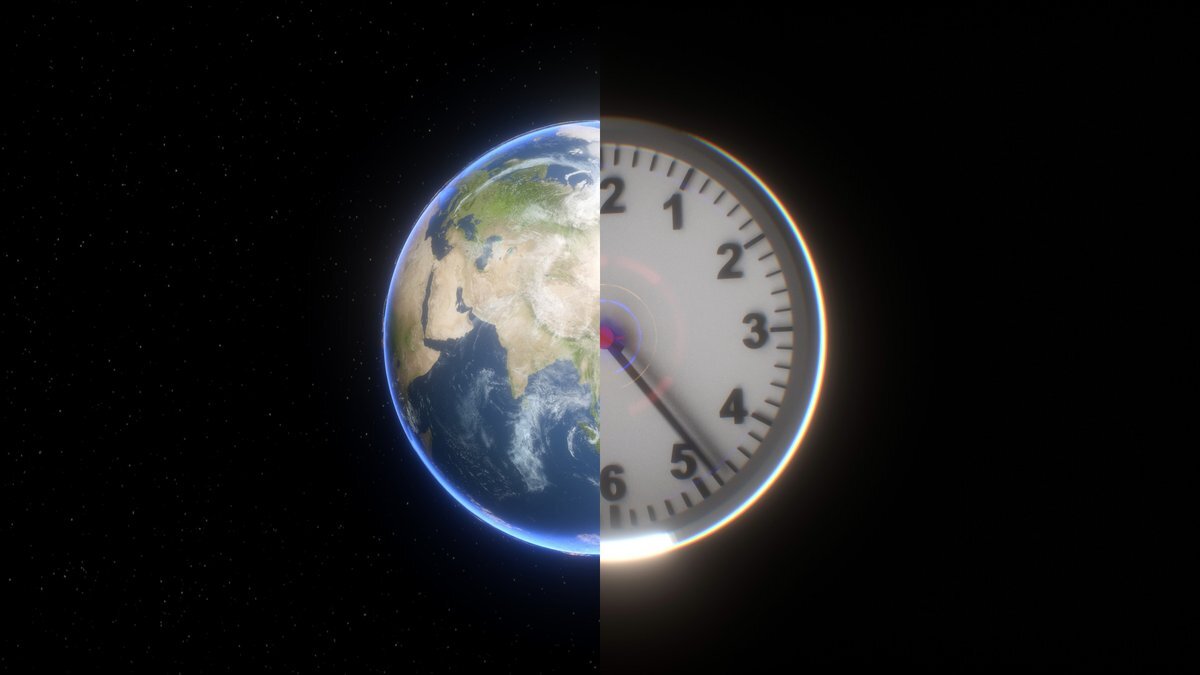
Today an international group of scientists, diplomats, and timekeepers voted to end the leap second, which has been keeping Coordinated Universal Time (UTC) aligned with the time according to Earth’s rotation (UT1) within one second of difference.
A new system, called the “leap hour,” will allow the Earth’s rotation and official time to fall out of alignment by a full hour
Good riddance to the leap second — it’s a scheduled outage for distributed systems. The 2017 Cloudflare incident happened purely because some code paths choked when 23:59:60 showed up, and every insertion window means NTP, databases, and financial systems all hold their breath.
The leap hour is a clever deferral though: pushing the correction out roughly a century means nobody running today has to implement anything, and by the time it matters the drift gets handled wholesale instead of one second at a time. Slightly odd that it’s the same diplomatic mechanism as the CGPM voting on measurement units deciding how software keeps time, but the engineering outcome is right.
https://gist.github.com/timvisee/fcda9bbdff88d45cc9061606b4b923ca
If your software is choking on completely expectable events, it it not sufficiently robust.
As you just proved, while it might be possible to write robust software that deals with dates/times, I wouldn’t bet on it, and it’s Definitely not practical to try.
But you are right that leap seconds were common enough to try and handle. There’s a bunch of ways to handle them though, each incompatible with the others.
There is an easy solution in 100 years. You simply adjust your timezone. Something we already have the capability to do. We already tolerate hour deviations from noon.
Think of it more like that the arbitrarily zero time point on the globe moves 1 hour west. But we keep longitude fixed.
The only weird thing is more places will go to +13 and some to +14. But that’s all relative.
It’s funny that the easiest way to break infrastructure around the world is not to be a world class hacker, but to ask computers to simply subtract a second from their clocks.
For a computer, it’s as confusing as the international date line for people
This feels odd, id expect scientists to urge for closer unity with reality - this further distances us from it.
If we just wanted to skip leapseconds, we could have created a different paradigm not based on earths daily rotation, such as epoch time or based on some other observable and more stable instance - instead now well just be talking two orders of magnitude less precisly about our own world because we got frustrated adding leap seconds to account for our already innapropriate paradigm.
They solved this problem with ductape, and with the offbrand stuff that really makes it all look ratty and bad
Earth’s rotation is unpredictable. It gradually slows due to tidal forces, but recently (since around 2020) it’s been speeding up due to climate factors like melting ice at the poles redistributing mass toward the equator. This acceleration means a negative leap second might have been needed soon, a scenario that terrifies computer engineers 😆
Thats what im saying, its a flawed paradigm were currently using.
Theres a daily time that makes sense for terrestial entities, like ourselves, who through our native sensors can easily detect boundries between days and night and highnoon and with tools and techniques more precision from there - but still the paradigm itself of measuring time as subdivisions of days and further years - is profoundly flawed for entities or concepts which are not dependent on earth - such as servers - who care not when the suns up or down or which season it is - purely that one moments happens after the next in sequential measurable order
Leap seconds are iirelavent to humans and a poor lens to perceive time through for servers. But now with this change to leap hours, theoretically times intended for humans tonperceive can be up to minutes off from reality - it means timing a sunset or sunrise or other earthly and solarly moments are now slightly more nuanced to coordinate.
Personally id have prefered all analog clocks to simply be centered on its local high noon - and then all coordinating systems like logistics, transport, servers, and so on to just use epoch time (or some more readable equivalent thats seperate from earthly physical days and years)
Astronomy has gotten way too easy since we accepted elliptical orbits. Let’s kludge it the fuck up again.
Astronomy works great. It’s the world’s software that can’t handle 61 seconds in a minute and keeps crashing every time there’s a correction.
Piece wise Weirstrauss function orbits?
It will make your differential equation based orbit solvers more fun!
Well, great, clocks are lying now too. (Or, will be, ever-so-infinitessimally, after May 2027)
To be fair they are always lying and always have been lying
Now they just lie in a different way.
Yes, you’re reading this right. In a 50-100 years the difference between UTC and UT1 will grow to one minute. In about 6000 years it can be even one hour and we will have to change our schedules.
I feel like the “problem” here is that we won’t remember to do this in 6000 years, and the habit of doing it each leap second keeps us maintaining time, whereas the leap hour will just fall into forgotten history.
So essentially I feel like with this announcement, scientist are basically saying “balls to this, we’re done here”.
Maybe we should build a scary-looking shrine with pictograms to remind our descendants of the issue and warn them to keep track
The year 8k problem.
It says “more than 1,000 years”, how’d you get 6,000?
1 minute every ~100 years, 60 minutes in an hour. Why 1000? 🤷
They never give us enough time, you know?
At least we’ll get an extra hour here in several thousand years.
Remember to future-proof your code against the year 8027 problem.
So in 144000 years we either skip a leap year or don’t skip one we usually would, whichever it is
What will happen to things like GPS that depend heavily on time, but cannot easily be reprogrammed in all devices that use it?
I think it shouldn’t matter. IIRC, the GPS algorithm depends on time differences, not absolute time. As long as the satellites are coordinated with each other, receivers won’t care which parameters the absolute time matches.
Not true. My 2015 car uses gps satellites to determine its clock. In 2019 there was a gps week number rollover due to a 10-bit counter rolling over. My car hasn’t had the correct time since and the manufacturer doesn’t distribute update CDs for it. I can set the clock manually and even change the settings to not auto update, but it resets every time I turn off the car.
So while yes the satellites just count seconds, it’s interpreted by other devices and the differences will confuse them.
But does the GPS work? Is it able to correctly locate your car on the map? There are other cool things we use GPS satellites for, but their purpose is to calculate the position on a globe. A Global Positioning System, if you will.
UTC is now UTU - universal uncoordinated time
UtU
eh doesn’t have the appeal like UwU
😒