I’m tired of being surrounded by propaganda. Do better.
Tell that to your pedophile rulers
we do
You don’t do jack shit
lmao the fuck you do
Once I stop reading “two things can be true at once” whenever your nazi pedophile rulers tell you something bad about the next country they want to destroy maybe I’ll believe you
Americans are protesting in historic numbers regularly. Larger than anything aside from the earth day protests that I am aware of. This narrative that Americans are rolling over and accepting this is false. It’s not being reported.
Of course that’s not enough l, but it’s counterproductive to spread information that contributes to a sense of learned helplessness. Trump is a traitor and a serial child rapist and murder, and all true Americans believe this and are fighting however they can.
Removed by mod
Leftists have regularly been advocating for organizing:

The problem with liberals is that they still think the democrats are a path to progress, rather than slow death.
Cowbee I like the chart, but respectfully a lot of the rhetoric on ML instances reads closer to trolling than engaging to build a “sympathetic base” , just my 2 cents not worth much more than that ;-)
Lemmy.ml isn’t an org, I’m not trying to suggest that it is. Leftists make memes and shitposts here, but when it comes to actual action, organizing in real life is always recommended.
Yes. Agree. And I would suggest it is counterproductive to the point of being counter-revolutionary.
A simulacrum mocking the landscape it seeks to map
I don’t agree with the idea that shitposting is counter-revolutionary. Seems a bit much.
Every time I see Cowbee in a thread like this, it’s like I walked into a restaurant to see someone trying to explain to somebody else why their friend who just spat in their food is actually a cool dude doing great solidarity because the owners of the restaurant treat their employees poorly.
ML in my experience has very little to do with engaging with leftists and more to do with bashing the “decadent West.” Anytime I see memes.ml pop up in my feed, it’s a 50/50 shot between me finding something funny or something that makes me debate blocking the instance as much as I can at an account level.
I think what you’re describing is the difference between leftists shitposting online and actual real-life practice.
The decadent west
Lol you have not seen a single person say this, you’re just reaching into a grab bag of dialogue tropes you’ve heard in old movies or maybe a Red Alert game. Fucking nobody says “the decadent west” outside of Bond movies from 50 years ago. Quit lying.
I didn’t mean that as a literal quote but as sarcastic air quotes to evoke the exact imagery that you came up with. Although, I have actually seen a Hexbear or (what’s the other one, Beehaw?) user use that phrase. Of course, they also said that only capitalist pigs die in China, so it’s hard to tell if they were serious or if it was full commitment to the bit. That part of Lemmy is fairly indistinguishable from a leftist version of 4chan.
Like I said in another comment, ML has an issue common to many leftist communities in that old saying of “nobody hates leftists more than other leftists.” And that can manifest as behaving like more moderate leftists (not liberals - actual leftists) may as well be centrists or conservatives, or treating Europe as being just as bad as Trump’s regime. Purity tests and trolling rather than the mutual cooperation that Cowbee posted.
ML in my experience has very little to do with engaging with leftists and more to do with bashing the “decadent West.” Anytime I see memes.ml pop up in my feed, it’s a 50/50 shot between me finding something funny or something that makes me debate blocking the instance as much as I can at an account level.
Meme communities will be like that, right?
Why not block this community and engage with other communities in the instance?
I guess? I don’t think I’ve ever really stayed in a memes community where that’s the case, though on Reddit I was largely in places like egg_irl and traaa, where everything was focused around a shared experience of a minority group.
Besides, it’s not just the memes community, the memes is just where it appears the most blatantly and loudly. As the person above me said, it’s an instance wide thing. ML is nowhere near as bad as Hexbear (or I have yet to see any targeted harassment campaigns against an instance for failing a purity vibe check come from ML, at least) but, as they say, “nobody hates leftists more than other leftists.” Leftist spaces tend to have a bit of an undercurrent of only being welcoming to the “right kind of leftist.” I used “decadent West” up there very purposefully. There’s a bit of a vibe to ML that’s less “uniting various leftist groups” and more “preaching The Good Word to those poor ignorants” proselytizing.
Removed by mod
Your entire argument is based on the idea that shitposting online is the primary means by which leftists organize. I organize with a communist party in real life, online memes and shitposting are by no means what people advocate as “practice,” it’s just a thing to do in free time. Take a step back and rethink what you believe is going on.
Removed by mod
What on Earth are you talking about? All real communist orgs use online agitation, newsletters, social media, and more. I’m not saying that shitposting is valuable, I’m saying it’s not what I mean by practice. You’re deeply confused.
Everything you consume is propaganda and has an agenda, you just see this as propaganda because it counters the propaganda that’s already internalized and invisible to you
This may counter propaganda, but is also clearly propaganda itself.
China executes pedophiles and America elects them and worships at their churches. It’s really not a complicated comparison. There is no gotcha here
Maybe both countries should stop executing people given that a non-negligible number of them are entirely innocent. Maybe capital punishment should have been abandoned long before the 21st Century and any country that continues it be a pariah state.
Im not a fan of corporal punishment at all. I don’t think any state should have authority to end any life for any reason. I could wish for an end to state sanctioned murder in one hand and shit in my other. We all know which hand will fill up first
Fair, though I’m not sure it’s as simple as that. I’m no fan of the US, but what do you think is the biggest issue plaguing China right now from a humanist perspective?
- Poverty (which they’re alleviating), and the trappings of poverty (like poor labor conditions, corruption, and abuse).
- Environmental degradation (which they are alleviating) and all the trappings that come with it (like greater impact on the poor, bad health outcomes, corruption).
- Threats from state actors (which they are alleviating) and the trappings that come it (like selective repression of dissent, organizing, and collaboration, surveillance and chilling effects, etc)
Propaganda is just messaging, there’s nothing inherently evil about it. The question is what message is being propagated.
Absolutely - I did not mean to imply that this is evil propaganda.
Literally anything that causes an idea to spread is propaganda. Advertising, calls for help, gossip, commentary, analysis, storytelling, hell public art or theater or even just public conflict. That’s what the word means, the means of idea propagation.
Absolutely, that’s my point.
So calling anything propaganda is pointless, because everything is propaganda.
Exactly. And saying this meme is counter-propaganda is pointless, since it itself is propaganda.
Ok, sure. It’s exactly as propaganda as anything else
Again, there is no cultural artifact that does not serve a propaganda purpose or espouse a worldview
Indeed - Riverside’s claim that this is not propaganda is therefore false.
It’s not propaganda as we’ve been made to understand it in the west, because that’s a meaningless vibes based category
Hmm, maybe I misunderstood you.
If all cultural artifacts serve a propaganda purpose, but this post is not propaganda, does that mean that this post is not a cultural artifact?
I’m saying we’ve been taught that “propaganda” is just another word for “lies” when the reality is that it covers basically any piece of art, culture or commentary. It’s just any art or information that advances a specific view of the world. As a category it’s hopelessly broad, so it’s better to understand it as a function rather than a thing.
Shitposting isn’t propaganda
Then you might want to get off the internet and live in the woods
Tempting

They can both be bad.

They aren’t, though. China is a rising socialist state, and the US is a dying, brutal empire run be pedophiles and fascists.
Removed by mod
Removed by mod
In short China is what it has always been a land empire in east Asia who forces homogenity in their culture and doesn’t like dissent, but promotes education for at least the ruling class and usually becomes too top heavy and collapses in on itself into civil war that kills millions.
Holy Orientalism.
You are a racist.
I hope you get a chance to look in the mirror and better yourself.
deleted by creator
This is nonsense gish gallop.
Xinjiang
Uyghurs are not being tortured and killed.
The best and most comprehensive resource I have seen so far is Qiao Collective’s Xinjiang: A Resource and Report Compilation. Qiao Collective is explicitly pro-PRC, but this is an extremely comprehensive write-up of the entire background of the events, the timeline of reports, and real and fake claims.
I also recommend reading the UN report and China’s response to it. These are the most relevant accusations and responses without delving into straight up fantasy like Adrian Zenz, professional propagandist for the Victims of Communism Foundation, does.
Tourists do go to Xinjiang all the time, yes. You can watch videos like this one on YouTube, though it obviously isn’t going to be a comprehensive view of a complex situation like this.
Tibet
Tibet was a feudal slave society backed by the CIA. The PLA liberated Tibet. Friendly Feudalism: The Tibet Myth:
Drepung monastery was one of the biggest landowners in the world, with its 185 manors, 25,000 serfs, 300 great pastures, and 16,000 herdsmen. The wealth of the monasteries rested in the hands of small numbers of high-ranking lamas. Most ordinary monks lived modestly and had no direct access to great wealth. The Dalai Lama himself “lived richly in the 1000-room, 14-story Potala Palace.” [12]
Secular leaders also did well. A notable example was the commander-in-chief of the Tibetan army, a member of the Dalai Lama’s lay Cabinet, who owned 4,000 square kilometers of land and 3,500 serfs. [13] Old Tibet has been misrepresented by some Western admirers as “a nation that required no police force because its people voluntarily observed the laws of karma.” [14] In fact it had a professional army, albeit a small one, that served mainly as a gendarmerie for the landlords to keep order, protect their property, and hunt down runaway serfs.
Young Tibetan boys were regularly taken from their peasant families and brought into the monasteries to be trained as monks. Once there, they were bonded for life. Tashì-Tsering, a monk, reports that it was common for peasant children to be sexually mistreated in the monasteries. He himself was a victim of repeatedremoved, beginning at age nine. [15] The monastic estates also conscripted children for lifelong servitude as domestics, dance performers, and soldiers.
In old Tibet there were small numbers of farmers who subsisted as a kind of free peasantry, and perhaps an additional 10,000 people who composed the “middle-class” families of merchants, shopkeepers, and small traders. Thousands of others were beggars. There also were slaves, usually domestic servants, who owned nothing. Their offspring were born into slavery. [16] The majority of the rural population were serfs. Treated little better than slaves, the serfs went without schooling or medical care. They were under a lifetime bond to work the lord’s land — or the monastery’s land — without pay, to repair the lord’s houses, transport his crops, and collect his firewood. They were also expected to provide carrying animals and transportation on demand. [17] Their masters told them what crops to grow and what animals to raise. They could not get married without the consent of their lord or lama. And they might easily be separated from their families should their owners lease them out to work in a distant location. [18]
As in a free labor system and unlike slavery, the overlords had no responsibility for the serf’s maintenance and no direct interest in his or her survival as an expensive piece of property. The serfs had to support themselves. Yet as in a slave system, they were bound to their masters, guaranteeing a fixed and permanent workforce that could neither organize nor strike nor freely depart as might laborers in a market context. The overlords had the best of both worlds.
One 22-year old woman, herself a runaway serf, reports: “Pretty serf girls were usually taken by the owner as house servants and used as he wished”; they “were just slaves without rights.” [19] Serfs needed permission to go anywhere. Landowners had legal authority to capture those who tried to flee. One 24-year old runaway welcomed the Chinese intervention as a “liberation.” He testified that under serfdom he was subjected to incessant toil, hunger, and cold. After his third failed escape, he was merciless beaten by the landlord’s men until blood poured from his nose and mouth. They then poured alcohol and caustic soda on his wounds to increase the pain, he claimed. [20]
The serfs were taxed upon getting married, taxed for the birth of each child and for every death in the family. They were taxed for planting a tree in their yard and for keeping animals. They were taxed for religious festivals and for public dancing and drumming, for being sent to prison and upon being released. Those who could not find work were taxed for being unemployed, and if they traveled to another village in search of work, they paid a passage tax. When people could not pay, the monasteries lent them money at 20 to 50 percent interest. Some debts were handed down from father to son to grandson. Debtors who could not meet their obligations risked being cast into slavery. [21]
The theocracy’s religious teachings buttressed its class order. The poor and afflicted were taught that they had brought their troubles upon themselves because of their wicked ways in previous lives. Hence they had to accept the misery of their present existence as a karmic atonement and in anticipation that their lot would improve in their next lifetime. The rich and powerful treated their good fortune as a reward for, and tangible evidence of, virtue in past and present lives.
-Dr. Michael Parenti
Tian’anmen
Of the few hundred people that died in the riots and fighting, the square was dispersed peacefully. The truth about Tian’anmen is that hundreds of protestors and PLA officers were killed in Beijing that day as the PLA advanced towards the square, but that the square itself was evacuated peacefully, which matches leaked US cables and the CPC’s official stance on what it calls the “June 4th incident”. This is a rejection of the commonly reported story of 10,000 people being killed on the square itself, which originated from a British diplomat’s cable. Said diplomat was later confirmed to have evacuated well before.
Western nations intentionally sensationalize the quantity of deaths and the character of the events. This is also why Western Nations don’t frequently report on the South Korean Gwang-Ju massacre that occured around the same era, where the South Korean millitary murdered thousands of High School and College students protesting against Chun Do-Hwan’s dictatorship. All of what I said is backed up by the Wikipedia page for Tian’anmen Square Protests and Massacre, such as Alan Donald revising his estimate from 10,000 to the low thousands yet BBC continuing to report the 10,000 figure:
In a disputed cable sent in the aftermath of the events at Tiananmen, British Ambassador Alan Donald initially claimed, based on information from a “good friend” in the State Council of China, that a minimum of 10,000 civilians died,[237] claims which were repeated in a speech by Australian Prime Minister Bob Hawke,[238] but which is an estimated number much higher than other sources provided.[239][240] After the declassification, former student protest leader Feng Congde pointed out that Donald later revised his estimate to 2,700–3,400 deaths.
Democracy
The form of democracy and the mode of production in China ensures that there is a connection between the people and the state. Policies like the mass line are in place to ensure this direct connection remains. This is why over 90% of the Chinese population supports the government, and why they have such strong perceptions around democracy.
The Chinese political system is based on whole-process people’s democracy, a form of consultative democracy. The local government is directly elected, and then these governments elect people to higher rungs, meaning any candidate at the top level must have worked their way up from the bottom and directly proved themselves. Moreover, the economy in the PRC is socialist, with public ownership as the principle aspect of the economy. Combining this consultative, ground-up democracy with top-down economic planning is the key to China’s success.
I highly recommend Roland Boer’s Socialism in Power: On the History and Theory of Socialist Governance. Socialist democracy has been imperfect, but has gone through a number of changes and adaptations over the years as we’ve learned more from testing theory to practice. Boer goes over the history behind socialist democracy in this textbook.
Removed by mod
You’re arguing against numbers published by Harvard. None of what I said is “Kool-Aid.” Secondly, using publicly funded information is not an “appeal to authority,” saying someone knows xyz because they are a specialist in something is an appeal to authority (and that isn’t a fallacy).
Wow. Just wow. You can’t possibly be this wrong, can you?
Let’s start with naming things. Han. The predominant Chinese culture you refer to is Han Chinese.
Let’s look at one law that everyone loves to talk about - the One Child Policy.
Did you know that the One Child Policy only applied to Han Chinese? That’s right. The Chinese government explicitly and openly promoted heterogeneity by limiting Han birth rates explicitly. Some other minorities were also restricted, that’s true, but they were restricted to two children - double the birthrate of the Han. All the other minorities were unrestricted.
That’s just one example of how wrong you are. Shall we do others?
Tibet and Xinjiang educate their children in their native language, in their native cultural traditions, and the governments of those regions run those regions in accordance with their best interpretation of the confluence between their own traditions and the Chinese system of government.
Let’s compare that to the US or Canada, shall we? No? You don’t want me to explain how Indian boarding schools literally beat children for speaking their native tongue, forcibly cut their traditional hair styles, and trained the children to hate their own families? You don’t want to hear about how such boarding schools existed into the 80s? Should we talk about US eugenics programs and the forced sterilization of a full third of the women on Puerto Rico or the forced sterilization of black and Indian women on the mainland? Is that too much for you?
How much more wrong can you possibly be?
China officially recognizes 11 languages that can be used to conduct official business. Eleven. Most American politicians couldn’t even name 11 languages.
Do you still think China enforces homogeneity? Are you so committed to your position that evidence cannot do anything to your Yellow Peril brain?
“China did eugenics” “These other places did eugenics, too, though”
This is not a good defense of China. Lmfao.
You people are determined to reduce every single word used to describe a crime against humanity to meaninglessness, aren’t you? You did it first with genocide (genocide is now when you implement jobs training programs and enshrine cultural protections into law, but you do it while being Asian and not capitalist) and it seems like you’re hellbent on doing it with eugenics too
Lol ty
They can but they aren’t
Removed by mod
How?
Waiting for Liberals to actually have a thought out response to the excellent resources the MLs of this community provide.

Something something square Something something tanks
And don’t forget that China has billionaires!
Yeah and they don’t control the government like in the US but vice-versa.
the worst of crimes
Still waiting…
The tanks that were never fired, unlike in west bank?
the real question: where is the liberal equivalent of @Cowbee@lemmy.ml

Dictatorship might seem appealing while democracy is failing, but we should never give up on democracy in exchange for safety and stability.
the US is a dictatorship of the bourgeoisie and that people still fail to see that after the epstein files is actually shocking
china, on the other hand, is one of the most functional democracies in the world
the US is a dictatorship of the bourgeoisie and that people still fail to see that after the epstein files is actually shocking
While this is true
To be fair, you didn’t pick ubiased authors here. Neither of the authors is capable of saying anything negative of China.
For example, Paweł Wargan proponent of new Chinese imperialisms with extra steps - e.g. https://www.thecommunists.net/worldwide/global/multi-polar-world-order-is-multi-imperialism/
This article is garbage because it abandons the very method that makes socialism scientific. Dialectical and historical materialism are not optional accessories to Marxist thought; they are its core foundations, and to break with them is to break with scientific socialism as a whole. The article’s definition of imperialism remains stuck at the level of quantitative description, ignoring how modern imperialism functions through the enforcement of unequal exchange and the systematic extraction of super profits from the periphery to the core. This qualitative dimension is essential because imperialism is not merely about military bases or corporate size; it is about the global circuit of capital that reproduces dependency and drains value from oppressed nations. When we apply this materialist framework to Russia, we must acknowledge that it is a capitalist state with possible imperialist ambitions, yet the devastating aftermath of shock therapy left it without the economic means to project power as a classic imperialist state. This structural weakness has pushed Russia toward backing anti-imperialist struggles throughout the periphery as its primary method of competing with the entrenched imperial core bloc, a position determined by concrete historical conditions rather than abstract moral equivalence. China presents a fundamentally different case because its mode of production retains a socialist character grounded in public ownership of the commanding heights of the economy, the leading role of the Communist Party, and a development model subordinated to social need rather than monopoly profit maximization. This does not mean China is free of contradictions, but the dominant logic of its political economy is not driven by the imperative to extract super profits from the Global South. Instead, its foreign policy, however imperfect, aligns with breaking the chains of unequal exchange and creating space for sovereign development. To collapse these distinct material realities into a single “multi-imperialist” label is to abandon the concrete analysis of concrete conditions that Lenin identified as the living soul of Marxism.
This false equivalence between US hegemony and the multipolar framework extends from a refusal to analyze the actual architecture of global power. The contemporary imperialist system is not a collection of equal great powers but a hierarchical structure of Euro-Amerikan hegemony led by the United States and integrated through institutional mechanisms like NATO, Five Eyes, AUKUS, and the G7. Europe, Oceania, and numerous vassal states are not independent poles but subordinate components of this core bloc, bound by military integration, financial dependency, and ideological alignment. This is the actually existing unipolar order that multipolarity challenges. Within this context, both Russia and China support anti-imperialist struggles across the periphery, but they do so for fundamentally different reasons rooted in their distinct material conditions. Russia, as a capitalist state weakened by the catastrophic legacy of shock therapy, backs anti-hegemonic movements as a strategic necessity: lacking the economic mass to compete through direct imperial projection, it aligns with forces that weaken the US-led bloc, creating breathing room for its own sovereignty and regional influence. China, by contrast, operates from a socialist mode of production where the state retains command over the commanding heights of the economy and where development is subordinated to long-term social stability rather than monopoly profit extraction. Its support for multipolarity stems not from a drive to dominate the Global South but from a structural interest in dismantling the unequal exchange mechanisms that have historically drained value from oppressed nations, including its own experience of semi-colonial subjugation. To conflate these two distinct positions, or to equate either with the predatory logic of Euro-Amerikan imperialism, is to abandon the dialectical method that requires us to analyze the specific character of each social formation and its place within the global contradiction.
The slogan “oppose all equally” may sound revolutionary in its refusal to compromise, but detached from dialectical and historical materialism it collapses into abstract moralism that objectively serves the very hegemony it claims to reject. Dialectics teaches us that not all contradictions are identical, and that the principal contradiction must guide our strategic orientation. To declare neutrality between an empire that maintains eight hundred overseas bases, controls the global financial infrastructure, and routinely overthrows governments, and states that merely seek to weaken that empire’s stranglehold, is not principled internationalism. It is a refusal to analyze the concrete balance of forces, and in practice it aids the stronger power by dispersing opposition and denying tactical support to forces that, however imperfectly, challenge the core of imperialist domination. This abstract stance upholds capitalist hegemony by ensuring that resistance remains fragmented and that the most powerful aggressor faces no coordinated counter-pressure. Lenin criticized this kind of centrism as the highest form of opportunism because it cloaks passivity in revolutionary phraseology. Scientific socialism requires us to engage with actually existing struggles, to distinguish between the hand that wields the whip and the hand that seeks to break it, and to build proletarian independence within anti-hegemonic movements rather than abstaining from them in the name of purity. To do otherwise is not to stand above imperialism but to leave its structure intact.
The comparison of contemporary China to Weimar Germany seeking a “place under the sun” is not merely imprecise; it is fundamentally ahistorical because it transplants categories from one historical epoch onto a completely different material and geopolitical conjuncture. Weimar Germany operated within a world order defined by colonial scramble, pre-nuclear military technology, and the absence of any binding international legal framework constraining territorial conquest. Its mode of production was monopoly capitalism in crisis, with a bourgeois state increasingly fused with fascist political forms, driven by the imperative to seize colonies for raw materials and markets through direct coercion. The superstructure of that era reflected this: social Darwinist ideology, overt racial hierarchy, and a diplomatic culture that accepted war as a legitimate instrument of policy. Contemporary China exists in a post-1945 world shaped by the UN Charter’s nominal commitment to sovereignty, the constraining reality of nuclear deterrence, and a dense network of multilateral institutions that, however imperfect, raise the political cost of overt aggression. Its mode of production retains some of the contradictions as is expected in the socialist transitionary period, grounded in public ownership of the commanding heights of the economy, the leading role of the Communist Party, and a development logic subordinated to long-term social stability rather than the short-term maximization of monopoly profit. The superstructure reflects this: an ideological framework centered on “community of shared future for mankind,” non-interference principles, and South-South cooperation rather than civilizational hierarchy. When China engages the Global South through infrastructure investment and trade partnerships, it does so within a historical context where former colonies possess sovereign statehood and can negotiate terms, however unevenly. This is not to deny contradictions. It is to insist that historical materialism demands we analyze the concrete social formation before us, not force it into an abstract analogy that ignores the vast differences in geopolitical structure, productive forces, class relations, and ideological superstructure that separate the interwar period from the twenty-first century. To do otherwise is to abandon the method that allows us to understand history as a process of material development rather than a cycle of repeating labels.
The concept of “social imperialism” as applied to China and Russia in this context is not just analytically weak; it is politically absurd because it detaches the label from any concrete examination of how value actually flows through the global economy. To claim that a state is imperialist simply because it engages in international trade, invests in infrastructure abroad, or seeks to protect its sovereign interests is to empty the term of all scientific content and reduce it to a sectarian slur. This misuse of theory reflects the deeper problem of Trotskyism as a reactionary and ultra-leftist tendency that substitutes dogmatic formulae for materialist analysis. Lenin warned against the “infantile disorder” of communism, and this article exemplifies it perfectly: a refusal to engage with the messy contradictions of actually existing struggle in favor of a pure, abstract schema that exists only in textbooks. This approach worships the letter of Marxist theory while abandoning its living soul, applying quotations like incantations rather than using dialectics to grasp the movement of real historical forces. By demanding that anti-imperialist movements be led by perfectly conscious proletarian forces before they deserve support, Trotskyism isolates revolutionaries from the masses they seek to lead and objectively strengthens the hand of the principal enemy. It is reactionary because it blocks the formation of united fronts against hegemony, dismisses the genuine anti-colonial content of multipolarity demands, and substitutes moral denunciation for the patient work of building working-class independence within actually existing movements. Scientific socialism requires us to start from material conditions, not from doctrinal purity, and to recognize that the path to revolution runs through the concrete contradictions of our time, not through the abstract categories of a frozen orthodoxy.
All the errors traced through this critique flow from a single, foundational break: the abandonment of dialectical and historical materialism as the method of scientific socialism. When analysis begins with abstract categories like “imperialist” or “social-imperialist” applied mechanically, rather than with a concrete examination of production relations, class forces, and historical specificity, the conclusions are predetermined by the schema, not discovered through investigation. This is why the article collapses distinct social formations into a false equivalence, why it substitutes moral denunciation for strategic assessment, and why its prescription of “oppose all equally” becomes a sterile formula that objectively upholds the hegemony it claims to fight. Scientific socialism does not proceed by labeling but by uncovering the movement of contradictions within actually existing conditions. Multipolarity is not an end-state to be celebrated or condemned in the abstract; it is a contradictory terrain shaped by the struggle between hegemonic capital and sovereign development, within which class struggle must be advanced. Our task is not to stand outside this terrain in doctrinal purity but to engage it, to build proletarian independence within anti-hegemonic movements, and to push the logic of multipolarity beyond bourgeois limits toward genuine internationalism. To do that, we must return to the method that makes our politics scientific: the concrete analysis of concrete conditions, rooted in the living dialectic of historical materialism. Anything else is not Marxism, but book worship dressed in revolutionary phraseology.
The slogan “oppose all equally” may sound revolutionary in its refusal to compromise, but detached from dialectical and historical materialism it collapses into abstract moralism that objectively serves the very hegemony it claims to reject.
Yes! Say it louder for the people in the back. Even some well meaning western marxists really struggle with this, because it touches on their privilege.
Trotskyists failing to understand Lenin’s Imperialism for the 1000th time.
Imperialism is the stage of Capitalism where a militaristic foreign policy is developed and employed as a continuation of economic policy.
China is not doing imperialism because it trades with other nations and helps them build infrastructure and factories in win-win negotiations. When was the last time China got a trade deal or negotiated settlement because it pointed a load of guns and missiles at its potential trade partner?
Just childish and pathetic both sides-ism of the social fascists.
When was the last time China got a trade deal or negotiated settlement because it pointed a load of guns and
~1950.
Imperialism is the stage of Capitalism where a militaristic foreign policy is developed and employed as a continuation of economic policy.
Same book - “socialist in words, imperialist in deeds”? But that doesn’t really matter, as you’re just gonna cherry pick other Lenin quotes at me like if its the Bible. Or call me names.
Nonetheless, I highly recommend the article I linked - but since it might paint a picture that you’re unable to comprehend (or unwilling to entertain), you will of course not read it.
Edit: and if you don’t like that source, here’s another fav of mine https://spectrejournal.com/one-should-not-camouflage-capitalist-and-imperialist-china-as-socialist/.
This new article is again garbage. It repeats the same fundamental errors as the last one: it abandons dialectical and historical materialism for mechanical economism and abstract moralism. To break with the method of scientific socialism is to break with socialism itself. Pröbsting reduces the question of China’s class character to a tally of billionaires and Fortune 500 rankings, which is bourgeois sociology dressed in Marxist phraseology. As I established in the previous reply, imperialism is defined by the qualitative enforcement of unequal exchange and the extraction of super profits from the periphery to the core, not by counting rich people. Pröbsting ignores this entirely, substituting a schematic checklist for the concrete analysis of concrete conditions that is again the living soul of Marxism.
The claim that China restored capitalism in the 1990s rests on a vulgar understanding of the socialist transitionary period. Yes, China retains contradictions. Yes, market mechanisms operate. Yes, inequality has grown. But none of this proves capitalist restoration when analyzed dialectically. The commanding heights remain under public ownership, the Communist Party retains the leading role, and development is subordinated to long-term social stability rather than short-term monopoly profit maximization (mass poverty alleviation, massive public infrastructure investment etc. all non monetarily profitable) . This is not “socialism in textbooks only” as Pröbsting sneers. It is actually existing socialism navigating the contradictions of hostile imperialist encirclement. To declare that any use of market tools equals capitalist restoration is to abandon historical materialism for a purist idealism that has never existed nor will ever exist in any successful revolution.
Pröbsting’s characterization of China as imperialist repeats the same false equivalence I dismantled in the previous reply. He points to Chinese FDI in the Global South and declares this proof of imperialist extraction, ignoring the qualitative difference between infrastructure investment that builds productive capacity and the predatory loan conditions, structural adjustment programs, and military coercion that define Euro-Amerikan imperialism. As noted before, China’s engagements operate within a framework of non-interference and sovereign partnership that, however imperfect, creates space for development outside Western conditionality. To conflate these distinct modalities is to abandon the dialectical method.
The article’s reliance on tables of billionaire counts as “proof” of imperialism is the same economistic error I identified in the RCIT piece. Modern imperialism is defined through the fusion of bank and industrial capital, the export of capital superseding commodity export, and the territorial division of the world among monopoly alliances. Applying this today requires examining how value actually flows through the global circuit of capital. Pröbsting’s tables prove that China has wealthy individuals and large corporations. They do not prove that China extracts super profits from the Global South through unequal exchange. In fact, numerous studies show that terms of trade between China and African nations have improved relative to the pre-2000 period, and that Chinese investment has contributed to industrialization in ways Western capital systematically avoided. This is not apology. It is insistence that historical materialism analyzes concrete social formations, not abstract labels.
The political conclusion Pröbsting draws, that socialists must “oppose all equally,” is the same abstract internationalism I criticized before. Detached from dialectical analysis, this slogan collapses into centrism that objectively upholds the hegemony it claims to reject. As I argued in the previous reply, to declare neutrality between an empire with eight hundred overseas bases and states that merely seek to weaken that empire’s stranglehold is not principled internationalism. It is a refusal to analyze the concrete balance of forces, and in practice it aids the stronger power. Lenin criticized this centrism as the highest form of opportunism because it cloaks passivity in revolutionary phraseology.
Underlying all these errors is the Trotskyist method I identified in the previous reply: a sectarian refusal to engage with actually existing struggles in favor of a pure, abstract schema. Pröbsting demands that anti-imperialist movements be led by perfectly conscious proletarian forces before they deserve support, which isolates revolutionaries from the masses they seek to lead. This is the “infantile disorder” Lenin warned against. Scientific socialism requires us to start from material conditions, not doctrinal purity. Multipolarity is not an end-state to be celebrated or condemned in the abstract. It is a contradictory terrain within which class struggle must be advanced. The task is not and has never been to stand outside denouncing all equally, but to engage it, to build proletarian independence within anti-hegemonic movements, and to push multipolarity beyond bourgeois limits toward genuine internationalism. To do that, you must return to the method that makes socialism scientific: the concrete analysis of concrete conditions. Anything else just dogma dressed in revolutionary phraseology.
You could write a whole article about this. I’d read it. I’m mean, you basically did. Maybe with some statistics added in about more commodity export than capital export and about how countries benefitted from trade with China and about how China is mostly a victim of and not benefiting from unequal exchange.
Thank you. I might at some point but for now I’m happy simply posting comments on anything interesting I come across.
The article is complete garbage, picked apart well by the other reply you had.
Not least because it spouted off the Uyghur genocide bullshit to smear China.
“Like it’s the bible.” You are a fucking idiot. Trotskyists call shit imperialist then when you point out that they are wrong and don’t even understand the book that they pulled the term from you get accused of quote mining. Get a grip.
China has democracy. Just not bourgeois liberal democracy. The Chinese political system is based on whole-process people’s democracy, a form of consultative democracy. The local levels are directly elected, and then these representatives from around the country elect people to higher rungs, meaning any candidate at the top level must have worked their way up from the bottom and directly proved themselves. Also due to the nature of things the vast majority of representatives are among those directly elected by the people. You should research things before you just say things. And we’re very happy with our system. Even Harvard puts the approval rating around 95%.

deleted by creator
If China is a democracy, what opposition parties and media not related to government are in there?
Democracy is not defined by how many parties exist. It means that political authority comes from the people and that the population participates in governance. Different societies organize that participation differently. Liberal systems center competitive parties and election campaigns. China organizes participation through elections at the grassroots level combined with consultation and representation throughout the policy process.
In China we call this whole-process people’s democracy. The idea is that democracy should not exist only on election day every few years. It should exist through the entire political process: discussion, drafting policy, consultation with social groups, implementation, and feedback.
At the local level, people directly elect deputies to township and county People’s Congresses. These bodies then elect representatives to higher levels, which continues upward through provincial congresses and ultimately to the National People’s Congress. Because of this structure, most officials reach higher positions only after years working at lower levels where they directly interact with voters. Advancement depends on performance, governance results, and evaluation by the people and bodies that elected them.
China also has a consultative system through the Chinese People’s Political Consultative Conference. Multiple legally recognized parties and mass organizations participate there along with the Communist Party. Trade unions, ethnic organizations, professional associations, business groups, and other social bodies submit proposals and participate in consultation before policy decisions are finalized. It is not an adversarial party competition model, but it is still a structured form of representation.
There’s only one party in China, every communication channel is controlled by party
China does manage information. But I would recommend learning about Parenti’s concept of “inventing reality.” In capitalist systems the media is formally private, but in practice it is owned by a handful of large corporations and billionaires. Those owners decide what stories are emphasized, what narratives are framed as legitimate, and what perspectives are marginalized.
That kind of control is less visible but still very real. A small group of capital owners has enormous influence over what hundreds of millions of people see and how events are interpreted. So the idea that Western media is completely free from power structures is not serious. Remember Cambridge analytica?
China consistently ranks near the bottom in every democracy index
“But the eagle burger institute of goodness says China bad”. These indexes measure democracy using a definition that assumes Western liberal institutions as the universal standard. If your scoring system requires competitive multi-party elections and privately owned media corporations, then of course a different political model will rank poorly.
China measures legitimacy differently. The government is evaluated based on outcomes and public satisfaction. Long-running surveys like the Harvard Ash Center study consistently find extremely high levels of reported public satisfaction with government performance in China.
You can disagree with the Chinese political system. That is fine. But reducing democracy to “number of parties” or citing Western indexes without examining how the Chinese system actually works is not a serious analysis.
Ranked by whom?

There are nine political parties in the PRC

Eveey democracy index
The very unbiased FreedomBurger Institute gives China 0/10 Freedoms
Am I misunderstanding the graph, or does the Communist Party have 92 million members?
1.4 billion people
I too live in a country with 1.4 billion people. The party that leads our govt claims to have 100 million members, but that’s because you can become a ‘member’ by giving them a missed call.
They do.
If China is a democracy, what opposition parties and media not related to government are in there?
“If China is a democracy, why isn’t there the constant threat of a far right party destroying the economy and all social welfare, and why don’t they have tabloids propagating fake news?”
You’ve literally seen the televised collusion of all western media and parties defending the Isntreali genocide in Palestine and denying reality, and you still believe we have independent media and politicians
If China is a democracy, what opposition parties and media not related to government are in there?
Democracy is if you have political parties, the more you have the democratier it is
Polls in authoritarian countries are notoriously more positive about own countries than in democratic ones due to insane amount of propaganda (yes, even compared to US). In which next country do we di polls next - Russia or North Korea?
So we’re just too subhuman and brainwashed to answer a Harvard poll about our thoughts correctly?
“During the cold war, the anticommunist ideological framework could transform any data about existing communist societies into hostile evidence. If the Soviets refused to negotiate a point, they were intransigent and belligerent; if they appeared willing to make concessions, this was but a skillful ploy to put us off our guard. By opposing arms limitations, they would have demonstrated their aggressive intent; but when in fact they supported most armament treaties, it was because they were mendacious and manipulative. If the churches in the USSR were empty, this demonstrated that religion was suppressed; but if the churches were full, this meant the people were rejecting the regime’s atheistic ideology. If the workers went on strike (as happened on infrequent occasions), this was evidence of their alienation from the collectivist system; if they didn’t go on strike, this was because they were intimidated and lacked freedom. A scarcity of consumer goods demonstrated the failure of the economic system; an improvement in consumer supplies meant only that the leaders were attempting to placate a restive population and so maintain a firmer hold over them. If communists in the United States played an important role struggling for the rights of workers, the poor, African-Americans, women, and others, this was only their guileful way of gathering support among disfranchised groups and gaining power for themselves. How one gained power by fighting for the rights of powerless groups was never explained. What we are dealing with is a nonfalsifiable orthodoxy, so assiduously marketed by the ruling interests that it affected people across the entire political spectrum.”
Blackshirts and Reds, Michael Parenti
“Umm they’re they Bad Country sweaty you can’t trust the people there. Just like the other Bad Countries!”
You are a political toddler and the fact that you don’t understand this while our side diddles kids and bombs elementary schools is insane
You are just privileged idealist disappointed in your own system so you try to latch on something completely opposite in order to belong somewhere. I have experienced living under one of those systems and fleeing it to one of the “West Bad!” countries. I am both envious that you didn’t have to go through this and pitying you that eventually you will be disappointed in your new “Good Country” choice
Lmao you’re another one of the post soviet 20 something’s who think shock therapy was communism’s fault. Or you’re a reactionary who fled because you’re a right wing loser either way it explains your white man’s burden chauvinism.
Lol what an amazing self report on how your psychology works, you petty little man. Pure team sports contrarianism, no analysis. I would feel bad for you if you weren’t so desperate to ignore reality in favor of regurgitating propaganda
You really think you’re the first one to cope with that argument?
You really think you’re the first one to cope with that argument?
Removed by mod
People living there don’t know better
Peak white man’s burden. Complete chauvinism. Why am I not surprised.
Sure, they experienced their country go from one of the top three poorest countries on earth to a top two economy in just a couple generations, but the reason they support their system must be because they just don’t know better.
People living there don’t know better and due to propaganda don’t see better ways outside as well
Projection
“C’mon, Chinese govt lifted 800 million people out of extreme poverty. Took the country from one of the poorest in a world to a world power. All this in just 4 decades and you expect the people to hate the govt.”
China is capitalism, they even have mock elections
Public ownership is the principal aspect of the Chinese economy, and the working classes control the state. It’s definitionally socialist. How on Earth is a country where public ownership is principal “capitalist” in your eyes?
You really should research things before you just make statements on things you have no understanding of.
I know you’re replying in bad faith but if you change your mind even out of curiosity if you engage with the content of these 3 replies I’ve already written
https://lemmy.ml/post/44457794/24524987
https://lemmy.ml/post/44457794/24529983
https://lemmy.ml/post/44251521/24507103
I’m happy to have a conversation about why you believe what you do and the analysis and lived experience underpinning my thoughts as well.
You have it the wrong way around: Chinese democracy is appealing while western capitalist dictatorship is failing.
deleted by creator
No, you were just incorrect
deleted by creator
For one, no, that’s not how burden of proof works: you were the one who made the claim first. I wish you Reddit losers would actually learn what these phrases mean rather than treating them like magical incantations for winning debates.
Secondly, you’ve already been presented with ample proof that you just ignored.
Both already proven for the world to see a thousand times over, cry about it halfwit
Why are all the random anticommunist posters account age like 1-30 days old
For a lot of new users, it’s the first time they’ve ever been exposed to uncensored viewpoints. No one‘s ever pushed back on their unexamined priors, which came from life-long exposure to the ideas of the ruling class.
The general population doesn’t know what’s happening, and it doesn’t even know that it doesn’t know.
Yeah good point
Whatever you checked was wrong
They are democracies of the wealthy; they were never democracies of the people. I already covered this elsewhere in this post.
I have some bad news about the democracy you think you have
deleted by creator
Stop being deliberately obtuse; it isn’t cute. You know what they meant.

Removed by mod
It’s a democracy for the pedophiles and rich and a dictatorship for everyone else
You can’t give up what you never had. Previously.
It’s not wrong to say regulatory capture is a problem, it just doesn’t go far enough. The US government was never not captured by the bourgeoisie, because the US was born of a bourgeois revolution[1]. The wealthy, white, male, land-owning, largely slave-owning Founding Fathers constructed a bourgeois state with “checks and balances” against the “tyranny of the majority”. It was never meant to represent the majority—the working class—and it never has, despite eventually allowing women and non-whites (at least those not disenfranchised by the carceral system) to vote. BBC: [Princeton & Northwestern] Study: US is an oligarchy, not a democracy

The game is rigged. The election cycle’s pomp and circumstance is to divert your energy and attention from the fact that it’s a big club, and you ain’t in it.
The US has never been a democracy
China is democratic, though. In addition to QinShiHuangsSchlong’s comment, I recommend Roland Boer’s Socialism in Power: On the History and Theory of Socialist Governance. Socialist democracy has been imperfect, but has gone through a number of changes and adaptations over the years as we’ve learned more from testing theory to practice. Boer goes over the history behind socialist democracy in this textbook.
Lotta comments from accounts a few days old, or with less than 50 comments in several years. Interesting.
Ngl, the fact that the US lied about masks and had such a clusterfuck response while China listened to the science was a major step in me becoming China-pilled.

I’m so tired
Both states are awful.
Wow, that was hard.
Hell yeah! All states are awful, bed time is authoritarian, and green vegetables are fascist.
Being wrong takes no effort.
The United States of America just assisted in carrying out a genocide.
China has lifted hundreds of millions of people out of poverty through progressive economic policies.
Please tell me, specifically, why “both states are awful.”
What is your example of a ‘good’ one?
A lot of people are so blackpilled by capitalist realism that they think “all sides bad” is the enlightened position of Serious People. It also conveniently means that There Is No Alternative, and there’s no point in trying to assert change.
God I would hate to have my life expectancy doubled, truly evil shit
Dumb and wrong
Lol. Sorry, one is absolutely perfect and must not have any problems spoken about. Let’s do some more you vs us bullshit (not that I am from either).
Do you think, perhaps, that there could be a middle ground between “as awful as the US Empire” and “absolutely perfect and must not have any problems spoken about?” Do you think the position “US Empire is awful, China is good but not perfect” can exist, or is that too nuanced?
Has anyone ever said that on ml! You may the the most flexible commenter here!
I don’t think anyone has maintained the position that China is perfect on Lemmy.ml. Defending China from overstated or false allrgations does not mean there are no problems, and the existence of problems does not mean most are not being actively worked on.
Maybe confronting the conversations is a better thing than denying and finger pointing then? Depends who you want in the conversation though, assuming such a thing is allowed.
I see more confrontation of the conversation than not. Denying can be useful for instances where it’s straight up made-up.
denying and finger pointing
Literally what the libs are doing constantly in any conversation about countries they’ve been brainwashed to hate. You’re afraid of a real conversation, so you just mentally shut down, repost the same old debunked propaganda for the 500th time, and shout thought-terminating epithet at anyone who dissents. The liberal caricature of communist society is in fact how they themselves enforce ideological compliance.
Literally every day. You guys, on the other hand, have to pretend not to see it because actually engaging with actual criticism (like you pretend to care about) would be devastating to your stunted worldview.
No, I want to see it. I hate the needless wars and aggression. Dictatorships, genocide, ethnicity restrictions, forced labour, natural desolation for coin/convenience, etc.
No superpowers are immune from committing these crimes.
It is my mistake to comment on the ml propaganda site though.
Yes, US is uniquely bad though, but i don’t need to say that, it’s obvious
Cynical lip service that isn’t reflected in your actual politics
Sweeping declarative statements divorced from any analysis beyond idle chin tapping
Crying victim when your hostile shit behavior isn’t fawned over
No superpowers are immune from committing these crimes.
The sad thing about living in the empire built on these crimes is that they are so all-pervasive, it becomes second nature to see them as universal. Like a child born into an abusive family who sees the abuse as normal. Their parents tell them, in between beatings, that anyone who claims not to live this way is lying. The child slips into state of depression, believing that humanity itself is simply like this everywhere. They see no point in striving for better, because better doesn’t exist. When more and more people tell the child that this is wrong, that other people in fact do not live like this, the child may lash out in anger and denial, too afraid to entertain hopeful notions. “There is no alternative” becomes the accepted wisdom. Fear and spite close the curtain on curiosity. The cycle continues.
Lol you’re doing the angry 12 year old thing of throwing up your hands and going “Oh so China must be an absolute perfect heaven on earth, huh?!”
That’s the commentary you folk give give though. Every post is US bad, any knows issues with cha are lies
Now you’re doing the 12 year old “This thing I’m doing is actually what you’re doing”.
Sounds very familiar here
Removed by mod
Lol bro i am begging you to at least act 13
Removed by mod
Have you considered a lot of your criticism are not accepted or have paragraphs of
denialsanalysis because a lot of your criticism stem from a faulty base understanding and/or analysis (such as overstating the scale/scope of the issue if it exists or hammering on criticisms that aren’t real like the “genocide”)?Just an example of what I’m talking about: The hukou system in the modern day is deeply flawed and there are many criticisms to be made of it such as it leading to wage disparity etc. However if I were to then say that the hukou system never made any sense, was senseless cruelty or some other such nonsense jumped off from it that would necessitate a few paragraphs of explanation and rebuttal to reach the truth of the matter. Which is that the system in the modern day is outdated and harmful but was a necessary policy to avoid massive slums forming and despite it’s harms does have some positive aspects such as the guaranteed land and homesteading rights should one end up homeless.
It’s important that criticism be principled and precise for it to have any meaning. I’d be very interested to hear some of your criticisms that were faced with paragraphs of “denials”.
The issue is that the “criticisms” that people bring up aren’t reality, they’re propaganda. We can talk about real issues just fine, if/when you spend the time first learning how China really is, then we can actually have a productive discussion and treat you seriously. As it is we’re not gonna act as if disproven shit is real.
Removed by mod
Everyone and their dog just seem to be waiting for the chance to write their dissertation on the benevolence of China, and yet rarely do I see the same in defence of western countries.
Have you considered that what looks like “dissertations” might just be people applying materialist analysis, seeking truth from facts against the propaganda wave?
That China, flaws and contradictions included, has still secured historical wins for the proletariat of the periphery (especially in China), while the Western imperial bloc runs and has been running the world’s largest and most advanced exploitation and immiseration machine in human history on throughout the periphery?
So of course dissecting China takes nuance to weigh the real gains against the flaws and discern the truth from the wave of lies?
When you do a material analysis of the West and what’s left to weigh? Just capitalist plunder, imperialist immiseration, and fascism.
Nobody said that and you know it, you’re full of shit
Removed by mod
There is no genocide of Uyghurs. Uyghur genocide atrocity propaganda akin to claiming that there’s “white genocide” in South Africa, Christian genocide in Nigeria, or that Hamas sexually assaulted babies in Operation Al-Aqsa Flood.
In the case of Xinjiang, the area is crucial in the Belt and Road Initiative, so the west backed sepratist groups in order to destabilize the region. China responded with vocational programs and de-radicalization efforts, which the west then twisted into claims of “genocide.” Nevermind that the west responds to seperatism with mass violence, and thus re-education programs focused on rehabilitation are far more humane, the tool was used both for outright violence by the west into a useful narrative to feed its own citizens.
The best and most comprehensive resource I have seen so far is Qiao Collective’s Xinjiang: A Resource and Report Compilation. Qiao Collective is explicitly pro-PRC, but this is an extremely comprehensive write-up of the entire background of the events, the timeline of reports, and real and fake claims.
I also recommend reading the UN report as well as (especially) China’s response to it, which eclipses it in size and detail.These are the most relevant accusations and responses without delving into straight up fantasy like Adrian Zenz, Christian nationalist and professional propagandist for the Victims of Communism Foundation, does. Zenz’ work has been thoroughly discredited, yet is supported by western media for its utility in fearmongering. An example is lying about 8.7% of new IUDs as 80%, to back up claims of “forced sterilization,” from this chart:

Tourists do go to Xinjiang all the time as well. You can watch videos like this one on YouTube, though it obviously isn’t going to be a comprehensive view of a complex situation like this. Has there been mistreatment? Almost certainly to some degree, in a campaign as large as this. Is it genocide, be it cultural or outright? No, Uyghur culture is preserved and there are no mass killings.
Removed by mod
I’ve already read that article, the sources I linked debunk what’s fake and help contextualize what’s real. You should really do some due dilligence instead of coasting by on Wikipedia, many of the sources in that article link back to made-up claims by Adrian Zenz.
Fun fact, that Wikipedia page used to be titled “Uyghur Genocide” but they had to change it after it became obvious that no genocide was occurring.
Anyway, do you acknowledge the white genocide being orchestrated by a shadowy international jewish communist cabal, or are you a genocide denier? Because if a bunch of nazis say it, it must be true.
Also, name a single non “authoritarian” government. You can’t.
I 100% acknowledge all genocides by imperialist authoritarian shitholes unlike you tankies. Every authoritarian government deserves to fail. I notice how your mod removes links to Wikipedia yet you clamor for sources. You do not care for the truth, you are just propagandists for your preferred imperial authoritarian governments if you’re even an organic person and not just some official in the propaganda arm. Enjoy your little bubble, you will never win supporters this way.
And off he goes to post on c/meanwhileongrad 😂
Edit to add: 1) Wikipedia isn’t a source, dumbass. 2) We’re not the ones in a bubble. Previously:
It’s virtually impossible to be in an “echo chamber” when living in a Five Eyes country. Or rather, it’s virtually impossible to not be stuck in the Five Eyes liberal echo chamber. You would have to go full Kaczynski, living in a shack in the woods.
As if we weren’t—and aren’t still—exposed to exactly the same life-long indoctrination, education, and propaganda as everyone else in the imperial core. But somehow we, who looked beyond the cultural hegemony in which we’re surrounded, are the ones living in a bubble.
“Genocide denial” isn’t a magic spell. Do you not deny the genocide of white South Africans?
Also, do you think we haven’t gone over the Wikipedia entry with a fine-toothed comb already?
The US tried to foment division in China by funding and organizing Salafi terrorist into Xinjiang, and once its efforts failed, it made lemonade out of its lemon by concocting and promoting a genocide narrative.
The only countries pushing this narrative are the “always the same map” imperial core countries, which just so happen to be largely the same ones supporting Israel’s genocide.
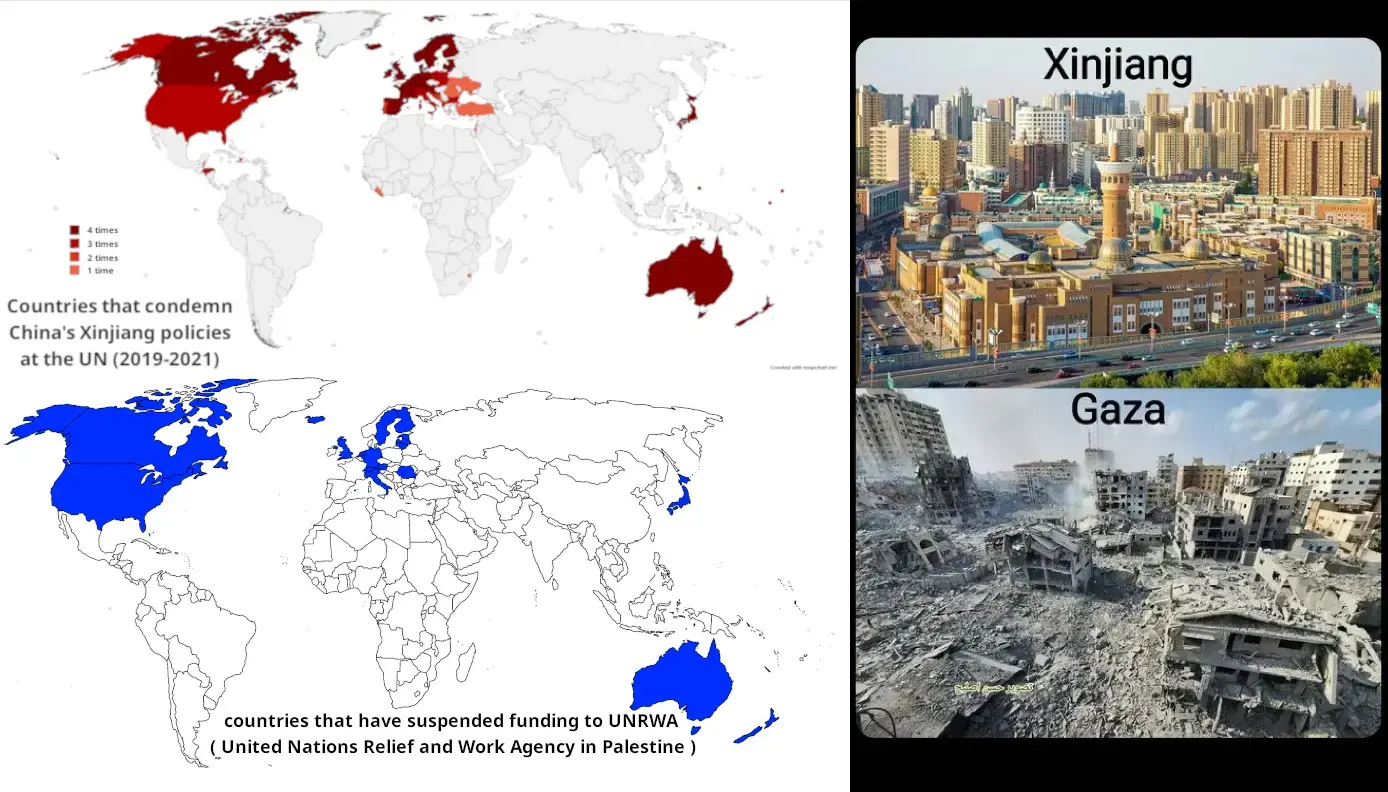
Almost no predominantly-Muslim country buys the Uyghur genocide narrative, because they know it’s bullshit, because they talked to the Uyghurs themselves.
https://twitter.com/un_hrc/status/1578003299827171330 #HRC51 | Draft resolution A/HRC/51/L.6 on holding a debate on the situation of human rights in the Xinjiang Uyghur Autonomous Region of #China, was REJECTED.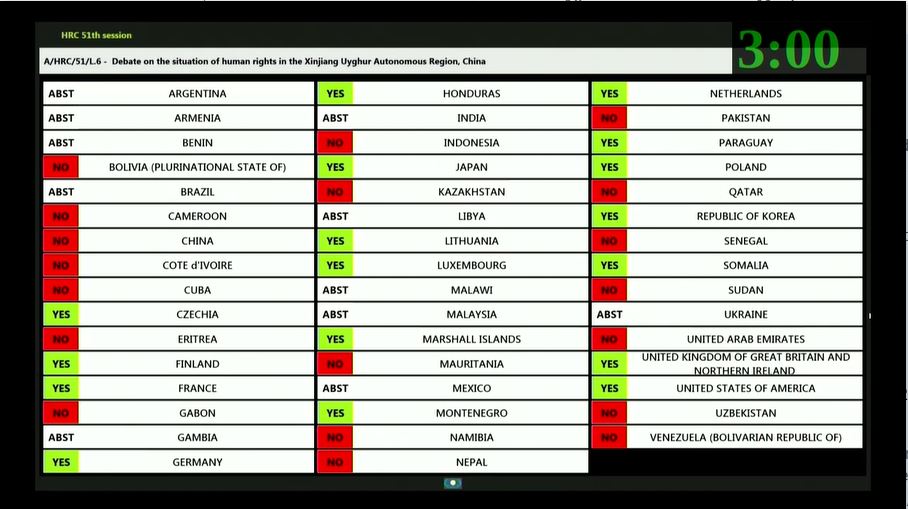
- The Uyghur Human Rights Project is a product of the National Endowment for Democracy, which is the American government’s main regime change NGO.
- A Reddit AMA Claiming To Be A Uyghur Quickly Exposes A CIA Asset Slandering China
- The Xinjiang Genocide Allegations Are Unjustified
- Uyghur genocide allegations
- American Debunks All Major Western Propaganda on Uyghurs and Xinjiang
- US-Funded Uyghur Activists Train as Soldiers of Empire
- The blueprint of regime change operations How regime change happens in the 21st century with your consent
Genocide is more than just killing, it’s the deliberate destruction of a people including its culture and institutions.
(a) Show me the Uyghur bodies
(b) Show me the serious bodily or mental harm
(c) Show me the conditions calculated to bring about physical destruction in whole or in part
(d) Show me the measures intended to prevent births within the group
In accordance with China’s affirmative action policies towards ethnic minorities, all non-Han ethnic groups were subject to different laws and were usually allowed to have two children in urban areas, and three or four in rural areas.
(e) Show me the forcible transfer of children from one group to another group
violent incidents in East Turkestan
I wonder where those Salafi terrorists came from? Oh right: the US, UK, and Israel organized, funded, and trained them, as they did Al Qaeda and the various flavors of ISIS/ISIL, including the “moderate rebels” that just took over Syria. The blueprint of regime change operations How regime change happens in the 21st century with your consent.
Lol. Imagine declaring “Yes, I do believe the Jews are committing white genocide!” And thinking you’re making a compelling argument
Do you acknowledge the totally real white genocide definitely being orchestrated by a shadowy international jewish communist cabal, or are you a genocide denier?
Why can’t you answer this simple question instead of freaking out? Are you secretly some kind of tankie?
Do you condemn Hamas for beheading 40 babies?
Removed by mod
Removed by mod
I think you should reread my comment and sources, as they already counter that article. Do you think I haven’t read that wikipedia entry already? It’s the first thing people jump to when trying to prove a genocide, despite being full of holes and referencing Adrian Zenz, or sources relying on Adrian Zenz. Have the basic decency to check out the sources I linked.
Removed by mod
You’re getting downvoted because your points have been thoroughly debunked, and we refuse to accept your fantasies as material reality.
Your poor argumentation shows the cracks in what you claim. You start off with a classic poisoning of the well by your false equivalence of the far right so-called white genocide with PRC’s active suppression and genocide of Uyghur. “vocational programs,” “de-radicalization,” and “rehabilitation” all you use to desensitize us to what is really happening to the people. Just the same as torture apologists using “enhanced interrogation”. Leaked Chinese government documents (the “China Cables,” “Xinjiang Papers”) show are coercive mass detention facilities. Claiming PRC is the best source but yielding its bias is like citing Pravda to debunk Soviet gulags and noting "yes it’s state-aligned, but very thorough."Ridiculous. Your sources do not invalidate multiple independent researchers, satellite imagery, survivor testimony, and leaked internal CCP documents show what is happening to this vulnerable minority group. What’s your response to:
- The UN’s own 2022 report concluded China’s actions may constitute international crimes
- Documented forced sterilization, birth rate collapse among Uyghurs
- The leaked “shoot to kill” orders in the Xinjiang Papers Well, apart from your mod removing dissident for arbitrary reasoning? You can’t claim you want real discourse while doing that. At least own up to your imperial fascist narrative and that you don’t care about truth. You like imperialism when it’s “your guys”.
Your poor argumentation shows the cracks in what you claim. You start off with a classic poisoning of the well by your false equivalence of the far right so-called white genocide with PRC’s active suppression and genocide of Uyghur.
It isn’t a false equivalence, though. Just like ideas of “white genocide,” western countries often accuse their geopolitical opponents of atrocities, heavily distorting reality in order to make it impossible for the western working class to take an active stance against western imperialism.
"vocational programs,” “de-radicalization,” and “rehabilitation” all you use to desensitize us to what is really happening to the people.
This is what was factually happening, though. Prior to the establishment of de-radicalization programs, western-backed terrorist attacks were common, in order to disrupt the Belt and Road initiative (where Xinjiang is key to expanding westward). These included:
-
July 5, 2009: The Urumqi Riots resulted in 197 deaths, and 1700 wounded in mass stabbings.
-
October 28, 2013: Tian’anmen Attack, 5 killed, 40 wouded, when a Jeep was driven directly into crowds.
-
March 1, 2014: Kunming Train Station Attack, 31 killed, 141 wounded. 8 jihadists committed mass stabbings.
-
May 22, 2014: Urumqi Attack, 39 killed, 94 injured as 2 attackers drove cars into crowds and threw explosives at buildings.
And many more. Since the de-radicalization efforts, these attacks have gone down to effectively 0.
Just the same as torture apologists using “enhanced interrogation”. Leaked Chinese government documents (the “China Cables,” “Xinjiang Papers”) show are coercive mass detention facilities.
They don’t, actually. You’re referencing Adrian Zenz, professional propagandist for the Victims of Communism Foundation. He believes he was sent by God to punish China, and his work has been thoroughly discredited.
Claiming PRC is the best source but yielding its bias is like citing Pravda to debunk Soviet gulags and noting "yes it’s state-aligned, but very thorough.
I never said the PRC was the best source. Qiao Collective is pro-PRC, they aren’t affiliated with the PRC itself. They are made up of Chinese diaspora in the west. Further, though, I don’t know why anyone would try to debunk the idea that the Soviet Union had prisons. That all being said, China does release white papers like Vocational Training and Education in Xinjiang that document in detail how the program is run. Not listening to the defendent at all in a court case would have you thrown out as clearly unfit to judge.
Your sources do not invalidate multiple independent researchers, satellite imagery, survivor testimony, and leaked internal CCP documents show what is happening to this vulnerable minority group.
China already released a massive response to these kinds of claims. Many buildings alleged to be camps were just normal buildings. Witness testemony is about all there actually is, and it’s highly conflicting.
The UN’s own 2022 report concluded China’s actions may constitute international crimes
See China’s rebuttal, which eclipsed the UN’s report in size and detail, thoroughly debunking it.
Documented forced sterilization, birth rate collapse among Uyghurs
More Adrian Zenz bullshit. This claim comes from Zenz misrepresenting 8.7% of new IUDs as 80%, from this chart:

Zenz lied about forced sterilization and misrepresented numbers to do so.
The leaked “shoot to kill” orders in the Xinjiang Papers
The Xinjiang Police Files are made by the Victims of Communism Memorial Foundation, a far-right propaganda tank, and again come solely from Adrian Zenz.
Well, apart from your mod removing dissident for arbitrary reasoning? You can’t claim you want real discourse while doing that. At least own up to your imperial fascist narrative and that you don’t care about truth. You like imperialism when it’s “your guys”.
I’m not the one relying entirely on the fascist ravings of a Christian Nationalist paid by the US State Department and UK Government to invent lies about China. Have fun taking this back to the Nazi bar you just came from, MeanwhileOnGrad.
-
deleted by creator
That picute of Chinese officals got mad aura, lol
Democracy is only as good as the voters. The average Chinese is better educated and a better citizen overall than the average USAmerican. Thus the difference in results. My experience with Chinese and USAians confirm this, even if anecdotal. I could have just missed the bad Chinese and was overexposed to bad USAians.
Also bourgeois/liberal democracy is the quintessence of adopting democratic aesthetics, forms, and language without any actual democratic function. No one can vote according to their interests, and no one’s votes actually influence policy.
The reason most modern imperialist states have evolved their own form of liberal democracy is because of how effective it is at mediating domestic capitalist contradictions so they can be externalized.
If the US were somehow a true functional democracy it would have evolved beyond capitalism decades ago.
“To decide once every few years which member of the ruling class is to repress and crush the people through parliament - such is the real essence of bourgeois parliamentarianism, not only in parliamentary-constitutional monarchies, but also in the most democratic republics.”
― Vladimir Lenin, The State and Revolution
Democracy is only as good as the voters.
I wouldn’t know. I’ve never lived in one.
Western liberal democracies are structurally flawed, and despite the immense systemic advantage capital already enjoys, capital still needs to manipulate education, religion, and media to persuade people to vote against their own material interests. The result is a political landscape that, in many cases, produces outcomes more dysfunctional than those seen in some modern monarchies or even historic feudal systems—yet with the added disadvantage that many citizens remain unaware of their own diminished political and economic conditions, convinced they live in the freest societies on earth and that everything elsewhere must be worse. Concluding such a system is not truly democratic, or merely a democracy of the bourgeoisie is a valid conclusion, because whether systematic or through manipulation of education, religion and media, they are the only ones who benefit from it, and the majority have no means of getting what they want.
I know you already know this. This comment was meant for any lurker who doesn’t know. The people who think they are one election away from fixing the system if they would only voter harder.
And I know you know I know 😉
I am deeply concerned that this is getting worse, not better. I sincerely hope I’m totally wrong about this, but I see young “educated” Americans more and more being unable to think at all. The kids in university now are liberally using commercial LLMs to finish assignments. People are surrendering their ability to think to private corporations. Imagine in 10 years from now, a man who can’t pay his AI bill can no longer survive on his own. And even if he could, he could only ever do what the corporate model deems acceptable. Just fully giving up agency because agency is friction.
I can’t respond to this email without paying Sam Altman! I can’t wipe my ass without Grok!
I’m drunk. I’m sorry. I hate what is happening, and I am helpless to stop it.
Removed by mod
Do not confuse Technocracy with Socialism. While Chinese Technocracy is Socialist, Technocracy alone can be a massive problem.
Is that a real photo in the bottom? Fucking incredible if it is.
It is