- cross-posted to:
- programmer_humor@programming.dev
- mop@quokk.au
- cross-posted to:
- programmer_humor@programming.dev
- mop@quokk.au
You must log in or register to comment.
This is how you tell rich people have some serious mental health issue.
Decent people would rather a world where people worked because they enjoy that type of work rather than being forced to do it because they need money to live.
If you removed money, imagine where we’d all be as a society without the toxicity of money, wars and hate! :(
If you removed money, imagine where we’d all be as a society
Probably dead or living in the stone age.
There’s so many jobs that people don’t enjoy but are necessary. Nobody enjoys working in the middle of an australian desert at 40°C in a lithium mine. Nobody enjoys collecting your stinking trash. Nobody enjoys sitting in a store for 8 hours a day, scanning groceries. Nobody enjoys working in a warehouse for 8 hours.
However, these jobs and many more are vital for todays society.
toxicity of money, wars and hate!
You make it sound like wealth and wars are an invention of capitalism and not something that has existed basically since the dawn of time, even as something you can observe in primates, albeit on a much smaller scale.
The reasons those jobs are such shit is also money. A lot of people enjoy cleaning, nobody enjoys being overworked. Normal functioning societies don’t leave heaps of stinking trash around, they neatly pack it and the work of a janitor of garbage collector becomes actually enjoyable if you’re a proper type of personality.
Hell, my uncle right now works as a part time street sweeper basically for free. He has his basic needs met by other means, and his “job” pays him enough to get a cup of coffee before the shift and a sandwich after. He just enjoys making the world cleaner, chatting with locals, taking care of stray cats, and having a routine. All of that is possible in a world that doesn’t revolves around squeesing every bit of labour from people so some pedos can buy themselves another island and fill it with sex slavesAnd you think your uncle is a scalable solution to a city of millions of people. These positions dont scale. Some quick googling show about a half a millions workers in waste remediation in the us in 2023. Do you honestly think you could find half a million people like your uncle that all live spread out enough to fill all the positions (thats on the low end of need also fyi, not surprisingly they have high turnover and difficulty keeping staff for extended periods) around the entire us and that those people would never lose motivation or get burned out or just tired or stop caring. Because that is what we need and that is a single job for a single industry.
Its not scalable
I just think it’s boring that you think money is the only reasonable motivator for these people. There are other forms of compensation and appreciation. And it’s not the only option available to us. It’s crazy to me that people understand the idea of countries that have military conscription but can’t fathom the idea of a system of workable civil conscription.
As I see it you successfully identified a problem and a solution, but that does not suggest that that is the sole or even best solution.
Where did i mention money at all
When you do your scaling you need to scale everything. The adult population of the US is estimated as 266 million people as of now. Half a million is roughly 1 adult in 530 people. Let’s quadruple it up so they have nice relaxed works schedule. Let’s say now you need 4 people per 530. If you think you can’t find 10 out of 1000 people who would do some sanitation work, with no stress and without having to think where their next meal comes from, you just never met people.
And this is the most important part that you seem to ignore - when people’s basic means are met, they want to fulfill higher levels of Maslow’s hierarchy of needs. For some that means doing arts or doing some engineering or running a company. For some, and there are s many of those some, that means “it’s not much but it’s honest work”. Doing small visible changes that make the world the better place one picked up piece of rubbish at a time, is exactly, precisely what significant portion of humanity will be doing.
This also works in another direction: billions of people who would be doing something grand and moving humanity further, are stuck in mundane repetitive broken jobs they hate, because they’re stuck in this cycle of needing to grind to survive, without having a moment to breath, which slowly kills every bit of light they once had a potential to have.That half a million is an extreme lowball number based on a single waste management company. And no i dont think you’ll find 10 in every thousand evenly spread that will want to do this for fun. Those half a million people turn over every couple of months with pay and benefits. And this will apply to every industry and every critical need of society. Theres already a massive shortage of medical personelle and that pays better than most of what were discussing. No it just xoesnt scale
I like how your own numbers immediately started to be unreliable the second I used them.
Again, we’re walking in circles because you’all refuse to even acknowledge the argument.
Shitty jobs are shitty because of financial intensives to keep it so. They don’t need to be. We have shortage of sanitation workers because they have to care about “pay and benefits”, and because companies try to pay them less and make them work more so they spend less money on workforce. They hesitate to improve their working environment because there is no “economic incentive” to do so. They don’t do automation because labour is cheaper. All of that are problems caused by revolving all what we do around making profit for shareholders.
We have so much labour that we just waste on people doing bullshit with the ultimate goal of the imaginary line going up. Obviously if we keep that, we don’t get people to do other work, all the people are overworked to death and also for some reason starving and struggling.
They have shortage of medical personnel despite them being rewarded with a bunch of money, and then you turn around and say that if we don’t do financial stick and carrot, we will have shortage of workers. Do you not see the obvious problem with this logic?
Normal functioning societies don’t leave heaps of stinking trash around, they neatly pack it and the work of a janitor of garbage collector becomes actually enjoyable if you’re a proper type of personality.
Idk if you noticed, but people won’t behave that way if there is no repercussion for it.
He has his basic needs met by other means, and his “job” pays him enough to get a cup of coffee before the shift and a sandwich after. He just enjoys making the world cleaner, chatting with locals, taking care of stray cats, and having a routine.
Great but some people have more aspirations than your uncle. And I think they should have the chance to achieve that. And I don’t think having a clean neighborhood should depend on having that uncle that enjoys cleaning for free.
All of that is possible in a world that doesn’t revolves around squeesing every bit of labour from people
I mean, yes, absolutely possible without squeezing every bit of labor from people. However, it’s not possible in a world without money or capital. The wide-spread introduction of capitalism has DRASTICALLY reduced the amount of people living in extreme poverty. According to https://ourworldindata.org/end-progress-extreme-poverty , from 1990 - 2025, the amount of people living in extreme poverty dropped by 65%, from 2.3 billion to 800 million. If we extend the timeframe a bit further, according to https://ourworldindata.org/history-of-poverty-data-appendix , the number went from 53.9% in extreme poverty to only 5.5% - meaning an almost 90% reduction in extreme poverty. Unless I’m too stupid to do math now.
(ourworldindata.org is a non-profit funded by the university of oxford btw - so it’s fairly reliable)
Now, capitalism isn’t the sole reason why poverty dropped - it’s the combination with effective social policies. Capitalism creates wealth, taxes take a part of that wealth and spread it to the rest of society. That’s how it should work and that is also by far the best system we could ever have in place. The fact that america fails on that tax-part is not the fault of capitalism. It’s a failure of the government.
It’s insane that so many people tried to flee from communist terror regimes, and still try to flee to this day out of North Korea or Cuba, yet people on lemmy will just close their eyes and pretend that communism is the perfect system and every system that fails is just because of the “CIA”.
Would you enjoy being a garbage man or a plumber? Or is that work you’re saving for others to enjoy?
Doctors make good money and we don’t have enough of them because it takes so much time and dedication. You think getting rid of money would help there?
Do kids need to go to school? Five days a week?
Doctors make good money and we don’t have enough of them because it takes so much time and dedication. You think getting rid of money would help there?
Yes. There are easier ways of making money. If you do it just for the money you won’t have the mental fortitude to get to the point of making money. Profit motives is about the path of least resistance.
Lol what MD is the goto job for making easy money. Getting the degree is difficult because everyone wants to do that job, not because it’s difficult per se
the degree is difficult because everyone wants to do that job, not because it’s difficult per se
Pretty much says everything about why your wrong on this. Being a doctor is hard. There are far easier career and business if profit is the motive.
Beyond that are doctors that rich? They are wealthy, but the Zucc ain’t no MD. Neither is Warren Buffet.
My point is that someone motivated by money will drop out of the MD path. Being a doctor is a career of passion that also happens to pay well.
Engineer is similar. Take some differential equations or read Jackson EM. There are easier things to do for money.
I know someone who make similar to a doctor with a seafood restaurant. Particularly when you consider fewer hours.
It’s not that gotcha that you think it is. I worked a lot of hard jobs, for 10 years I did very hard and complicated work in very unpleasant environments for very very little money only because I loved what we did and the results of our labour, and I was good at it. I would be doing that still if I didn’t need money to feed my family. In my years I’ve met a lot of people who were enjoying, properly enjoying jobs that other people will call hell. My job at the time, and to a big extend my job now, is something other people will never want to do for any amount of money.
Doctors make good money and we don’t have enough of them
And your conclusion isn’t that the system of people working for money and only for money is a broken system that demonstrably doesn’t work, but that we need to conserve it as long as we can because it was always done like that?
Yes, getting rid of money will absolutely help. Many people want to be doctors but can’t afford the time or resources to either become one, or to actually put their existing education to use.
And as an example I’ve personally witnessed, being a doctor in Russia in the 90s was about the worst job you can get, you don’t get any money, and I mean none, they were going multiple consecutive months without any salary. The shortage was about on par with the doctor’s shortage in US right now. Trapping people in jobs they don’t want to do is not something that helps humanity in any way.Do kids need to go to school? Five days a week?
I struggle to understand how this is relevant to the conversation.
Like, half of the jobs you listed would be automated out pretty quick in a world without money, out of the other ones, a few would be rendered obsolete without profit motive (pretty sure we can find something better for batteries than lithium, and why would you need someone scanning groceries if there was no money?). What’s left can be rotated out or done by lottery, and those doing the undesirable labor get to have more luxury items or whatever. It’s not hard to imagine, people have been doing it for centuries.
Automated by who?
We do need incentives to work. As technology and efficiency advances we should be able to work less, but we still need people to do work they/we don’t want to do.
Personally I think people are pretty happy working 24 hours a week even if their job isn’t something they love doing. I’m more interested in working towards that, slowly, over time, than just going to “nobody needs to work”.
Like, half of the jobs you listed would be automated out pretty quick in a world without money
If that was even remotely possible, companies would’ve done that already. Every company tries to cut staff as much as possible.
pretty sure we can find something better for batteries than lithium
Which requires research, which requires investment. Much of the research we currently have only exists exactly because of funding, and a lot of funding is done by companies, not by the government.
What’s left can be rotated out or done by lottery, and those doing the undesirable labor get to have more luxury items or whatever
I like the “whatever”. Let’s just introduce a shitty system that also potentially forces people to do work they don’t want to do and they get like a bar of soap or “whatever” as reward…
It’s not hard to imagine, people have been doing it for centuries.
I don’t know where these people lived that you talk about, but it certainly wasn’t on this planet. Such a system has never existed.
1
pretty sure we can find something better for batteries than lithium
Trust me, bro
would you need someone scanning groceries if there was no money?
Because this is the most efficient way of keeping track of how many goods leave your moneyless store, and ensuring assholes aren’t just taking everything for themselves and hoarding it. Tracking how many goods leave the store at any given time allows you to order an appropriate amount to keep things in stock so that people who need things don’t go without, and is especially important for perishable goods like fresh produce.
What’s left can be rotated out or done by lottery,
People have different skill sets and specialties. Many jobs take years of training and practice to reach an acceptable level. Also, you just invented state-sanctioned slavery/a non-military draft. What do you do with someone who refuses to perform their lottery-assigned job?
and those doing the undesirable labor get to have more luxury items or whatever.
That’s literally the system we have now, but more authoritarian, since someone has to decide what is a “luxury good” and how much undesirable work is required to attain a given level of luxury.
people have been doing it for centuries.
Citation needed. Concerns: authoritarianism; scaling; maintenance of the modern standard of living
I didn’t cite sources because the literal decades and decades of refutations to your arguments already exist.
But I will leave you with this: Why do libraries work?
If there are so many refutations, then it should be trivial to point me to one. Assume I am an idiot who doesn’t know how a search engine works - I very well might be. Would you be able to point me to one of these innumerable refutations that would disprove me - otherwise, how am I to learn?
Why do libraries work?
I’m not sure what you mean here. If you explain your point of view, I can explain mine. But I will point out that libraries are not a full, functioning society - just part of one.
Fine. Sure. A few starting points since you asked in good faith:
For historical examples of non-market/cooperative organization, see Elinor Ostrom’s Governing the Commons (1990), which documents real communities managing shared resources without privatization or central coercion. David Graeber’s Debt: The First 5000 Years also covers many societies that operated through reciprocity/obligation rather than modern monetary exchange.
I can point you to some great podcasts if you want.
For historical examples, Revolutionary Catalonia (1936–39) and numerous Indigenous communal systems demonstrate large-scale cooperative production/distribution outside traditional capitalist structures. See the previous Debt: the First 5000 years and just SO MUCH research. Maybe Orwell’s Homage to Catalonia would be a good place to look.
My library point wasn’t “libraries are a whole society,” but that they demonstrate distribution based on shared access/need rather than direct purchase can function effectively. Public institutions already allocate many goods/services this way.
As for undesirable labor, societies don’t need to choose between “profit motive” and “slavery.” Additional leisure, prestige, reduced hours, or enhanced benefits can incentivize difficult work just as effectively as wages. Automation can also reduce much of the repetitive labor currently done purely because it’s cheaper than innovating away the need for it.
I’m not claiming a moneyless society would be simple or easy—just that the idea humans can ONLY organize through profit incentives is historically and empirically false.
Nobody enjoys working in the middle of an australian desert at 40°C in a lithium mine.
Believe it or not I’ve actually met someone who enjoys this line of work. He lives in the middle of nowhere in Paraburdoo Australia and loves the heat. So not exactly nobody…
Okay, let me rephrase it: Not enough people enjoy working the middle of an australian desert at 40°C in a lithium mine to cover the global demand of rare earths.
I think what causes this imbalance is human nature and our insatiable desire for more that is contrasted by the demand for convenience and ease. Not saying that I have a solution but that’s what causes this need for the motivation you speak of, in the form of money/power. And with an entitled human population that is unwilling to let certain demands go, and the willing few who would sell their convenience and time for a profitable venture, which others have deemed a mental illness (a desire for money).
Capitalism is different from a regular market in that it is not just trying to make a profit in order to have enough money to exchange for useful goods and services.
Capitalism demands that your profit grows and grows and grows. It’s growth for it’s own sake. A capitalistic economy like our world economy needs to grow 3% or so every year or it gets into a recession. 3% doesn’t sound like much, but it’s exponential growth, doubling every 25 years or so. This growth doesn’t come out of thin air, but from extracting from value from other people, our world and so on.
And measuring an economy by GDP is incomplete, because it doesn’t take uncompensated labor, human happiness and wellbeing, and public goods (like a healthy nature) into account. When a factory owner pollutes and dries up the river while employees have no choice but to work 16 hour weeks, GDP goes up.
In nature, things grow until they are mature. That does not mean progress halts. Adults don’t grow anymore, but continue to learn.
My try to explain why money and markets are okay, but growth for it’s own sake (growthism you may call it) is destroying our societies, making us unhappy, and is also killing us with the climate and biodiversity crises.
There’s so many jobs that people don’t enjoy but are necessary.
I take it you asked all 7 (or whatever) billion then?
Nobody enjoys working in the middle of an australian desert at 40°C in a lithium mine.
Who says they’d need to? You talk like someone would need to do that because right now capitalism demands more production!
Nobody enjoys collecting your stinking trash. Nobody enjoys sitting in a store for 8 hours a day, scanning groceries.
Again, if we didn’t produce so much garbage, products with layer upon layer of plastic, we’d make glass and clay pots and grow, make and reuse locally making less garbage all the way but then in the 90s you had to collect bin bags off the street, now its all wheelie bins, if my health allowed I would happily go round collecting rubbish.
Also I’ve had issues with drains in the past and when I asked them about the job, they actually enjoyed the challenge. So I think you’re confusing people who do a job because too much demand means people doing jobs for the money rather than less demand would actually mean people wouldn’t even need a set job. Feel like drains on Monday, go for it. Had enough and feel like helping someone tin food on Tuesday, go for it.
Look at Animals, how many animals work 2 jobs just to survive?
Nobody enjoys working in a warehouse for 8 hours.
Another thing thats only a thing because capitalism demands we keep producing more and more shit. That washing machine that used to last 10 years now breaks after the warranty because some riches want more money and power!
It amazes me how blinded people are to a capitalist free world. Look at the waste now, the plastic pollution and then look carefully at the next package you buy and ask “does this really need ‘this’ much packaging? Do i care if this new spade I bought with all its shiny cardboard and plastic protection, arrived with a scratch? But even if the TV was scratched, does it really matter so long as it worked as intended?
But then I have no kids of my own and every year I feel better not having brought kids into this mess because unless you’re born into money now there is very little to offer kids in the near future right. 😕
Who says they’d need to?
We have a certain standard of living right now that is only maintainable that way.
we’d make glass and clay pots
Lmao.
people doing jobs for the money rather than less demand would actually mean people wouldn’t even need a set job
Yes, that’s how it generally works. Most jobs that people expect this day and age are not enjoyable. Are there people who’d do them for free? Yes. But not on a massive scale that works for billions of people.
Look at Animals, how many animals work 2 jobs just to survive?
What a retarded comparison. Probably the dumbest you could’ve made.
Animals don’t have access to a network of goods and services, they also don’t live in a city with potentially millions of inhabitants. They don’t have internet, they don’t have healthcare, they don’t have delivery drivers, plumbing, electricity or anything that we know from modern life.
With all due respect, but if that’s something you strife for, get a few like minded people and go live on an island. Nobody is stopping you. There, you can live free of capitalism. But you also get all the disadvantages.
It amazes me how blinded people are to a capitalist free world
We had a capitalist free world and it was shit for the most part. People got killed, life expectancy was shit, education was shit, extreme poverty was rampant (WAY more than under capitalism) winters were harsh and potentially deadly - bro you talk like someone who just played 12 hours of manor lords straight. You’re romanticizing a time that was just straightup terrible for the most part.
And if you’re referring to “modern” communist countries, ask yourself why so many people try to flee from them and why the regimes actually made leaving the country illegal.
Look at the waste now, the plastic pollution and then look carefully at the next package you buy and ask “does this really need ‘this’ much packaging? Do i care if this new spade I bought with all its shiny cardboard and plastic protection, arrived with a scratch? But even if the TV was scratched, does it really matter so long as it worked as intended?
You’re talking about minor individual problems. How is this a problem that warrants the abolishment of capitalism? Why not just fix that singular problem? You’re finding a small scratch in the wallpaper of your house and instead of just fixing it, you want to tear down the entire house? All of these things are SOCIETAL problems that are not the fault of capitalism. Capitalism doesn’t force companies to use excessive plastic for each cucumber - it’s the customers expectation that makes companies do that.
Society would collapse.
While working out of enjoyment instead of necessity is a noble and good goal. There are jobs that no one enjoys. Money can be used as an incentive to motivate people to work on jobs that aren’t that enjoyable, but still necessary.Which jobs? Most of the time there are people enjoying something you wouldn’t expect
Some yeah, but undoubtedly not enough to keep it working. For example i doubt that many people enjoy working at garbage disposable or basically any waste disposal. Of course these jobs should be fully operated by machines. Or any assistant jobs in manufacturing or jobs that operate in shifts.
deleted by creator
Do you think your uncle was in any way representative of the millions of people employed in waste disposal? The city of Birmingham’s bins have gone partially uncollected for over a year due to a dispute over pay. If waste disposal workers were, in general, doing it for the love of it, they’d surely be happy to do it for minimum wage.
Seems more likely your uncle was the odd one out, and most people need to be paid to do stinky work.
I think that mostly happens because it’s a hard job and because people need money to live. If they didn’t they wouldn’t need more pay
If it’s so enjoyable, why don’t they do it as a hobby and have a different paying job?
To be clear, I think the answer is obviously that, to most people, it’s not that enjoyable.
deleted by creator
If you agree most people need to be paid to do work, then we have no disagreement on the topic at hand, so there is no need to argue at all.
The pay argument is cause it wasn’t enough to cover necessities. If necessities were 100% covered then there’s no need to argue over pay.
For example i doubt that many people enjoy working at garbage disposable or basically any waste disposal
Ehhh I bet you’d be wrong. Only anecdotal obviously, but at practice and games for the kids, a lot of dads just chat when there isnt much going on. A couple of them work for the local garbage company. One of them commented that he doesnt know how I stay inside and work all day, he really enjoys being outside with the trucks in the morning, then enjoying the afternoon outside with the kids. Another one is a mechanic for them, he always thought the trucks were cool, and he still enjoys working on them (though he will 100% tell you, in great detail, which manufacturers suck for various parts). Haven’t talked much with the last one about work, I think he is the only one just straight up doing it for money though.
And who knows, maybe the guy who likes being outside says that to be positive about his choices in life, but I see him at the park with the kids a lot, I’ve run into him heading out to the trails on his mountain bike, etc, so I believe him that he’s perfectly happy doing it.
Automation for unwanted tasks is great though, I agree, and where automation should be focused.
One of them commented that he doesnt know how I stay inside and work all day, he really enjoys being outside with the trucks in the morning, then enjoying the afternoon outside with the kids.
He could be taking the local kids out for hikes in nature instead - an activity which also gets him outside, provides a benefit to society, and lets him spend time with his kid and their friends. If he didn’t get paid, do you think he would prefer picking up garbage, or going on hikes with his kid? And even if he finds picking up trash meaningful now, do you think he started the job for the money, benefits, and schedule, and then learned to appreciate the good he was doing for the community after years of doing the work?
I’m not him so I couldn’t say, but considering I know he does volunteer cleanup days at the trails, I really dont think he looks down on garbage pickup the way you and others seem to be, that its only fulfilling because of money.
I met a guy last week who was unusually passionate about water filtration and wanted to make a business globally. People are wonderfully weird.
Great, and how many of those you think exist?
And how many would we need to run the global water filtration systems?
Would you really trust podiatrists or proctologists who were in it just for the love of the game?
Tbh I’d kind of trust them more. Even if they got off thinking of my feet later (which, who cares, have at it), they are going to put a lot more effort and get a lot more knowledge than someone just doing it for the high billing rate, dont you think? And probably care more about the quality of my arch than the guy writing a prescription for orthotics because the manufacturer just bought him a nice dinner.
Just because they are pervs doesnt mean they’d be bad at it, I’d say they’d be even better at it than most. Wouldn’t you think?
They might not even be pervs, maybe they’re autistic and feet are their special interest.
Also true, I was just working off the implications in the comment I was replying to
On the contrary, I don’t trust any medical profession that is in it for the money.
I daresay there’s a few people out there who might enjoy going into the sewers to manually remove the fatbergs, but probably not enough.
I was also thinking that. As an example, retail work seems to me to be a kind of hell I don’t think I’d want to endure. But I know people that really enjoy it. So it’s probably true of any job you might think is only done by those that are forced to.
I think, if AI and robotics replace most jobs. After some years of pain when capitalists enjoy the infinite money glitch they’ve discovered, there will either be a revolution or a natural coming to understand that things need to work differently.
Now, understand this would only work if the vast majority of work could be done via automation. In this case the vast majority of people would be able to pursue what they enjoy, a bit like the star trek anti-economy. If all remaining required jobs were no longer filled by those that volunteered to do them, there would be some kind of draft (think like jury duty), where people able to do a job have a chance to be called in to do it for a few months then released back to pursue their own interests.
I’ve always seen capitalism as the carrot on a stick we need, when we need human productivity from the vast majority of people. If that’s no longer the case, it’s not a suitable solution and all the ideas like universal basic income are just stopgap measures to try to eke a bit more time out of the capitalist system that has already run past the point where we can keep enough people usefully employed to make it work. That’s almost certainly the reason we’re seeing the huge wealth disparity that increases. As the productivity per person goes up, all the increased value only ever rises to the top.
Bit of a mini rant there, sorry about that.
deleted by creator
I build rockets that go on satellites and scientific missions. I enjoy my job; I find it extremely interesting and often quite fulfilling. In the grand scheme of things, I really wouldn’t change much. But like my boss said on the first day of the job, “This job is awesome, but it’s not worth doing for free.” If you told me I could still enjoy the same level of comfort at home that my job affords me, but I wouldn’t be paid, I would quit. I’d rather be at home reading, spending time with my family, playing around with my hobbies, etc.
My wife is a nurse. She loves her job, but she wouldn’t do it for free either. Her love for the job prevents her from quitting when she’s abused by the public for 12 hours, the pay makes her come in.
Some people are motivated by enjoyment alone to do jobs for free, but many are not. Or the thing they love doesn’t help society in a meaningful way. Or they just don’t want their hobby to turn into a job. I don’t think there’s a big enough overlap to have a functioning society.
I can’t imagine anyone enjoying being a correctional officer enough to do it for free. Or waste management (sewage).
Why do you assume that we’d need correctional officers in a world without money?
Because people murder each other for reasons other than money.
Oh I dunno, people are still inclined to uh probably murder and/or rape people for fun, steal things, commit any other unlawful acts society may deem against the law that doesn’t involve monetary situation. I understand money is the root of all evil but some people are evil just because.
Going into sewage vats and breaking up solidified waste and oil clogs
Deep sea oil rig repair
Underwater dam repair
Driving public transportation (not enough to maintain a system)
Elder care (there is a worldwide lack of people willing to clean up piss and shit of often angry, sometimes aggressive people and deal with regular loss for bad pay, much less in an ideal profession freedom world, relative to the amount of people needing care)
Forensic pathology is something that very very few people enjoy also, but is very needed.
Urine farmer (hunting luring, sprays for animal repellant)
Coal miner
Any precious or rare metal or stone miner
People love intellectual jobs, creative jobs, and some public service jobs. It is much much harder to find people to do body-destroying terrible-condition manual labor jobs. Ideally those are the jobs to be replaces, but of course capitalists want to replace the former category of jobs because those cut into their profits more.
Roofing during the summer
I’m not saying you’re wrong. But you realise how that reads right? It sounds like you’re saying we should keep a boot on the neck of “the little people” so the rest of us can have a good life.
Fair point, though i did try to use positive encouragement model to incentice people to work in not so enjoyable jobs. Even if not permanently, maybe in rotation.
Living in a nice society is all the motivation people need. I hate doing dishes, but I do them because I hate living without clean dishes even more. Everyone understands sometimes we gotta do stuff we don’t like doing for a greater good. Acting like we need a wageslave class to do menial tasks otherwise we’d just let our world collapse is insulting our collective intelligence. We can share the burden.
Living in a nice society is all the motivation people need.
You might want to read up on the bystander effect. You do the dishes because no-one else is going to do it. But as soon as there are others who can do the job people will just stand around and let other die before they put in the effort.
Don’t you think there is some way we could structure society to counteract that without creating an underclass of wage slavery?
That’s been one of the goals of just about every socio-economic system, but since are not yet at the point where we can completely automate away all undesirable jobs, it all circles back to being shit.
I believe that there’s a way we can fairly share out all the shitty work among everyone, rather than a few at the top who do no work and exploit everyone, and a lot of people at the bottom who do all of the dirty work.
We don’t need to automate everything, we just need a fair system to distribute the work evenly. We have the technology. We can do it. The reason we haven’t is because those in power benefit too much from the current system.
I don’t think I can see a way to actually accomplish that without still ending up with negative outcomes.
Take for example a surgeon, one who is a specialist who’s time is 100% occupied saving people. Does he get taken away from that to do his time as a garbage collector? Do you tell the patient “sorry, you are going to die. You could have been saved, but we needed your surgeon to go pick up garbage.”, or do you have an exemption list?
And if there’s an exemption list, you will never convince me that people wouldn’t start abusing who is and isn’t on that list. You arrive right back to having a class society.
Yes, paying more for the shitty jobs.
Do you think the capitalistic system is going to just pay people fairly out of the goodness of the hearts of the ruling class?
How can people be paid the value of their labor while still generating profit? Profit is, by definition, the extraction of surplus labor value. Under capitalism, inherently and definitionally, no member of the working class is ever paid fairly.
No, never even implied that. But in any system we need something that can be exchanged for labor in carrying quantities so we can give more to the people who do the shittiest jobs. Whatever system you come up with, it’s not going to work without money.
ubi, competitive wages, strict caps on profits. there is lots of ways to mitigate capitalism. but basically no way to completely remove it at this point in time.
And all of those reforms will be resisted and then removed by the ruling elite, who control politicians and the media through capitalism. Reform is just short term harm reduction. I agree we are just at the start of our journey to abolish capitalism, but we need to reach our destination, or we will be cursed to forever live through cycles of fascism rising and falling inevitably again and again.
That’s absolutely not what bystander effect is, not even close. It has also nothing to do with the issue at hand. Bystander effect caused not by not willing to put an effort, it’s incredibly complicated, layered, and not exactly explained, but probably the only thing we know about it for sure is that it’s not because people are lazy
Sure is a good thing doing this dishes is the most complicated and least-pleasant thing people can do…
Who’s gonna volunteer to go through years of training specializing in commercial diving in wastewater to treatment plants for free?
Someone who wants to live a life of luxury and comfort in a world with wastewater treatment plants, knowing that everyone else is also pitching in and doing their part.
Someone who wants to live in a world without billionaire pedophiles in power doing nothing but hoarding all of the wealth and abusing women and children.
Someone who cares about the wellbeing of their community and is motivated by that, rather than by selfish greed.
In other words, anyone. Everyone.
This is idealistic to the point of parody.
These are all real things. A better world is possible. It is easier to imagine the end of the world than the end of capitalism, but remember that incredible changes that would have seemed impossible have happened before and will happen again.
If you told a pioneer in the Virginia company back in 1607 that black women would be given rights and the abililty to vote to elect their leaders, they’d probably burn you as a witch.
Everyone can’t do everything, and some specialized jobs with specialized skills are extremely unpleasant. Are you suggesting that we just hope things get done, or that we force people to do it while giving nothing in return.
One is delusional - the other is just slavery.
I’m suggesting that we can come up with a better system than the current one we have. I have ideas for how we could do that, and if you’re interested you can check out an anarchist FAQ for a wide variety of ideas, but I don’t have all the answers, no one does. We can only reach a system which works for everyone by first acknowledging our current system is deeply flawed, then coming together to work to build a better alternative.
“Who’s gonna do mindbraking soulcrushing jobs for days without a break?” Nobody, that’s not a job that has to be done this way. “But if we stop orphan crushing machine, what will crush all the orphans?”
When you’re imagining the worst parts of the worst jobs, remember that the reason those jobs have worst parts is because the main incentive of every job is to have the profit of a job as high as possible, and to exploit the workers. Yeah, some jobs are hard, some are complicated, some are dirty, some are all three. But all that is something people can and regularly enjoy. People don’t enjoy when it’s degrading, when it’s soulcrushing for no reason, when there is obvious injustice. And it has nothing to do with jobsSome things require years of specialization and simply can’t be done by novices. You don’t want volunteer engineers, pharmacists, etc. Some of those specializations are also unpleasant. We need to support people and not require that all humanity be profitable, but we also need to incentivize people to do shitty and/or difficult jobs. That balance is extremely difficult to find, and the most effective solution we’ve found is paying people for that work. There’s an incredible imbalance in our system right now that values non-productive ownership over all else, but the solution to that isn’t saying “Fuck it - nobody gets paid and it’ll all work itself out.”
The easiest solution is to tax the shit out of the uber-wealthy. Right now we have lower classes defined by income and an upper class defined by wealth. If we remove the wealth and make work and productivity more valuable than ownership, it moves us much closer to equity.
It sounds like you have never come across the concept of the tragedy of the commons?
The particular topic of waste disposal is a good one because we have good historical accounts of the transition from a free-for-all to regulated, paid profession. Take the example of Paris, which in the 17th century was infamous for its dirt and stink. Repeated efforts to force people to keep their own streets clean failed, and ultimately residents complained that if the King wanted the streets to be clean, he had better pay for someone to come and clean them. Eventually city officials managed to force (through threat of punishment) residents to sweep waste and mud into the middle of the streets, and pay people to come through and collect and remove it.
In 15th century Britain, nightmen removed waste from cess-pits and charged two shillings a ton. If there were enough people who just loved shoveling shit so much to do this without money changing hands, why weren’t they out doing that?
I’m actually very familiar with the idea of the tragedy of the commons.
Rather than re-cover well tread ground, I hope that you don’t mind if I quote from a relevant section of an Anarchist FAQ, and I encourage you to check the link I shared, as it goes into far more detail:
In reality, the “tragedy of the commons” comes about only after wealth and private property, backed by the state, starts to eat into and destroy communal life. This is well indicated by the fact that commons existed for thousands of years and only disappeared after the rise of capitalism – and the powerful central state it requires – had eroded communal values and traditions. Without the influence of wealth concentrations and the state, people get together and come to agreements over how to use communal resources and have been doing so for millennia. That was how the commons were successfully managed before the wealthy sought to increase their holdings and deny the poor access to land in order to make them fully dependent on the power and whims of the owning class.
[…]
In fact, communal ownership produces a strong incentive to protect such resources for people are aware that their offspring will need them and so be inclined to look after them. By having more resources available, they would be able to resist the pressures of short-termism and so resist maximising current production without regard for the future. Capitalist owners have the opposite incentive… unless they maximise short-term profits then they will not be around in the long-term (so if wood means more profits than centuries-old forests then the trees will be chopped down). By combining common ownership with decentralised and federated communal self-management, anarchism will be more than able to manage resources effectively, avoiding the pitfalls of both privatisation and nationalisation.
If you want a modern, real-world example of this which you may have actually experienced yourself, look no further than this medium we are using to communicate. The Internet is a great example. The Internet was a fantastic common space lovingly maintained and curated by individuals, with services and content provided freely. Corporations encircled it, and turned it into the torment nexus we have today. It wasn’t because of us, collectively, that spoiled the commons of the Internet - it was capitalism itself.
I feel like that entire passage completely ignores the fact that last time the bulk of humanity lived a communal lifestyle, the number of humans on the planet was a few orders of magnitude smaller. It’s a fairly easy setup to maintain when settlements are small and the bulk of people’s time is spent as hunter-gatherers or subsistence farmers. As soon as you put a very large number of people into a city, the communal arrangement falls apart. And many people like living in cities. That genie is out of the bottle, and people are not going to be willing to go back to being a subsistence farmer in a commune.
I don’t see why we would need to give up modern agriculture, fertilizer, heavy machinery, or automation in order to abolish capitalism, can you explain why you feel that way?
There are many things that people are willing to do for their own satisfaction, I don’t disagree with that. I don’t think waste disposal is one of them.
The “communal life” you’re talking about cannot exist in an urbanised society, because most people you affect in a city are not personally known to you, and there will be no opportunity for the social mechanisms we evolved to pressure us into doing the right thing. In a village of 200 people, if you throw your shit in the street, your neighbour, whom you know personally and whose opinion you likely care about, will complain. In a city of 2 million, if someone throws shit in the street you have no idea who it was, they’ve never met you, and what are you gonna do about it anyway?
Anyway, I should bow out now. I have no interest in discussing politics or economics with an anarchist.
Do you really believe everyone would act like a psychopath if they aren’t always directly accountable for their actions? And how does that differ from our current system?
I have no interest in discussing politics or economics with an anarchist.
That’s really too bad, because I’m sure you’d learn a lot! Anarchism is not what you think it is. Either way, have a great day, I wish you all the best. Solidarity forever!
Do you really believe everyone would act like a psychopath if they aren’t accountable for their actions?
No.
because most people you affect in a city are not personally known to you, and there will be no opportunity for the social mechanisms we evolved to pressure us into doing the right thing
That’s a demonstrable bullshit. Believing that the only motivation people can have is the fear of repercussions is the same level of that christian psychotic “if it wasn’t for the fear of god everyone would be raping and killing all the time” that says more about you than about supposed issue you’re afraid of.
It’s not fear of repercussions; it’s social glue. Crime is much more common in cities, out of proportion with how many people there are, because people who are willing to commit crime are not willing to commit it against people they know personally. Urbanisation allows depersonalisation allows bad behaviour.
It also allows effects to be transmitted that are simply way less direct than you have any hope of instinct being able to reckon with. Like, you can work out that tossing shit out of your window will piss off your neighbour, but the knock-on-effects of what you do can be harder to figure out than that. Did you buy a little bit more of anything at the start of COVID, “just in case”?
That seems kinda too idealistic view of the world.
I know much more people who, if not directly forced, would let the dishes or basically any environment around them completely mould and break down before even considering cleaning up even just the mess they have left behind, than people who altruistically do clean up after themselves and others.I do agree that living in a cleaner and nicer society should be enough of a motivation and for some it is, but there’s not enough of us.
We can already observe it in many public spaces where trash gets left laying around even if trash cans are available or public bathrooms or showers or my favorite example in the gym where plates get constantly left on the machines and cable attachments just piled up wherever those fell.
I’m not suggesting that we just leave everything to chance and just hope society maintains itself, I’m saying that we can structure society in a way that everything that needs to get done still gets done without the profit motive, because everyone inherently understands that if we evenly and fairly divide up the work that needs to get done, that they’re doing their part to live in a better world - does that make sense?
Yeah it makes sense and I’m not actually that much against the idea. I’m not that fond of the current wage slavery system either.
I just don’t trust general populations altruism that much to believe it would work on a large scale without any sort of a positive Incentivization in addition to just keeping the society running.
I don’t think we need to fully rely on altruism - humans can be selfish and we need to take that into account, and even make use of that tendency for us to want to feather our nests.
I believe that we can create an awesome society based on anarchist principles - freedom, liberty, bottom-up structures, socialized and democratized control of the means of production, and so on. If you’re interested in learning more, I’d recommend the Q&Anarchy video series by Thought Slime, and/or an anarchist FAQ if you’re more of a reader.
Indigenous peoples figured this shit out before centralized governments and computers, I’m sure we can think of something.
But those were significantly smaller groups of people with significantly worse quality of life.
In addition the ones that got bigger naturally evolved centralized governing structures. Even before that all the groups had leaders or some group(elders) making decisions that can effect the whole group.Cleaning a outhouse after 50 people from time to time, isn’t that big of an issue and can be done just for the good of the whole group. It can be easily done in rotation or a group just gets together in an afternoon and digs a new one.
Doing the same after 100 000 up to 1 000 000+ people is in orders of magnitude more difficult and time consuming.
Same applies to any governing structure. Even the idea OP brought up needs a governing body of some sort to allocate resources and work plans.
I don’t think you understand. I want my boat to be bigger than your boat.
I mean, thats easy, I don’t have, or care to own a money pit that I only use once a year, i mean boat! 😎
Unless you count 3D printed benchy… and even then if you scaled your benchy up then it’s bigger than mine!
But what about our other neighbors boat? I have an insatiable need to feel like I’m better than anyone else, and I don’t know how to express it without inflicting mass amounts of suffering and evil on tons of people.
That sounds like a you problem, not an our problem! 😎
What you could do to really piss your neighbour off is to help everyone else get bigger boats so that your neighbour gets so pissed off and sells the boat because they can’t afford a bigger boat.
If the neighbour buys a bigger boat, just keep upgrading everyone else’s boat until the neighbour runs out of money and sells it.
Now where do I find the post where I can suggest someone buys me a M4 Mac mini so I can run AI locally and try and setup a business so I can get rich and join the boat club before I miss out on the fun? 🤔
I would gladly fix and assemble home appliances as hobby if I didn’t have to worry about money.
Hell, I’d teach for free if I didn’t have to worry about rent.
Yeah, some of that would be amazing!
I’d also happily shovel shit at the local zoo or assist nurses with prepping beds, etc (probably just ending up getting in their way, however!)
I would do basically any job that needed doing if my needs were provided for no matter what.
I would like to do that too but it is so bad in my country.I have to work hard for the university and the job that i don’t even want when you graduate from the university. its soo hard to live properly in a third world country.
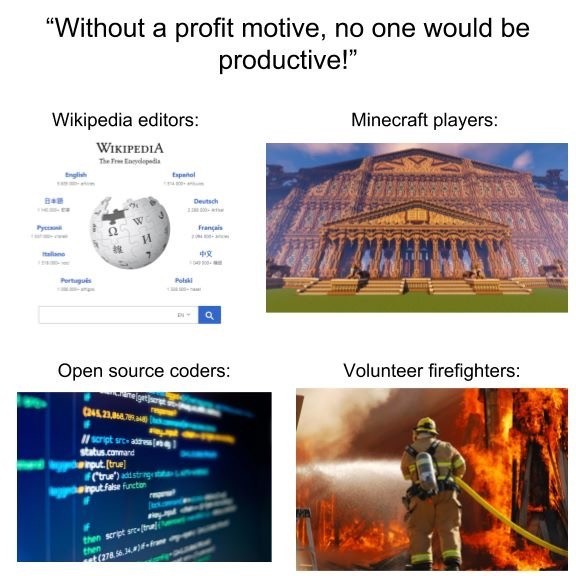
All of these people have motives… Their motives simply aren’t money
I do believe this was the message that was intended to be conveyed by the post itself
Sure, but some people really need it spelled out.
Like in the title of the post? Or in the image comprising the post?
Show me where in the post title or anywhere in the rest of the post it says “their motives aren’t money”.
Maybe I just missed that part?
Because “spelled out” and “implied“ are not the same thing. But I guess some people just need that spelled out for them.
¯\_(ツ)_/¯
“without a profit, no one would be productive”
It’s cropped out the top of the image unless you open it lol.
Don’t blame me for someone else cropping it.
Speaking of motivation, my motivation was to add clarity, not to start petty arguments
What’s yours?
deleted by creator
In the image itself, it directly calls it a “profit motive,” not just a general motive. I figured you may have missed that by mistake, wasn’t trying to be rude.
Then the rest the of the post implies that these other people are able to do stuff without a profit motive, though yes it doesn’t state they have other motives i suppose? But i think that’s the point
wasn’t trying to be rude.
Sure, but why pass up the opportunity for some petty bickering?
No need to reply
I don’t think I was involved in any bickering. I meant to clarify my thoughts from earlier.
Hence: without profit motive.
Are people not profiting off their feel good hormones just like they would getting a shiny new doohickey?
SHOULDN’T all these people be paid?
???
- Feel good hormones are not profit.
- Yes I think that firefighters should be paid, some open source developers deserve compensation for the value created by their work, and some Wikipedia contributors should probably be paid as well.
Turns out passion, curiosity, and purpose are way stronger motivators than profit ever was 😅
It depends on the person. I’ve known people who are much more motivated by money. Some of them ended up in prison, some are doing quite well, and some are still trying.
Honestly, I sometimes wish I were more money-motivated. I’m very lucky that my passion happens to earn a good salary (for now), but I gave up my business for it.
Everything depends on the person. Hitler could have been a great artist if he wasn’t a genocidal maniac. 🤣
And Trump could have been great… well, person if he wasn’t, eh… Trump. 🤷🏻
Problem being the jobs that don’t inspire passion, curiosity, and purpose, but we still need them to get done.
They lock essential things (e.g. food, water, shelter, medical services, etc.) behind a paywall because they know it is not true that people do not always—or even usually—want money.
But people do need essentials to live, and if they’re the only ones who can give you money to get those, then they can order you to do what they want instead.
Imagine an Internet where services are provided to make our lives better, not just to turn a profit.
Imagine a world where automation didn’t take away our livelihood, but helped us to spend more time doing what we wanted to do.
Imagine a world where food, water, shelter, education and healthcare was available to everyone, not paywalled.
This world is possible. We can get there. If heaven exists, we must create it here on earth.
Organize, protest and elect. Emphasis on organize and protest.
- Get as involved as you can with activist efforts locally.
- Organize, network, focus on building solidarity. Join or form a union. Join the IWW.
- Vote at primaries and elections for the best candidate, even if you doubt they can win.
- Don’t punch down.
- Don’t punch left.
- Educate yourself, politically.
- Push for voting reform and for anything that breaks the two-party system
How does capitalism inevitably lead to fascism?
Basically, the issue with capitalism is that the more wealth you have, the easier it is for you to make more money. And since money can be used to buy goods, services and influence, there is always a way to use money to gain more political and social power. With that political and social power, you can push society and the legal system in the direction you want to go. So you can use your wealth to gain power, and then you can use your power to change laws and society so that you can make even more wealth and power. It’s a positive feedback loop.
Obviously, though, if the billionaires and ruling class are accumulating more and more of our society’s wealth, that inevitably means that there’s less for everyone else to go around - therefore, working class people feel poorer and poorer. Meanwhile, the economy is going absolutely great for rich people, so inflation continues to go up - everything gets more expensive, but wages don’t increase. The wealthy just keep more and more of the wealth for themselves. To accumulate more and more wealth, they change the laws so that they can avoid paying taxes, so public services collapse. Politicians are lobbied to ensure that public funds are diverted away from where it is most needed - housing, healthcare, transportation, infrastructure - and instead into industries where their class interests most benefit from it, such as weapons manufacturing and extractive industries such as fossil fuels and mining.
The working class are bound to notice that their lives are getting shittier and shittier, and if that situation is left unchecked, the working class would realize that the ruling class are fucking them over, rise up, and overthrow their rulers. Obviously, the ruling class need to do something about this, but there’s no solution that the ruling class can offer. They’re causing all of the problems, to fix them they’d have to give up some of their wealth and power - and that’s not something they’re going to do. So they need to find someone else to blame the problems we have in society on. Unfortunately, though, no matter who they blame the problems on, and no matter what they do to “fix” it, the issue will continue to persist, because the material conditions underlying the issues are, very intentionally, never addressed.
So, the conundrum returns: The ruling class said that minority A caused all of the problems, minority A is persecuted and oppressed, but society doesn’t actually get any better. Either the problem wasn’t minority A, or minority A just hasn’t been oppressed enough yet. So the ruling class can either escalate the oppression, or they can shift the focus to another minority group. The division continues to escalate in terms of how vitriolic and extreme it is, and it also continues to divide the working class into smaller and smaller groups.
To get the working class to buy into this hateful message, they need to take advantage of our worst instincts, and one of those instincts is the in-group bias. The majority are manipulated into being suspicious, then intolerant, then hateful, then violent, then genocidal, towards whatever the targeted minority of the day is. Anything that can be used to divide the working class - sexuality, nationality, immigration status, ethnicity, religion, sex, gender identity, age, all of these will be used as wedges to keep the working class split apart and not working together, because they know that if the working class actually unite against them, they are completely and truly fucked.
That’s exactly how fascism manifests. It’s because it’s possible for people to accumulate power through wealth. This is why capitalism must be abolished. If we do not abolish capitalism, fascism will always return. It’s just a matter of time.
The fantasy-story of profit motive: Without capitalism, people are just lazy, unproductive and die eventually. But with capitalism, there is great innovation, motivation and excitement.
Cool story, but absolute nonsense.
It’s a few bad players that are extremely greedy who ruin the whole game for everyone else. Most people don’t want to be that rich, they just want to live without starving to death, being healthy and have a roof over their head.Yep, years ago there was a massive jackpot for mega millions or Powerball, I can’t remember. I was hanging out with a buddy and we got to talking about what we’d do if we won. Of course we joked about all the stupid things we’d do, but after that night the thought stayed with me and I’ve put a lot of thought into it.
After years of thinking about it I realized that when I take vacation from work, I stay home but I work on projects I care about. Homelab, open source, animal welfare, ect. I have severe ADHD and can’t stand just laying around, so I know I wouldn’t stop working, I’d just stop working to live.
I even spent one weekend researching and developing a plan for if I actually won and put it all in a folder so I can just open the doc and see my plan, then take that an the spreadsheets to the lawyers, asset manager, and CPA, and protect myself and the money. Definitely not a obsessive ADHD weekend…lol.
As it stands right now I’d take $5 million and live off dividends, each parent gets $5 million, and anything left over goes into a nonprofit foundation I would set up to fund all the open source and nonprofit projects I care about.
When people ask me why I waste money on the lottery, I just say I don’t want the money to be rich, I want the money to be free. Also I only spend $12 a week to play, the only time I buy extra tickets is if I win a few bucks on a ticket, then I just cash it in for some extra draws.
Yeah it is one of my biggest pet peeves when people say capitalism drives innovation. Like, it does help spread technology, and it can cause tech to be refined quickly (e.g. the smartphone), but it is absolutely not what has driven the vast majority of innovation. People just want to solve problems and fiddle with things they find interesting, not make bucketloads of money.
It’s one of those “every accusation is a confession”. People are thinking about themselves when talking about others.
Volunteer firefighters do actually still get paid a lot of the time.
Source: Was volunteer firefighter. Was paid per-call.
Same, 6 years from 2005-2011, $7.50 an hour for a call was great money in 2005. I think we were up to $10 by the time I quit
I was thinking that was shit money, but I was making $2.13 as a waiter in 1999-2000, so that’s about right. I made $5.15 for awhile, then min wage was finally raised to $7.25, where it’s been for almost 20 years.
Thanks for sharing that - out of curiosity, would you still have done it if it wasn’t paid? No judgment, just curious!
Hell yeah! I didn’t even know I would be getting paid until I went down to the station to ask how I sign up.
Good for you! Thanks for being a good human <3
Most firefighters in the U.S. are volunteer, and make no money at all. Being paid per call is not the norm.
Isn’t it just a small stipend? Nothing you could live on, even if houses were burning down 40 hours a week.
I’m convinced people who believe that are some of the biggest shit stains on the planet.
Personally, I was one of the people who used to believe that, because I was born and raised in a society that taught me that since birth. I can totally understand that there are people out there who still believe it, and I do everything I can to try and bring them up to speed. It’s hard to unlearn everything you have learned, especially if you’ve already made big, irreversible decisions in your life based around the lies you believed. I think the key is to try and find common ground, and to empathize with people, even when they’re not acting their best. I believe nearly everyone is redeemable.
So did I, but I’m more referring to the Wall Street and CEO as well Billionaire types who wouldn’t do anything if they didn’t get more out of it.
Yeah, that’s totally valid. There may be some of us who don’t make it, billionaires are probably too far gone, it seems to me that living for long enough surrounded by sycophants and people who can’t say no to you warps your brain and fundamentally robs you of your humanity. In a way, it must be extremely alienating.
Capitalism and so called meritocracy have brainwashed humanity.
Meritocracy is a lie when almost every who wields wealth or power is a white old man. It’s like they have special quota for white men.
Maybe the problem in our society is the people who are only motivated by profit.
"Without the fear of poverty, no one would be submissive "
My Minecraft survival world is awesome, but I think in this context “productive” is usually referring to, you know, farming and stuff.
Honestly if people didnt need to take the first job they could under threat of homelessness i truly believe enough people will just end up doing everything we need done out of the sheer need to do something
I think UBI would give us a lot more artists.
Yeah for sure, it took me a couple decades but i finally got a data job, where i really just enjoy the work, after starting from the bottom minimum wage and working up a bit in two other careers first lol
Finally im somewhere where if i get laid off inwould literally just happily work on a data analysis portfolio while applying to jobs. My two prior careers (law and education) I left them because i just hated the day to day work.
I dream of swimming in data with a few clear questions, a rudimentary sketch of the preferred output format and the side quest to note patterns or things that stick out and offer suggestions for improvement in SHORT FORM (caps needed)
As long as you enjoy data cleanup lol, that’s the unglorious part, getting a shitshow of manually entered data from a few different sources and then answer some clear questions lol. AI helps a lot with that though nowadays, you feed it a bunch of manually entered garbage and it does like 80-90% of the job for you!
Excel helper columns tend to show complexity in data cleanup through their breadth
If I’m 15 columns deep iterating it’s as if you can see the top of the mountain but weather can turn at any moment
I think it serves as an illustration that people will do difficult and tedious computer work for reasons other than money it specifically being Minecraft isn’t really the point to me
For sure, but people have lots of incentives to do farming and stuff even without the profit motive, otherwise human civilization wouldn’t have made it out of the paleolithic era. Humans are actually the most co-operative species on the planet, it’s biologically hard wired into us to work together to improve our living conditions for our communities and to share what we have with others.
This altruistic instinct rapidly tapers beyond one’s immediate community. Sure, we have the instinct to try helping others, even those who are very distant. But without reinforcement of our good behaviors, any given behavior will peter out.
Like, suppose you are making enough money to live comfortably. You then hear about a charity that builds wells to provide clean drinking water to people in impoverished parts of the world, and decide you can spare $5 per month to help them. So you donate $5. However, this charity focuses entirely on doing the actual charitable work, so you have to remember to donate and manually type in your credit card information each month. And they don’t do any PR. No monthly emails with personal stories about the people they helped or anything like that. Instead, they simply have a publicly accessible spreadsheet that has data on wells built and people served. Almost everyone would stop donating to this charity after a month or two, simply because they would forget or procrastinate until they forget, because our brains don’t assign relevance to things which don’t create an emotional impression on us. Compare this with, say, helping your child and their new partner build a home with your own hands. This kind of project provides lots of positive reinforcement - exercise, time outside, time spent with others, seeing progress being made day by day, the appreciation of others, the knowledge that you have helped someone who is important to you.
Hence why most people find most jobs to be unpleasant in one way or another. Not many people want to spend their days pumping a stranger’s septic system. The unpleasant work (aka, “work”) is what is left over after everyone does the pleasant work for free.
Also, some anthropologists theorize that the beginning of labor intensive agriculture and large permanent settlements was only possible via forced labor, coerced by violent, authoritarian leaders. Evidence shows that early agrarian life was significantly worse in just about every way than nomadic hunter-gatherer life, which explains why hunter-gatherer tribes almost universally fought against or fled from agrarian settlements.
Do you not believe that we can structure society in such a way that our best instincts are leveraged for the benefit of as many people as possible, rather than leveraging our worst instincts for the benefit of a select few?
You managed to cram an impressive amount of false dichotomies and unfounded assumptions into a single sentence.
If you say so! I think the claims implied by my statement are pretty self-evident, but if there’s something specific you take issue with, I’d welcome a discussion on it. I am always more than willing and able to defend my positions.
You might like this initiative: https://www.minecraft.net/en-us/article/uncensored-library
I think the more automated the job is, the easier it is for people to get started. So with better farming technology I would expect more people interested on it.
We already have better farming technology. People prefer to grow gardens in their back yard with compost made from their coffee grounds instead. Iirc, John Green calculated that - even excluding the cost of his own labor - one tomato that he grew in his garden cost him $18.
There are certainly a lot of problems with modern agriculture. But food is far cheaper than it has been for pretty much all of human history, when the collection and preparation of food took up the vast majority of most people’s time.
I think that’s a disingenious estimate to say that food is far cheaper now than it was previously in human history. Before industrialization, growing food did take up a large portion of people’s time but their yearly work hours were much smaller.
As the other commenter said, even if your claim about having more free time is true (I highly doubt it, more likely we simply aren’t counting the various tasks historical peoples had to do which were still “work”, but not their main job, and overcounting the “work” that modern people do when they are actually just scrolling tiktok), as a society we spend far less time making food than we used to. This is obvious by the fact that in the past century, worldwide levels of famine and hunger have dropped lower than they have ever been in recorded history.
What do work hours of people not in the farming industry have to do with the raw costs of food?
The “cost of food” has been abstracted from the “amount people have to pay downstream to afford food” by companies’ desire for profit. One guy can manage acres of land with a few good machines. Food is cheap: that is why people can afford to ship it around the world to be processed in one country and then sold across the ocean in another country. We don’t have to work as many hours as we do to sustain ourselves to the level they did back then. Industrialists have just countered work efficiency improvements with…more work.
Industrialists have just countered work efficiency improvements with…more work.
Yes, exactly. Before industrialisation people worked on average less hours than we do now.
I…what?
In your mind, what happened to the rest of my comment that preceded the literal final line you quoted?
I thought there was a ton of farming in Minecraft
Farming Patreon support for your Minecraft streaming gig.
Volunteer firefighters are paid pretty damn well while 20 of them stand around a car wreck at 2am.
You think the guys who don’t get paid at all are paid pretty damn well? I don’t follow.
Volunteer firefighters are not unpaid, that not what volunteer means in this context. They are not full time, professional firefighters, they have normal jobs and when a call goes out, whoever can make it drops what they’re doing and goes in. But they absolutely get paid, very well, for their time, from the tax payers dollar. Or by directly suing for restitution as with my car accident. $1700 for a gaggle of looky lous
Volunteer firefighters are unpaid. That is what volunteer means in this context. They make $0.
There are some places where they get tossed a few bucks per call, but most of them don’t make a cent.
In our town they are paid hourly at calls
Then they’re not volunteers. They’re PRN employees. What you have in your town is a paid, professional fire department.
Volunteers on the other hand not paid. They don’t make a dime at any fire call. The law generally allows small, nominal cash rewards as incentives while still being considered volunteer, like awarding a couple hundred bucks at the end of the year for top responders, or a small dispensation of cash per call, but that’s it.
More than 80% of the fire departments in the United States operate this way, with over 65% of firefighters in the country being unpaid volunteers. The firefighters in your town are not included in these numbers.