

Transcript
[A dog is walked by an old lady wrapped in a blanket siting in a wheelchair] Old Lady: A doggo! [Close up of the old lady’s happy, yet not all there expression] Old Lady: A heccin good pupper. [A Nurse rushes to the Old Lady’s chair. The dog stairs at the Old Lady, the owner off screen] Old Lady: 13/10 good boi. Dog Owner: huh? [The nurse wheels the Old Lady away] Nurse: Don’t worry no one understands her- Old Lady: Could be a fren.
You must log in or register to comment.
5/7 perfect score.
5/7 with rice!
Oh lol. Never realised how 5/7 is so close to 67.
Wow. Such True. Many Funny.
Cool beans, roflcopter.
We did successfully revive “23 skidoo!” and “bee’s knees” during the third wave ska and swing band craze, so it’ll be interesting to see what eventually works it’s way into youth’s slang lexicon.

My roflcopter goes soi soi soi.
ERMAGERD
ZOMG

Whatever. I’m am the Great Cornholio!
Wassuuuup!
Talk to the hand. You aren’t all of that and a bag of potato chips.
Oh snap!
Are you threatening me?
♫ Will the circlejerk be unbroken, by-and-by OP, by-and-by? There’s a better joke awaitin, in the replies, oh in the replies ♫
e; no for real tho, I love how each generation finds their own way to be dumb
11/7 with rice.
fr fr no cap gyatt rizz
And after millennials pass, old folk’s homes will be filled with people shouting “SIX SEVEN” over and over
deleted by creator
skibidi toilet pilled
I still don’t know what mogging (sp?) is and I’m not sure I want to …
I’m pretty sure I do, and I’m almost certain I don’t want to 🤷🏻
No you don’t, or you would be totally certain? 🤔
You’d think so, wouldn’t you?
yo what does this mean
you don’t want to know, oh the horror
Right? Much better to get your skibidi rizz on than have your cortisol spiked by 67 mogged millennials.
I’d argue its a different kind of “bad” humor, with the aging millennial style being cringey and painful to hear vs just plain stupid
I am happy I can yet understand both.
“This adulting thing is hard. I guess I’ll die.”
My least favorite term is “adulting”.
When I hear it, I want to respond with, you mean taking care of shit on your own? Because you’re not living at home?
Early 20’s it’s cringey. When someone is pushing 35, I want to vomit on them.
When someone is pushing 35, I want to vomit on them.
Out of context that’s quite a statement.
It’s a weird kink, but I’ll own it.
“I don’t like it when people say ‘life is hard’ in ways that I disagree with. When I hear it I say ‘you mean exact synonyms that take longer to say?’”
I think there’s a brief window of time that it fits, like college-age when young people are learning how to do a bunch of stuff for the first time.
After that, it just sounds like arrested development (as in “perpetual adolescence”, not the show).
After that, it just sounds like arrested development

This is triggering me to start the series over again… It’s been years since the last rewatch.
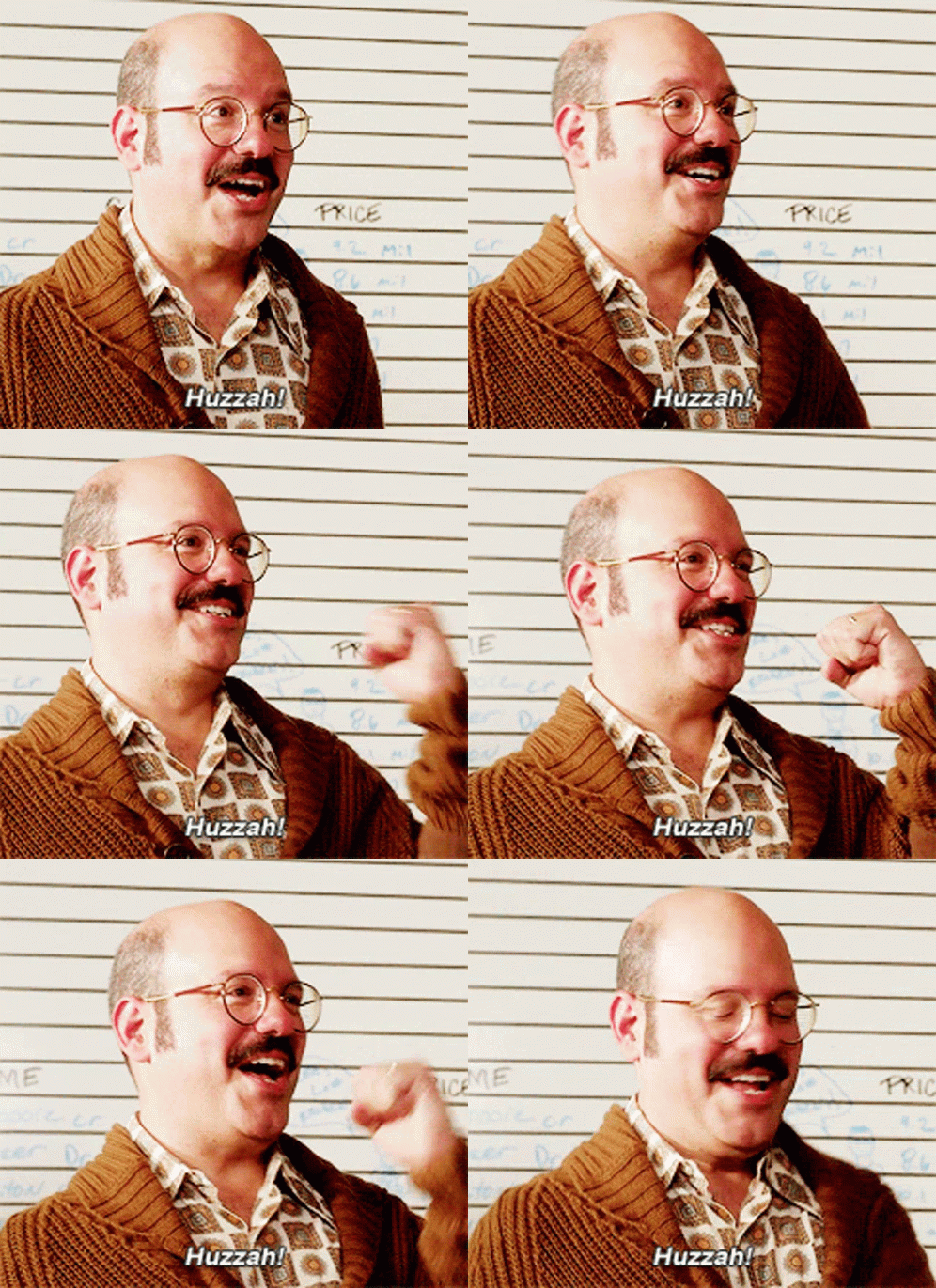
I just blue myself.
It doesn’t seem to bother me as much as others in this thread. I just read it as being responsible or doing the daily shit you are supposed to do. Which is often annoying to do.
It almost sounds like something that could have come from Seinfeld, predating the term by almost a generation.
seethe more
deleted by creator
There needs to be the geriatric equivalent, like “olding”
I use ungracefully aged for my wife and I
This is what I love about any movie/tv show/book/novel/short story about the future … it’s all spoken in the same language that we all understand now.
But if we could listen to regular everyday English spoken in North America 100 years ago, it would sound a bit off and unusual. Listen to English as it was spoken in England 300 years ago and it would probably sound very strange and unsual, go back to 500 years ago and we would probably have a hard time understanding.
The same thing is going to happen in the future (IF there is any kind of future and we don’t blow ourselves up or kill ourselves off in some unusual, creative and complicated way) … historians will listen to recordings of how we talk today and think of us in the same way we think about someone from 1800. Go even far into the future about 500 years and someone from 2526 will probably not be able to understand anything we’re saying unless they use a translator of some kind. Those people 500 years from now will probably look back us like we’re making grunting sounds like some cave people from prehistory.
How far back in time can you understand English. A fairly long but facinating read.
That is interesting … but that’s the written language. Up until about 1950, literacy was only reserved for those who could actually afford a decent education. A hundred years ago, it was only a very small percentage of the population who could actually read or write. The vast majority of speakers spoke only a common language that was particular to their location and history … so the English they spoke was probably very different than what was being written by a nobleman from their time period.
Another fascinating read is just basic Tom Sawyer by Mark Twain … one of the reasons his writing became so famous was the fact that he wrote his characters speaking in every day language that people spoke … not a polished aristocratic uptight proper English that only the most wealthiest and properly educated people could appreciate.
The excerpts in that blog post are interesting but they would only represent the language of the most wealthiest people of their particular time. If you spoke and listened to a common worker from their same time period, you’d probably hear an entirely different language being spoken … and the difference would be even more pronounced the further back in time you went.
Jeez, what country are you talking about with that level of literacy up until 1950? India?
Most global historic statistics have fairly accurate information for first world countries but seldom have any for developing, third world countries or rural populations.
I’m Canadian, Indigenous Canadian and my parents were born in the wilderness in the 1940s when starvation was still a thing when they were children. They got an education but one that centered around beating the ever loving shit out of you for being brown than in teaching them how to read or write. Even though they lived in a first world country, their generation in Indigenous Canada was more or less illiterate. And that was the style at the time … you counted only the people that were worth counting and you didn’t count those you didn’t care about (which was usually 90% of the rest of the world).
So in the 1950s, when the US, UK and French average literacy rate was about 70% to 80%, they only represented less than 10% of the global population … most of the world was unrecorded, badly recorded or just ignored, the global average at the time was about 20% (or probably less)
I hadn’t thought about Canada at all, nor about how indigenous people in North America / Australia wouldn’t necessarily have been included in historical literacy rates – instead I’d glibly taken the literacy rates of the largest countries that ostensibly ‘spoke English’ at face value, and you make a compelling point. All very interesting, thanks
To play devil’s advocate since sound recording modern English has only gotten more succinct. Also everyone speaks their own variation of English they know. Besides actors
390 years ago i doubt you’d understanf anything tbh
Sure you could. That’s basically Shakespeare. Reading it is a little tough but you can make it out. Hearing it is probably just a matter of getting used to a different accent. But it’s modern English.
Did you really intend to write 390 years, or is 9 a typo like the end of understanf?
Plenty visible just reading some old books. It took a bit to parse through reading Robinson Crusoe just for the way sentences are formed sometimes.
Badgerbadgerbadgernbadger
🍄‼️
🐍‼️
Apropos of nothing, the term “doggy” or “doggo” is possibly going back to the roots of the word; the Middle English word “dogge” kind of came out of nowhere and it’s hypothesized that it might have been a diminutive slang word (like “doggy” or “bunny”) that ended up becoming the standard term for the animal, supplanting “hound”.
Unrelated but I think it’s funny when people pronounce doge like doje instead of doggy.
It literally never occurred to me to pronounce it as “doggy.”
Dog “E” was where the spelling came from.
Anyone who doesn’t pronounce it as “doje” is a psychopath.
Aw shit am I outing my age when I say “pupper” god damn it.
Don’t worry, the smol puppers and doggo frens don’t care, and theirs is the only opinion that matters.
Idc I love my lil pupperoni and cheese!
I make jokes about https://en.wikipedia.org/wiki/BIFF_(Usenet) and /. and no one already understands me.
Ey, I know B1FF! Idk what you mean by /. tho.
--

  DDDDD   IIIII   AAA   PPPPPP  HH   HH RRRRRR    AAA     GGGG  MM    MM
  DD  DD   III   AAAAA  PP   PP HH   HH RR   RR  AAAAA   GG  GG MMM  MMM
  DD   DD  III  AA   AA PPPPPP  HHHHHHH RRRRRR  AA   AA GG      MM MM MM
  DD   DD  III  AAAAAAA PP      HH   HH RR  RR  AAAAAAA GG   GG MM    MM
  DDDDDD  IIIII AA   AA PP      HH   HH RR   RR AA   AA  GGGGGG MM    MM

                           WW      WW PPPPPP
                           WW      WW PP   PP
                           WW   W  WW PPPPPP
                            WW WWW WW PP
 diaphragmwp@devio.us        WW   WW  PP                  yomamas@mail.ee
 DMWP@DMWPVM.BIT.NET                                 DMWP+@ANDREW.CMU.EDU
   DMWP@AOL.COM  DMWP@DELPHI.COM  DMWP@PRODIGY.COM  DMWP@COMU$ERVE.COM
          DMWP@NETCOM.COM  DMWP@WORLD.STD.COM  DMWP@MCS.COM
            DMWP@DMWPNET.FIDONET.ORG  DMWP@WELL.SF.CA.US
              DMWP@ATHENA.MIT.EDU  DMWP@CYBER.SELL.COM
                             DMWP@MSN.COM

   MY SIG         /^^^^^^^^^^^^^^^^^^^^^\          WAITING
  CAN BEAT        !@@@@@@NUKULAR@@@@@@@@!                 4
   UP YOUR       -------------------------            ARMAGEDIN
    SIG           !@@@@@@@@PIZDOS@@@@@@@!          IT"LL B
    !!!           \--------!   !--------/            AWESOME!!!!
                           !   !
                         ---------         THIS SPACE 4 RENT CALL DMWP
      /\\\                 !   !               HA HA FOOLED YOU!!!
       |||                /     \
       /-\
  /----/-\------------------------------------------------------------\
 | DMWP|@|AOL.DELPHI.PRODIGY.COMPU$ERVE.NETCOM.WORLD.MSN.DMWP.EDU DUDE!>
  \----\-/------------------------------------------------------------/
       \-/
       |-|     BANG THE FALSE METAL HEAD THAT DUZZN"T DRINK BEER!!!
      \///          HOT METAL TUBS RULE IN A MAJOR WAY DUDEZ!!!
                                                               ,---,
                           ____                  ,-.----.   ,`--.' |
        ,---,            ,'  , `.           .---.\    /  \  |   :  :
      .'  .' `\       ,-+-,.' _ |          /. ./||   :    \ '   '  ;
    ,---.'     \   ,-+-. ;   , ||      .--'.  ' ;|   |  .\ :|   |  |
    |   |  .`\  | ,--.'|'   |  ;|     /__./ \ : |.   :  |: |'   :  ;
    :   : |  '  ||   |  ,', |  ': .--'.  '   \' .|   |   \ :|   |  '
    |   ' '  ;  :|   | /  | |  ||/___/ \ |    ' '|   : .   /'   :  |
    '   | ;  .  |'   | :  | :  |,;   \  \;      :;   | |`-' ;   |  ;
    |   | :  |  ';   . |  ; |--'  \   ;  `      ||   | ;    `---'. |
    '   : | /  ; |   : |  | ,      .   \    .\  ;:   ' |     `--..`;
    |   | '` ,/  |   : '  |/        \   \   ' \ |:   : :    .--,_
    ;   :  .'    ;   | |`-'          :   '  |--" |   | :    |    |`.
    |   ,.'      |   ;/               \   \ ;    `---'.|    `-- -`, ;
    '---'        '---'                 '---"       `---`      '---`"

 DMWP@BIT.NET DMWP@PSUVM.PSU.EDU DMWP@DMWPVM.BIT.NET DMWP+@ANDREW.CMU.EDU
   DMWP@AOL.COM  DMWP@DELPHI.COM  DMWP@PRODIGY.COM  DMWP@COMU$ERVE.COM
          DMWP@NETCOM.COM  DMWP@WORLD.STD.COM  DMWP@MCS.COM
            DMWP@DMWPNET.FIDONET.ORG  DMWP@WELL.SF.CA.US
              DMWP@ATHENA.MIT.EDU  DMWP@CYBER.SELL.COM
                           DMWP@MSN.COM

                     K0M1NG S00N T0 THEATREZ NEER U!!!!!!
 _______   __       ___       __    __  .______    __    __
|       \ |  |     /   \     |  |  |  | |   _  \  |  |  |  |
|  .--.  ||  |    /  ^  \    |  |__|  | |  |_)  | |  |__|  |
|  |  |  ||  |   /  /_\  \   |   __   | |   ___/  |   __   |
|  '--'  ||  |  /  _____  \  |  |  |  | |  |      |  |  |  |
|_______/ |__| /__/     \__\ |__|  |__| | _|      |__|  |__|

.______          ___       _______ .___  ___.
|   _  \        /   \     /  _____||   \/   |
|  |_)  |      /  ^  \   |  |  __  |  \  /  |
|      /      /  /_\  \  |  | |_ | |  |\/|  |
|  |\  \----./  _____  \ |  |__| | |  |  |  |
| _| `._____/__/     \__\ \______| |__|  |__|

____    __    ____  ___      .______          _______.
\   \  /  \  /   / /   \     |   _  \        /       |
 \   \/    \/   / /  ^  \    |  |_)  |      |   (----`
  \            / /  /_\  \   |      /        \   \
   \    /\    / /  _____  \  |  |\  \----.----)   |
    \__/  \__/ /__/     \__\ | _| `._____|_______/

              FEETUR1NG THE GRATE DMWP1NSK1 AS C4PTA1N DMWP!!!!!!

                    DMWP 4RUOND TH4 W3RLD!!!!!
                                   .
                               _--_|\
                     P3RTH--> /      \<--SIND3Y
                              \_.--._/
                                    v<---DMWPSM4NIA!!!!!!!

                ___                          (_)
              _/XXX\
             /XXXXXX\_ <-- MT. DMWP1NGT0N                 __
 __    __   /X XXXX XX\     MT. K1BO (SHORT3R    _       /XX\__      ___
   \__/  \_/__       \ \    TH4N DMWP'Z) ----> _/X\__   /XX XXX\____/XXX\
 \  ___   \/  \_      \ \               __   _/      \_/  _/  -   __  -
 __/   \__/   \ \__     \\__           /  \_//  _ _ \  \     __  /  \____
  __    \  /     \ \_   _//_\___     _/    //           \___/  \/     __/
 /_______\________\__\_/________\_ _/_____/_____________/_______\____/___
                                    /|\
                                   / | \       _____ ______
                                  /  |  \      \    V     /
     THE RO4D T0 DMWPN3SS!!!!    /   |   \      |TOLLROAD|
                                /    |    \     |  666   |    +---------+
     ALL MUST TR4V3L 1T        /     |     \    \___ ____/    | DMWP    |
                              /      |      \       V         | R00LZ!! |
     SUMD4Y!!!!!!!!          /       |       \      |       o +---------+
                            /        |        \     |      o
                           /         |         \    |   |\__/|  .~    ~.
                          /          |          \   |   /o=o'`./      .'
                         /           |              |  {o__,   \    {
                        /            |                   / .  . )    \
                       /             |                   `-` '-' \    }
                                     |                  .(   _(   )_.'
                                     |                 '---.~_ _ _|
              ch3ck 0ut my sh1t @ /home/diaphragmwp/public !!!!1
                             imma l33t haxxor
^(this is in my .plan on devio.us)^
That asciii ART is something to behold.
Does this mean that people will return to speaking normal English in the future?
This is just translated to today’s standard English. Future English obviously will become a tonal language, where all expression is based on different intonations of the word “skibidi”.
Of course!
Here’s the start of a really good series, all in normal English:
Whan that Aprille with his shoures soote, The droghte of March hath perced to the roote, And bathed every veyne in swich licóur Of which vertú engendred is the flour; Whan Zephirus eek with his swete breeth Inspired hath in every holt and heeth The tendre croppes, and the yonge sonne Hath in the Ram his halfe cours y-ronne, And smale foweles maken melodye, That slepen al the nyght with open ye, So priketh hem Natúre in hir corages, Thanne longen folk to goon on pilgrimages, And palmeres for to seken straunge strondes, To ferne halwes, kowthe in sondry londes; And specially, from every shires ende Of Engelond, to Caunterbury they wende, The hooly blisful martir for to see, That hem hath holpen whan that they were seeke
All I understood was “longing folk to goon on pilgrimages”. That thing never changed!
Middle English, yeah, that’s Chaucer from 700 years ago. Hearing someone read this is a treat, though. It is an amazingly musical language, I feel much more so than Modern English.
To be fair, survival bias. This is the poetry that was so beautiful and engaging it was repeated and preserved for 500+ years. I’m sure there were vassals trading japes in Middle English who didn’t rise above the erudition and imagery of your average teenage wastrel shooting the shit in Modern English.
And there is still plenty of good poetry being created, which I can’t always appreciate fully because I don’t get the references or even some of the words. Which will last? Let’s check back in 500 years.
Ugh, this gives me PTSD from junior year high school English class, we had to memorize & recite that Chaucer’s Canterbury tales 🤮
And in junior high they probably didn’t clue you into the bawdier bits of the individual tales.
I said junior year in HIGH SCHOOL. Eleventh grade. Our teacher told us everything but I didn’t care. I hated it all.
Oh my bad.
“normal” is relative.
In other words, no.
This tends to be how I think of the generation that fell in love with words like “yeeted” and “gabbin”* and all those words that are completely unnecessary in lingual context, and just meant for style points or whatever.
* ach, it’s not exactly that, but something similar
Chat is this skibidi rizz gyattmaxing?
Gyorkin spurfinwittlin jeah!
and all those words that are completely unnecessary in lingual context
I mean, some of the most beautiful prose I’ve ever read has “unnecessary” words
EDIT: That’s fine and all, but not what I was talking about.
What I’m thinking of are more like cool / pet words used to help establish the uniqueness of a younger generation, helping to draw a divide from those older than them. Which actually makes a certain amount of sense…
cool
Like that word. They’re isn’t anything temperature related in that sentence. It’s impressive how long “cool” keeps being used.
These words are important though. Without them you get in a 1984 world where some fool forces people to use double plus good.
There’s a reason “cool” has remained in use.
Without them you get in a 1984 world where some fool forces people to use double plus good.
What, dog-whistling?
These words are important though.
Now here I have to call BS, just like the OC.
Aw c’mon, I kind of like yeeted, it’s better than chucked. But then I’m in my 60s so I’ve seen a lot of slang come and go.
‘Tis better to yeet than be yoted. – proverb of some dubious kind
I like some pop-slang, not others. “Neckbeard” is pretty good, because there wasn’t quite a word like that, and it really does capture a certain type. Meanwhile, “yeet” doesn’t mean anything to me, and wasn’t needed in the slightest IMO.
Languages naturally change over time, but usually that’s down to stuff like peoples mixing, and new situations & tech coming along, or dying out. This pop-slang stuff is okay for what it is, but I also feel the OC captured the other side of how useless it can be.
Kids have always been changing the lexicon, its kinda what they’re for.
THATS ALL THESE KIDS ARE GOOD FOR!
That’s what I’m saying just above.
All that and a bag of chips.
no cap I’m gabbin all day fr fr
SIX SEVEN!!
There’s a difference between being funny and referencing something funny. This isn’t humor, it’s recall.
Totally recall…













![Aging Millennial Humor [Sarah Scribbles]](https://lemmy.world/pictrs/image/7eef1682-ad36-4a23-bc2d-d88a6681fa49.jpeg)