

Spoiler
Probably at the hardware store picking up more Phillips head screws.
You must log in or register to comment.
I have impact-driven thousands of screws into wood in my back yard in the past 18 months. Over 1,000 of them were 6" (15cm) big guys, along with tons of 2.5" (~6cm) and 3.5" (9cm).
Every last one was Torx / hexalobular / 6-point. When I bought hardware that came with free phillips head screws, I threw that shit away and used my own.
The “feature” that philips head brings to the table makes it worse for just about every use case other than “I own exactly one screwdriver and never want to get another one.”
Torx doesn’t HAVE to be the alternative. There are many good screw designs out there. It’s just that where I live, that’s the non-philips choice that dominates the market. Every store has a variety of choices for torx-driven construction screws.
I think a lot of people who strip screws do so because no one told them that Phillips and Posidriv are different and incompatible
They literally don’t teach it at school and I’m pretty sure my grandpa couldn’t tell the difference either so quite literally nobody taught me until I got a screwdriver kit that had both PH and PZ.
Even worse is JIS, where it seems that its explicit and singular goal was to make a screw that would be instantly obliterated the moment a Phillips driver touched it. Fun fact, JIS drivers work far better on Phillips than Phillips drivers do, and I’ve yet to strip one since using JIS drivers almost exclusively
Is that what the PZ means, Posidriv?
And this is why I buy torx acres for anything I’m building myself. Unfortunately most premade things I buy have this crappy screw type.
Using well made screwdriver bits, replacing them when worn. Never had a ph head stripped since I started doing that. I’ve more Robertsons stripped in that time. In fact I’ve grown to dislike Robertson.
i love how the head in the before picture is ALREADY stripped
And half the time it came from the factory like that.
If it comes from the factory with such pronounced corners, chances are its a Phillips/Square drive combo. In which case you can use a square drive bit which will drive it without slipping (IIRC square drive has similarly high torque before cam-out as torx). There are a ton of different kinds of screw drives though, the phillips-adjacent ones are under cruciform here: https://en.wikipedia.org/wiki/List_of_screw_drives
Stripped for Your pleasure!
Don’t feel bad, it’s the PH design who’s at fault. For some reason, someone decided PH should have tapered flanks, so that the bit has a constant tendency to slip out of the screw unless you push the bit into it with absurd amounts of force.

- They’re not a great design
- Screws are made as cheaply as possible
- People assume their drivers last forever. Just a tiny bit of tip damage and they’re grind up any screws.
- Philips in impact drivers is a sin.
edit: 5. There are different Philips sizes; any Philips will fit in any equal or larger plus-sized hole, but barely engage and both strip the screw and the driver.
People assume their drivers last forever. Just a tiny bit of tip damage and they’re grind up any screws.
I had honestly never even considered this possibility…
The one on the right is actually “Pozidriv” (PZ), which is a little better than regular Phillips at least.

Looks like a dystopia to me, can’t get anywhere by foot and all the cars look like the same general design
there’s literally someone walking in the pic
Walking to a car

How is that any different from today?
in the US, no different
I do. proof: that is my backyard
Nah I’m buying hex screws/bolts or flathead ones. It is a feature, the feature is: the screw sucks.
I’m buying… Flathead…
Now see flathead is number two on my list of fasteners designed by dark forces.
It’s even worse than Philips for power tools.
Hex isn’t much better in my experience. Torx is great though.
Small hex fucking sucks, but cheap tools don’t help either
Neither does loctite
I could be wrong but I’m pretty sure phillips head originated for use in screwable rivets and large screws on automobiles where it was implied that the screw action was a one time deal using your hydraulic/pneumatic screw gun on the assembly line.
If you were to unscrew it, you probably should be using a fresh screwed rivet to replace it.
Of course those days are long gone because of superior non screwed riveting and pretty much everything removable in automotive being replaced by hex for the same reason of phillips being easily strippable.
The standard just stuck around because it was cheap.
Yes, the design is meant to effectively have a torque limit where the driver will cam out before the screw strips.
Phillips in electronics is what needs to die. They’re always stupidly small and strip so easily

just bought a bike from an american dude up here in Canada and I don’t think he owned a metric hex key set, judging by how every other bolt is stripped to fuck
I’d ask how, but I bought my nephew his first set of tools for his 25th birthday. He doesn’t exactly know how to use them (I’d gladly teach if I lived closer) but none of his blood relatives are mechanically inclined.
Still, better to have a plunger and not need one than to need a plunger and not have one.
Just bought a bike from a Vietnamese dude here in Vietnam and Holy shit who the fuck thought it was a good idea to put steel Philipshead screws into soft aluminum.
Unrelated, but making both metric and imperial hex was a mistake.
Edit: Turns out everyone in vietnam intentionally replaces JIS with philipshead because its easier to find.
Star drive and Torx are so much better I can’t believe they haven’t taken over the whole world
And square drive!
Amen brother!
Get a drill!! You can do this twice as fast with half the effort
Better make it an impact driver, just to be sure.
Best suggestion I have is to buy yourself a decent screwdriver or driver bits, then when it starts getting worn and slipping easily throw the bit/driver away and use a new one. You can get away with using a worn Phillips driver for a long time past it’s prime but you’re just making life hard for yourself by doing this.
Also make sure you’re using the correct size and type of bit, I’ve seen plenty of people struggling with Phillips heads because they’re doing something like using a ph1 bit on a ph2 screw or using a pozidrive bit on a Phillips head.
using a pozidrive bit on a Phillips head
So many people don’t even know Pozidriv exists, even in technical jobs. It keeps surprising me.
Some of those electric screwdrivers have torque settings. I don’t know how accurate they are (if I was doing an engine, first I’d be using a drill not a screwdriver second I’d actually take the time to calibrate it if I was working on something important) but I haven’t stripped out a screw with that driver yet.
Fucking love electric screwdrivers. They make shit a lot easier most of the time.
If it makes you feel any better, the Phillips head was designed specifically to strip out so assembly line workers wouldn’t over-torque them. It is stupid that they are the default in so many things when we have things like torx that are infinitely better.
From Wikipedia:
There has long been a popular belief that this was a deliberate feature of the design, to assemble aluminium aircraft without overtightening the fasteners. There is no good evidence for this suggestion, and the property is not mentioned in the original patents.
Philips shape is the next step up from a flat head. Its just a double flat head sort of. It self centers and only requires 2 tooling motions if they are being ground.
The dont overtighten thing has always seemed like a weird misunderstanding that all bit types could be designed to do that.
Huh…well guess I was wrong. Thanks for the info!
Acknowledging own error and thanking the counterparty for pointing it out with no sign of spite? Fucking witchcraft! How do I acquire this power?
I mean you just gotta try it I guess. You know what’s more fun that being right? Learning something and then being right.
You absolute legend.
It wasn’t an intentional feature. But, when they realized it happened it became a feature that they thought was useful.
There are a lot of things like that, where something has a design quirk that people come to rely on. The quirk is so useful that people assume it was designed to work that way intentionally, but sometimes it was just coincidence.
Sounds like Hyrum’s Law.
Edit someone linked this post from tool manufacturer tekton saying much of what I described may be popular misunderstanding, it may be worth taking this info with serval grains of salt https://www.tekton.com/blog/jis-vs-phillips-screwdriver-tip-geometry-and-fastener-compatibility?slug=jis-vs-phillips-screwdriver-tip-geometry-and-fastener-compatibility
If you like Philips aside from that feature (being self-centering is nice sometimes), JIS the Japanese industrial standard is basically the same design but its not intended to cam out, stripping the fastner
To my understanding you can safely use a JIS bit with a Philips fastner to reduce likelihood you strip it. But you ideally shouldn’t use a Philips bit to turn a JIS screw. You can identify a JIS fastner by a little dimple in the corner by the plus shaped indentation
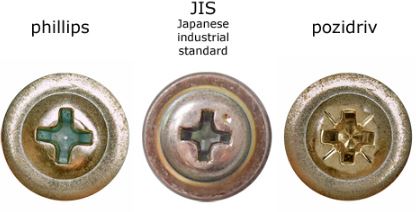
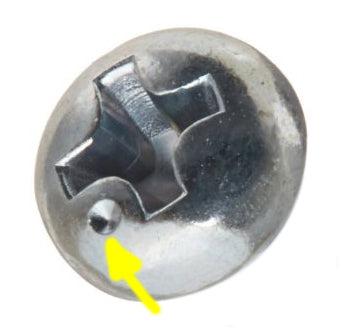
And TIL that the crappy Philips screw was actually this pozidriv one. I hate it. But at least now I know I just don’t have the right tool to use it.
I’m having trouble picking out the differences beyond the dimple. What makes it harder to strip?
The geometry of the area the bit slots into is different
I believe the difference is that the Philips bit is kind of a star shape, where the blades and the slots that fit together are widest at the middle where they converge, and narrow towards the outside, creating a wedge that ramps the bit out of the fastner. And with JIS they don’t narrow, creating a simpler plus shape that functions like two flatheads intersecting with eachother, but with a pointed tip so its self centering
The dot is there to communicate which kind it is since they look a lot like Philips. I believe thats also why posidrive has the little lines- so you can tell the difference. No idea what posidrive is about, maybe its similar 🤷🏻♂️
Edit, I was able to find some diagrams attempting to show the geometry differences (sorry, the side depicting each geometry swaps between the two pictures)
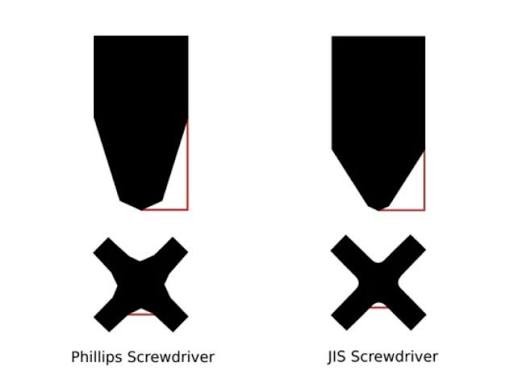
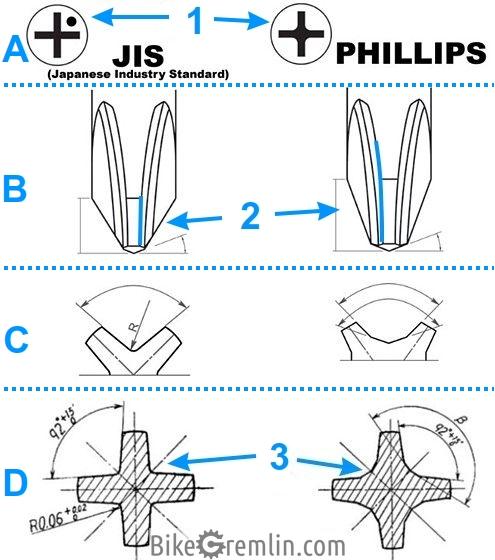
Note that according to hardware manufacturer Tekton, the differences are smaller than you think and especially the diagrams are highly misleading as they actually compare PH2 and PH0.
Just about the only major difference is the thread pitch and that is only different in JIS screws if they don’t have the dot.
Can you elaborate on what comparing PH1 and PH0 means?
The diagram is not comparing between two standards but between two sizes within the same standard. Philips size 0 (PH0) has a slightly different shape than Philips size 1 (PH1) and up.
Jeez… it’s like Phillips is DESIGNED to strip. WHY WOULD YOU MAKE IT LIKE THAT?
Someone said in another comment it’s designed to cam out, not necessarily strip, in order to prevent over-tightening. Someone else replied that wikipedia says there’s no evidence of that though.
I appreciate it. That was what I suspected, but it’s so hard to tell from just a picture.
Posidrive bits being mixed in with Phillips also helps strip out a lot of Phillips fasteners
That’s what op meant by “iT’s A fEaTuRe”