
You must log in or register to comment.
Doesn’t apply to fish, as they can’t move their eyes or heads. A wider field of vision is more advantageous in their case.
i think it may be affected by the need to watch above and below as well
And the fact that sight is much less valuable and more limited underwater
how does this affect jellyfish
Fish can move their eyes. I don’t know if it applies to all of them. Here’s a study about their eye movement with further source in the introduction. Link
Also many fish or ocean animals tend to have other sensory organs as eyes arent that useful in darker depths
Also for an enormous part of their evolutionary history sharks were prey animals.
It pretty much only applies to mammals. Doesn’t work with fish, birds or reptiles
Edit: typo
Well, it does with some birds.
Sharks are prey animals for giant squid.
Giant squid are prey animals for Cthulhu.
And the whole thing about Orcas coming at them from the side and knocking them over so they essentially fall asleep and then the Orca may or may not eat its liver.
the Orca may or may not eat its liver.
Depends if it has some fava beans and a nice Chianti
Explain narwhals then.
They’re unicorns, therefore magical creatures, making anything possible
causing a commotion again, i see
Made up animal. No way anything that adorable lives in the sea.
Where does Cthulhu have its eyes though
Everywhere
Cthulhu is just a bored angel.
So everywhere.
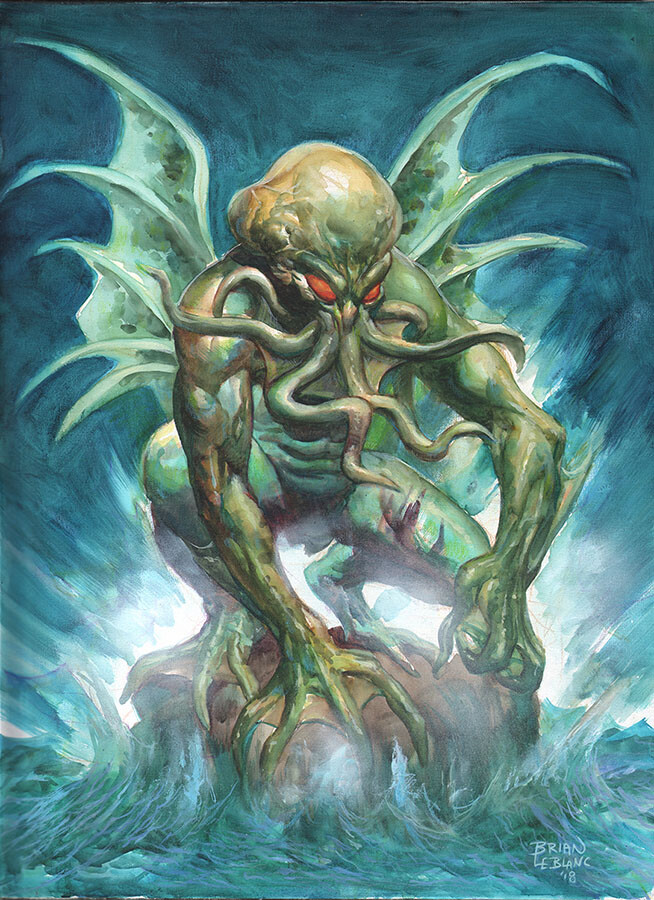
Dude’s practically a cyclops.
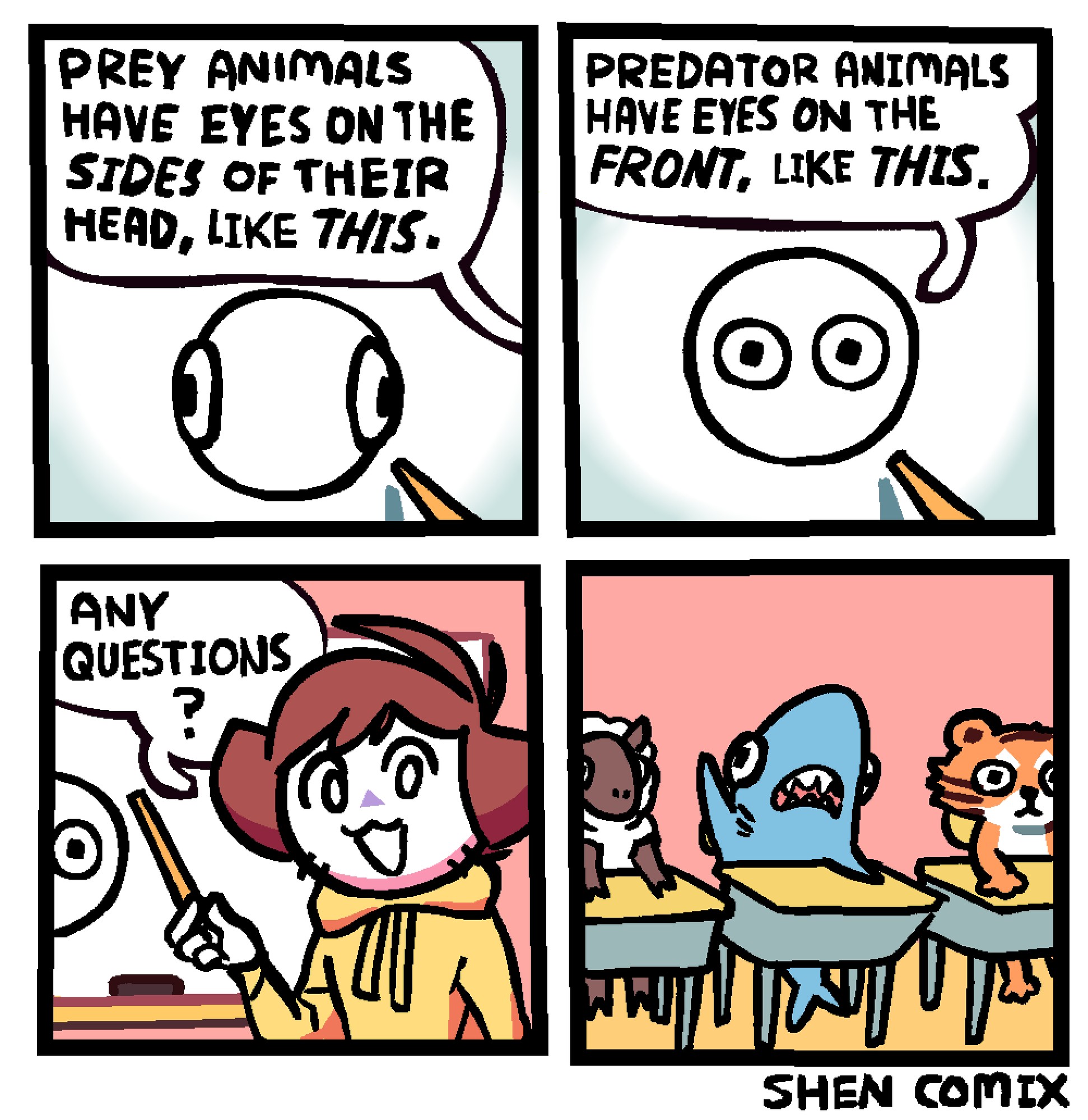
Damn, who knew the teacher was a predator all along…
He’s an ape, so he’s a predator!
Yet another example of why people need to learn to use the word “mammal” instead of “animal” when they mean “mammal”.
Isn’t is also a generalisation rather than a rule?
Yep.
But the Arabian sand boa is well known to be the most predatory of snakes:

ETA: This is a joke. I don’t think there is a “most predatory snake” (though I guess you could argue that egg-eaters are least predatory?). I just like their goofy faces.
Those eyes are not forward-facing in the same way our eyes, or the eyes of a wolf, are forward-facing. And I said that the statement is mammal-centric, not that it can never be true for any other animals than mammals.
Sorry, it was a joke to show off a goofy-looking snake. I’m pretty sure their eyes are actually positioned like that because they are fossorial, I don’t think snakes rely on their eyesight much at all.
Well, seeing this goober has been delightful. Silly looking creature.
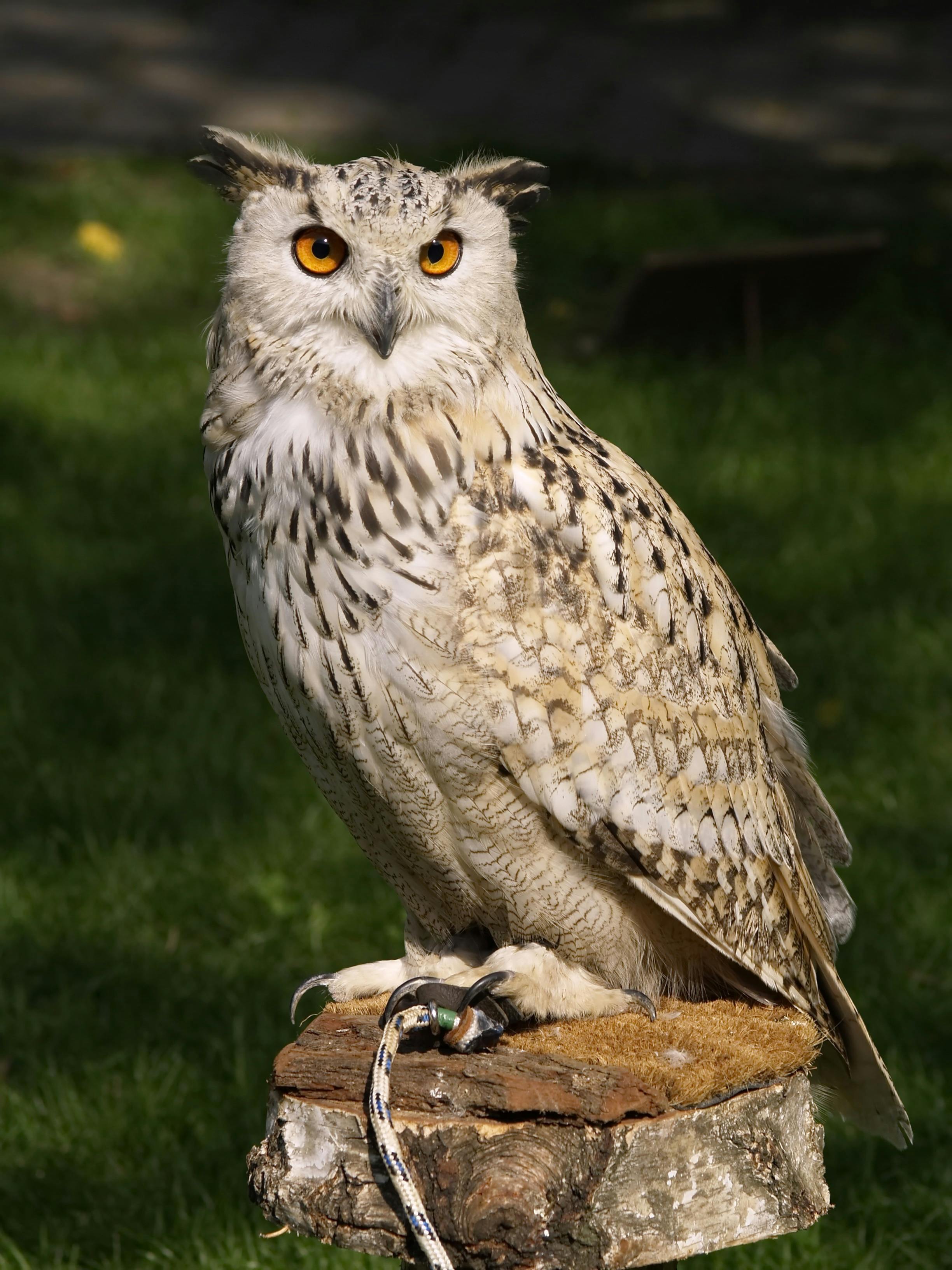
Birds of prey have entered the chat.

They are significantly more forward-facing than the eyes of, say, a pigeon.
My point is that they’re entirely forward facing. Calling it a mammal rule isn’t really accurate. It’s about whether or not the animal needs to judge distance to attack. Sharks use their vision to scan for prey above and below them, but they use their other sense to attack. Hawks and cats have a significantly different sense of vision, but both need to be able to accurately judge distance with their eyes when attacking.
Oh right, I see
That one looks like it’s both. Not sure their eyes can turn that far to the sides, but the sockets seem to be positioned for both good focus ahead and a wide peripheral.
It just looks that way because they’ve got very narrow heads. Its much clearer on owls, which have very broad faces, that birds of prey have fully forward facing eyes.

Does this really applies to mammal when things like Koala and Sloth both have front facing eye?
Or does that mean dropbear is real
Those animals are like our primate relatives, they climb for a living, so depth perception is pretty important unless you want to end up breaking your skull because you miscalculated how far a branch was
because you miscalculated how far a branch was
Except koalas do that all the time. So often that they evolved extra cushioning for their brains
Don’t underestimate sloths.

I mean, have you seen sloth claws? Crazy… I’d almost go for the monster from It Follows than a truly pissed off sloth … at least, y’know, if it also knew where I was at all times and actually made the effort.
Their teeth aren’t sunshine and rainbows either. If they want to bite you they’ll grab you with their claws and pull you in.
So likely immortal snail. Only it’s slower.
Yea, except a sloth can climb many things a snail cannot. Though I suppose if the snail had good intelligence, it could pull tricks like hiding in produce deliveries and whatnot that a sloth couldn’t pull off.
Definitely a few pitfalls for both!
While they aren’t predators, they aren’t really prey animals either, right?
Is it all predators or just pursuit and ambush style predators? They are the ones that really need depth perception. There must be a real cost to depth perception, so animals would have to have a need for it, even if they are not predators. Sharks have the lateral line senses, which is a lot better in the water then vision.
I don’t think there’s a hard rule you can put on it. Sharks are ambush predators, but they need a wide field of vision to scan above and below for prey. Monkeys are mostly herbivores or opportunistic omnivores, but they have forward facing eyes to jump through trees. It’s just about what they animal needs their eyes to do, and forward facing eyes are mostly used for trying to grab another animal.
There’s probably an obvious exception I cant remember, but maybe this only applies to mammals?
Pandas (both giant and red) would be exceptions I would think, since they aren’t predators, and in fact almost exclusively herbivorous.
I think giant panda’s a bit special because they were originally carnivorous (or at least evolved from carnivorous bears) and they retain a carnivorous digestive system. The main theory iirc is they started eating bamboo due to food pressure, and I guess really liked it and won’t eat what their body is built for.
If someone just saw their bones, they’d be classified as carnivores.
they started eating bamboo due to food pressure, and I guess really liked it and won’t eat what their body is built for.
AND they won’t fuck! If ever there was a species (other than humans) actively trying to make itself go extinct…
That bamboo must be really good it they forgo meat AND sex
Pandas aren’t true herbivores, they’re more like vegetarians. Their teeth, digestive tracks, and eyes are all better adapted to eat meat, but they’re too dumb and clumsy to catch any, so they’ve settled on bamboo. If a smaller, dumber, clumsier animal moved into their ecosystem, they would start eating it immediately.
The morphological characteristics of extinct relatives of the giant panda suggest that while the ancient giant panda was omnivorous 7 million years ago (mya), it only became herbivorous some 2–2.4 mya with the emergence of A. microta.[64][67] Genome sequencing of the giant panda suggests that the dietary switch could have initiated from the loss of the sole umami taste receptor, encoded by the genes TAS1R1 and TAS1R3 (also known as T1R1 and T1R3), resulting from two frameshift mutations within the T1R1 exons.[54]Umami taste corresponds to high levels of glutamate as found in meat and may have thus altered the food choice of the giant panda.[68]
Wikipedia says otherwise, despite them still having many carnivore/omnivore features. It’s also -very- unlikely there haven’t been suitable prey species in their range in the last 2.4 million years.
Their faces, bodies, behavior, and various aspects of their metabolism are adaptations for bamboo-eating. They were omnivores, but they are no longer.
Two of the panda’s most distinctive features, its large size and round face, are adaptations to its bamboo diet. Anthropologist Russell Ciochon observed: “[much] like the vegetarian gorilla, the low body surface area to body volume [of the giant panda] is indicative of a lower metabolic rate. This lower metabolic rate and a more sedentary lifestyle allows the giant panda to subsist on nutrient poor resources such as bamboo.”[62] The giant panda’s round face is the result of powerful jaw muscles, which attach from the top of the head to the jaw.[62] Large molars crush and grind fibrous plant material.[64]
https://en.wikipedia.org/wiki/Giant_panda
I like how everyone replying to me is giving pandas all these special asterisks to their classification that don’t actually exist or matter, when it’s literally just an exception to the predator rule, and has been for over 2 million years.
That article says exactly what I said about Panda’s:
Despite its taxonomic classification as a carnivoran, the giant panda’s diet is primarily herbivorous, with approximately 99% of its diet consisting of bamboo. However, the giant panda still has the digestive system of a carnivore, as well as carnivore-specific genes, and thus derives little energy and little protein from the consumption of bamboo. The ability to break down cellulose and lignin is very weak, and their main source of nutrients comes from starch and hemicelluloses.
While primarily herbivorous, the giant panda still retains decidedly ursine teeth and will eat meat, fish, and eggs when available. In captivity, zoos typically maintain the giant panda’s bamboo diet, though some will provide specially formulated biscuits or other dietary supplements.
They have developed some minor digestive traits that help them process bamboo, but they don’t have the four chambered stomach of a cow or the extra-long hindgut of a gorilla to thoroughly digest plant matter. They have to seasonal migrate to get the amount of nutrients they need from young bamboo shoots and mature bamboo leaves. Their bodies could easily process a carnivorous diet, but their metabolism has become too slow for then to manage to hunt almost anything besides plants.
Hmm being herbivores doesn’t automatically make them prey, right? Not that I expect them to have much in the way of defense
For giant pandas, they don’t have to be prey, they just aren’t predators.
Their young get eaten, the adults aren’t particularly threatened by anything other than humans.
Red pandas are small enough that I’m sure they are prey. Probably for some large cat.
maybe they don’t attack you but to the feeble bamboo sprout their predations are most fierce.
– Sir Richard A.
Works with an octopus or squid too.
Many tentacles raised.
That sharkie is adorkable as hell lol